Showing posts with label Technology Open RAN. Show all posts

Tuesday, 5 August 2025

Telstra’s Bold Journey to RAN Autonomy and Beyond

At the recent rApp DevCon 2025 hosted by Ericsson, Gavin Spain, Group Owner of Wireless Network Strategy at Telstra, delivered a keynote that set out an ambitious and compelling vision for the future of RAN autonomy. As operators around the globe seek to simplify operations and reduce cost in increasingly complex networks, Telstra’s strategy places autonomy at the heart of network transformation.

Telstra has set clear targets: level 3 RAN autonomy within three years, and level 4 by 2030, as defined by TM Forum standards. Achieving this will demand deep changes across technology, process, systems, and tools. But more than just a transformation project, Gavin Spain framed autonomy as a strategic necessity to meet rising expectations and scale networks efficiently. For Telstra, autonomy is not about buzzwords but about delivering adaptability, optimisation and self-healing capabilities across its vast and varied network landscape.

With tens of thousands of 4G and 5G sites, spanning dense cities to remote regions, Telstra faces a highly diverse RAN environment. Rather than seeing this as a burden, Telstra views variability as an opportunity. Automation at the cell level enables a granularity of control not possible through manual approaches. Autonomy can unlock previously inaccessible value from the existing infrastructure and allow dynamic, performance-driven decisions at scale.

Central to this transformation is Telstra’s four-year agreement with Ericsson, a cornerstone investment of 800 million Australian dollars. This will upgrade the RAN with Open RAN-ready hardware, integrate 5G Advanced software, and crucially, adopt Ericsson’s Intelligent Automation Platform (EIAP) to power rApps and enable intelligent, programmable networks.

Telstra’s early focus is on two operational journeys: streamlining the planning, design and deployment of network infrastructure, and improving performance management and optimisation. This includes energy efficiency use cases, where Telstra is applying machine learning to find the right balance between performance and consumption. The long-term vision extends well beyond 5G. As future generations like 5G Advanced and 6G arrive, the complexity and costs will only grow. Programmability and intelligence must evolve with them.

Gavin Spain also highlighted the key architectural elements required to make this vision a reality. These include open and standardised interfaces to encourage portability and innovation, conflict resolution frameworks to manage competing app intents, integration of AI/ML pipelines to support closed-loop optimisation, seamless support for both traditional and virtualised RAN, and certification frameworks to ensure rApp quality and reusability.

Beyond the technology, the keynote emphasised economics. Operating mobile networks is increasingly expensive, while revenues per user remain flat or in decline. This puts pressure on operators to lower TCO and improve efficiency. For developers, this presents an opportunity. Even small improvements, such as reducing energy consumption by 1% or minimising truck rolls, can translate into significant cost savings. rApps that can deliver this type of value are well-positioned to scale across the global ecosystem.

Gavin encouraged developers to understand operator challenges, build with purpose, and iterate rapidly. He highlighted that the value of AI is not just in rApps themselves, but also in how developers can use AI tools to speed up development and testing. With the network domain evolving rapidly, speed and bold ambition will be essential.

The call to action was clear: no single player can deliver autonomy alone. Operators, vendors, standards bodies, and developers must collaborate closely. Operators like Telstra will contribute use cases and domain expertise. Vendors like Ericsson will provide platforms. Standards bodies ensure interoperability. And developers will bring the innovation and execution speed required to translate vision into reality.

Telstra has already begun migrating legacy Self Organising Network functions to EAIP. Initial use cases include configuration automation, anomaly detection, and intent-based optimisation. These are the first steps on a much longer journey, one that aims to reshape how networks are designed, deployed, and operated for the next decade and beyond.

Telstra’s message to the ecosystem is simple: collaborate, move fast, and focus on real-world value. With the foundations being laid today, the path to RAN autonomy is no longer just a concept but a concrete roadmap for intelligent, adaptive and customer-centric networks of the future.

The video of Gavin Spain’s keynote at rApp DevCon 2025 is embedded below. It is well worth watching for a deeper understanding of Telstra’s strategy and the broader opportunities for developers and partners across the ecosystem.

Related Posts

Friday, 22 November 2024

Deutsche Telekom’s Open RAN (ORAN) Plans

Open RAN (O-RAN/ORAN) took centre stage at Deutsche Telekom AG’s Capital Markets Day 2024 (#DTCMD24), with multiple mentions highlighting its growing significance in the telecom industry. Claudia Nemat, Member of the Management Board responsible for Technology and Innovation, underscored its role in co-creating with partners and kick-starting transformative initiatives like Open RAN and network APIs.

In her presentation, she highlighted both the opportunities and challenges presented by Open RAN. While it offers greater choice and flexibility, it also introduces significant complexity—someone must "stitch it all together." To navigate this complexity successfully, Deutsche Telekom is focusing on robust procurement at the subcomponent level, alongside developing strong software engineering, testing, and integration capabilities.

Deutsche Telekom’s transition from SRAN (Single-vendor RAN) to ORAN is not a new strategy, but Claudia shared an important update: the company is also developing its own RAN management system. This system aims to control costs, improve user experience, and mitigate risks associated with reliance on Chinese vendors. The approach involves replacing external configuration management systems with an in-house solution—a shift supported by a public agreement.

Deutsche Telekom reaffirmed its commitment to Open RAN, setting an ambitious goal to fully develop its conflict management capabilities by 2027. This long-term strategy positions the company as a leader in balancing innovation with operational resilience.

At Fyuz 2024 in Dublin, Petr Lédl, Chief Architect of DT O-RAN and Vice President of Network Trials at Deutsche Telekom talked about the progress in its three core areas of Open RAN – open fronthaul, an independent management framework, and the adoption of cloud RAN for hardware/software disaggregation. Deutsche Telekom is building on its in-house service management and orchestration (SMO) platform to develop a common management system that can cope with traditional RAN as well as Open RAN elements, says Lédl.

The video of his talk is embedded below: 

Related Posts

Monday, 11 December 2023

AT&T's Plans on Open RAN and 6G

AT&T was in news recently for their announcement about acceleration of Open and Interoperable Radio Access Networks (RAN) in the United States. According to their press release

This industry-leading move, in collaboration with Ericsson, will further the telecommunications industry efforts and help build a more robust ecosystem of network infrastructure providers and suppliers. AT&T’s spend could approach roughly $14 billion over the 5-year term of the contract with Ericsson. 

AT&T’s Open RAN plan is for 70% of its wireless network traffic to flow across open-capable platforms by late 2026. The company expects to have fully integrated open RAN sites operating in coordination with Ericsson and Fujitsu, starting in 2024. This move away from closed proprietary interfaces will enable rapid scaling and management of mixed supplier hardware at each cell site.  Beginning in 2025, the company will scale this Open RAN environment throughout its wireless network in coordination with multiple suppliers such as Corning Incorporated, Dell Technologies, Ericsson, Fujitsu, and Intel.

At the Brooklyn 6G Summit (B6GS), Chris Sambar, who leads AT&T’s Network organization and teams responsible for designing, engineering, building, and operating AT&T’s next generation mobile and fiber networks, gave a keynote on "Network: The Innovation Platform". The narrative of the talk says: 

Today’s 5G build is the foundation of 6G. Flexible and open architecture being developed and fine-tuned with 5G will be central to 6G, and maintaining a customer-centric, forward-looking mindset will be critical as we scale and deploy technologies such as Stand Alone core, edge computing, AI, and NTN integration. Implementing the lessons learned in the 5G era and ensuring we have end-to-end alignment across the 6 pillars of our architecture will be vital to making 6G a success.

RCR Wireless provides a concise summary of the talk here:

AT&T has spent $40 billion on spectrum in the last few years; Verizon has spent more than $50 billion; and T-Mobile US had to acquire another major operator to get its spectrum holdings. With 5G not even at its midway point and the industry already trying to figure out what they might have to spend on 6G, “it can’t be a bottomless-pit industry,” he said.

That said, Sambar did also discuss the promise of 6G for extended and virtual-reality immersive experience for training public safety and military members, and the potential of better network-focused AI and ML to save network operators “hundreds of millions or billions of dollars” if things like self-optimization of networks can be done better and faster. That in itself represents a major challenge. Sambar says that he has thousands of employees in network operations, between AT&T’s wireline and wireless networks and “hundreds” of algorithms that do very simple if-then work and essentially send tickets to humans when a scenario comes up that fits its if-then criteria. If one of those algorithms breaks, he said, “we have to go figure out where it is, what server it’s sitting on, what’s wrong with it and how do we fix it. I would love a machine to manage that for me”—or even better, to stitch the capabilities of multiple algorithms together for more efficient and effective AI/ML applicability to network operations.

The video of the talk is embedded below, thanks to IEEE TV:

Related Posts

Wednesday, 22 February 2023

Energy and Carbon Footprint Reduction are a Priority for Orange

At Huawei's Mobile Broadband Forum (#HWMBBF) 2022 in October, Emmanuel Chautard, SVP of Operations & Networks Economics at Orange Group presented their vision on transitioning 'Towards a Green, Software-based Telco'.

During his talk he mentioned that to fight global warming, Orange has identified three areas of concern:

  1. The carbon footprint does not scale with traffic and there is no proportional relation between them
  2. A major element source of greenhouse emissions is the customer device which can have a big impact on carbon footprint reduction.
  3. Finally, ICT and softwarization can have a positive contribution to the overall carbon footprint impact for the society and for the other verticals and industries.

Devices, on the other hand has a huge impact on carbon footprint reduction. An article on the group page highlights that it takes around 70kg of raw material to make a 120g smartphone (500 times its weight!). Raw material has to take four turns around the world before the phone arrives in our hands.

In his talk Emmanuel highlighted that Orange is reviewing how devices are one of the largest sources of greenhouse gas emissions. To support this fact he shared French regulator statistics showing that more than 75% of the carbon emissions are associated with the devices whereas the share for Network traffic is reduced to 6% for overall network and data centers consume 16% of the overall energy. Hence according to them, one quick win would be to increase the lifetime of the customer devices and focus on recycling.

The final area that we are touching in this post is Orange's transition towards software-based Telco. 

This softwarization, as can be seen in the picture above, is based on four pillars. The first being disaggregation, which is the fact that Orange plans to no longer implement black boxes within their networks as they have traditionally done. The journey towards identifying the software layer, the OS, and the infrastructure layer has started with the introduction to virtualization and deploying several Network functions on the same Cloud infrastructure. 

In addition, the softwarization journey continues further with Automation, AI and Machine Learning in order to support both the life-cycle management and the in-life management of the network. Introduction of software with APIs that are exposed Network APIs is expected to enable the on-demand network connectivity that their customers have started expecting.

Emmanuel also talked about the 100% software-enabled experimental network in Lannion, in the Britany department of France, which was announced in a press release back in June 2021 by Mavenir. The press release had noted that "This first phase of a two-year project is a key pillar in Orange’s preparations to transition towards more efficient and agile cloud-native zero-touch Open RAN networks."

The talk of the video is embedded below:

Related Posts

Monday, 15 August 2022

Colombians Pin Their Hopes on 5G Due to Lacklustre 4G Experience

Despite the harsh impact of the Covid-19 pandemic on the country’s population and economy, Colombia’s telecom sector has been recovering due to positive performances in the fixed-line broadband, mobile broadband, and mobile voice and data markets.

Colombia’s fixed-line penetration remained stable by the end of 2020, though began to increase into 2021 as a result of the particular demands on households resulting from government measures associated with addressing the pandemic. However, at less than 15% it is well below the Latin American average. The mobile market, by contrast, reached a penetration rate of 136% (an increase of over three percentage points on 2019) and managed to keep the same upward growth trajectory that it has sustained over the last ten years. The fixed-line broadband market also expanded, with the number of subscribers increasing 11.4%, and with revenue increasing 9.9% thanks to increased data usage as many customers were forced to work or study from home during the year.

The mobile broadband market was the standout performer in 2020, with a 13% increase in the number of subscribers year-on-year, albeit the penetration rate is relatively low compared to other Latin American countries. Most significant of all was the surge in mobile broadband traffic — a 51% increase over the previous year — which was again a reflection of the strict lockdowns that Colombians had to endure for much of 2020.

Market leader Claro continued to expand its dominance of the mobile broadband market, increasing its share over the last decade by 10% to reach 54% at the start of 2021. Tigo, conversely, has seen its share halved over the same period of time, yet its subscriber base has still managed to grow on the back of a strong overall market. Tigo also suffered the most from Colombia’s imposed lockdowns in 2020, severely impacting its retail sales (a 20% decline in revenue) with nearly half of its stores being forced to close.

There are 4 networks in the country: Claro (formely Comcel), Movistar, Tigo Une (Tigo merged with UNE) and newcomer WOM. The three major operators share almost 90% of the market, led by Claro with about the half and followed by Movistar and Tigo with about 20% each.

2G and 3G is on 850 MHz on Claro and Movistar and 1900 MHz on all three majors. 4G/LTE started 2013/4 on 2600 MHz (B7) on Claro and Tigo and 1700 MHz (AWS/B4) on Movistar and Tigo and reaches already most of the population. WOM started as a 4G/LTE network only on 1700 MHz (B4) and roam on other networks for 2G/3G.

The most recent Open Signal report found Tigo to be the best performing operator in most of their categories. 

While Colombia’s Ministry of Information Technologies and Communications (MinTIC) has not yet scheduled an auction of 5G spectrum , in November the regulator announced plans for public consultation on increasing spectrum caps for the frequencies below 3 GHz — up to 50 MHz in the frequency range below 1 GHz and to 95 MHz in the 1710MHz-2690MHz range. The regulator is also considering applying an 80 MHz spectrum cap for the 3300MHz-3700MHz frequencies and intends to make all 400 MHz in this range available for 5G services. Earlier this year, in October, MinTIC renewed Claro and Movistar’s 1900 MHz spectrum licenses, while requiring the operators to update their technology and improve their coverage and quality of services.

In terms of 4G download speeds, Opensignal users on Tigo experienced the fastest average download speeds of 18.7 Mbps. Movistar and Tigo users saw declines in average 4G download speeds, of 0.5 and 2.1 Mbps respectively, while Claro users observed an increase of 1 Mbps. In addition, OpenSignal users on WOM networks enjoyed average 4G download speeds of 14.5 Mbps, which led to a statistical tie with Claro for second place. These changes resulted in Tigo’s lead over second-placed competitors decrease from 6.9 to around four Mbps.

In 2013 Claro merged with Comcel, dropping the name Comcel. They are now the market leaders in Colombia with the best nationwide coverage and a 48% market share. 4G/LTE on 2600 MHz (Band 7) is available for prepaid in about 200 towns and 28 capitals served by its network.

In May 2022, Claro Colombia announced its intention to switch off all 2G services by December 2022 in order to re-farm more spectrum for 4G and for a possible 5G launch.

In 2014 the merger of the two smallest networks in Colombia UNE and Tigo was finalised. The new joined network is marketed mostly under the name of Tigo. They remain the smallest major network in the country with slightly less coverage and 4G/LTE is available for prepaid on 1700 MHz (Band 4).

Tigo wins all but one of the Open Signal awards outright. The only exception is 4G Coverage Experience, which Claro successfully defends and claims outright for the fifth time in a row. Tigo increased its lead over its competitors in Upload Speed Experience and 4G Availability categories, but its lead in Download Speed Experience over Claro declined. 

In May 2021 Millicom International Cellular (MIC) announced that its Tigo Colombia subsidiary will become the first operator in Latin America to deploy Open Radio Access Network (O-RAN) architecture. The rollout will be carried out in partnership with Parallel Wireless and deliver 4G service coverage at 362 rural sites. 

Telefónica acquired the former state-owned Colombia Telecomunicaciones in 2006 and sells it under its brand name of Movistar. It's now the 2nd operator in the country giving good coverage and speed. 4G/LTE has started in 5 main cities – Bogota, Medellin, Cali, Barranquilla and Bucaramanga on 1700 MHz (Band 4) and 77 municipalities. 

WOM announced in August 2021 that it signed up one million subscribers since it launched in April 2021. The operator attracted new customers by offering plans, which undercut its competitors’ prices by 40%. With a new aggressive player in the market, managing subscriber churn will become an even greater challenge for the established mobile operators in Colombia. Maintaining high quality of mobile network experience will remain crucial to retain existing customers and attract new ones. 

DirecTV Colombia – a subsidiary of US telecoms giant AT&T – has reportedly switched on a fixed-wireless 5G service in selected parts of Bogota. According to Tecno Movida, the network has gone live in Kenedy and Engativa, and utilises equipment from Ericsson, Qualcomm and Gemtek. The network, which includes a cloud native 5G core and uses Massive MIMO technology, is capable of supporting download speeds of up to 100Mbps.

According to TeleGeography’s GlobalComms Database, satellite pay-TV provider DirecTV Colombia won a 4G concession in June 2013, securing 2×15MHz of FDD-LTE spectrum and a 40MHz block of TD-LTE spectrum in the 2600MHz band. The operator went on to launch its LTE-based 4G wireless broadband service in July 2014 and served 187,322 4G subscribers as of 31 December 2019.

Monday, 2 May 2022

Swisscom Outlines Challenges and Plan to Transition to a Software Company

In a recent keynote at Mobile Europe's Telco to Techco, Christoph Aeschlimann, CTO & CIO, Swisscom gave a presentation on 'Redefining telco for the digital age'. During the presentation he highlighted the challenges of being a 170 year old operator, from infrastructure to processes and mindset.

To overcome these challenges, Christoph believes that a three pronged approach will be needed as highlighted in the image below:

  1. Disaggregation of Hardware and Software
  2. Telcos need to be become software companies
  3. AI and automation to create new opportunities

The current CEO of Swisscom, Urs Schaeppi, is stepping down from his role as a CEO and the Board of Directors has elected Christoph Aeschlimann as the new CEO of Swisscom. This will allow him to implement his vision of transitioning to a software company where many of the tools will be developed in house.

The presentation below is definitely worth listening to, along with the interesting Q&A at the end. Kudos to him for tackling all difficult questions on how they plan to transition to a software company going forward and how they will operate.

Interested in knowing your thoughts.

Related Posts

Wednesday, 6 April 2022

Telefonica's Vision of Open RAN from MWC 2022

Open RAN is very much work in progress at Telefonica with initial phases about to reach completion and massive deployments about to start. Maite Aparicio is Head of Open RAN and Global CTIO at Telefónica. She leads a team that drives the development of the Open RAN solution for Telefonica with the objective of ensuring that this Open RAN solution fulfils the technical and economic requirements.

At MWC, she gave a talk on Open RAN on their booth. The session covered Open RAN plans and an overview of the main technology elements that Telefónica is developing in collaboration with selected partners of the Open RAN ecosystem. 

The presentation highlighted that Telefonica expects Open RAN to play a big role in their network going forward. From their point of view, Open RAN enables new use cases, and allows new business opportunities. The removal of dependency on vendors is an added bonus. There is still work that needs to be done, as can be seen in the slide above.

The fact that Telefonica has been one of the leaders in the field has provided them with valuable insights on the challenges and concerns that must be solved before the massive adoption of Open RAN

Even though Open RAN vendors have been continuously improving their products and reaching a parity with traditional vendors, there is still room for improvement based on the learnings. 

The video of the presentation is shared below. In this Telefonica shared the main lessons learned from the initial Open RAN pilots and how they plan to progress with Open RAN going forward.

The slides are available here.

Related Posts:

Sunday, 20 March 2022

Vodafone to keep pushing for Open RAN

At Mobile World Congress 2022, Johan Wibergh, Chief Technology Officer of Vodafone presented their vision and plan going forward in the 'Evolving the Network for the Future' session. On his LinkedIn post, he said:

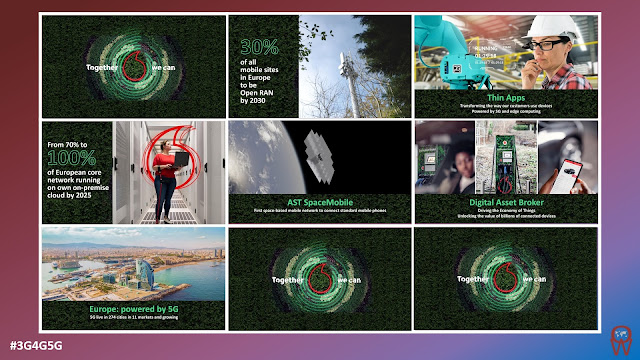
I have just presented at Mobile World Congress #MWC22 and was delighted to announce that around 30% of our European network will run on #OpenRAN by 2030, following the first site going live in the UK last month. This will give us more flexibility and speed in how we operate.

It is also an example of how innovation is coming back to the network.

Disruptive technologies such as Open RAN, Network as a Platform and Multi-Access Edge Computing are perfect illustrations of how we are meeting demand for fast connectivity, as well as driving supply chain diversity, creating digital eco-systems, and inventing new industrial-strength applications.

Also, through our scaled platforms – M-PESA, IoT and now Digital Asset Broker (DAB) – combined with our geographical scale, we aim to help support the digital needs and ambitions of our customers and societies across Europe and Africa.

Around 30,000 sites across Europe will eventually use OpenRAN, with rural areas the first to benefit from the new 4G and 5G masts. When the roll-out reaches cities, the equipment from any existing 5G masts being replaced will then be reused elsewhere to reduce unnecessary wastage.

A press release release from Vodafone has details here

Their MWC22 page has more related news on this and other topics they discussed in Barcelona.

In another news Vodafone announced that seven UK communities is set to receive 4G based on Open RAN. Last year we wrote about their first Open RAN site with Samsung here. At that time it was assumed that Samsung is bring 2G (GSM) but Light Reading recently mentioned that Samsung hasn't got 2G. 

Parallel Wireless has been in Vodafone Turkey network for the last few years doing 2G and 4G as we detailed before. In a press release, Juniper Networks announced that it is working with Vodafone and Parallel Wireless conducting a multivendor RAN Intelligent Controller (RIC) trial for tenant-aware admission control use cases. It says:

The trial, initially running in Vodafone’s test labs in Turkey and with plans to move into its test infrastructure, supports O-RAN interfaces and addresses the key business challenges faced by mobile operators around personalized user experience, viable revenue generation and reduction in both CAPEX and OPEX for 4G and 5G services.

The trial is based on an open, software-driven architecture that leverages virtualization to deliver more programmable, automated granular-by-user traffic management. The initial focus is on delivering tenant-aware admission control capability, enabling operators to personalize services and provide superior user experiences. Real-time tracking and enforcement of radio resources across the RAN enables mission-critical users – for example, hospitals and schools – to receive prioritized mobile data services delivery. This capability is enabled by Juniper’s rApp/xApp cloud-based software tools that manage network functions in near real-time, along with Parallel Wireless cloud-native Open RAN functions.

The trial’s design philosophy is focused on demonstrating the potential of enabling open, agile resource management and mobile data delivery in any software-driven RAN environment. This approach enables services and applications to be managed, optimized and mitigated automatically by the RAN, built on real-time data insights from its own performance.

All three organizations are active operators/contributors of the O-RAN ALLIANCE and the Telecom Infra Project (TIP), underlining their shared commitment to industry innovation and standards.

Juniper’s RIC solution is architected as an open platform supporting open interfaces on the north bound and south bound side, enabling easier integration with Open RAN partners in the ecosystem. Juniper’s RIC platform will also enable easy integration of third-party rApps/xApps, using UI-based onboarding and deployment tools coupled with flexibility to select between either network-based or SDK-based APIs (Application Programming Interfaces).

Parallel Wireless brings cloud-native Open RAN solutions - which are now integrated with the leading-edge RAN Intelligent Controller (RIC) based on O-RAN ALLIANCE specifications from Juniper Networks, giving operators more choices to build the best-of-breed RAN.

Juniper has a short RIC explainer video which is embedded below: 

Telecom TV reminds:

It’s no coincidence that Juniper is involved in Open RAN tests and trials in Turkey: It engineered its way into the RIC R&D scene by striking a deal in January 2021 to take the early RIC work undertaken by Netsia, the tech R&D unit at Türk Telekom, and develop it further, all the while ensuring that the resulting platform would not only conform to Open RAN specifications but also be suitable for deployment by Türk Telekom. As part of that deal, Juniper gained all the IPR and rights, and so has bene able to take it into tests with other operators at will.

Related Posts:

Thursday, 16 December 2021

NTT Docomo is Open and Virtualized Networks Leader

We have highlighted many firsts of Japanese operator NTT Docomo in many different posts in our blogs. For the regular readers of our blogs, it won't come as a surprise that NTT Docomo announced that they have already 10,000+ base stations based on O-RAN principles and the number is expected to exceed 20,000 by March 2022. 

In fact NTT Docomo is also trying to export their know-how, partners and ecosystem to other interested operators. To highlight how this would work, they had also published a 5G Open RAN Ecosystem (OREC) Whitepaper back in June as can be seen in the Tweet above. 

In not just the RAN virtualization where Docomo leads. Back in 2016, Docomo introduced world's first multi-vendor network virtualization technology to LTE packet service. By March, the core network virtualization adoption rate had increased to 56%. It is expected to reach the 100% target by the end of FY 2024.

At 5G Techritory conference, Takehiro Nakamura, SVP and GM of 6G-IOWN Promotion Department at NTT Docomo Inc., presented the 5G Status in Japan, most with regards to NTT Docomo. His talk contained some interesting nuggets and is embedded below, for as long as the talk is available online.

In addition, please check out all the posts below providing interesting insights from NTT Docomo.

Related Posts:

Saturday, 9 October 2021

Telefonica Presents Strategy for Systems and Network Evolution

Last month, speaking at Morgan Stanley Telecoms CTO Symposium, Enrique Blanco, Global CTIO of Telefónica laid out their strategy for 'Systems and Network Evolution'. This included mobile as well as fixed line evolution.

As part of the presentation, he covered the following topics:

  • Evolution of Fiber technology towards 50G-PON by means of a multiservice approach
  • Providing differential customer experience through excellent Wi-Fi quality and home equipment
    • Moving forward to Wi-Fi 6, using home devices ecosystem as an open service platform at home and providing FWA solutions
  • Completing coverage and capacity deployments of 4G networks as 5G networks are activated
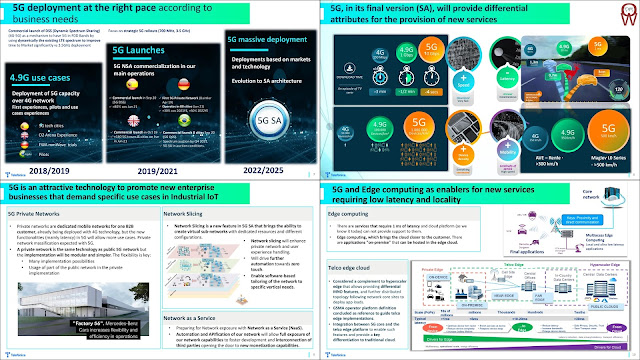
  • 5G deployment at the right pace according to business needs
  • 5G, in its final version (SA), will provide differential attributes for the provision of new services
    • 5G is an attractive technology to promote new enterprise businesses that demand specific use cases in Industrial IoT
    • 5G and Edge computing as enablers for new services requiring low latency and locality
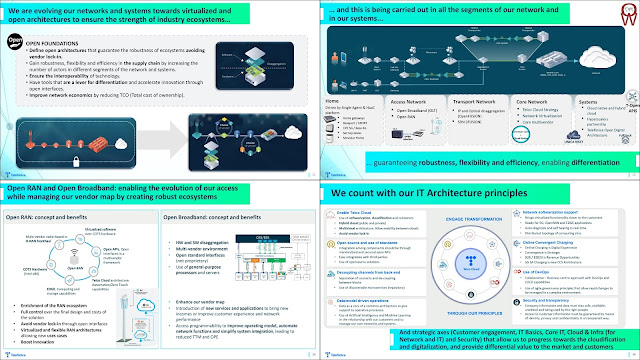
  • Evolution of networks and systems towards virtualized and open architectures to ensure the strength of industry ecosystems
    • This is being carried out in all the segments of the network and the systems
  • Open RAN and Open Broadband: enabling the evolution of our access while managing the vendor map by creating robust ecosystems
  • Follow IT Architecture principles to progress towards the cloudification and digitalization, and provide differential value to the market and customers
    • While building a new operating model where AI would be a key component…
  • Create value with 5G beyond improvement in browsing, speed and latency
  • Working with active sectors in 5G and approaching horizontal multi-sector 5G applications
  • Serving Society as a whole while supporting sustainability
  • Become leaders in cutting-edge digital services by unlocking the power of integrating technology

You can get the slides for the above presentation from here. Pablo Eguiron, CFO at Telefónica Tech also did a virtual presentation on 'The partner to fully capture the B2B opportunity' at 18th Caixabank BPI Iberian Conference. Slides from that are available here.

Related Posts:

Sunday, 1 August 2021

Deutsche Telekom's 'Tech Grounds' 2021


Back in June, Deutsche Telekom hosted a digital conference for sharing knowledge and experiencing the latest innovations. 'Telekom Tech Grounds' for magenta technology and green power took place on 28 & 29 June 2021. The event was hosted virtually and the admission was free for all. You can access the event here.

The Media Information kit highlighted:

Deutsche Telekom presents ideas and technical solutions that address four key questions: How will we tackle climate change as a Telco – together with our partners and clients? How will innovations empower business and digital health solutions? How will we leverage real-time data to build smart digital lifestyle environments and ecosystems? How will we transform networks into software-based platforms and services, enabling new business models? 

Four topic areas will be presented on different virtual stages. They focus on "Business Innovation," "Network Differentiation," "Home Innovation" and "Sustainability." 

Digital transformation in the telecommunications and IT industry is advancing at a rapid pace. "Digital technologies will play a key role in overcoming current challenges: without them, for example, we will not achieve climate neutrality," said Claudia Nemat, Telekom Board member responsible for technology and innovation. The CTO adds examples: "Video conferencing can continue to replace a large part of business travel. In agriculture, IoT-based applications effectively reduce the use of fertilizer, while smart home and smart grid applications help reduce our electricity consumption."  

Telekom switches on O-RAN Town in Neubrandenburg

Deutsche Telekom has put its ‘O-RAN Town’ into operation in Neubrandenburg, Germany. RAN stands for "Radio Access Network" and refers to components of antenna technology in mobile communications. And Open RAN, because unlike in the past, technology components from a large number of different technology suppliers are to work together. O-RAN Town will provide 4G and 5G services based on Open RAN at up to 25 sites. The first sites have now gone into operation and been integrated into Telekom Deutschland's live network. This includes Europe's first integration of Massive MIMO radio units (mMIMO, MIMO = multiple input, multiple output). This involves the use of a large number of small antennas per transmission unit. 

At O-RAN Town, Deutsche Telekom is researching, enhancing and verifying the end-to-end capabilities of the Service Management and Orchestration Tool (SMO) developed in-house based on open source. The SMO is used for automated testing, remote site configuration, and network anomaly detection and resolution. Deutsche Telekom plans to gradually expand O-RAN Town, working with various vendors. These solutions are currently being tested in the lab to ensure interoperability across all components. 

Network slicing for customized networks

Individual requirements are playing an increasingly important role, especially in industry: data rates, speeds or latency times. To meet these requirements, Telekom is testing network slicing. This means operating multiple virtual networks in parallel on the basis of a common network infrastructure. Network slicing is a key feature of 5G. Several virtual networks can be operated on a single physical network infrastructure. The network is “cut into slices", the so-called network slices. Different service characteristics and quality parameters can be provided for each "slice". The slices are completely isolated from each other. They can thus be adapted to different customer requirements. 

Together with its partners Ericsson and Samsung, Deutsche Telekom has now announced the world's first implementation, which was carried out across all manufacturers in the laboratory environment in Bonn. Another new feature allows a device to steer applications and services with specific requirements to a defined slice. With this, a customer can experience great service quality by serving applications with the right network slice.

Deutsche Telekom and Samsung join forces for sustainability 

Deutsche Telekom and Samsung are entering into a strategic partnership for sustainability. The core of the collaboration is the development of a green smartphone suitable for the mass market. It will support 5G technology and be designed to be sustainable. This includes easy repair and a removable battery. The smartphone is planned for the end of 2022.

The two companies are also focusing on a holistic approach. This also focuses on the service life of smartphones. Samsung is already an integral part of the Telekom cell phone cycle in Germany and Poland, which gives phones a second life. As part of the cycle, Telekom repurchases used phones, refurbishes them, and puts them back into circulation.

Digital port logistics: Drones secure port of Hamburg

Customer satisfaction is also a focus for Telekom when it comes to setting up campus networks. A few days ago, Telekom announced the establishment of a campus network in the Port of Hamburg on behalf of HHLA Sky, a subsidiary of Hamburger Hafen und Logistik AG. HHLA Sky will control and monitor a fleet of industrial drones from a single control center using the campus network. At HHLA's terminals, the drones will inspect container bridges and asphalt surfaces to improve safety on the port site. This saves time compared to previous inspection procedures. In addition, the drones reliably transmit sensor and flight data via the campus network.

IoT Boost

Getting devices and applications up and running on the IoT is now easier than ever: Telekom and 1NCE, with clear focus on low bandwidth IoT connectivity, in cooperation with Amazon Web Services, Inc. (AWS), offer the new Zero Touch service. This makes the integration of Internet of Things (IoT) solutions as if by magic: simple and fast in the cloud with automated device onboarding on AWS. This is designed to rapidly reduce the complexity for customers by enabling them to easily set up and run their IoT solutions.

And that's the point. Technology must put people at the center. That applies to this solution as well as the others presented. Hence the motto of the Telekom Tech Grounds: #HumancenteredTechnology.  www.techgrounds.telekom.com.

You can also find a short summary of Telekom Tech Ground Network Differentiation Session by Dr. Alex Jinsung Choi, Deutsche Telekom Senior Vice President, Head of Strategy & Technology Innovation, COO of O-RAN Alliance, on his LinkedIn post here. Some pictures from the O-RAN session can be found on the LinkedIn post by Abdu Mudesir, Senior Vice President of Deutsche Telekom, here.

Related Posts:

Tuesday, 29 June 2021

Vodafone UK Selects Commercial Open RAN Network Partners

Vodafone has been a huge supporter of the Open RAN movement. Not only have they supported it with projects, expertise, etc., they have also contributed their IPR to TIP to drive it further. Last year, I wrote about how they have been evangelizing the benefits to other operators. Now, Vodafone has unveiled its strategic vendors – Dell, NEC, Samsung Electronics, Wind River, Capgemini Engineering and Keysight Technologies – to jointly deliver the first commercial deployment of Open Radio Access Network (RAN) in Europe. A press release said:

The company believes the move will spark other large-scale Open RAN launches and spearhead the next wave of digital transformation across Europe.

Pioneered by Vodafone and its partners, Open RAN will drive greater innovation through a diverse and open vendor ecosystem. It will lead to a more cost-effective, secure, energy efficient and customer-focused network of the future.

Vodafone’s initial focus will be on the 2,500 sites in the UK that it committed to Open RAN in October 2020. It is one of the largest deployments in the world and will be built jointly with Dell, NEC, Samsung and Wind River. Vodafone also expects to use new radio equipment defined under the Evenstar programme, a joint initiative it contributes to. Capgemini Engineering and Keysight Technologies are providing support to ensure interoperability between all the components.

Starting this year, the vendors will work with Vodafone to extend 4G and 5G coverage to more rural places across the South West of England and most of Wales, moving into urban areas in a later phase. Vodafone is also working to launch Open RAN in other countries within both Europe and Africa, enabling the digital society to be accessible to all, with no one left behind. 

Under this initiative to deliver an open and disaggregated network in the UK, Samsung will be a reference RAN software provider. Samsung and NEC will supply Massive MIMO – a method to boost capacity of a mobile antenna – along with Samsung and Evenstar radio units, which establish a signal between users’ smartphones or devices and the mobile mast.

Evenstar radios are part of a joint effort between Facebook and Vodafone to create ‘white-box’ radio units within the Telecom Infra Project (TIP) and are a key component for Open RAN success. These will provide vendors with detailed specifications needed to develop compatible radio units much more cheaply, and are designed to encourage new players to the market to boost the ecosystem and stimulate innovation.

The initial deployments will be implemented using COTS (common off the shelf) Dell EMC PowerEdge servers to support the combined DU/CU function running Containers as a Service (CaaS) software from Wind River Studio, which will provide a distributed cloud-native platform hosting the Open RAN applications and virtualised RAN from Samsung. This gives Vodafone the benefit of being able to mix and match and install new software releases and upgrades more easily. 

Keysight Technologies will deliver its comprehensive Open RAN test solution portfolio designed to support conformance, interoperability and E2E system testing. Capgemini Engineering will be the key partner within our lab testing to ensure interworking of the Open RAN multi-vendor ecosystem.

The O-RAN Alliance 7-2x split, that defines the interface between the radio antenna and the baseband unit, will be used in the deployments, following successful test and simulations that make it the option of choice. The resulting Open RAN network is expected to improve energy efficiency compared to the existing solution from traditional widely deployed RAN products.

In addition, Vodafone is working with several chipset suppliers, including an important research & development (R&D) collaboration with Intel, whose role in developing Open RAN is widely recognized in the industry. Vodafone’s Open RAN Test and Integration lab in Newbury, UK, has been devised to be an innovation centre to foster collaboration and implement new ideas. In this space, Vodafone’s newly announced partnership with Qualcomm will provide solutions that will be added to the project in the future.

The new Open RAN lab will be complemented by two newly created European digital skills hubs in Málaga and Dresden, employing 600 and 200 people respectively. Opening later this year, the skill hubs will be used to develop a number of new solutions for businesses, including cyber security, mobile private networks and Open RAN.

Vodafone is working with other operators to lower the entry barriers for smaller vendors and startups. Recently published Open RAN technical requirements by Vodafone and other telecommunications companies will provide a blueprint to help expedite the development of new products and services based on industry specifications from the O-RAN Alliance (of which Vodafone is a member) and eventually ETSI standards (from the European Telecommunications Standards Institute), always compatible with 3GPP.

There was a considerable amount of confusion regarding different G's and Core, etc. It was all clarified in a Tweet from VF UK Communications Manager as can be seen above. It seems that Samsung went off and dusted their 2G stack to support a legacy technology along with 4G and 5G.

Related Posts:

Tuesday, 22 June 2021

Peru wants more 4G and Open RAN

Peru is the third largest country in South America, after Brazil and Argentina. It's roughly over three times the size of Japan or Germany or five times as large as UK. Having said that, its population is just over 33 million. It is made up of a variety of landscapes, from mountains and beaches to deserts and rain forests. Most people live along the coast of the Pacific Ocean, where the capital, Lima, is located.

Peru’s fixed-line teledensity remains among the lowest in South America, with obstacles to fixed-line growth including widespread poverty, fixed-to-mobile substitution, expensive telephone services, and geographical inaccessibility in the rugged Andean mountains and lowland Amazon jungles. The government is addressing these shortcomings via ambitious investment plans to deploy telecom infrastructure and services in underserved areas. Most of the work was complete by the end of 2017, when eight regional fibre-based networks were connected to the National Fibre-Optic Backbone.

Broadband penetration in Peru is considerably lower than the Latin American average, despite government efforts to encourage the development of the sector.

Mobile penetration is on a par with the regional average, though high penetration is attributed to the popular use (especially among urban dwellers) of multiple mobile subscriptions. This phenomenon is becoming less pronounced as network operators respond to market competition by providing generous data and voice bundles (so obviating the need for SIM cards from different networks) and as the regulator endeavours to remove illegal devices and unregistered SIM cards from the market.

Telefónica Perú (trading as Movistar Perú) is the leading player in the mobile market, followed by Claro Perú, Entel Perú and Viettel (trading as Bitel). The market still has considerable potential to expand, especially given the country’s low fixed broadband penetration which has encouraged the uptake of mobile data services. By late 2020, the mobile broadband penetration rate reached 69% of the population.

2G/GSM and 3G/UMTS are on 850 and 1900 MHz on the three major operators Movistar, Claro and Entel. 4G/LTE has started in 2014 in major cities on AWS frequency 1700/2100 MHz on Movistar and Entel and 1900 MHz on Claro and is already open for prepaid. Soon on all three operators the 700 MHz frequency (Band 28) will be added. Bitel has a limited 3G network so far on 900 and 1900 MHz and launched 4G/LTE on 900 MHz (Band 8).

In the most recent OpenSignal report Entel was the dominant operator as far as the awards table was concerned, winning three out of seven awards outright and jointly winning another three. This time round, both it and Movistar each hold two awards outright and two jointly. However, Entel remains the operator with the best scores for our two speed metrics — Download Speed Experience and Upload Speed Experience. Neither operator has been able to challenge Claro’s grip on the 4G Coverage Experience award.

Also, Bitel users’ mobile experience has improved very significantly since the previous report, with impressive gains seen across Video Experience, Download Speed Experience, Upload Speed Experience and 4G Availability. With the exception of 4G Availability, much of the improvement made up for the lost ground seen back in the August 2020 report, when many scores dropped significantly due to the headwinds created by the COVID-19 pandemic. However, Bitel’s scores in this report for Video Experience, Download Speed Experience and Upload Speed Experience have risen more strongly than other operators and are up by 6 points (15.1%), 1 Mbps (23.8%) and 0.6 Mbps (30.5%) respectively from the scores in Opensignal’s February 2020 report.

Although operators are yet to launch commercial 5G services for smartphone users and the auctioning of spectrum in the 3.5 GHz and 26 GHz bands will not take place until 3Q 2021, there have still been a number of interesting developments in the Peruvian mobile market since the last report. These include the news that the country’s Ministry of Transport and Communications (MTC) is seeking to invest around $413 million to bring 4G connectivity to more than 2,600 communities. In addition, MTC has also published draft network sharing regulations that it believes will cut the cost of network rollout and make it easier to serve rural areas.

Movistar in Peru, owned by Spanish Telefónica, is the biggest provider and market leader in the country. It has more than 1/2 of all mobile customers and the best coverage (coverage map). But this comes at the highest prices. Also, you should keep in mind when you are travelling overland between major cities many hours without any signal are common.

4G/LTE has started in 2014 on the AWS frequency of 1700/2100 MHz (band 4) and added 700 MHz (band 28) which is open to all prepaid tariffs. Movistar guarantees speeds of 5-130 kbps on 2G, 0.4-1 Mbps on 3G and 2-5 Mbps on 4G/LTE. They use carrier aggregation of both LTE bands in the capital for the highest speeds.

Claro is the big rival of Movistar in Peru. It has more than 1/3 of all mobile customers and only a slightly lower coverage at lower prices.

4G/LTE has started in major cities and is available on all prepaid plans. Unlike its competitors, Claro uses the 1900 MHz (band 2) frequency for it, which is more accessible to many devices from out of the US. In 2016/7 it added the 700 MHz (band 28) in Lima and 38 more towns for LTE. In and around Lima they have added support for 2600 MHz (band 7) 4G+ is available using both bands.

Their LTE coverage is on par and partly surpasses that of Movistar, if you don't have a device that carries band 4. However, you should keep in mind when you are travelling overland between major cities many hours without any signal are common.

As in many other countries, the incumbent operator Movistar offers the best coverage, but at higher rates. Claro as challenger has a heavy marketing footprint all over the country, while Movistar is less visible. Despite that, where there is Claro, there is always Movistar too. Either next door (literally) or in the same Claro-colored small shop/street vendor.

This operator has launched commercial fixed-wireless broadband services via 5G technology, having received authorisation from the telecom ministry to use its existing 3.5GHz spectrum for the service earlier this year.

The Chilean market leader Entel bought Peruvian network Nextel in 2013 and changed its name to Entel in 2014. It's still building up its network and lacks the coverage of the big two providers, but can be reasonable if you stick to the cities. Please note however coverage is very limited in the Loreto Department (Amazonas region). There is no (zero) siginal when travelling by boat between Yurimaguas and Iquitos.

4G/LTE has started in 2014 in Lima on the 1700 MHz AWS (B4) frequency and spread out to more places. According to OpenSignal's country report compiled in 2019, it's the best 4G/LTE network in the country what speed is concerned and matches Movistar's coverage of 85% covered by 4G networks.

This operator as also launched a fixed-wireless broadband service utilising 5G technology on the 3.5GHz band. Both Entel and  Claro, were granted permission by the Ministry of Transport and Communications (Ministerio de Transportes y Comunicaciones, MTC) to utilise its existing frequencies in the band to offer a fixed-wireless internet service using 5G New Radio (NR) technology. Entel’s 5G plan provides downlink speeds of up to 50Mbps for PEN150 (USD40.13) per month, plus an up-front fee of PEN1,499 for the modem and installation.


Bitel is the latest arrival in Peru. They are the Latin American branch of Vietnamese army-owned Viettel and started in 2014 with an own network in the country. It's in a rather limited area (see coverage map) on 900 MHz and 1900 MHz. The rather unusal 900 MHz spectrum is used for 3G, added by 1900 MHz. In 2016 Bitel launched its 4G/LTE network through 1,750 4G base stations, covering 500 population centres on the rather unusual band 8 (900 MHz). It has a wide 4G coverage in Peru now, but focuses on rural areas which are not covered by other operators. So it's only recommended if you go to these places. In an OpenSignal test in 2019 speeds were much lower than on the other three networks.

Back in 2018, Telefónica announced “Internet para todos” (“Internet for all”), a collaborative project to connect the unconnected in Latin America. The Initiative is aimed at connecting the more than 100 million people in Latin America with no internet access. Telefónica agreed collaboration with Facebook on key technological and commercial innovations and collaboration with multiple stakeholders: rural operators, technology firms and regulators.

Parallel Wireless have been deploying OpenRAN sites with them and even did a press release last year to say hundreds of sites have been deployed.

Last month Telefónica announced that 'Internet Para Todos' is two years old and has contributed to connecting more than 2 million Peruvians in rural areas with 4G internet. Internet para Todos expects to close 2021 with 13,000 communities with high-speed mobile internet access.

Related Posts