Showing posts with label Operator TPG Telecom. Show all posts

Tuesday, 19 August 2025

SIMBA Telecom to Acquire M1 in Singapore’s First Major Consolidation

SIMBA Telecom, Singapore’s youngest mobile operator, is preparing to take a major leap with the acquisition of rival M1. This transaction, valued at S$1.43 billion, represents the first significant consolidation in Singapore’s telecoms sector and signals a new phase in the market’s development.

SIMBA’s story began in 2016 when, then known as TPG Singapore, it secured spectrum rights in a government auction. Initially part of TPG Telecom Australia, the Singapore business became independent in 2020 following the merger of its Australian parent with Vodafone Hutchison. The local unit was listed under Tuas Ltd and later rebranded as SIMBA in 2022. Over the past few years, the operator has steadily grown its customer base to more than one million subscribers, doubling its mobile connections in the space of two and a half years. Its lean cost structure, no-frills approach and competitive pricing have allowed it to establish itself as a disruptive challenger in a highly competitive environment.

M1, by contrast, is one of Singapore’s established operators with a history stretching back to the mid-1990s. Today it serves more than two million mobile customers and over 200,000 fixed broadband households. The company has invested heavily in 5G, building a standalone network that covers much of the island, and it has also developed a growing enterprise business. For the financial year ending April 2025, M1’s telecom operations generated S$806.1 million in revenue and S$195.4 million in EBITDA.

Bringing SIMBA and M1 together would create a company with over 3.2 million mobile connections and almost 240,000 fixed broadband lines. That scale would push the merged operator into second place in the mobile market, behind Singtel with its 4.5 million customers and ahead of StarHub with 2.4 million. On the broadband side, the combined business would hold just under 16 per cent of the market, still far behind Singtel and StarHub but with room to grow.

From an infrastructure standpoint, the benefits for SIMBA are clear. The company has been rolling out its own 5G network but remains at an earlier stage than its competitors. By combining with M1, SIMBA gains access to a denser radio footprint, both indoors and outdoors, as well as stronger fixed broadband infrastructure and an established enterprise platform. The merger also consolidates spectrum resources, giving the enlarged operator more capacity to support high-speed services and to compete on network quality as well as price.

Operationally, Tuas, SIMBA’s parent company, expects significant synergies. The two operators have relatively little overlap in resources, which makes it easier to combine their networks and retail footprints while avoiding duplication. Analysts expect efficiency gains in spectrum use, site sharing and core network integration. Together, the businesses generated S$948.8 million in revenue and S$256 million in EBITDA in the past year, providing a strong financial base for further investment.

The deal comes at a time when Singapore’s telecoms sector is under pressure from falling revenue per user. Mobile virtual network operators have been driving down prices with low-cost plans, forcing the main players to compete aggressively for subscribers. Consolidation from four operators to three is likely to ease some of that pricing pressure, allowing the remaining players to focus on improving network quality and investing in new technologies such as advanced 5G and future fibre upgrades.

For the market leader Singtel and its close rival StarHub, the emergence of a larger SIMBA-M1 entity presents both a challenge and an opportunity. On the one hand, competition becomes sharper as a stronger second player emerges. On the other, consolidation reduces the intensity of price competition that has squeezed all operators in recent years.

Regulatory approval will be required from the Infocomm Media Development Authority (IMDA). If approved, SIMBA’s acquisition of M1 will mark a turning point in Singapore’s telecoms industry. It will create a more balanced market structure, strengthen investment capacity and reshape competition, with SIMBA moving from a challenger to a genuine contender for market leadership in the years ahead.

Thursday, 10 March 2022

Singapore is a 5G leader in Southeast Asia


The Covid-19 pandemic had a significant impact on Singapore’s telecom sector in 2020, pushing down penetration rates and delaying several major infrastructure projects due to production and supply chain disruptions. The good news, at least, is that the overall effect on the sector has been relatively modest compared to other industries that effectively collapsed under the shutdown. Telecommunications remained an essential service during the period, with many people even needing to upgrade their services and plans to enable a shift to working and schooling from home. Singapore’s modern infrastructure and capacity weathered the storm well.

Most telecom operators suffered financially, with declines in revenue and profit as subscribers tightened their belts and reduced discretionary spending. The downturn was roughly in line with the retraction in the Singapore economy. All the major players continued to provide services, and to proceed with their investment programs, particularly in 5G networks (with a focus on standalone). The operators are voicing strong optimism for the coming months as travel restrictions are reduced and economic activity starts to bounce back. While forecasting should be viewed as a very risky activity in such uncertain times, there is a high degree of confidence across the industry that penetration rates in Singapore will quickly return to pre-Covid-19 levels.

Singapore continues to push ahead with its 5G rollout. 5G networks and services are expected to form the backbone of growth in the telco sector over the coming years as service providers seek new ways to engage customers in a market that is otherwise already saturated.

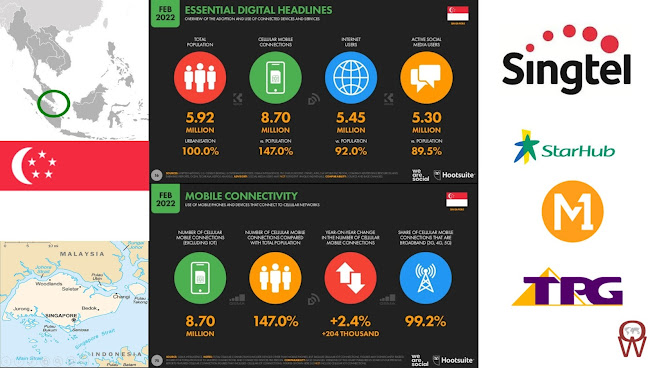
Singapore currently has 4 mobile operators, Singtel Mobile, StarHub, M1 and TPG Telecom (4G-only).

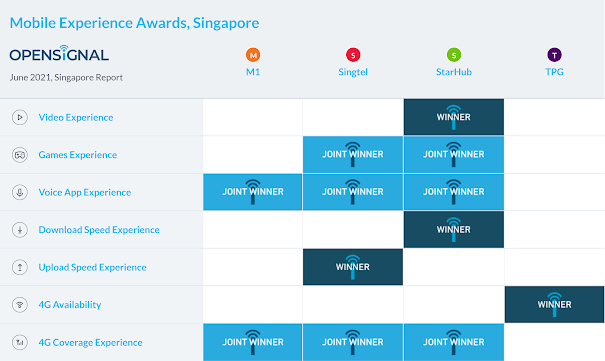
Singtel is the market leader, Starhub is in second position, M1 is in third and TPG is in fourth. Coverage and speed is excellent in the city on the three major networks. No 2G is available, 3G on 900 and 2100 MHz, and 4G/LTE has started on all three providers on 1800 MHz (band 3) and 2600 MHz (band 7). 900 MHz (band 8) and 2500 MHz (band 41) were later added, and from 2019 spectrum on 700 MHz (band 28) is added for 4G/LTE.

5G trials were started by Starhub in August 2020 on 2100 MHz (n1) and by Singtel in September 2020 on both 2100 MHz (n1) and 3500 MHz (n78), and quietly commenced commercial operations on the three major operators in early-2021 when 3500 MHz (n78) was also added for 5G for Starhub and M1, but is currently not open for prepaid.

The coverage and speeds in this city state are superb by all three providers. 4G/LTE covers all of the city outdoors and the MRT (= metro, subway). Note that for Singapore you'll need to bring a 3G/4G device as 2G is switched off. 2G/GSM networks of all three providers were shut down on April 1, 2017. There is no 2G coverage anymore. So bring a 3G or 4G/LTE capable device. The sale of 2G-only mobile devices has been banned from January 2017 or retailers could be given a penalty. 


Singtel Mobile by the Singtel Group is the biggest provider in town and has a market share of about 45%. The Singapore Telecommunications Ltd. is one of the largest mobile network operators in Southeast Asia. It has a coverage of 99% for 3G and 4G/LTE: Singtel 3G 4G. 4G/LTE is on 900, 1800 and 2600 MHz, bands 3, 7 and 8.

Singtel is ramping up its 5G standalone (SA) deployment in Singapore, by expanding the network and developing new 5G use cases in partnership with Ericsson. In a press release the Swedish vendor said it is powering Singtel’s 5G SA network with 5G radio access products and cloud-native dual-mode 5G Core network solutions. The pair hope to deliver high-quality connectivity for outdoor coverage in densely populated areas and help drive strong indoor-mall coverage across the city-state. Ericsson went on to say ‘the COVID-19 pandemic has fuelled the need for better connectivity indoors, due to the numerous travel and lock-down restrictions’. The deployment builds on a long-standing relationship between the two companies, including with Singtel’s initial wave of 5G rollouts.

In September 2021 Singtel confirmed that its 5G network now covers over two-thirds of Singapore, with new 5G sites added in densely populated areas like Choa Chu Kang, Punggol, Sembawang and Tampines. In addition, the mobile operator has expanded its 5G indoor coverage to more major shopping malls island-wide such as Funan, West Mall, Tampines Mall, Northpoint City and Waterway Point. In April 2021 Singtel revealed that as part of its 5G ‘push’, it had deployed hundreds of 5G SA sites across the city-state, in areas such as Orchard Road, the Central Business District, Harbourfront and Sentosa. With work ongoing to boost in-building coverage in Ngee Ann City and selected Singtel Shops across Singapore (having already begun the process at VivoCity), Singtel confirmed that in readiness for commercial launch, it had begun offering 5G SA compatible SIM cards. The cellco’s 5G SA sites run on 3.5GHz spectrum, enabling it to deliver ultra-fast speeds and swifter response times.

StarHub by local StarHub Ltd. is the 2nd provider in Singapore giving good speeds and coverage in 3G and 4G/LTE reaching a nationwide coverage. StarHub is the local partner of Vodafone and is the only provider to offer VoLTE (branded as HD Voice+) on prepaid. 4G/LTE is on 1800, 2100, 2500 and 2600 MHz, bands 1, 3, 7 and 41.  StarHub's 5G standalone network has also been very successful: 

 M1 (previously known as MobileOne) is the 3rd largest national provider in Singapore. Coverage on 3G and 4G is on par with the other two providers. 4G/LTE is on 1800 and 2600 MHz, bands 3 and 7.

 M1 launched its 5G Standalone network in July 2021 via what it terms ‘an exclusive market trial, allowing both its existing and new mobile customers to enjoy the enhanced benefits of the … technology’. In a press release the operator confirmed that customers can experience ‘true’ 5G by signing-up for a ‘5Go Plus Booster’ plan both online or in-store. As part of this, the carrier is running an exclusive launch promotion giving users ‘at least three months of free access to the True 5G experience, following which they can continue to enjoy the service at a discounted price starting at SGD5 per month, until the end of 2021’.

The operator’s new 5G SA network currently covers about 50% of the city-state including the Central Business District (CBD), Marina Bay Financial Centre, key town centres and high data usage areas such as Ang Mo Kio, Bishan, Chinatown, Clementi, Orchard Road, Pasir Ris, Paya Lebar, Sengkang, Tampines and Woodlands. Going forward, M1 plans to extend coverage to 75% of Singapore by the end of 2021 with full coverage completed by the end of 2022 – eclipsing the regulator’s requirements of 50% coverage by that date.

In 2016 the bidding auction for a 4th operator was started. The winner was named with TPG Telecom from Australia, founded by Malaysian billionaire David Teoh. It was allocated spectrum in the unusual 900 MHz and 2300 MHz bands (8 and 40) to provide only 4G/LTE services which started in 2020.

According to Mobile World Live TPG Telecom has two years to reach 50 per cent coverage with an SA 5G network and five years for nationwide. It holds spectrum in the 900MHz and 2.3GHz bands won as part of its market entry in 2016. It has also been provisionally awarded 2 (two) 5MHz paired lots of spectrum in the 2.1 GHz band for a price of S$31m. 

Related Posts:

Thursday, 27 February 2020

Rakuten details its Open RAN and Innovation Journey


In a recent Qualcomm event, the CEO of Rakuten, Mickey (Hiroshi) Mikitani and Tareq Amin, CTO of Rakuten Mobile did a joint presentation laying down the innovation that has helped create the most advanced open mobile network.


Recently, Singapore newcomer TPG Telecom selected Rakuten Mobile as its partner to run OpenRAN trials on a new network in the city state, advancing toward a 4G service launch this year.

Anyway, here is the clip from the video of Qualcomm's live stream that they did instead of MWC 2020 (that was cancelled due to coronavirus fears) that details Rakuten Mobile's innovations.


There was quite a bit of discussion around this as you can see from the tweet above. As it says, the whole network is 4T4R and the advanced radio feature support include NB-IoT on every Node B.


There is of course question around the cost of the server and that it would require to be dedicated for a site.

Light Reading has a good summary of the presentation if you rather prefer to read than watch. It's available here.

Related Posts: