Showing posts with label Operator NTT Docomo. Show all posts

Thursday, 4 December 2025

The Power of AI in NTT Docomo’s 5G Journey

At FutureNet Asia 2025 in Singapore, Takehiro Nakamura, Chief Standardisation Officer at NTT Docomo, delivered the closing keynote on day two of the summit. His session focused on how AI has become central to Docomo’s 5G strategy and how those developments are shaping the operator’s path towards 6G. It was a forward looking talk that connected practical achievements with the longer term vision for future networks.

Nakamura-san explained that while 5G and 6G fall within the familiar ten year generational cycle, there is also a broader twenty year technological rhythm that influences how mobile systems evolve. After voice in the first wave and mobile multimedia in the second, the third wave is centred on unlocking new business value. In Docomo’s view, the success of 5G is essential for the success of 6G, especially in enterprise services where operators hope to build new revenue streams.

AI now sits at the heart of Docomo’s capability. The operator has built its data analytics on a very large foundation, spanning data from around one hundred million customers and hundreds of thousands of base stations. By combining this scale with a wide range of AI techniques, Docomo has created applications for enhanced customer service, network optimisation, personalised services and digital transformation across both internal and external domains.

Nakamura-san described a broad AI technology stack that includes natural language processing, customer behaviour modelling, location analysis, advanced analytics and video recognition. These core capabilities feed into applications across marketing, CX, healthcare, finance, network operations and local government. One of the examples he highlighted was Docomo’s LLM value added platform, designed to address security, reliability and safety concerns while offering a user friendly interface for internal teams and partners.

Another focus area is customer understanding through a platform known as Docomo Sense. By analysing subscriber information alongside online and offline behavioural data, the operator can segment customers with much higher precision. This supports personalised services, targeted marketing and new business creation. Nakamura-san shared a successful use case with Audi Japan, where Docomo’s segmentation helped the automaker reach customers with a strong interest in electric vehicles. The result was a significant increase in dealership visit rates and a notable rise in new customer engagement.

Docomo has also embedded AI deeply within its network operations. Silent hardware failures, which previously were often discovered only after customer complaints, can now be detected proactively. AI also enables early identification of device related issues that arise from complex interactions between specific hardware and spectrum conditions. This allows the operator to act before performance degradation becomes visible to subscribers.

Looking ahead to 6G, Nakamura-san emphasised that AI must be native to the design of future networks. AI will optimise the network while the network itself will be designed to serve AI driven applications. This mutual reinforcement is central to Docomo’s AI centric network concept. The ambition is to reduce human error, minimise outages, improve resilience in disaster prone environments and maximise customer experience.

Docomo is collaborating globally on 6G research, including work with Nokia and SK Telecom on an AI native interface. One promising line of research is pilotless transmission. Today’s radio systems use pilot signals to estimate channel conditions, but these signals create overhead. By applying AI on both the transmitter and receiver sides, Docomo tested the feasibility of reducing or eliminating pilots. In indoor trials, static measurements showed immediate gains due to the removal of pilot overhead, while dynamic measurements also delivered positive results despite channel fluctuations. Nakamura-san stressed that more trials are needed across different environments, but the early findings indicate strong potential for efficiency improvements in 6G.

As he concluded, Nakamura-san reinforced that progress in both 5G and 6G will depend on collaboration across the industry, particularly with partners that possess deep expertise in AI. Docomo sees AI as an essential tool for building resilient, efficient and high performing networks and is preparing for a future where AI permeates every layer of the system.

His talk is embedded below:

Related Posts:

Friday, 21 February 2025

NTT Docomo's Beyond 5G and 6G Vision

NTT Docomo has been at the forefront of Beyond 5G and 6G research, exploring how emerging technologies will shape the future of mobile networks. In this post, I’m sharing insights from two recent keynotes by NTT Docomo executives, highlighting their vision for AI, Big Data, and next-generation connectivity.

6G Promotion and AI Utilization – Takaaki Sato, Brooklyn 6G Summit

Takaaki Sato, Senior Executive Vice President at NTT Docomo, delivered a keynote at the Brooklyn 6G Summit, discussing "6G Promotion and Prospects for AI Utilization." His talk explored how AI will be deeply integrated into 6G networks, moving beyond the siloed approach seen in 5G. Watch the keynote below:

AI-Native 5G Evolution and 6G – Takehiro Nakamura, FutureNet Asia 2024

For a more technical perspective, Takehiro Nakamura, Chief Standardization Officer at NTT Docomo, spoke at FutureNet Asia 2024 on "AI-Native 5G Evolution and 6G." His presentation delved into the role of AI and Big Data in network evolution and how 6G will leverage advanced technologies to enhance efficiency and performance. Watch his presentation here:

The Path to 6G: AI, Big Data, and the IOWN All-Photonics Network

A key theme in both keynotes was the convergence of AI and Big Data, which were largely separate in 5G but will be deeply intertwined in 6G. NTT Docomo envisions this integration—along with the IOWN All-Photonics Network—enhancing human experiences and driving innovation.

As the industry moves towards 6G, it’s clear that AI and network intelligence will play a foundational role in shaping next-generation connectivity. What are your thoughts on NTT Docomo’s vision? Share your comments below!

Related Posts: 

Thursday, 3 February 2022

Is Japan an undisputed 4G/LTE Leader?

A recent survey conducted by ICT Research Institute, Inc., Japan, came to a conclusion that the quality of communication across Japan was at a very high level when compared to other developed nation while at the same time the costs were very reasonable and much lower than other countries. 

The following is an extract from the press release (in Japanese, translated by Google translate):

In the summer of 2018, the government pointed out that there is room for a 40% price cut, giving the impression that mobile phone charges in Japan are high, but after that, mobile phone operators have introduced new rate plans one after another. It seems that the new rate system of Japanese MNOs (mobile network operators) has taken root in the past year, including online-only plans.

The purpose of this survey was to understand the current state of communication charges in Japan, including a comparison with "communication quality," which is emphasized as an important core infrastructure.

The subjects of the survey were his MNOs in six countries, Japan, the United States, the United Kingdom, France, Germany, and South Korea, and the smartphone charges for each country were as of December 1, 2021. In December 2021, we conducted a web questionnaire survey for Japanese mobile phone users. This survey is positioned as a sequel to a similar survey announced by the Company in July 2020.

As a result of the survey, the average monthly smartphone charges for the six countries as of December 1, 2021 are 3,538 yen, 5GB 3,895 yen, 20GB 4,614 yen, and unlimited 7,097 yen for a data capacity of 2GB. Overall, fares in Japan and the United Kingdom were low, and fares in the United States and Germany were high.

Japan has the lowest monthly charge of 2GB (1,477 yen) and 20GB (2,445 yen) among the six countries, and the United Kingdom has the lowest monthly charge of 5GB (2,222 yen) and unlimited (3,777 yen) among the six countries. .. Japan is second only to the cheapest data capacity category, and the United Kingdom is second only to the cheapest data capacity category.

The United States is the highest among the six countries in the 2GB, 5GB, and 20G categories, and Germany is at a high level overall, exceeding the average rate of the six countries in all data capacity categories.

In the previous survey (announced in July 2020), Japan's tariffs were "medium level" among the six countries, but in this survey they have dropped significantly to the lowest level among the six countries. It turned out that there was.

In this survey, we referred to the survey data of Agoop Co., Ltd. in order to compare the communication quality of each country. According to this network connection rate result, Japan has the highest 4G connection rate of 99.4% among the six countries. South Korea was followed by 96.0% and the United States at 93.1%.

Not only is Japan the top 4G connection rate, but the 3G connection rate is also 0.3%. The ratio of "out of service / timeout" is only 0.3%, and it can be said that the communication quality is the highest among the six countries.

The results of the three European countries have lower 4G connection rates than the three countries of Japan, the United States and South Korea. About 10% are connected by 2G or 3G communication method, and the ratio of "out of service / timeout" is also relatively high.

The press release here has more details and graphs.

It should be kept in mind that this is a very small sample of countries and most importantly it is missing China, which would make some of these comparisons very tricky.

Related Posts

Thursday, 16 December 2021

NTT Docomo is Open and Virtualized Networks Leader

We have highlighted many firsts of Japanese operator NTT Docomo in many different posts in our blogs. For the regular readers of our blogs, it won't come as a surprise that NTT Docomo announced that they have already 10,000+ base stations based on O-RAN principles and the number is expected to exceed 20,000 by March 2022. 

In fact NTT Docomo is also trying to export their know-how, partners and ecosystem to other interested operators. To highlight how this would work, they had also published a 5G Open RAN Ecosystem (OREC) Whitepaper back in June as can be seen in the Tweet above. 

In not just the RAN virtualization where Docomo leads. Back in 2016, Docomo introduced world's first multi-vendor network virtualization technology to LTE packet service. By March, the core network virtualization adoption rate had increased to 56%. It is expected to reach the 100% target by the end of FY 2024.

At 5G Techritory conference, Takehiro Nakamura, SVP and GM of 6G-IOWN Promotion Department at NTT Docomo Inc., presented the 5G Status in Japan, most with regards to NTT Docomo. His talk contained some interesting nuggets and is embedded below, for as long as the talk is available online.

In addition, please check out all the posts below providing interesting insights from NTT Docomo.

Related Posts:

Sunday, 14 February 2021

Top 20 Telcos Worldwide in Q3 2020, Based on Capex by MTN Consulting


Matt Walker, Chief Analyst at MTN Consulting shared this chart on LinkedIn

The following are some interesting points from the discussions:

  • This does not include spectrum.
  • China Unicom is 12th with $1,862M in 3Q20 capex spend. Vodafone Idea spent only $140M in capex in 3Q20, which would rank it #72 on our list of 138 telcos. 
  • Reliance Jio was just outside the top 20 (#23) for 3Q20, based on $730M in estimated capex spend. 

More details about the report here

Related Posts:

Saturday, 31 October 2020

NTT Docomo outlines their 5G Journey and 5G Network Deployment details

We have often written about NTT Docomo in this and other blogs. Even though Docomo doesn't shout a lot about their achievements, they are one of the pioneers of many new technologies and innovations, not just in Japan but in the world.  


Now that the main architecture of 5G is ready and the industry focus is on 6G, NTT Docomo has detailed their 5G journey and achievements in the latest NTT Docomo Technical Journal here. In addition to highlighting their approach, innovations and journey, these articles also show how the current 5G ties to NTT Docomo's vision that was set in 2014/15. 

In addition to the vision and innovation, they have done numerous trials with many different partners (see the videos and related posts below) to make sure that the visions do translate into reality. The tables above lists all the technology and field trials. Some of these are in the videos below.

You can read the latest issue of the NTT Docomo Technical Journal here.

For more details, please check the posts below. If there is anything interesting we have missed, please add it in the comments below.

Related Posts

Saturday, 11 July 2020

NTT Docomo Provides an Overview of 5G Commercial Service

There is no shortage on posts about NTT Docomo on this blog and other sister blogs. Not only are they innovators and trend setters, they have pioneered quite a few technologies that have gone mainstream after many years of them trying it out.


While Docomo launched their 5G network only recently, they have been working on it for a very long time, since 2010. They have published an article on this in the latest instalment of their Technical Journal here. The following is just some selective extract:

Prior to launching its 5G commercial service, NTT DOCOMO began basic 5G studies in 2010 and commenced high-frequency-band trials in 2014. Then, after contributing to early formulation of 3GPP standards for 5G in collaboration with major global mobile enterprises, NTT DOCOMO launched its 5G pre-commercial service in September 2019 creating many solutions together with co-creation partners.

Going forward, NTT DOCOMO plans to construct and roll out 5G service areas successively starting with major train stations/airports and stadiums in urban and regional areas as well as various types of facilities with partner collaboration in mind.

High Speed and Large Capacity: The 5G system will provide much higher broad- band data transmission compared with the existing system. It will realize high-definition video including Virtual  Reality  (VR) and  Augmented Reality (AR) experiences while enabling users to enjoy high-presence video and services as a familiar part of life. 

The maximum receive speed will be 3.4 Gbps achieved through the use of various technical advances such as high-order Multiple Input Multiple Output (MIMO) technology and the combining of many frequency bands. This value corresponds to the maximum receive speed at the time of the 5G commercial service launch as shown in Table 1, but NTT DOCOMO will continuously improve transmission speed through a variety of technical approaches including higher spectral efficiency.

Low Latency:  In 5G, low latency will enable high-real-time control. For example, it can contribute to even higher levels of automation by determining current running conditions of plant facilities and machines and controlling and operating them in real time.

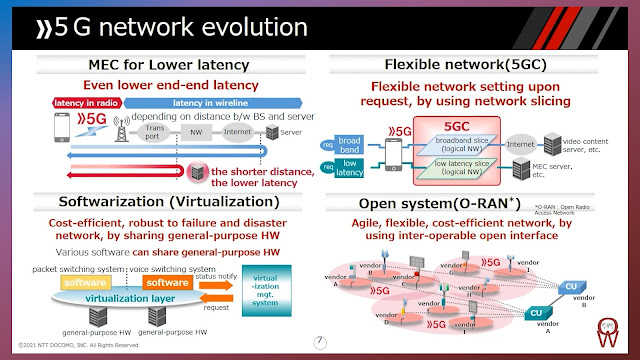
Also in 5G, the radio transmission unit has been shortened to one-half to one-eighth that of 4G depending on the frequency band,  and  the  timing  for confirming delivery has been positioned immediately after data transmission. These technologies combined are expected to achieve low latency in the radio interval compared with 4G. In addition, the adoption of Multi-access Edge Computing (MEC) is expected to achieve low latency on an end-to-end basis.

NTT DOCOMO has achieved its 5G service through a non-standalone format in which terminals  connect to  the  mobile network through both the NR and eLTE radio access systems. Specifically, it has leveraged the know-how obtained in deploying an Advanced Centralized Radio Access Network (Advanced C-RAN) in LTE to provide high-speed communications through Dual Connectivity (DC), which uses two radio access systems in an area in which both NR and eLTE (eLTE is defined as an LTE communication specification conforming to 3GPP Rel. 15 or later.) can be used.

A system configuration diagram of the 5G service is shown in Figure 2.


Up to now, specifications for interconnecting base station equipment (signal send/receive rules) differed from vendor to vendor without sufficient consideration given to international standards. This situation made it difficult to interconnect base sta- tion equipment of different vendors so the usual approach was to interconnect base stations from the same vendor. However, in the 5G launch period, in which expansion of the 5G area would take place while using the existing 4G network, this approach would limit the vendors of 5G base station equipment that can be selected to vendors of 4G base station equipment. To solve this problem, the Open Radio Access Network (O-RAN) Alliance that NTT DOCOMO has been participating in promoted the international standardization of interoperability specifications between base stations thereby unifying interoperability specifications across 4G and 5G base station equipment and enabling multi-vendor connections.

These interoperability specifications have made  it possible to deploy newly developed 5G base stations without having to rely on 4G base-station vendors and to achieve a speedy 5G rollout while using existing 4G assets.

You can read the complete article here.

Finally, if you were wondering what NTT Docomo's real world speedtest results are, here is one of them from twitter.


Related Posts:

Wednesday, 29 April 2020

NTT Docomo's Aggressive 5G Expansion Plan


Source: NTT Docomo

NTT Docomo, maybe the largest operator in Japan, however they recently announced a drop in profit and revenue for the past financial year but in response, detailed for the first time a plan to grow their 5G network. There 5G expansion plans are both aggressive and ambitious.

The operator, which launched 5G service last month, said it signed up 14,000 5G users at end-March and targets 2.5 million subs by March 2021 and 20 million three years later.


Coverage is forecast to increase from 500 base stations in 150 locations to 10,000 sites (in about 500 cities) by June 2021 and 20,000 by March 2022. Despite lagging behind the United States and South Korea, which introduced their versions in April last year, the new wireless service  available in the 150 locations in Japan covers 29 of the nation's 47 prefectures.

Their 5G plans for its next fiscal year ending 30 March 2021 include promoting Open RAN technology and deploying millimeter wave, as well as expanding the range of 5G smartphones, which stood at six devices at launch. It also mentioned pursuit of new experience and sensory services, e.g., music, gaming, video, sports, etc and value creation suited to remote‐work society  (medical / education / manufacturing, etc.)


Docomo's 5G plans for its next fiscal year ending 30 March 2021 include promoting O-RAN (see Open RAN terminology) technology and deploying mmWave, as well as expanding the range of 5G smartphones, which stood at six devices at launch.

Source: NTT Docomo

NTT Docomo has delivered Japan's fastest speeds for both downloads and uploads for the last two years. Operators in Japan have received an ideal amount of spectrum for 5G services. NTT Docomo 5G service is achieving a maximum data rate of 3.4 Gbps in downlink currently which is expected to increase to 4.1 Gbps in June. Of course these are theoretical maximum values and no individual user can expect to receive this.

Related Posts:

Friday, 17 April 2020

5G Officially Makes a Debut in Japan

Statistics source: We are social

If you follow the 5G developments closely, you may have thought that 5G was available in Japan for a while. NTT Docomo has been talking about 5G for the last 5 years. Finally, 5G has launched commercially in the country.

Three out of four Japanese mobile service providers launched 5G services on three successive days at the end of March 2020. The fourth local player Rakuten Mobile is expected to follow in June 2020.


NTT DoCoMo launched Japan’s first 5G smartphone service on March 25, 2020. The network is live in 150 areas in Japan covering 29 of the nation’s 47 prefectures. Customers can get 1 GB of data at 1,980 JPY (16.8 EUR) or 100GB of data at 7,650 JPY (62 EUR) per month, excluding taxes.

According to the operator, the network will continue to expand throughout June, ultimately reaching 500 cities by March 2021, and will have an initial maximum downlink data rate of 3.4 Gbps, followed by a speed of 4.1 Gbps expected in June. In addition, the uplink will start at a 182 Mbps peak, before increasing to 480 Mbps. NTT Docomo anticipates it will have 10,000 base stations by the end of June 2021, and 20,000 by the end of March 2022.

While KDDI launched 5G mobile services in 15 of Japan’s 47 prefectures on March 26, 2020. The operator said it aims to install 10,000 base transceiver stations by 31 March 2021 and another 10,000 BTS by the end of March 2022. Customers can get unlimited data and 30 GB for tethering at 3,460 JPY (29 EUR) per month, 60 GB for tethering at 4,260 JPY (36 EUR), and 80 GB for tethering at 5,460 JPY (46 EUR). Last plan includes streaming from Netflix, YouTube Premium and Apple Music.

SoftBank turned-on its 5G network on March 27, 2020. 5G mobile services are available in selected areas in seven prefectures across Japan for an additional charge of 1 000 JPY (8 EUR) per month. The operator aims to install over 10,000 5G base stations by the end of March 2023 and expects population coverage to reach 90% by the end of 2021.

KDDI and SoftBank had in 2019 cemented a 5G network sharing agreement, by establishing a joint venture to oversee build-out of the technology in rural areas. In a joint statement, the companies said the 50:50 joint venture 5G Japan would oversee “mutual use” of their existing base stations along with construction design and management of new sites. At time they explained joint trials were being readied in Asahikawa City in Hokkaido, Narita City in Chiba prefecture and Fukuyama City in Hiroshima prefecture.

On its newly inaugurated website, 5G Japan explained the higher frequency bands being used for the next-generation technology, including the 28GHz and 3.7GHz bands, required a long-term commitment to, and large investment in, infrastructure construction.

KDDI and SoftBank committed to “rapidly” construct 5G networks to serve all industries with the aim to raise “Japan’s international competitiveness by contributing to its industrial development, regional revitalisation and national resilience.”

Rakuten, the new operator on the market has already garnered 2.3 million customers on its MVNO network. Rakuten Mobile made a full-scale entry into the mobile phone market on April 8, 2020, when the company turned on its 4G network. The greenfield operator plans to launch its 5G operation in June 2020.

Even as the Japanese operators make significant 5G progress, it cannot be ignored that the COVID-19 pandemic is threatening 5G deployments.

Related post:

Sunday, 22 March 2020

NTT Docomo's 5G Launch on 25 March 2020

NTT Docomo announced this week that they will launch their much anticipated 5G service on a commercial basis in Japan on March 25. At the time of launch, the service will achieve a maximum data rate of 3.4 Gbps. In June the downlink will increase to a maximum 4.1 Gbps. I am assuming this is the theoretical maximum that can be achieved in their network.


Their press release stated:

DOCOMO's 5G coverage will encompass some 150 locations nationwide initially and then expand to all prefectures by June. More than 500 cities are expected to have access to DOCOMO's 5G service by March 2021.

Customers who purchase a 5G-compatible smartphone from DOCOMO will be able to choose between two types of billing plans according to their data needs.

At launch, DOCOMO's lineup of 5G-compatible devices will include seven models in the docomo Smartphone series and a mobile Wi-Fi® router. All models will be compatible with DOCOMO's existing LTE network.

Going forward, DOCOMO is committed to steadily expanding and enhancing its 5G network service to create new value for society and to make customers' lives more convenient and fulfilling.


In addition to the press release, Docomo released a whole lot of interesting material.

The first is the new 70+ pages PDF titled 'New 5G Services & Products Presentation'. This details all their services, devices, partnerships, etc. It is always a pleasure to see an operator having such an open approach, consistently. I blogged about a recent presentation from NTT Docomo that talked about their Open Innovation Cloud that is bringing together partners to offer innovative 5G applications using their infrastructure. Some of these are detailed in here too.

The second is that they have put their launch up on the YouTube channel. This is embedded below:


The third is that they have created some 5G vision adverts, the playlist is embedded below:


Finally, over the years, NTT Docomo have always been in the forefront of trying out new 5G related use cases, approaches, materials, etc. Here is another of our list embedded below that provides some more details.


Related Posts:

Friday, 21 February 2020

NTT Docomo presentation on 5G Launch Plans and Use Cases Solutions Partnership


In a recent presentation in Malaysia, organised by the regulator MCMC, NTT Docomo's Takehiro Nakamura, VP, 5G Laboratories presented the 5G roadmap and preparations for launch and 5G Olympics. He also talked about the Open Innovation Cloud that is bringing together partners for creation of 5G Use Cases

In fact over 200 use cases have been co-created with the partners and the video below shows some of these use cases. The emphasis on creating the ecosystem where companies that have ideas can quickly turn them into a solution is a winner for all parties involved.


Related Posts:

Thursday, 30 January 2020

AIS Thailand, Preparing for a 5G World


Leading  Thai mobile operator Advanced Info Service (AIS) have announced they have developed various solutions for 5G tech adoption after a year of collaboration with their partners.

These solutions potentially serve several major industries, including innovative technologies like robotics, remote control vehicles, 3D holograms, digital health, connected drones and smart logistics.

AIS have been operating 5G testbeds in all five geographic regions of Thailand, collaborating with universities,global vendors, operators, innovative tech developers partners and the telecom regulator.

A anonymous source in the telecom industry disclosed AIS's partners on 5G tech include China Mobile, the world's largest mobile operator by subscription base, and Japanese mobile operator NTT DoCoMo.

Wasit Wattanasap, head of nationwide operations and support at AIS, said the proper time for commercial 5G use cases in the country depends on when related industries are ready to adopt the high-speed internet network and the ecosystem involved. Mr Wasit said several industrial players have talked with AIS about collaboration on 5G tech adoption in the future.

AIS recently launched a 5G tech showcase at Samyan Mitrtown shopping mall.

The showcase was held to educate the public about the benefits of 5G technology in various fields of application. Mr Wasit said 5G will enhance internet speed, boost the capability of IoT device connectivity and ensure a fast, stable and responsive network.

Five innovative features linked to 5G tech are on display at the mall. They consist of 5G 3D holograms, 5G video calls, robotics, remote control vehicles and connected drones.

Mr Wasit said it's the first time for 5G hologram 3D technology to be showcased in Thailand.


This technology will be useful when applied to business meetings, distance education, medicine, agriculture, and fashion and entertainment jobs, as well as in developing games.


The demonstration of remote driverless vehicle technology via 5G is a collaboration of the Digital Research and Innovation Institute, Prince of Songkla University and AIS.

The presentation showcased the potential of the 5G network with high speed, low latency and fast response times.

Remote-control drones will also be demonstrated between Bangkok and Nakhon Ratchasima, giving an idea of how unmanned flying vehicles can be operational in the 5G era with high speed and low latency, Mr Wasit said.

The drone can be controlled remotely via a mobile network.


AIS and SCG (a leading business conglomerate in the ASEAN region) have also jointly launched the country's first 5G use case for industry, offering trial remote-controlled forklifts via 5G tech on the 2600-megahertz spectrum range.

The trial used two forklifts for SCG's routine operations in Saraburi, controlled from headquarters in Bangkok's Bang Sue district.

The number of connected forklifts for remote operation is expected to increase soon. Other 5G use cases are also projected to rise.

Through the cooperation, SCG was able to operate the forklift, manoeuvring pallets from point A to point B accurately in real time.

The development serves as a model for other industries to follow. AIS and SCG signed a deal for joint R&D for the application of 5G technology to other projects. They also commit to jointly develop workers' skills in line with digital development.

Related Posts:

Thursday, 26 September 2019

NTT Docomo: Bringing 5G to the Rugby World Cup


NTT Docomo has recently launched a pre-commercial 5G service in select areas of major cities in Japan, delivering on its commitment to provide trial coverage at stadiums for the currently ongoing Rugby World Cup. The stadiums at eight venues nationwide will be converted into 5G areas.

The pilot service in 11 locations, including Tokyo, Nagoya and Osaka, is designed to give customers a preview of the capabilities of the technology. A total of 7,000 5G-compatible devices will be available at the operator’s experience centres at stadiums and in some cities for visitors to try out. The devices from Sony, Samsung, LG and Sharp are not for sale.

Docomo which is Japan's largest mobile operator by subscribers (78.45 million as of February 2019) said it won’t be offering 5G smartphones from Chinese vendor Huawei because of concerns about restricted access to Google services.


There will be various initiatives at the Rugby World Cup 2019 for example Docomo will provide a multi-viewer that can simultaneously watch the game from multiple viewpoints at the stadiums of eight venues nationwide where the `` Rugby World Cup 2019 Japan Tournament '' is held and docomo's live viewing venue. They are offering new watching styles such as “Angle Viewing” and “Live Viewing” as well as news and broadcast styles as part of “5G Pre-Service”.

While those outside the stadium can enjoy a innovative and powerful game watching experience due to Docomo transmitting multiple high-definition video and audio information via 5G communication.

Japan’s three major mobile operators – Docomo, KDDI and SoftBank – all aim to launch commercial 5G service in March or April 2020, in time to have their networks up and running for the Summer Olympics in Tokyo.

Docomo says they will expand 5G coverage by combining 5G networks with existing 4G networks using equipment from multiple vendors. They plan to deploy about 10,000 base stations by June 2021. The operators also aim for 60% population coverage by 2023.

While Japan was one of the leading voices in the 5G during the early years despite continued progress of the Japanese telcos, they have been overshadowed by others around the world have been much more vocal and ostentatious.

Also it doesn't matter how quickly 5G networks are switched-on whats more important is how  quickly the operators can provide the country-wide coverage.

This is a challenge which will be faced by every nation around the world, though with the Rugby World Cup and the Summer Olympics next year, Japan has an excellent opportunity to stake a claim for global leadership.

Related Posts:

Saturday, 6 July 2019

Japan on Infrastructure Sharing Mission, Driven by 5G


Japan has started exploring different approaches for Infrastructure Sharing. Earlier I wrote about Infrastructure Sharing over Electric Power Infrastructure. TEPCO (Tokyo Electric Power COmpany) Power Grid, Incorporated, KDDI CORPORATION, SoftBank Corp. and Rakuten Mobile Network, Inc. announced that the four companies have reached an agreement to collaborate on trials of base station site and equipment sharing utilizing TEPCO PG’s utility poles and other electric power infrastructure, ahead of the introduction of 5th generation mobile communications systems (5G) in Japan. The trials are due to be begin in the first half of FY2019. 

We have written earlier about the Japanese Market, the new entrant Rakuten that is transitioning from MVNO to MNO and 5G Spectrum Allocation. After the 5G Spectrum allocations were over, last month, Japanese Cabinet approved a project to install 5G wireless relay devices, to support the provision of 5G services, on traffic signals across the country. The government is allowing 208,000 traffic signals to be used to deploy the new 5G equipment, expecting to the network installation to be complete by the end of March 2026. In addition, the government also plans to upgrade the traffic lights with communication functions that allow them to collect and share more traffic data.
Regarding the relays, I am assuming something similar to Type 1a/1b, see here. NTT Docomo has been trying our a lot of innovation including small cells (probably relay) on traffic lights, reflectors and even mobile relay node. I am sure some of these will make it into practice.

This week, KDDI and SoftBank announced they have reached an agreement on the mutual use of their base station assets to jointly promote the rapid build-out of 5G networks in Japan's rural areas. According to the press release:

Many issues lie ahead for Japanese society, including an aging population, a shrinking workforce, depopulation in rural areas, deteriorating infrastructure and natural disasters of increased intensity. To address these issues, the Japanese government is advocating Society 5.0 and promoting initiatives to achieve it. With the spread of a super-smart society under Society 5.0, large volumes of data will need to be shared to utilize IoT, big data and AI, and a rapid build-out of 5G networks is expected to help facilitate this. In particular, 5G networks are expected to help resolve Japan's regional issues by enabling remote monitoring and operation through the transmission of high-definition images. Furthermore, 5G networks can help increase productivity by facilitating data gathering and analysis, which could contribute to the revitalization of regional industries, including local companies and startups.

Since 5G networks use the 28GHz and 3.7GHz high-frequency bands, many base stations need to be installed nationwide, and this requires long-term construction and large investment commitments. Accordingly, to quickly provide services that meet Japan's regional revitalization needs, more than ever before, carriers need to promote mutual infrastructure sharing to efficiently construct a network of 5G base stations. To accelerate the build-out of 5G networks in rural areas, KDDI and SoftBank will explore options with a view to establishing a joint construction management company that would facilitate construction designs and manage construction work to efficiently utilize the base station assets of both companies.

As a first step, both companies will establish a preparatory office, and starting this fall, conduct joint trials in Asahikawa City in Hokkaido, Narita City in Chiba Prefecture and Fukuyama City in Hiroshima Prefecture. In addition to streamlining processes from design to construction management stages, the trials will be used to verify the effects of 5G network quality improvements and shortened construction periods in rural areas.

KDDI has also be testing relay nodes (small cells) in rural areas, camouflaging it to not spoil the natural beauty of the area. They can very well be sharing this with Softbank.

Many countries are looking towards Japan to learn from the outcome of these infrastructure sharing schemes. Hopefully we will learn more about them in the coming years, if not months.


Related Posts:

Wednesday, 5 June 2019

NTT Docomo's Green Base Stations


GSMA Future Networks detail a case study on NTT Docomo's Green Base Station:

NTT DOCOMO have developed Green Base Stations, a non-traditional, environmental-friendly and sustainable energy supply scheme for radio base stations.

Green Base Stations are equipped with photovoltaic (PV) panels, cycle-type Li-ion storage batteries, DC power controllers, and supply generated power to radio equipment with smart power control. They can make use of renewable energy by local PV power generation, therefore can reduce CO2 emission from commercial electric power use. Additionally, in case of a power outage due to disaster, they work longer time by PV power generation rather than relying on backup power alone.

Green Base Stations have been installed since 2013 and a total of 133 stations were installed by March 2018. The company aims to increase PV generation capacity to 2000 kW by 2020. Mobile network operators (MNOs), introducing 5G networks, will increase consumption of electric power for 5G network facilities in the future, and are expected to reduce power consumption both in terms of business and CSR requirements.

You can read the complete article here.

Couple of related articles were also published in NTT Docomo Technical Journal:

NTT Docomo Related Posts:

Friday, 12 April 2019

Japan allocates 5G Spectrum in 3.7GHz, 4.5GHz and 28GHz bands

The Japanese Ministry of Internal Affairs and Communications (MIC) has announced the results of 5G spectrum allocation in Japan. The press release (in Japanese) is available here. An accompanying presentation (in Japanese too) is available here.


According to TeleGeography:

The MIC also published on the ministry website its approvals relating to 5G BTS deployments for all four companies. Based on a report from the Radio Frequency Control Council, 5G frequency authorisations are as follows:

NTT DOCOMO: 3.6GHz-3.7GHz, 4.5GHz-4.6GHz and 27.4GHz-27.8GHz

KDDI: 3.7GHz-3.8GHz, 4.0GHz-4.1GHz and 27.8GHz-28.2GHz

Softbank: 3.9GHz-4.0GHz and 29.1GHz-29.5GHz

Rakuten Mobile: 3.8GHz-3.9GHz and 27.0GHz-27.4GHz.

The MIC’s conditions will likely require the four MNOs to balance sizeable investment programmes against the need to remain profitable, and with new competition looming in the shape of Rakuten Mobile – which is set to kick off its fledgling 4G network this October, targeting 15 million subscribers in the medium-term – price competition is expected to intensify.

All four firms aim to commercialise 5G services in 2020, with KDDI and Softbank pencilling in launches in March and Rakuten in June 2020, and taken together the big four will invest JPY1.6 trillion (USD14.4 billion) in the five-year deployment phase, of which at least JPY795 billion is being spent by DOCOMO, JPY466 billion from KDDI, JPY206 billion (Softbank) and JPY194 billion (Rakuten).

This is a big win for Rakuten, Japan's newest mobile operator and their CEO H. Mickey Mikitani was quick to announce this win on Twitter.

It was also interesting to see NTT Docomo get the 4.5 GHz band. They are pioneers of this band and have worked with NEC, Nokia, Huawei, etc. on trials in this band. They have also conducted URLLC tests in 4.5 GHz band. An NEC press release back in January talked about providing 5G base stations to NTT Docomo supporting 4.5GHz and 28GHz bands.


NEC was showing its Open RAN (O-RAN) enabled Radio Unit (RU) at MWC 2019 which are planned to be used with NTT Docomo 5G base staations.

NTT Docomo 5G plans can be seen in their MWC 2019 5G presentation that was being shown on their booth and is also available online here.

In a report by Reuters:

One of the conditions from the telecoms ministry was to “take sufficient cybersecurity measures including responding to supply chain risk”.

The condition effectively prevents the telecom providers from using network equipment from China’s Huawei Technologies and ZTE Corp, and follows a de facto ban implemented last year on Japanese government purchases from the manufacturers.

According to Mobile World Live:

Japanese operators are required to install 5G base stations in half of 4,500 blocks, or districts, established by the ministry within five years, Nikkei Asian Review said. Docomo and KDDI both target 90 per cent coverage by 2024; SoftBank and Rakuten are aiming for 64 per cent and 56 per cent respectively.

All four operators are targeting the launch of  mobile 5G services sometime in 2020. In December 2018 they stated they have no plans to deploy gear from Huawei and ZTE in the networks, following a ban on the use of Chinese telecoms equipment by government agencies in the country.

Docomo, KDDI and SoftBank are also working toward launching limited commercial 5G services in 2019, with pilots due to take place at the Rugby World Cup.

Related posts: