Showing posts with label Country Philippines. Show all posts

Wednesday, 8 June 2022

5G in Philippines is Gaining Momentum but still Long Way to go

Philippine’s telecom sector in 2020 suffered only minor impact as a result of the Covid-19 pandemic. Subscriber numbers fell in some areas, but this was offset by strong growth in mobile data and broadband usage since a significant proportion of the population transitioned to working or studying from home. Major investment programs covering LTE, 5G, and fibre broadband networks suffered slight delays due to holdups in supply chains, but activity has since ramped up in an attempt to complete the rollouts as per the original schedule.

Currently there are four mobile operators in the country. The major telecom operators had mixed financial results during the Pandemic. PLDT reported record revenues, whereas Globe Telecom’s performance dropped below 2019 levels. Shifts in customer behaviour during the enforced lockdown bolstered mobile data and broadband, whereas Globe Telecom’s leadership of the mobile market saw it suffer to a greater extent overall, as the total number of mobile subscribers fell in the first quarter of 2021. In spite of the setback, both companies predicted a positive outlook for growth through the rest of 2021 and into 2022. 

PLDT and Globe Telecom have maintained their dominance of the Philippines telecom market, despite having their duopoly status removed by the government as far back as 2017. Two new entrants – DITO Telecommunity and NOW Telecom – have since become the third and fourth operators, but delays in their respective launch programs have caused minimal impact to the leaders’ market share. The government remains keen, and committed, to seeing strong competition, growth, and service excellence in the telecom sector, so there is likely to be continued support (financially as well as through legislation such as enabling mobile tower sharing and number portability) to ensure that the sector remains viable for emerging players.

The mobile sector will remain the Philippines’ primary market for telecommunications well into the future. The unique terrain and resulting challenges associated with accessing remote parts of the archipelago means that in many areas fixed networks are neither cost-effective nor logistically viable. Both PLDT and Globe Telecom continue to roll out fixed networks in some urban areas where it remains feasible to do so (primarily to support fixed broadband or — in Globe Telecom’s case — fixed wireless services). However, the bulk of telecoms investment over the coming years will continue to be in 5G and 5G-enabled LTE networks. Coverage of LTE and 5G networks extends to over 95% of the population, and for the vast majority of people mobile will likely remain their only platform for telecom services.

In their most recent report on The Philippines, Open Signal have directly compared for the first time, the mobile network experience and the 5G experience of Filipino users in the same report and in another first they have also analyzed the consistency of users’ experience. Smart is once again the operator to beat in the Philippines. This time around it has snapped up 11 out of a possible 16 awards including all those for download speed and users’ experience when playing multiplayer mobile games or using over-the-top voice apps on cellular connections. DITO comes top for both Upload Speed Experience and Availability, while Globe wins the 5G Video Experience award and both awards for consistent quality.

Smart Communications by PLDT Inc, on of the two leading providers in the Philippines, as of end June 2021, had a total of 71.68 million mobile subscribers.

Smart announced they were teaming up with South Korea’s Samsung Electronics to accelerate the deployment of 5G Standalone (5G SA) technology in the Philippines. The pair recently activated commercial 5G SA sites in Makati City in the wake of Samsung’s successful Voice-over-New Radio (VoNR) tests at the PLDT-Smart Technolab in the city. 

To support growing mobile data traffic, Smart has deployed base stations nationwide as of end-December 2021, supporting its 4G/LTE and 5G subscribers from Batanes to Tawi-Tawi. This includes around 16,900 3G base stations, 38,600 4G/LTE base stations and 7,200 5G base stations.

Smart is the outright winner of all four Open Signal awards for users’ experience when playing multiplayer mobile games and using voice applications over cellular connections. Smart’s margin of victory is impressive for both Games Experience and 5G Games Experience for the former, its score of 54 points is 12.9 points (31.5%) higher than that of second placed DITO. Smart wins 5G Games Experience with a score of 68.1 points, ahead of Globe’s score of 56.8 points by an impressive 11.3 points.

Globe Telecom, the other major telecommunications provider in the Philippines, had the majority of its customer base in its mobile segment. In 2021, the company had around 87 million mobile subscribers, including postpaid and prepaid. In addition, Globe Telecom had around 3.7 million home broadband subscribers and 1.3 million landline subscribers.

It has now been over a year since DITO entered the market as the Philippines’ third mobile operator and it announced in March 2022 that its customer base had grown to seven million active mobile subscribers and that it was close to hitting its year three commitment to provide 70% population coverage, having deployed more than 4,000 cell towers.

DITO has recently launched a 5G home broadband service in some areas of the National Capital Region (NCR), it has yet to commercially launch a 5G mobile service.

The Philippines now also has a fourth major commercial mobile operator, with Now Telecom set to launch 5G services and build out a backbone network across the country.

With an enterprise offering that includes wireless broadband and cloud services, Now Telecom is well positioned to enter the consumer market in the Philippines as it holds both a congressional franchise for telecom services valid for the next 25 years as well as a mobile telecoms licence.

With the new provisional license Now Telecom can use 220MHz of spectrum in the 1,970MHz-1,980MHz, alongside 2160Mhz to 2170Mhz and 3.6Ghz to 3.8Ghz, including 5G frequencies for mobile and fixed wireless.

Related Posts

Thursday, 4 June 2020

Philippines Dynamic Mobile Market has been Tipped for Improvement


There continues to be a great deal of investment in telecommunications infrastructure throughout the Philippines.  There is an emphasis on supporting high speed broadband access. The majority of fixed services are in urban areas but this market remains underdeveloped and fixed line penetration continues to show stagnant growth. The major reason for this is due to the dominance of the mobile segment and the rapid expansion of the mobile broadband market.

Over the past five to ten years and particularly more recently over the past two years there has been significant new data centre builds and more and more people are getting online and using cloud computing services, which is driving demand for data centre services.

During the last few years, the major operators have also been forced to cope with the pressures of slowing growth in traditional areas of the market and rising investment needs for new growth areas such as consumer broadband – both fixed line and mobile. In particular, there has been good progress in the rollout of optical fibre infrastructure.

The Philippines has seen a very rapid increase in mobile broadband penetration over the past five years driven by a rising level of wireless broadband users. Strong growth is predicted over the next five years to 2024, however at a slower and declining rate as the market further matures.

There are so far only two network operators, a duopoly of Smart and Globe in the Philippines with a third one: Dito Telecommunity to start in 2021.

Smart Communications by PLDT Inc, is the leading provider in the Philippines with more than 70 million customers on its three brands Smart, Sun Cellular and Talk 'n Text. It was the first to start 4G/LTE in 2012 in Manila and expanded it now to some other cities. For 4G/LTE Smart uses 700 MHz (28), 850 MHz (5), 1800 MHz (3) and 2100 MHz (1). MVNOs Talk 'n Text and Sun Cellular are under the Smart umbrella.

Smart Communications, was the first operator in the country to complete a video call on a 5G connection, showcasing interoperability in a multi-vendor environment. The call was made from the operator’s headquarters in Makati City to Clark Smart 5G City in the Clark Freeport Zone, using 5G radio and core equipment from Huawei (Makati) and Ericsson (Clark). Initial tests achieved downlink speeds of up to 700Mb/s using Huawei’s kit. The operator said it was the first 5G video call in the country.

Smart Communications plans to roll out additional 5G cell sites across the Makati central business district, paving the way for pilots in densely populated areas. To deliver these services, it is also upgrading its core and transport networks, which includes using fibre backhaul to connect the network’s cell sites nationwide.


Globe has been slowly gaining on the market leader Smart. It is 1/2 owned by SingTel from Singapore and has more than 40 million customers. But most Filipinos hold SIM cards of both operators. Globe sometimes has better data rates, because its cells are less congested. 4G/LTE is available mostly in city areas so far: 4G/LTE coverage list on 700 MHz (28), 1800 MHz (3), 2500 MHz (41/TDD-LTE) and 2600 MHz (7).


The Philippines has long been notorious for having very slow connectivity and patchy coverage.
2G covers all inhabited islands but is practically useless for data transmission (even for WhatsApp) because of congestion. On 3G you only get data speeds comparably to other southeast Asian countries in Manila and a few provincial capitals. Generally the 3G coverage is somewhat patchy and speeds are often quite poor.  4G/LTE coverage isn't nationwide and mostly exists in greater urban areas so far. In fact, Open Signal writes that 4G is only available to 72.4% of the country. Both Globe and Smart had pledged to cover 95% of population with 4G/LTE by the end of 2018.

So has the situation improved? Open Signal have analyzed the mobile network experience of the Philippines' two national operators in the 90 days starting November 1, 2019, both at a national level and across 25 provinces, to see how Globe and Smart measure up.


As you can see Smart dominated the awards. The PLDT-owned operator won six out of seven national awards outright and drew for Latency Experience. Globe also made some impressive improvements in other areas, particularly Video Experience, where it increased its score by 30.6% from a previous report.

Both operators also achieved some important milestones. Smart became the first Filipino operator to pass the 80% 4G Availability mark nationwide with Globe only a few percentage points behind it. Smart also dominated 4G Availability at a regional level winning 12 awards and drawing with Globe in 12 other provinces.

Therefore despite having just two mobile operators, the Philippines’ mobile market continues to be fairly dynamic and we have seen improvements to both operator networks. But this two-operator scenario is about to change. Dito Telecommunity, a third national player, plans a technical launch in July 2020. Dito must have 37% coverage of the population in its first year with an average speed of 27 Mbps. The company says it will have at least 1,600 cell sites deployed by the end of July. Dito’s full commercial launch is now slated for March 2021. Ultimately, the operator is required under its license terms to have a network that covers 84% of the population with speeds of at least 55 Mbps.


Regarding the current scenario the incumbent operators in the Philippines have taken several initiatives to tackle the COVID-19 pandemic and provide support to their customers, both on new offers and services and also on network coverage.

For its fiber broadband subscribers, Smart offered free ‘speed boost’, providing a minimum Internet connection speed of 25 Mbps. They also offered free access to official websites.

Moreover, to equip COVID-19 medical front-liners with reliable data connectivity, Smart is providing free, fast, and 24/7 Smart Wi-Fi to newly-activated COVID-19 facilities.

Globe Telecom has partnered with the Philippine Red Cross to power the ‘RC143’ mobile app. RC143 is a contact tracing mobile app created by Red Cross to help medical frontliners identify possible patients, as well as help users track their levels of exposure to the virus.

The RC143 navigational tool uses Bluetooth and GPS to trace contact events between users. Through the app’s contact tracing feature, users can assess their risk level of contracting the virus as well as get in touch with Red Cross representatives to know more about COVID-19 and for medical assistance.

The app also has a feature that helps users navigate away from high-risk areas, guided by constant monitoring by Red Cross personnel and Artificial Intelligence (AI). This feature mainly targets Filipinos who need to leave their homes for work or for other necessities such as buying food.

Mobile users in the Philippines can download the RC143 app free of charge at the Google Play Store. The app is currently only available for Android users (version 6.0 and above) and will be made available for iOS soon.

Friday, 24 October 2014

Country Overview: The Philippines


With the second-largest population in South-east Asia after Indonesia, the Philippines has a large consumer base for its mobile market. Penetration in 2012 reached 106%, or 102.3m subscribers, according to a report by PwC. Filipinos are also among the world’s most prolific texters, accounting for 10% of global SMS messages.

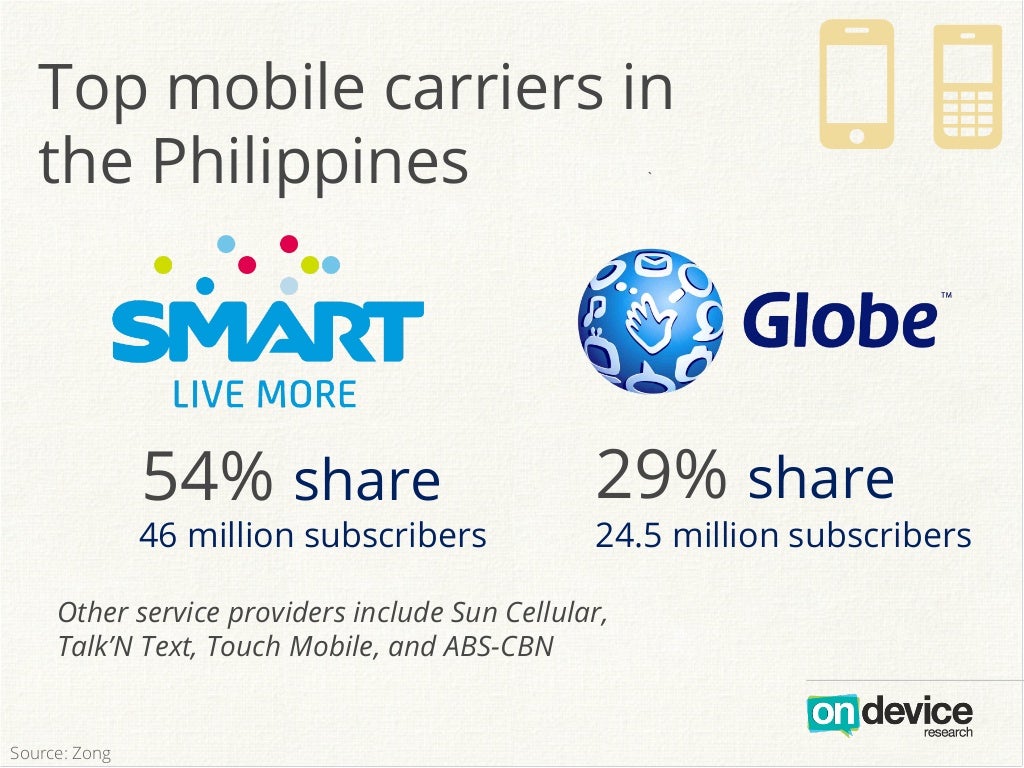
The two major network operators for mobile internet in the Philippines are Smart Communications and Globe Telecom, which combine to make a total of 83 percent of the market share. Sun Cellular is a distant third.

3G services
The roll out of the 3G network began in 2005 when the government opened bidding on five new 3G licences. Despite having five licences on offer, the NTC ultimately granted only four, as it argued that the remaining applicants lacked the capacity to effectively provide 3G services. The four successful companies included Globe Telecom, Connectivity Unlimited Resource Enterprise (CURE), Smart Communications (owned by PLDT), and Sun Cellular. Smart Communications, having acquired CURE in 2008, was itself acquired by PLDT in 2011. As a condition of the latter deal, PLDT agreed to relinquish its CURE licence.

Delays in spectrum allocation have been a drag on the region’s 3G uptake, which has been relatively slow. Low penetration of smartphones that are equipped for mobile broadband have also dampened growth.
All the same, growing data demand and the introduction of low-cost smartphones, such as the Nokia Lumina series unveiled in the Philippines in March 2014, paint a bright picture for the future of the industry.
LTE
Smart Communications was one of the first operators to introduce 4G LTE services in the Philippines. In August 2012, it launched LTE service at bands of 850 MHz and 2600 MHz, adding additional capacity at 1800 MHz the following month. These services are already available in larger cities such as Manila, Caloocan, Las Piñas, Makati, Quezon City, San Juan, and Valenzuela, according to Telegeography, a telecoms research firm.
The company is also set to expand this service further. In March 2014, it unveiled plans to extend its 4G LTE network to all major cities by the end of 2014 – areas including Bohol, Bacolod, Davao del Sur, Tagaytay and Ilocos Norte – thus reaching 50% of the population. In addition, the P32bn ($714m) of planned capital expenditures for 2014 will include expanding Smart Communications’ 3G coverage from its current coverage of 71% of the population to 100%.
Globe Telecom, too, is widening its networks. In November 2011, it launched a $790m programme to modernise its services, including the roll-out of a 4G LTE network in Makati, Manila, Pasig, Muntinlupa, Mandaluyong, Cebu City, Boracay and Quezon City. The company’s president and CEO, Ernest Cu, told OBG that the existing network infrastructure in the Philippines was built primarily to handle SMS traffic, which requires considerably less backbone capacity than data-intensive services. Now, in addition to expanding the company’s fibre optic network, Globe Telecom is seeking to standardise the communications protocols used for voice, SMS and data in order to further improve network capacity and help in future proofing the system. In 2014, capital investment in excess of $200m has been earmarked to further expand the data network and build additional capacity, which is becoming more important given high-end customers' growing mobile data needs.

Globe narrowly leads for LTE download speed, with an average speed of 6.1Mbps., slightly faster than Smart's 5.9Mbps. Internationally, however, both speeds are comparatively slow – with Australia ranked as the fastest country for LTE in the world, averaging 24.5Mbps earlier this year.

For upload speed the results are again very close, with Smart edging ahead of Globe with speeds of 7.2 Mbps. With speeds this close, as with the close download speeds above, most mobile users will not notice a significant difference unless they are downloading particularly large files, or using some other data-intensive service.


costofplans    

Smartphone penetration

The smartphone penetration rate in the Philippines is still at a low fifteen percent according to a recent study by On Device Research. That pales in comparison to the total mobile penetration in the country of 101 percent.Smartphone penetration in the Philippines is also the lowest of all the countries in Southeast Asia, including Malaysia (80 percent), Thailand (49 percent), and Indonesia (23 percent).

Smartphone penetration is expected to more than triple to 50 percent by 2015. Another positive: 88 percent of the total mobile internet population is below the age of 34. 

The battle for smartphone supremacy will be fought (and won) largely on price, given that 20 percent of the population lives on less than US$1.25 a day (54 PhP). For example, local brands Cherry Mobile, My Phone, and Star Mobile offer Android phones priced between US$50 and US$250 (2191 PhP to 10,958 PhP). This range is expected to be the sweet spot that will drive further adoption of smartphones.

International brands are also getting in on the action. Chinese brands Oppo and Xiaomi plan to expand into the Philippines, while Huawei is already offering their Ascend G6 to Filipinos. Priced at US$228 (9,994 PhP), which is half the cost of the previous model known as the P6, the Ascend G6 represents the Chinese firm’s bid to capture 10 percent of the market for mid-priced smartphones.


The race to be the cell phone brand that dominates the Philippine market is wide open. At the moment, Samsung leads at 43 percent. No other cell phone manufacturer has larger than a 10 percent market share. Sony and Cherry Mobile each have seven percent, Lenovo has five percent, and LG, Alcatel, and MyPhone each have three percent.

Samsunglead


The rising prevalence of smartphones will likely be the main driver of mobile revenues going forward, as consumers alter their preferences by reducing voice and SMS usage and increasing reliance on alternatives such Skype and instant messaging. While this may cause revenue losses with respect to these more traditional offerings, the wider range of data-driven services, such as applications, video-streaming and mobile gaming, will likely compensate over the longer term.

References: