Showing posts with label Company Tefficient. Show all posts

Tuesday, 17 March 2026

Norway’s Mobile Market Balances Competition and Performance

Data from GSMA Intelligence indicates that there were 6.07 million cellular mobile connections in Norway at the end of 2025. For context, many individuals use more than one mobile connection, so it is common for the total number of connections to exceed the total population. For instance, a person may have one mobile connection for personal use and another for work. The growing availability of eSIM technology has made it even easier to manage multiple connections in recent years.

GSMA Intelligence’s figures show that mobile connections in Norway were equal to 108 percent of the total population in October 2025. Looking at changes over time, the number of mobile connections in Norway declined by 35 thousand, or 0.6 percent, between the end of 2024 and the end of 2025.

At the same time, GSMA Intelligence reports that 99.1 percent of mobile connections in Norway can now be classified as broadband, meaning they connect through 3G, 4G, or 5G mobile networks. However, devices that are capable of connecting to broadband mobile networks do not always use cellular data. Some subscription plans may only provide access to voice and SMS services, so this broadband figure should not be interpreted as a direct measure of mobile internet usage.

Norway’s mobile market is characterised by a relatively concentrated structure, with three mobile network operators and a range of mobile virtual network operators that rely on wholesale access to the main networks. The three companies that operate mobile network infrastructure in Norway are TelenorTelia Norway, and Ice. These operators account for the vast majority of mobile subscriptions in the country and provide the underlying infrastructure that supports a number of smaller service providers.

Historically, Norway’s mobile market has been dominated by two large operators. Telenor has long been the market leader, while Telia has served as the primary challenger since entering the market through its predecessor NetCom. Over the past decade, Ice has emerged as a third infrastructure operator following significant investment in network deployment.

The presence of three network operators has strengthened competition in the Norwegian mobile sector, although the market remains relatively concentrated compared with larger European markets.


Telenor continues to hold the largest share of mobile subscriptions in Norway. The company operates extensive nationwide infrastructure and has historically maintained strong coverage across both urban and rural areas.

Telenor Norway reports 111k FWA subs in Dec 2025, a number that is the same as in the beginning of 2022 (or 15k down from peak). The total number of fixed broadband subs (incl. FWA) is in decline as a growth in fibre subs can't compensate for losses in cable and FWA. FWA now 16% of total base.

[image or embed]

— Tefficient🚥 (@tefficient.bsky.social) 6 February 2026 at 08:14

Telenor also emerges as the dominant force in Norway’s mobile landscape, retaining its Best Network title and standing out as the most-awarded operator in Opensignal’s November 2025 report. From the awards grid, Telenor secures six outright wins and five joint wins, leading in 11 out of 15 measured categories. Telia follows with two outright and six joint wins, while ice collects five joint wins, according to real-world experience data recorded by users.

Telia Norway represents the second largest operator and competes directly with Telenor across most segments of the market. The operator has invested heavily in network upgrades in recent years and has expanded its 5G footprint across the country.

Following on several trials, Telia is first to launch 5G SA commercially in Norway. Telia now offers 5G SA as 'Avansert 5G' to B2B customers across its 5G network nationwide. kommunikasjon.ntb.no/pressemeldin...

[image or embed]

— Tefficient🚥 (@tefficient.bsky.social) 13 February 2026 at 06:18

Ice, the third network operator, has focused on building its own infrastructure while also relying on national roaming agreements to extend coverage beyond its network footprint. The company has positioned itself as a challenger operator with a focus on competitive pricing and data centric mobile plans.

Breaking: Lyse Tele (ice Norge) and Telia Norway to share mobile network across Norway, a first for the country. news.cision.com/telia-compan...

[image or embed]

— Tefficient🚥 (@tefficient.bsky.social) 2 February 2026 at 18:06

Norway has consistently ranked among the leading European markets in terms of mobile network performance and coverage. Independent benchmarking conducted by Rohde & Schwarz has placed Norwegian operators among the strongest performers globally, reflecting sustained investment in network infrastructure despite the country’s challenging geography and dispersed population. In recent testing covering more than 7,000 kilometres and over half of the population.

Which country - Norway, Denmark, Finland, Sweden - has the highest mobile and fixed broadband ARPU? What value for money do customers get? The Norwegian government's @dfd.regjeringen.no made this Tefficient analysis public. www.regjeringen.no/no/dokumente...

[image or embed]

— Tefficient🚥 (@tefficient.bsky.social) 8 March 2026 at 09:19

The country’s operators have invested heavily in 4G and more recently 5G infrastructure. For example, Telia reported that its 5G network now reaches close to 99 percent of Norway’s population following several years of nationwide deployment, highlighting the rapid pace of next generation network rollout in the market.

Recent industry developments include plans by Telia and Lyse, the parent company of Ice, to combine parts of their mobile radio access networks in Norway through a jointly owned entity. The companies expect the arrangement to reduce infrastructure costs and improve coverage while continuing to operate as separate retail competitors with independent core networks.

Norway’s mobile market is likely to remain relatively stable in terms of structure. The presence of three infrastructure operators, combined with a range of virtual operators, provides a balance between network investment and retail competition.

Future developments in the sector will likely be shaped by continued 5G deployment, infrastructure sharing arrangements, and the evolving role of wholesale access in supporting smaller mobile brands.

Related Posts

Friday, 20 September 2024

A Billion for China and China Mobile

As of September 2023 (last year), China had an estimated 750 million active 5G subscriptions. The share of the four operators, all of which have the Chinese government as a majority shareholder, is as shown in the picture above.

China Mobile, the world’s largest operator in terms of subscribers, surpassed the 1 billion subscriber mark at the end of July, according to the carrier’s latest available data. In the 5G segment, the Chinese carrier ended July with 527.9 million network customers, with a net addition of 13.7 million during the month. It ended the first half of the year with a total of 2.3 million 5G base stations, after adding 351,000 base stations in the period.

According to their latest monthly subscriber stats, China’s ‘big three’ telcos – China Mobile, China Telecom and China Unicom – between them chalked up more than 20 million 5G net adds in July alone.

China Mobile is the country’s 5G growth engine, notching an additional 13.7 million subs during July. It took the operator’s 5G customer base to just under 528 million, which accounts for more than half of its total mobile subscriptions of just over 1 billion: China Mobile snagged its one billionth mobile subscriber in June.

China Telecom and China Unicom report the number of ‘5G packages’ rather than active 5G subscribers (which is the statistic that China Mobile now reports). This skews upwards China’s 5G number since those signed up to a 5G package (data bundle) can’t necessarily access 5G services, either due to insufficient network coverage or the lack of a suitable smartphone.

Putting that quibble to one side, China Telecom and China Unicom reported 5G package gains of 3.1 million and 2.9 million subscribers respectively during July. At the end of the month, China Telecom had nearly 340 million on 5G packages, accounting for 81% of its total mobile subscriber base. China Unicom had 279 million 5G package subscribers at that time, which, like China Telecom, represents around 81% of all its mobile subscriptions.

Related Posts

Tuesday, 3 September 2024

South Korea has Nationwide 5G Coverage

Back in April, the Korean Ministry of Science and ICT (MSIT) announced that South Korea had nationwide 5G coverage. Just as a comparison, South Korea is about 2.4 times smaller than United Kingdom with a population of 52 million vs 68 million. 

Tefficient compares it with Sweden, which is four times bigger but has a far lower number of base stations compared to that of South Korea. 

While the OpenSignal report from late last year wasn't that impressive regarding the 5G availability, it would be good to compare it with the next one whenever released. 

Finally, here are other couple of charts from Tefficient highlighting the 5G data traffic growth and the subscription growth from South Korea:

Related Posts

Friday, 16 August 2024

World's Largest Mobile Networks by Data Traffic - Q1 2024

Last year, India became the most populous country in the world. India's population stood at slightly over 1.428 billion, edging past China's population of 1.425 billion people. India and China's combined population is one third that of the whole world. As a result it won't come as a surprise that the operators with most data consumption in their networks are the ones from India and China.

At the end of Q1 2024, Reliance Jio was the operator with largest mobile data traffic flow through its network. China Mobile was just behind. 

As Tefficient reported, Jio says that 5G's share of traffic is 28%, the rest being 4G as it doesn't have 2G/3G network. Another interesting stat was that the monthly usage per AirFibre (FWA) subscription was 390 GB, 30% higher than for a JioFiber subscription.

You can do a comparison with Q4 2022 numbers available here.

Thursday, 18 July 2024

Data Usage in Estonia is Growing Thanks to Improved Coverage and 5G

According to DataReportal’s key insights on digital adoption and usage in Estonia as of early 2024: Estonia had 1.24 million internet users at the beginning of 2024, with an internet penetration rate of 93.7 percent. In January 2024, Estonia had 1.04 million social media users, representing 78.7 percent of the total population. There were 1.92 million active cellular mobile connections in Estonia in early 2024, equating to 145.7 percent of the total population.

Data from GSMA Intelligence shows that many people use more than one mobile connection—such as one for personal use and another for work—making it common for mobile connection figures to exceed the total population count. GSMA Intelligence also reports that the number of mobile connections in Estonia increased by 17 thousand (0.9 percent) from the start of 2023 to the start of 2024.

Investment in Estonia’s telecom market has concentrated on upgrading fixed-line infrastructure and deploying 5G services. Fixed broadband subscribers are gradually transitioning from DSL to fiber, with legacy copper networks being replaced.

The mobile network operators (MNOs) Telia, Elisa, and Tele2 have established comprehensive LTE infrastructure and have recently directed investments towards 5G. Several 5G trials have been conducted, but commercial service launches have been hindered by a lack of available spectrum. The regulatory body began addressing this issue in May 2022 by awarding a 3.5GHz concession to Elisa. A second license will provide sufficient spectrum for national coverage by 2022. Delays in spectrum allocation were partly due to challenges in offering services in areas bordering Russia.

Progressive government policies on broadband infrastructure and an active regulatory regime have also contributed to Estonia achieving one of the highest broadband penetration rates in Europe. Broadband is available through various fixed-line and wireless technologies, including ADSL2+, FttP, cable, Wi-Fi, and WiMAX. Elisa’s consolidation with the main cable company Starman in April 2017 has enabled it to offer a more comprehensive suite of bundled services, enhancing its competitiveness with Telia.

2G is on 900 and 1800 MHz, 3G is on 900 and 2100 MHz with good coverage, 4G/LTE has started with all providers on 800, 1800 and 2600 MHz (Bands 3, 7, 20) plus 2100 and 2300 MHz (Bands 1 and 30) on Tele2 all over the country and is generally available for prepaid. 5G has started to be available on some high-data postpaid plans from Telia since November 2020 and on Elisa since June 2022.

Telia Eesti is part of Swedish telecom giant Telia Company, Telia has the best overall coverage in Estonia and focuses heavily on 4G/LTE services.

The major mobile operator in Estonia is Telia and it has a market share of over forty percent. They provide the largest network coverage consisting of 4G and 5G services available in most major cities across the country. Although Telia’s plans are mainly costlier than rivals, they provide more data and speed.

Ericsson and Telia have launched the Baltic region's first enterprise 5G private network, Ericsson Private 5G. This private cellular network became operational in early May at Ericsson’s supply site in Tallinn, Estonia.

Ericsson highlights that the 5G private network’s advanced capabilities, including reliability, predictable latency, security, and speed, enable various use cases such as asset condition monitoring and management, computer vision, digital twins, collaborative robotics, and precise indoor positioning.

The Tallinn supply site is strategically significant to Ericsson’s global supply chain, accounting for nearly half of the company’s new product introductions (NPIs). These NPIs require extensive research and development to ensure the products are relevant, competitive, and scalable, which is crucial for their successful market introduction.

Telia Eesti switched off of its 3G network in September 2023 this has enabled Telia to focus on the build-out of its 4G and 5G networks instead. The company currently has 150 5G base stations in Tallinn.

Elisa is the number two mobile operator in Estonia, owning about 30% of the market. These firms often give the same kind of network coverage that we find in Telia at reasonable prices. Elisa is a little bit slower compared to Telia, but both speeds are sufficient for most users. Elisa Group’s Estonian arm offers competitive rates, especially for family plans and long-term contracts. The company is rapidly deploying 5G in major cities.

With regards to spectrum, in May 2022 Elisa won 130 MHz of spectrum for which it paid EUR 7.2 million. Then in November 2022, it won 2x10 MHz of 700 MHz spectrum which laid the foundation for it's 5G coverage. Finally, in May 2023 Elisa won 800 MHz of 26 GHz spectrum for EUR 1.63 million. It hasn't commercially used the spectrum yet.

Tele2 Eesti is a subsidiary of Tele2 Group, Tele2 boasts the fastest mobile broadband speeds in the country. It has invested significantly in 4G and emerging 5G networks.Tele2 has the smallest share of approximately 20% in the Estonian mobile market. They are the cheapest, but their network coverage is only half of what Telia’s and Elisa’s are. Tele2 is are also among the three operators, their speeds being the slowest but satisfactory for basic internet access.

Back in 2022, Tele2 won the 700 MHz spectrum auction. It already had 3.5 GHz licenses and was also using 2300 MHz band for 5G. According to their press release, the added 700 MHz frequency band would allow them, in addition to better coverage, to offer services that do not require large data volumes, such as Internet of Things (IoT) services. 

Alongside rivals Telia and Elisa, Tele2 obtained 800MHz of spectrum in the 26GHz band back in 2023. It spent EUR1.6 million (US$1.7 million) on 24.7-25.5 GHz despite the fact that there are currently no devices commercially available in Estonia capable of operating via the 26GHz band.

Tele2 previously revealed that Nokia is its primary partner for 5G core networks in the standalone era, with deployment expected to have started during 2021. Nokia said it will deploy standalone 5G core and voice-over-5G technology for Tele2 operations in Sweden, Latvia, Lithuania and Estonia.

Tefficient's latest report identified that the data usage in Estonia has been growing along with other Baltic countries as can be seen in the chart above.

Related Posts

Thursday, 17 February 2022

Finland is on top of the world with 5G and Data Consumption

Finland’s telecommunications market is among the more progressive in Europe, with operators having been at the forefront in deploying technologies and with the regulator being among the first to auction spectrum for 5G use. These efforts have been supported by the government which is working towards its target of providing a broadband service of at least 100Mb/s by 2025. 5G services were available to more than 40% of the population by early 2021, and take-up among subscribers has been strong although most will remain with LTE in the short term.

The country enjoys one of the highest broadband and mobile penetration rates in the region, with customers able to make use of the latest iterations of technologies including DOCSIS3.1, LTE-A, 5G, and GPON fibre infrastructure.

Just as Finland was in the forefront of LTE developments in Europe, so has it emerged as one of the pioneers in 5G. The auction of spectrum in the 700MHz and 3.5GHh bands has enabled network operators to extend the availability of LTE services nationally and to prepare for 5G services. Spectrum in the 2.5GHz band was auctioned in mid-2020 and has since enabled the MNOs to widen their 5G footprint considerably.

Finland has three national network operators: Telia (by the Telia Group, formerly called Sonera), Elisa (prepaid packages under Saunalahti brand) and  DNA (by DNA Oyj, part of Telenor Group)

2G is on 900 and 1800 MHz, 3G on 900 and 2100 MHz, 4G/LTE on 700 (B28), 800 (B20), 1800 (B3) and 2600 (B7) MHz. In the less populated northern and eastern parts of the country Telia and DNA share one common network called Yhteisverkko covering more than “half of Finland’s total geographical area" and serving more than "15% of the population". In 2020 all three networks started 5G NR on 3500 MHz (n78) mostly in the cities and is so far only offered on some 5G plans of Telia and Elisa on prepaid. 

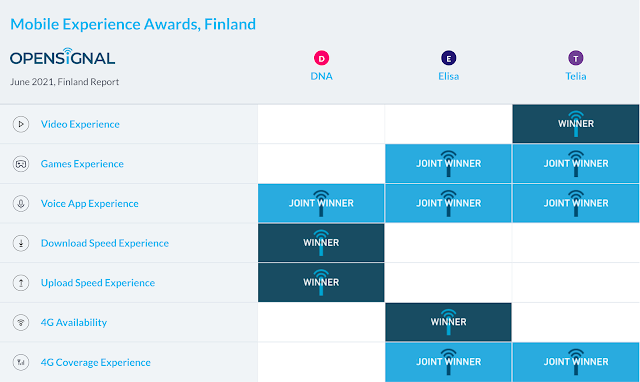
All three operators have a very good coverage and high speed at low prices even in remote and rural areas. Because of the heavy data usage in Finland, 5G becomes very important. According to OpenSignal in 2021, 5G was available to about 11% of Finns and had an average download speed of 200 Mbit/s. In 4G availability all three networks are close at around 93% and download speeds of 37 Mbit/s. DNA featured as the fastest mobile network for both average download and upload speeds, while sharing the victory in Voice App Experience. Elisa solely won 4G Availability, while sharing Games Experience, Voice App Experience and 4G Coverage Experience. Telia solely won Video Experience, while sharing the victory in Games Experience, Voice App Experience and 4G Coverage Experience.

All three national mobile operators in Finland are busy deploying their 5G networks in the country, as they all secured the same amount of spectrum in the recent 700 MHz, 3.5 GHz and 26 GHz 5G spectrum auctions.

Telia, rebranded from Sonera in 2017, has the most customers in Finland and its coverage on 3G and 4G is equal to Elisa. In 2018 4G/LTE reached 98% of population. Telia has opened its 5G network to some prepaid plans in 2022.

In November 2021, Telia claimed to have launched the Nordic and Baltic regions’ first commercial Standalone 5G core network in partnership with Nokia. 

Nokia noted that the rollout included its cloud packet core and registers, which allow subscriber data to be consolidated into a common repository using a distributed and flexible architecture. Telia Finland is also reportedly using Nokia’s RAN. This network was initially launched in 20 geographical areas across Finland with more rollout in future that will lower latency and include network slicing capabilities. 

Elisa Saunalahti is Elisa's consumer sub-brand, which has very good coverage and speed in Finland. For 3G it mostly uses the 900 MHz band (in contrast to 2100 MHz in the rest of Europe), but it is still supported by almost all modern devices. In 2017 B28 on 700 MHz was added for LTE in rural areas. 5G was opened in 2022 for some prepaid plans.

In January 2022 Elisa has confirmed that it has doubled its 5G footprint in the twelve months since January 2021, and now covers four million Finns with its fifth-generation infrastructure. As such, 5G connectivity is now available in a total of 153 locations – equivalent to more than 70% of the population.

In a separate announcement, Elisa has highlighted the level of 5G adoption within its user base. Ville Valkama, Elisa’s Business Director for Consumer Customers, revealed: ‘In 2021 5G phones became commonplace in Finland. The share of 5G models in the phones we sell is already approaching 90%.’

DNA is the 3rd operator in Finland, yet it offers comparable coverage and very high speeds at good rates: coverage map. In 2019 the majority of DNA shares were sold to Telenor from Norway. Unlike Telia and Elisa, 5G is not yet offered by DNA for prepaid, only for subscriptions.

DNA has announced that all of its 5G base transceiver stations (BTS) are now connected to a core network that supports Standalone (SA) 5G architecture. Kimmo Liikonen, DNA’s Director of Core and IP Networks, commented: ‘For our customers, the implementation will take place in stages during 2022, as long as the last quality assurance and design work has been done. We are also looking forward to the sale of terminals that fully support the Standalone 5G network, which are not yet widely available.’

In August 2021, DNA announced that it was planning to shut down 3G by the end of 2023 freeing up spectrum for 4G and 5G network connections. Also, in December 2021, Finnish Transport and Communications Agency Traficom announced an invitation to submit bids for three spectrum licenses for 700 MHz frequency bands which will be technology-neutral. Although 3G shutdown and technology-neutral spectrum auctions are not directly related to 5G, they are certainly positive steps towards releasing valuable spectrum for 5G deployment.

Telecoms tech developers from Japan and Finland are planning to work collaboratively on the development of 6G technologies, an area becoming increasingly influenced by Chinese companies. The Nikkei writes that Nokia will join the effort and that Japan’s ‘Beyond 5G Promotion Consortium’ will sign the agreement soon with Finnish group ‘6G Flagship’. The accord will be formally announced at the Global Digital Summit 2021, an event the paper has organised with Japan’s Ministry of Internal Affairs and Communications (MIC).

Japan’s Beyond 5G Promotion Consortium aims to commercialise sixth-generation communications technology in the 2030s, and includes the University of Tokyo and domestic telcos NTT Corp, NTT DOCOMO, KDDI (au), SoftBank Corp and Rakuten Mobile. 6G Flagship, meanwhile, is led by Finland’s University of Oulu. Talks are also said to be underway to draw in a US counterpart, with the likes of Cisco Systems and Intel touted as possible candidates.

Related Posts:

Thursday, 10 February 2022

Nordics are Winning the Mobile Networks Experience Race

As an outsider, it is always confusing as to which countries are Nordic and which are Scandinavian. Tripsavvy nicely explains this as: In short, Iceland, Norway, Sweden, Finland, and Denmark are all Nordic countries with Scandinavian roots, but typically, you will only find Danish, Norwegian, and Swedish people referring to themselves as Scandinavian. In the mobile industry though, Iceland doesn't seem to be included in Nordic countries while reporting speeds, etc. 

Opensignal recently announced "Global Mobile Network Experience Awards 2022". As can be seen in the chart in the Tweet below, quite a few entries from the Nordic operators.

Back in January, Tefficient nicely showed how the four Nordic countries compare over population and 5G population coverage with Venn diagrams.

There is definitely a lot of work that still needs to be done but it's interesting to see how Nordics are punching well above their weight.

Related Posts:

Sunday, 8 August 2021

The Growth of Cheap Mobile Data

The analyst first Tefficient whose motto is to "Measure, compare and improve competitiveness within telecoms" recently published this chart on their Twitter. It nicely shows that the data usage is growing while the costs are generally getting lower.

Canada has always been an exception and a leader in expensive data plans. It doesn't look like it will change any time soon.

For more details see Tefficient’s 31st public analysis of the development and drivers of mobile data that compares 45 countries from all regions of the world. You can also download the detailed analysis in PDF here.

Related Posts:

Sunday, 28 March 2021

World's Largest Mobile Networks by Data Traffic - March 2021

The analysis firm Tefficient, posted this chart in one of their Tweets. As you can see that China Mobile is the leader, followed by Reliance Jio and then China Unicom, China Telecom, Airtel and Vi (Vodafone Idea). 

As you can see, Bharti Airtel, India and China Telecom are also enjoying huge traffic growth.

Last year, Tefficient had also reported the absolute number up to 1H 2020. Vodafone Group (excluding vi) is the next highest carrier of the data traffic followed by Telkomsel Indonesia, Telenor group, MTS Russia, AIS Thailand, 3 Group Europe, Zain Group, XL Indonesia, Indosat and 3 Indonesia.

Of course not everyone agrees with all the numbers

We will provide updated ranking when it is available. 

Monday, 22 March 2021

Wi-Fi and 5G Status in South Korea


Last year we reported on this blog that South Korean Ministry of Science and Technology Information and Communication is heavily promoting Wi-Fi 6, in 6GHz (a.k.a. Wi-Fi 6E). 

Back in February, South Korea's ICT ministry said that it has made over 15,000 new public Wi-Fi service zones available across the country and in buses last year, bringing the total locations with free public Wi-Fi to over 57,000. Yonhap News Agency revealed:

The Ministry of Science and ICT said the public can access free Wi-Fi in 28,132 public locations, such as bus stations, public facilities and parks, and also in 29,100 buses.

By region, there are 2,529 public Wi-Fi locations in Seoul, with 4,358 locations in the surrounding Gyeonggi Province, according to the ICT ministry.

South Korea has recently boosted efforts to expand public Wi-Fi zones that had previously been limited to indoor facilities, such as community centers and traditional markets.

The ICT ministry said it has focused on outdoor locations, installing free Wi-Fi at 7,949 bus stations, 1,286 parks and 320 major streets across the country from 2019 to 2020.

The ministry has also replaced 18,000 aging routers with the latest Wi-Fi 6 equipment, resulting in speeds that are three times faster on average.

The ministry said it plans to establish 15,000 additional public Wi-Fi zones this year.

You can see a video of one such Free WiFi on Bus event here.

Hackaday reported that the government has released the details of the 220,000 WiFi access points to the public. This includes the location, IP address, and RSSI data for use by people and companies wanting to develop location-based services.

Aju Business Daily said Geographical locations, internet protocol addresses and received signal strength indicators (RSSIs) have been collected for emergency response purposes and to pinpoint the location of an AP or to calculate the floating population. RSSI is an estimate of the strength of WiFi signal between an AP and recipient device.

In the mobile news,  Tefficient reported that 4G/LTE traffic has been going down as 5G traffic grows.  February 2019 was the last time monthly 4G traffic was so low (380 PB) in South Korea as it was in January 2021. 4G visibly in decline the past months while 5G traffic grew to 45% of total.

Also as you can see in the other tweet, South Korea's operators net added over 1 million 5G subscribers in January 2021 - the first month over 1 million since the 5G launch. 18% of total mobile subscriber base now 5G.

But not everyone is happy with 5G. The Korea Bizwire reported:

Hundreds of 5G smartphone users in South Korea are banding together to take legal action against the country’s three major telecom operators — SK Telecom Co., KT Corp. and LG Uplus Corp. — for spotty connection and the poor quality of the latest generation network, industry sources said Thursday.

As of Thursday, around 1,000 5G smartphone users have expressed intent to take part in the collective lawsuit to seek at least 1 million won (US$890) in compensation per user from the three mobile carriers over their 5G network quality that fall short of expectations, despite their costlier pay plans, according to Kim Jin-wook, a lawyer at law firm Joowon, which is spearheading the legal action.

Kim argues that 5G network quality is not a discernible improvement from previous 4G LTE networks and has drawbacks, such as limited availability.

The three telecom operators had deployed 166,250 5G base stations as of November last year, which is just 19 percent of the number of 4G base stations, according to industry tracker Opensignal.

South Korea’s 5G coverage centers around major urban areas, such as Seoul, with carriers aiming for nationwide coverage by next year.

Carriers also initially advertised 5G download speeds as being 20 times faster than 4G LTE, but a government report last year found that average 5G download speeds were around four times faster than those of 4G.

“Considering that monthly 5G plans are around 50,000 won more expensive than 4G LTE plans, we expect around 1 million won in compensation for users subscribed to two-year plans,” said Kim.

He added that the lawsuit will be filed in May after gathering more participants.

This may be the catalyst the Korean operators need to massively improve the 5G user experience for the end users.

Related Posts:

Sunday, 7 February 2021

China Mobile on The Next Phase of 5G: Progress, Challenges, and Opportunities


China always makes the news when it comes to the number of base stations and the vastness of the mobile network deployment. According to Tefficient, China will soon have 10 million mobile base stations. Of these, 718K are 5G equipped.

According to a recently posted lecture from IEEE 5G World Forum back in September, Dr. Chih-Lin I of China Mobile showed that there were 480k+ 5G capable base and the number of users that have a 5G capable phone or subscription exceeded 130 million. 

Back in April 2020, we looked at China Mobile's 5G+ network in detail here. There has been a lot of progress as over 200 5G devices were available back in October and over 400 5G application trials were conducted.

Remote surgery is one of the applications I take an exception with and have detailed it here and here. It looks like China Mobile is using 5G for a lot of medical use cases. Some of these are detailed in the pictures above and more details is available in the video below.

Finally, it is good to see that China Mobile sees 6G as Open & Smart. They are one of the founding operators of O-RAN Alliance so they definitely have a vision for open. AI is expected to play a big role in 6G networks and hence Smart.

At the IEEE 5G World Forum 2020 Virtual event, Dr. Chih-Lin I delivered her presentation embedded below. Chih-Lin I is one of the authorities driving the transformation. As China Mobile’s chief scientist, she is one of the experts helping to create a faster, greener, and healthier 5G world. You can find her complete bio here.

Her talk is embedded below.

While slides from this talk were not shared, Dr. Chih-Lin I delivered a very similar presentation to the Open Networking Foundation (ONF). The slides from that are available here and the video from that is here.

Related Posts:

Saturday, 15 August 2020

How many 5G Cell Towers & Base Stations Worldwide?

A question I often see people ask is how many cell towers / base stations are there worldwide? Surprisingly this information is not as easy to obtain as you may think initially. We can use this chart from a Light Reading webinar as a starting point:


Many years back someone explained a rule of thumb to me. There is on an average 1 site for every 1000 subscribers. With roughly 8 billion subscribers, this will amount to 8 million sites.

Omdia statistics from above says that there are 7 million physical sites and 10 million logical sites. As there are many sites hosting infrastructure from multiple operators, the number of logical sites are more than the number of physical sites.

In addition there will be small cells mounted on lamp posts, side of the buildings, indoors, etc. that generally may not be included in the count mainly.

When it comes to base stations, there is a debate on what is included. For example on a tower hosting multiple operators, each of them will have their own Baseband Unit (BBU), so this is multiple base stations. If for an operator, there are multiple generations of technologies and within each of these generation, multiple frequencies, sectors, etc. Do they count as a single base station or multiple?

Then there are towers and masts. Wikipedia nicely explains that "The terms "mast" and "tower" are often used interchangeably. However, in structural engineering terms, a tower is a self-supporting or cantilevered structure, while a mast is held up by stays or guys."

So coming back to 5G, how many base stations have been rolled out in the major markets?

Japan

In an earlier post on NTT Docomo, we pointed out that Docomo coverage is forecast to increase from 500 base stations in 150 locations to 10,000 sites (in about 500 cities) by June 2021 and 20,000 by March 2022.

According to Tefficient, Rakuten had 5739 LTE base stations on air at the end of June. The three incumbent operators have roughly 200000 LTE base stations each.


South Korea

South Korea were the first to launch commercial 5G by all operators in the country. As of July 2020, they had 121,000 5G base stations


China

Back in December last year, Global Times reportedthere are currently approximately 6 million 4G base stations worldwide, more than half of which are in China and about 300,000 in the US. Why does China have so many base stations? This is because of a nation-level project in China in 2003. The project required that more than 95 percent of remote mountainous areas should be covered with communication signals and the fees must not be higher than those in urban areas.

In an earlier post we reported, the total number of 4G base stations in the first half of 2019 was 2.71 million including a net addition of 300,000, providing robust support for the development of large volumes of data traffic business.

European 5G observatory reported that China intends to have 600,000 5G base stations by the end of 2020. According to RCR wireless, Chinese telcos have already deployed over 20,000 5G base stations in Shanghai.

According to Tefficient, China Mobile had 188k 5G base stations in June 2020. So China then had a total of 398k 5G base stations


This video from CGTN a few months back gives some good info on the Chinese 5G deployments.


There isn't information available from other countries. If available in the next few months, I may add them here.

Related Posts:

Monday, 1 June 2020

Nearly Perfect 4G in Australia is Preparing Users for 5G Era


The Australian mobile market is dominated by the three major mobile network operators Telstra, Optus, and Vodafone. All three operators provide comprehensive population coverage with their LTE networks and have launched 5G services.All three Australian mobile operators are now investing billions of dollars in their networks annually, with a view to securing new customers and retaining existing ones. Increasingly, consumers are looking to mobile communications for their broadband needs.

In common with most mature markets, in Australia there are significantly more subscribers to mobile services than there are people. Growth is being driven by population increases as well as a rise in the number of people using two or mobile subscriptions – commonly one is for personal use and another for business use. Very slow growth is predicted over the next five years to 2024 with penetration rates predicted to rise only slightly above projected population increase.


Telstra Australia launched its 5G service on the 3.6 GHz band at the end of May 2019 as it had switched on over 200 5G sites since August 2018. The 5G service was available in over 10 cities, including parts of Melbourne, Sydney, Canberra, Brisbane, Adelaide, Perth, Hobart, Launceston, Toowoomba, and the Gold Coast. Twenty-five additional cities should be covered before end-June 2020 including the major regional cities in Australia. However, the operator announced it is ahead of its target and 5G services are now available in 47 cities across the country.


Telstra added it has seen a massive expansion in the number of potential customers, growing from 4 to 8 million. Swedish vendor Ericsson has announced collaboration agreements with the operator to provide 5G equipment and upgrade Telstra’s network.

The Australian operator previously acquired spectrum in the 3.6 GHz auction for AUD 386 million (EUR 240 million), giving it 60 MHz of contiguous 5G spectrum in all major capital cities and between 50 MHz and 80 MHz in regional areas.


Telstra has also begun trialling faster millimetre-wave 5G mobile phone technology, which could be up to eight times faster than 4G, in sites at Parramatta and on the Gold Coast as the company announces its 5G network is now available in more than 700 towns across the country.

The trial marks the next step in the construction of 5G networks in Australia. 5G networks in Australia could only use lower-spectrum bands they already had licences for, meaning the much faster mm-wave 5G could not be used in Australia because it needs to use spectrum in higher bands (upwards of 26GHz).


The higher-end spectrum allows data to transfer at much higher rates, and with lower lag in communication to devices. Lower-spectrum (3.6GHz currently) 5G is around two times faster than 4G, but using the higher spectrum, 5G can be significantly faster, just over a shorter distance. Ericsson, the company behind the technology in Telstra’s 5G network, reported earlier this year speeds of up to 4.3 gigabits per second in its lab test.


Rival mobile network operator Optus announced the commercial launch of 5G mobile and 5G residential fixed broadband services covering selected areas in November 2019. 290 5G network sites went live and 1,200 sites were planned by March 2020. Recently, the company announced that by the end of May 2020 customers in parts of the western Sydney suburbs of Bonnyrigg and Minchinbury, Niagara Park on the NSW Central Coast, Cook in the ACT and the Brisbane suburb of Kenmore will be able to order 5G services. The telco is using equipment from both Ericsson and Nokia in its rollout of 5G.


Optus secured spectrum in the 3.6 GHz spectrum auction for AUD 185 million (EUR 110 million) in late 2018.


Optus have now launched a dual-band 5G network in Sydney using the 2300MHz and 3500MHz bands, with plans to extend coverage to Melbourne in the coming weeks.

The operator said it is testing Samsung Galaxy S20 5G devices on the dual-band network, which it claimed in a world first. The network uses Ericsson’s 5G Radio System equipment and Optus said initial findings indicate it has the potential to increase capacity and coverage. They have also worked with Nokia and Qualcomm last year.

Meanwhile Vodafone Australia switched on its 5G network at Parramatta in March 2020. They expect 650 sites in other parts of Sydney, Melbourne, Brisbane, Adelaide, Perth, and Canberra, will be live from mid-2020.

Vodafone Australia has teamed up with Nokia to conduct what the pair are calling the first field test of 700Mhz spectrum in Australia and APAC.  Nokia said the use of low-band spectrum and its AirScale equipment would improve indoor coverage and will be combined with the operators 3.5GHz holdings. 700Mhz spectrum in Australia has previously been used for 4G networks.


Open Signal notes that while 5G may be the focus for Australian operators, 4G continues to play a vital role because it is the network generation that handles the vast majority of users’ traffic and is the technology that most smartphones are using. Additionally, the early 5G networks continue to rely on 4G connections in order to operate because they use 5G non-standalone access. All three of Australia’s national operators have surpassed the 90% mark in 4G Availability and Optus is approaching the coveted 95% mark with a score of 94.9%.

In this report, Open Signal analyze the mobile network experience of Australia’s three national operators in the 90 days starting January 1, 2020. They monitored the network experience at a national level and across six cities, to see how Telstra, Optus and Vodafone performed.


In Opensignal’s regional analysis of six of the largest cities in Australia, Telstra is the operator to beat. The wireless carrier won awards in more cities in each of their metrics than any other operator. In Download Speed Experience, Telstra was the winner in five cities and tied with Optus in one city. They also saw the download speed Telstra users enjoy soar to 73.4 Mbps in Adelaide, which was 26.1% higher than its national score of 47.3 Mbps.


Related Posts: