Showing posts with label Operator China Telecom. Show all posts

Friday, 20 September 2024

A Billion for China and China Mobile

As of September 2023 (last year), China had an estimated 750 million active 5G subscriptions. The share of the four operators, all of which have the Chinese government as a majority shareholder, is as shown in the picture above.

China Mobile, the world’s largest operator in terms of subscribers, surpassed the 1 billion subscriber mark at the end of July, according to the carrier’s latest available data. In the 5G segment, the Chinese carrier ended July with 527.9 million network customers, with a net addition of 13.7 million during the month. It ended the first half of the year with a total of 2.3 million 5G base stations, after adding 351,000 base stations in the period.

According to their latest monthly subscriber stats, China’s ‘big three’ telcos – China Mobile, China Telecom and China Unicom – between them chalked up more than 20 million 5G net adds in July alone.

China Mobile is the country’s 5G growth engine, notching an additional 13.7 million subs during July. It took the operator’s 5G customer base to just under 528 million, which accounts for more than half of its total mobile subscriptions of just over 1 billion: China Mobile snagged its one billionth mobile subscriber in June.

China Telecom and China Unicom report the number of ‘5G packages’ rather than active 5G subscribers (which is the statistic that China Mobile now reports). This skews upwards China’s 5G number since those signed up to a 5G package (data bundle) can’t necessarily access 5G services, either due to insufficient network coverage or the lack of a suitable smartphone.

Putting that quibble to one side, China Telecom and China Unicom reported 5G package gains of 3.1 million and 2.9 million subscribers respectively during July. At the end of the month, China Telecom had nearly 340 million on 5G packages, accounting for 81% of its total mobile subscriber base. China Unicom had 279 million 5G package subscribers at that time, which, like China Telecom, represents around 81% of all its mobile subscriptions.

Related Posts

Thursday, 20 January 2022

China Telecom explains Implications of Innovative Fixed 5G (F5G) Applications

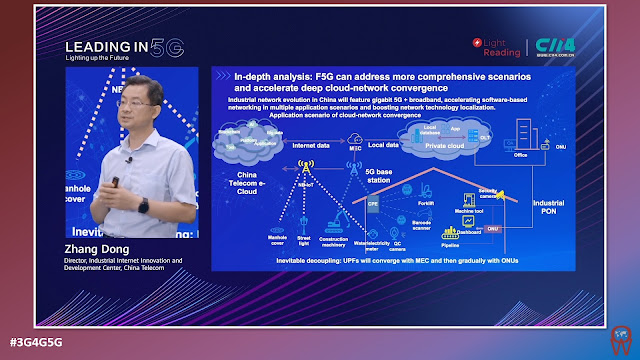
Last year, Zhang Dong, Director, Industrial Internet Innovation and Development Center, China Telecom, spoke at at Light Reading’s Leading in 5G webinar series.

He said China Telecom began trials three years ago with half a dozen early adopter clients.

The base station cost was mostly paid for by the enterprises, while China Telecom sold O&M services and applications on top including big data, AI, and so on, he said.

While we see challenges like how to ensure lower latency and higher network assurance, and deal with problems like jittering, or how to simultaneously deliver 8K HD video from eight cameras, China Telecom is still making important milestones on its 5G journey.

Zhang said that after deploying more than 1000 5G use cases, China Telecom experts have identified four key categories.

The first is using 5G to enable high-speed mobility, with applications such as autonomous driving, remote control of vehicles or remote management of ports and warehouses.

The second type is those leveraging the faster 5G uplinks and downlinks. This is mostly related to video and in the future will also include various other integrated media, like AR and VR, Zhang said.

The third type of 5G use case focuses on scenarios where people and things gather, such as transportation hubs, and places with large number of people or large objects moving around.

The fourth type is deployment of 5G in hazardous environments. For example, some working environments might expose personnel to toxic gas, loud noise or other safety hazards. 5G can play an important role in ensuring safety.

Zhang cited some of China Telecom’s collaborations in the resource and utility sectors.

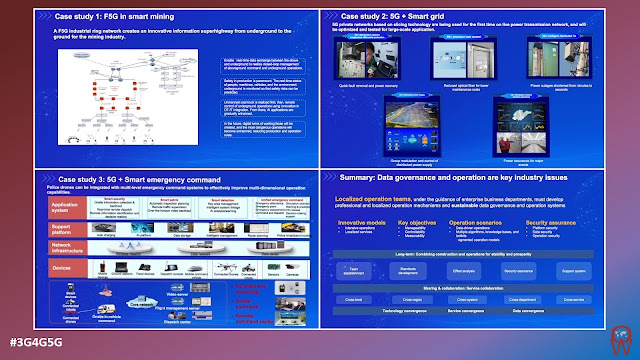
One was with oil and gas giant Sinopec, which was one of the first to trial 5G because it was willing to pay for the base station rollouts and services.

Another was the Shendong Coal Group in the mining sector, which had worked with China Telecom to roll out private networks under the wells, requiring investment of over 100 million yuan ($15.6 million).

China Telecom had also partnered with Qingdao Power Grid in a project where network slicing ensured the connectivity and lower latency to support precision power distribution.

We have looked at Fixed 5G (F5G) in our blog posts here and here. During the talk, Zhang also discussed F5G. 

He highlighted that in F5G,  there's a F before 5G where this F stands for fiber connection. Fiber connections and 5G joining hands will usher in another wave of technological innovations with 5G.  Base stations already need fiber for data transmission, etc. These connections can be extended to OT industry, which would mean that the fiber connection can be used to control robots, etc. If fiber connections are deployed together with 5G, mining and other use cases in verticals will emerge in addition we know do today.

The video of his talk is embedded below:

Related Posts:

Sunday, 28 March 2021

World's Largest Mobile Networks by Data Traffic - March 2021

The analysis firm Tefficient, posted this chart in one of their Tweets. As you can see that China Mobile is the leader, followed by Reliance Jio and then China Unicom, China Telecom, Airtel and Vi (Vodafone Idea). 

As you can see, Bharti Airtel, India and China Telecom are also enjoying huge traffic growth.

Last year, Tefficient had also reported the absolute number up to 1H 2020. Vodafone Group (excluding vi) is the next highest carrier of the data traffic followed by Telkomsel Indonesia, Telenor group, MTS Russia, AIS Thailand, 3 Group Europe, Zain Group, XL Indonesia, Indosat and 3 Indonesia.

Of course not everyone agrees with all the numbers

We will provide updated ranking when it is available. 

Sunday, 14 March 2021

China Telecom's 5G and IoT Progress


China Telecom's 2020 results were published this week. The PDF of that is available here. Capacity Media reported:

China Telecom has reported 2020 revenues up by 4.7% on the year with earnings up 1.4%.

The company said its revenues were 393.6 billion renminbi in 2020 — equivalent to US$60.7 billion. EBITDA was 118.9 billion renminbi, said the company, equivalent to $18.3 billion.

Meanwhile the company said that “5G achieved a promising start, with 86.5 million people now subscribing to 5G packages, 24.6% of the company’s mobile customers. “The number of mobile subscribers reached 351 million with net addition of 15.45 million, and the market share expanded to 22.0%.”

The small print of the company’s revenue breakdown show that 5G customers are spending on average 65.6 renminbi ($10.11) each, compared with 44.1 renminbi ($6.79) for mobile customers as a whole.

RCR Wireless said

China Telecom expects to increase investments in 5G infrastructure this year with the aim of almost doubling the number of base stations in the country, the company said in its annual report.

The Chinese carrier said it has earmarked a total of CNY39.7 billion ($6.1 billion) for 5G capex, slightly up from CNY39.2 billion in 2020.

Last year, China Telecom, together with rival operator China Unicom deployed 300,000 5G sites across China and ended 2020 with a combined 380,000.

For 2021, China Telecom said it expects to reach a total of 700,000, offering full 5G coverage in all counties and in certain developed towns, rural areas, railway lines and highways.

At the end of 2020, the telco had a total mobile base of 351 million mobile subscribers, up 4.6% year-on-year. The operator added an average of 6.83 million 5G subscribers a month to end 2020 with a total of 86.5 million. China Telecom had commercially launched 5G services in late October 2019 and closed that year with 4.6 million subscribers.

In 2020, 5G subscribers generated ARPU of CNY65.60 compared with CNY44.10 for its overall user base, which experienced a decline of 3.7% year-on-year.

But the most interesting bit was on IoT as can be seen from this Tweet

Ibraheem Kasujee, IoT Analyst at Analysys Mason noted that, IoT connections reached 237.6m (+50.9% on 2019), but IoT revenue was 'only' CNY2.2 billion (USD338 million), +16.9% on 2019. Implies a monthly ARPC of < USD0.15. Tom Rebbeck, Partner at Analysys Mason noted that China Telecom’s IoT division has (roughly) twice as many connections as Vodafone, and generates (less than) half the revenue.

The annual report points out that, "IoT includes mobile data traffic, SMS, value-added services & applications related to IoT, other IoT Projects, etc."

We will have to wait and see how many of these are 2G/3G IoT vs 4G NB-IoT/LTE-M.

Related Posts:

Sunday, 14 February 2021

Top 20 Telcos Worldwide in Q3 2020, Based on Capex by MTN Consulting


Matt Walker, Chief Analyst at MTN Consulting shared this chart on LinkedIn

The following are some interesting points from the discussions:

  • This does not include spectrum.
  • China Unicom is 12th with $1,862M in 3Q20 capex spend. Vodafone Idea spent only $140M in capex in 3Q20, which would rank it #72 on our list of 138 telcos. 
  • Reliance Jio was just outside the top 20 (#23) for 3Q20, based on $730M in estimated capex spend. 

More details about the report here

Related Posts:

Wednesday, 19 February 2020

China Allocates Shared Spectrum for Indoor Use, CBN gets Third Spectrum for 5G Network

China's Ministry of Industry and Information Technology (MIIT) has granted licenses to China Telecom, China Unicom and China Broadcasting Network (CBN) to share 5G spectrum for indoor coverage in the latest push to commercialise the new mobile technology. The 3 operators will share the 3.3GHz to 3.4GHz band for indoor coverage. The intention is that this will reduce China Mobile's monopoly as it has already got a a big chunk of spectrum in 2.6GHz as well as 100 MHz in 4.9 GHz band.

A report in International Finance states:

China Broadcasting Network (CBN) has received approval to deploy a 5G network across 16 cities using a spectrum in 4.9GHz band. It plans to have a nationwide coverage by 2021 after it signed a deal with State Grid last year. 

CBN is a broadcasting company headquartered in China. The telecom provider’s initial deployment will cover major cities such as Beijing, Guangzhou, Shanghai and Shenzhen among 12 others. 

In last October, CNB started trialling standalone technology on the 700MHz band in Shanghai. The telecom provider is working on an investment worth $35.8 million for its 5G network. 

CBN received its commercial 5G licence in June when the country’s big three telecom operators also received the licence. The operators are China Mobile, China Unicom and China Telecom. 

China Mobile received a licence for 260MHz of spectrum across 2.6GHz and 4.8GHz bands. China Telecom and China Unicom each received 100MHz in 3.5MHz band — and they operate jointly for their 5G deployments. 

Mobile World Live reported yesterday that China Mobile is reaching 7 million 5G subscribers soon. Joseph Waring reported:

China Mobile, the largest operator in the world, signed up 6.7 million 5G users in the space of three months, with 74,000 base stations deployed in 50 cities by end-January, C114.net reported.

It reportedly installed 24,000 5G base stations in January.

The subscriber numbers quoted would place China Mobile as the largest 5G player in the world. In November 2019 it set the aggressive target of signing up 70 million 5G users by end-2020.

This report contains this nice picture of spectrum allocation to the operators in China, it's not up to date but still quite detailed.
(click to enlarge)

Related Posts:

Sunday, 3 November 2019

China's Synchronized 5G Launch


As reported by Mobile World Live:

China’s three major mobile operators officially launched 5G services in parts of 50 cities, claiming the largest rollout in the world just six months after the government issued licences.

The three operations deployed about 86,000 5G base stations and expect to have more than 130,000 by year-end. Market leader China Mobile aims to install 50,000 sites by end-December, while China Unicom and China Telecom each target about 40,000.

China Unicom claimed ubiquitous 5G coverage in 14 cities and 28,000 base stations.

All three operators announced similar packages with different speed tiers. Users without a 5G device can still subscribe to the 5G plans to take advantage of the larger data allowances.

China Mobile, for example, offers five plans with two speed tiers: speed limits of 500Mb/s and 1Gb/s. Monthly prices range from CYN128 ($18.10) for 30GB (low tier) to CNY598 for 300GB (high tier).

It’s giving 30 per cent discounts to existing customers, who have subscribed for three to five years. The company said it already registered 10 million customers to 5G packages.

China Unicom, the third largest operator in the country, claimed ubiquitous coverage in 14 cities, with plans to have service in 40 cities by the end of the year.

Chen Zhaoxiong, vice minister of Industry and Information Technology (centre), kicked off the launch with representatives from the three operators at PT Expo China in Beijing today (31 October).


Arjun Kharpal, China Technology Correspondent at CNBC pointed out in the tweet above that China Telecom has changed its app logo to “Hello 5G”.


Mike Dano from Light Reading points out in his tweet that China mobile is selling 5G 30% cheaper as compared to 4G, which will simulate demand for 5G networks.

Picture Source: Dean Bubley on Twitter

The picture above shows summary of 5G Spectrum that has been allocated to the operators. Both China Telecom and China Unicom has 100MHz in the 3.5MHz band (C-band), while market leader China Mobile has 160MHz of spectrum in the 2.6GHz and another 100 MHz in 4.8GHz band. China Broadcasting Network (CBN), which was established in 2014 by the National Radio and Television Administration (NRTA) to consolidate the country’s fragmented cable-TV industry also has 100 MHz in 3.3GHz band.

Related News:


Related Posts:

Tuesday, 5 March 2019

Current IMT Spectrum Allocation in China

A nice slide summarising IMT spectrum allocation in China can be seen below.

Presentation Source


According to Mobile World Live back in December,

China’s government allocated 5G spectrum in the mid-band frequency range to the three state-owned mobile operators, preparing the way for large-scale network testing in 2019 and the launch of commercial 5G services in 2020, China Daily reported.

Both China Telecom and China Unicom received 100MHz in the 3.5MHz band (also known as the C-band), while market leader China Mobile obtained 260MHz of spectrum in the 2.6GHz and 4.8GHz bands, the Ministry of Industry and Information Technology revealed.

Sunday, 27 January 2019

World's largest mobile networks by subscriber numbers - Jan 2019

Here is a list of top 10 mobile networks by subscribers. The list is very dynamic as some operators grow while others shrink. The best example of operator that has been growing rapidly, overtaking others is Reliance Jio.


1. China Mobile, China, 925 million [1]

2. Vodafone Group, UK, 536 million [6]
Note: Vodafone Idea, India has 422 million subscribers [2]

3. Bharti Airtel Group, India, 413 million [4]
Note: Airtel India has 329 million subscribers [3]

4. China Unicom, Hong Kong, 315 million [1]

5. China Telecom, China, 303 million [1]

6. Reliance Jio, India, 280 million [6]

7. América Móvil Group, Mexico, 279 million [5]

8. Telefónica Group, Spain, 272 million [7]

9. MTN Group, South Africa, 221 million [9]

10. Veon Group, Netherlands, 211 million [8]
10. Orange Group, France, 211 million [10]*

* = added later

[1] https://www.mobileworldlive.com/asia/asia-news/china-telecom-narrows-subs-gap-to-unicom/
[2] https://discover.vodafone.in/about-us/home?section=consumer
[3] https://www.airtel.in/about-bharti/equity
[4] https://www.airtel.in/about-bharti/about-bharti-airtel?icid=footer
[5] http://q4live.s22.clientfiles.s3-website-us-east-1.amazonaws.com/604986553/files/doc_financials/quarterly/2018/3Q18.pdf
[6] https://www.mobileworldlive.com/asia/asia-news/jio-profit-surges-on-continued-subs-gains/
[7] https://www.telefonica.com/en/web/shareholders-investors/financial_reports
[8] https://veon.com/Global/Files/Reports/3Q18/Q3%202018-Full%20announcement.pdf
[9] https://www.mtn.com/MTN%20Service%20Detail%20Quarterly%20Quarterly%20Trading%20Upd/MTN_Q12018_Results.pdf
[10] https://rai2017.orange.com/orange2017-content/uploads/2018/05/orag_1802135_ra_150x210_gb_mel.pdf

Thursday, 28 June 2018

APAC's 32 largest operators ranked by revenue


You have probably seen the map above. It shows there are more people in this circle than outside. Its also where many huge telecom operators are located. Well, Asia-Pacific or APAC is much bigger than what you see above. See this pic below.

Total Telecom just published a list of 32 top operators in this region by revenue. Here is the list.

Mobile In Tokyo makes a good point (tweet below) that even though Japan is roughly 1/10th of China by population, the 3 Japanese operators generate 37% of revenue in Asia.

In other interesting analysis in the article:

India contributes the most operators to the Asia 32 table with five representatives, but its revenue share is just over 5%, down slightly on the previous report. As detailed in the full Global 100 report, India's telcos are experiencing more than their fair share of difficulties, with Reliance Communications and Tata Communications both pulling out of retail telecoms on the back of fierce competition from newcomer Reliance Jio Infocomm. Jio will also be a newcomer to the Global 100 in the next report. It generated revenues of 239.16 billion rupees in the year to the end of March 2018, which equates to around €3 billion and would afford it 22nd place in the current Asia-Pacific ranking and 65th in the full Global 100.

There was a newcomer to the current Asia 32 table in the form of Malaysia-based Axiata, which ranks 17th in the Asia-Pacific and 51st in the overall Global 100. There were previously just 31 representatives of the Asia-Pacific region in the Global 100.

The region's overall revenue total came in around €1 billion higher than in the previous ranking, with the Asia 32 together generating €502.3 billion. The Asia-Pacific accounted for 36% of total Global 100 revenues, down from 38% two years earlier.

You can read the complete article here.

Total Telecom's Global 100 report is available here.

In related news, according to Telecom TV:

Asia Pacific is on track to become the world’s largest 5G region by 2025, led by pioneering 5G markets such as Australia, China, Japan and South Korea, according to the latest edition of the GSMA’s Mobile Economy report. Launches of commercial 5G networks in these markets beginning next year will see the Asia region reach 675 million 5G connections by 2025, more than half of the global 5G total expected by that point. Asia’s move to state-of-the-art mobile broadband networks reflects the mobile ecosystem’s growing value to the region’s economy. According to the report, Asia’s mobile industry added $1.5 trillion in economic value last year, equivalent to 5.4 per cent of regional GDP.

The latest GSMA Mobile Economy report is available here.

Thursday, 2 November 2017

The 4G explosion in China

The popularity of 4G mobile services in China continues to increase and subscriber growth shows no signs of slowing down. In fact China has built the world's largest 4G network within just four years and is aiming to add 2 million 4G base stations, mainly for townships and villages, by 2018. China began a campaign aimed at faster and more affordable Internet connection in 2015 resulting in a total of 950 million 4G network users as of the end of September 2017, according to figures from the Ministry of Industry and Information Technology (MIIT).


Served principally by three mobile network operators, China’s mobile sectors are largely divided along technological lines. China Mobile - currently the largest operator by subscribers focuses on the locally-developed TD-LTE 4G standard.  While rivals China Unicom and China Telecom have gone for a mix of TD-LTE and frequency division duplex LTE (FDD-LTE). 

According to Shang Bing, chairman of China Mobile the operator has pursued a strategy of 'Big Connectivity' and invested about CNY450 billion ($66 billion) over the last three years to build  the world’s largest 4G network. Its 4G user base reached 583 million in May 2017, with 4G penetration at 67.5 per cent. “One in four 4G users in the world is a China Mobile user.” It has deployed 1.6 million 4G base stations, or about 30 per cent of the global total, Shang said. Its 4G coverage will reach 99 per cent of the population by the end of the year, when its LTE base station count rises to 1.77 million.

China Telecom’s 4G user base doubled last year to 122 million, with LTE subscribers accounting for 57 per cent of its mobile connections and deploying 1.05 million base stations, while China Unicom’s 4G subs rose from 44.1 million at end-2015 to 104.5 million, representing 40 per cent of its customer base, with 770,000 base stations.


How 4G has helped change and improve lives in China

So why is 4G so important? Probably because it is a vital foundation for all that is to come:

"Future technologies, including 5G, the internet of things and AI (artificial intelligence) will drive society into the era of the internet of everything. The development of 4G has brought about the prosperity of mobile internet and changed people's lives," 

says  Li Zhengmao, vice-president of China Mobile. Industry pundits insist that 4G has been the greatest achievement in the national information technology sector during the past five years in rural and urban areas.But then the benefits of 4G are not limited to urban areas. Rural regions in China have also been opened up by the service. In Huanggang, Hubei province, farmers can sell their produce online through e-commerce sites, and buy crucial equipment safer and quicker through the network. China Telecom has spent 200 million yuan ($29.46 million) to roll out 1,300 base stations in Huanggang.

The decision has increased 4G coverage rates from 35 percent to 93 percent. It has also helped local farmers with vital agricultural information, as well as alleviating poverty through online education.

Even after all this progress, VoLTE is still long way away. According to a report in summer, China Mobile targets 17% VoLTE penetration this year. China Mobile group vice-president Mr.Liu Aili had said back in 2015, "VoLTE network deployment is the one of the most difficult project ever, the implementation complexity and workload is unparalleled in history"

Its not unreasonable to think that since China has the world's largest 4G market it is the  country that will lead the world in the development and utilization of 5G. 

Friday, 19 September 2014

Chinese carriers dominate global operator ranking as M&A deals shake up US market

All three Chinese mobile operators feature in the top ten in GSMA Intelligence’s latest ranking of mobile operator groups, underlying China’s status as the world’s largest mobile market.
The study ranks global operators using a model based on reported mobile connections and mobile revenue (see methodology below). China Mobile was comfortably the largest group by both measures, reaching 790.6 million mobile connections and recording annualised revenue of £66.4 billion for the period to Q2 2014. China Mobile’s two domestic rivals, China Unicom and China Telecom, are ranked third and tenth, respectively.
The remaining positions in the top ten were filled predominantly by operator groups with substantial global footprints across multiple markets, including Vodafone, Telefónica, América Móvil, Deutsche Telekom, Orange and VimpelCom.
Notes on methodology
Subsidiaries are included within a parent group as per reported consolidation. Minority holdings (less than 50 percent plus one share) are included where a group does so within its audited financial statements.
Data for connections is shown as the period-ending value, excluding customers from any subsidiaries that have been divested over the course of the year. Revenue data is annualised, such that revenue attributed to any qualifying subsidiary is included on a quarterly basis over the four quarters provided the subsidiary meets the rules for consolidation in the respective quarter.
The ranking gives equal weighting to period-ending connections and annualised mobile revenue in determining final positions. The ranking by connections and revenue is combined to give an overall ‘score’, with a lower combined score ranking higher. For example, Vodafone is ranked second by connections and fifth by revenue, giving it a combined score of 7 (2+5). This ranks the group second behind China Mobile, which scores 2 (1+1), as it the largest group by both connections and revenue. Where scores are tied, the rank by connections is used as the deciding factor.


Tuesday, 24 June 2014

China Mobile massively increases 4G growth rate


Chinese telco drives TD-LTE market as customer numbers exceed 8 million; China Telecom still reporting subscriber losses.
China Mobile had a 4G customer base of 8.11 million at the end of May having added over 3 million new users in just one month.

The telco, the world's biggest mobile operator and a key driver of the TD-LTE 4G standard, recorded 3.31 million 4G net additions last month, 
compared with just over 2 million in April. China Mobile launched its 4G service in December.

According to the Global mobile Suppliers Association, there are 300 LTE networks in commercial operation worldwide, of which 36 run on the TDD variant.


14 of those 36 are in the Asia-Pacific region, nine in the Middle East and Africa, and eight in Europe (see chart).
"Dozens more" LTE TDD networks are either in deployment or in the planning stages, the GSA notes.

In total, China Mobile had 787.3 million customers at the end of May, up by 2.7 million on the previous month and by just over 20 million since the start of the year.

It's a different story for China Telecom though, which is still suffering customer losses.

The smallest of the three Chinese operators saw its overall customer base decline by 950,000 in May to 181.2 million; 
it has lost 4.36 million since the start of the year. The telco has had a statement on its Website for the past few months attributing the decline to increased competition as a result of the launch of LTE services in China as well as strong marketing from its rivals.

China Unicom, meanwhile, added 2.7 million customers in May to take its total base to 293.3 million.
Source.