Showing posts with label Country Norway. Show all posts

Tuesday, 17 March 2026

Norway’s Mobile Market Balances Competition and Performance

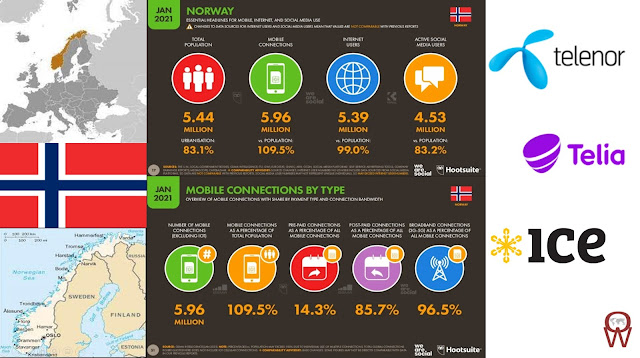
Data from GSMA Intelligence indicates that there were 6.07 million cellular mobile connections in Norway at the end of 2025. For context, many individuals use more than one mobile connection, so it is common for the total number of connections to exceed the total population. For instance, a person may have one mobile connection for personal use and another for work. The growing availability of eSIM technology has made it even easier to manage multiple connections in recent years.

GSMA Intelligence’s figures show that mobile connections in Norway were equal to 108 percent of the total population in October 2025. Looking at changes over time, the number of mobile connections in Norway declined by 35 thousand, or 0.6 percent, between the end of 2024 and the end of 2025.

At the same time, GSMA Intelligence reports that 99.1 percent of mobile connections in Norway can now be classified as broadband, meaning they connect through 3G, 4G, or 5G mobile networks. However, devices that are capable of connecting to broadband mobile networks do not always use cellular data. Some subscription plans may only provide access to voice and SMS services, so this broadband figure should not be interpreted as a direct measure of mobile internet usage.

Norway’s mobile market is characterised by a relatively concentrated structure, with three mobile network operators and a range of mobile virtual network operators that rely on wholesale access to the main networks. The three companies that operate mobile network infrastructure in Norway are TelenorTelia Norway, and Ice. These operators account for the vast majority of mobile subscriptions in the country and provide the underlying infrastructure that supports a number of smaller service providers.

Historically, Norway’s mobile market has been dominated by two large operators. Telenor has long been the market leader, while Telia has served as the primary challenger since entering the market through its predecessor NetCom. Over the past decade, Ice has emerged as a third infrastructure operator following significant investment in network deployment.

The presence of three network operators has strengthened competition in the Norwegian mobile sector, although the market remains relatively concentrated compared with larger European markets.


Telenor continues to hold the largest share of mobile subscriptions in Norway. The company operates extensive nationwide infrastructure and has historically maintained strong coverage across both urban and rural areas.

Telenor Norway reports 111k FWA subs in Dec 2025, a number that is the same as in the beginning of 2022 (or 15k down from peak). The total number of fixed broadband subs (incl. FWA) is in decline as a growth in fibre subs can't compensate for losses in cable and FWA. FWA now 16% of total base.

[image or embed]

— Tefficient🚥 (@tefficient.bsky.social) 6 February 2026 at 08:14

Telenor also emerges as the dominant force in Norway’s mobile landscape, retaining its Best Network title and standing out as the most-awarded operator in Opensignal’s November 2025 report. From the awards grid, Telenor secures six outright wins and five joint wins, leading in 11 out of 15 measured categories. Telia follows with two outright and six joint wins, while ice collects five joint wins, according to real-world experience data recorded by users.

Telia Norway represents the second largest operator and competes directly with Telenor across most segments of the market. The operator has invested heavily in network upgrades in recent years and has expanded its 5G footprint across the country.

Following on several trials, Telia is first to launch 5G SA commercially in Norway. Telia now offers 5G SA as 'Avansert 5G' to B2B customers across its 5G network nationwide. kommunikasjon.ntb.no/pressemeldin...

[image or embed]

— Tefficient🚥 (@tefficient.bsky.social) 13 February 2026 at 06:18

Ice, the third network operator, has focused on building its own infrastructure while also relying on national roaming agreements to extend coverage beyond its network footprint. The company has positioned itself as a challenger operator with a focus on competitive pricing and data centric mobile plans.

Breaking: Lyse Tele (ice Norge) and Telia Norway to share mobile network across Norway, a first for the country. news.cision.com/telia-compan...

[image or embed]

— Tefficient🚥 (@tefficient.bsky.social) 2 February 2026 at 18:06

Norway has consistently ranked among the leading European markets in terms of mobile network performance and coverage. Independent benchmarking conducted by Rohde & Schwarz has placed Norwegian operators among the strongest performers globally, reflecting sustained investment in network infrastructure despite the country’s challenging geography and dispersed population. In recent testing covering more than 7,000 kilometres and over half of the population.

Which country - Norway, Denmark, Finland, Sweden - has the highest mobile and fixed broadband ARPU? What value for money do customers get? The Norwegian government's @dfd.regjeringen.no made this Tefficient analysis public. www.regjeringen.no/no/dokumente...

[image or embed]

— Tefficient🚥 (@tefficient.bsky.social) 8 March 2026 at 09:19

The country’s operators have invested heavily in 4G and more recently 5G infrastructure. For example, Telia reported that its 5G network now reaches close to 99 percent of Norway’s population following several years of nationwide deployment, highlighting the rapid pace of next generation network rollout in the market.

Recent industry developments include plans by Telia and Lyse, the parent company of Ice, to combine parts of their mobile radio access networks in Norway through a jointly owned entity. The companies expect the arrangement to reduce infrastructure costs and improve coverage while continuing to operate as separate retail competitors with independent core networks.

Norway’s mobile market is likely to remain relatively stable in terms of structure. The presence of three infrastructure operators, combined with a range of virtual operators, provides a balance between network investment and retail competition.

Future developments in the sector will likely be shaped by continued 5G deployment, infrastructure sharing arrangements, and the evolving role of wholesale access in supporting smaller mobile brands.

Related Posts

Thursday, 12 February 2026

How Telenor Keeps Svalbard Connected at the Edge of the World

Svalbard is a Norwegian archipelago in the Arctic Ocean, situated halfway between mainland Norway and the North Pole, and is known for its dramatic glaciers, rugged terrain, and a population of polar bears that outnumbers humans. Despite being about as remote as it gets for a functioning community, Svalbard is a premier destination for Arctic adventures such as dog sledding, northern lights viewing, and polar exploration, with Longyearbyen serving as the main settlement and hub alongside communities like Ny Ålesund and Barentsburg. Remarkably, even in these tiny settlements and extreme polar conditions, residents and visitors can make voice calls, send texts, and stream photos, showcasing how modern connectivity thrives in one of the most isolated places on Earth.

The unique telecom landscape of Svalbard is shaped by its governance under the Svalbard Treaty and is part of the Kingdom of Norway. It uses the Norwegian country code (+47) and integrates into Norway’s telecom framework, but due to geography and policy, its connectivity looks very different from the mainland. Svalbard’s remote Arctic setting brings harsh weather and vast areas with no coverage outside major settlements, yet it remains connected to the global internet through the Svalbard Undersea Cable System, a twin submarine fiber link to northern Norway that provides essential bandwidth for both mobile and fixed telecommunications. In its early years, satellite links were vital for communication, but today fiber infrastructure has become the backbone, enabling more stable and higher capacity connectivity.

In Svalbard, Telenor Norge is the dominant mobile network operator and, in practice, the only company physically deploying cellular infrastructure across the archipelago. Telenor has a long and historic presence in Svalbard dating back to the early 1900s, when it provided some of the first telephone and radio services, and today it operates the region’s cellular networks, evolving from GSM to 3G and 4G LTE while also testing 5G for mission critical and emergency use in the uniquely challenging Arctic environment. Early GSM 2G coverage enabled basic voice calls and SMS, followed by the introduction of 3G services in Longyearbyen in the early 2000s, which brought mobile data for the first time. Today, 4G LTE is standard in populated areas such as Longyearbyen, Barentsburg, and Ny Ålesund, making Svalbard home to one of the northernmost LTE networks in the world, and as of 2025, 5G trials are underway for specialized use cases. As a result, residents, researchers, and tourists can access relatively modern mobile data, but only within the limited network footprint of town centres and nearby settlements.

In practice, mobile coverage in Svalbard is concentrated around a few key settlements and drops off quickly beyond them. Longyearbyen has the most comprehensive service, with strong 4G LTE coverage throughout the town and nearby areas, supporting calls, data, navigation, messaging, weather checks, emergencies, local transport, and tourism services. Ny Ålesund historically lacked regular mobile coverage due to strict restrictions on radio frequencies around research facilities, but Telenor has since installed a tailored mobile network there, making it the northernmost operational mobile station in the world. Barentsburg is also served by the network, although coverage is generally more limited than in Longyearbyen. Outside these towns there is no mobile service at all, and once you head into the wilderness for activities such as hiking or fieldwork, you are completely offline, which is why satellite communications like Iridium devices remain essential for polar expeditions and remote research.

Other operators can technically work in Svalbard, but almost always through Telenor’s infrastructure. Official licensing records show that a few Norwegian operators, including ICE and Telia Norge, hold mobile spectrum assignments for Svalbard, yet in practice Telenor is the only operator running live cellular infrastructure in the archipelago. Many smaller or virtual operators simply roam on Telenor’s network when in Svalbard, and real world reports from locals and travellers indicate that providers such as ICE rely on Telenor’s base stations because there is no alternative network in town. Telia and others may have spectrum rights on paper, but they do not operate separate physical networks in Svalbard. For visitors using Norwegian or international SIM cards, roaming agreements and coverage can vary, but when a phone does connect, it is effectively using Telenor’s network in these Arctic settlements.

Looking into the future, as Arctic activity continues to grow from tourism to scientific research, Norway is pushing the boundaries of mobile technology in some of the harshest polar conditions on Earth. Ongoing 5G trials aimed at supporting mission critical services such as coordinated rescue operations highlight how Svalbard remains a frontier for telecom innovation. Whether you are planning a journey north or are simply fascinated by communications in extreme environments, Svalbard’s mobile landscape shows that even near the roof of the Earth, staying connected is possible with the right network and careful preparation. 

Wednesday, 23 February 2022

Norway is a Global Leader in Opensignal Global Awards 2022


Much like other Scandinavian countries, Norway has a sophisticated telecom market with high broadband and mobile penetration rates and a highly developed digital media sector. Although not a member of the European Union, the country’s telecoms sector is synchronised with relevant EC legislation. Telenor is the dominant operator in all sectors, though there is increasing competition from new entrants. Telia Norway increased its market share by acquiring the operations of Tele2, Phonero and Get.

Norway enjoys near comprehensive LTE coverage, while both Telenor and Telia are looking to close their 3G and 2G networks (by 2020 and 2025 respectively), focussing instead on LTE and 5G technologies. The mobile broadband sector was bolstered by the auction of spectrum in the 700MHz and 21MHz band in June 2019. Additional spectrum in the 700MHz is expected to be auctioned for mobile broadband use (5G) in 2021.

The broadband penetration rate is among the highest in Europe, while in recent years subscribers have been migrated to faster broadband solutions over fibre networks, VDSL and upgraded cable infrastructure. The leading ISPs Telenor and NextGenTel have also deployed services based on G.fast technology.

The regulator has called on the government to help fund additional cable infrastructure to reduce the country’s dependence on Telenor’s networks. In late 2019 the government proposed making broadband of at least 20Mb/s a universal service.

Norway currently has three mobile networks: Telenor, Telia (formerly NetCom), now merged with Tele2 (by Network Norway) after being acquired by Telia and ice.net (4G/LTE and 5G, no prepaid).

Many public places and public transport are covered by WiFi. For instance, the shuttle bus from Oslo airport to the city centre has free WiFi. Norwegian airline provides free WiFi, many ferries and metro trains as well. So you might not need mobile internet when entering the country.

Populated areas have very good mobile network coverage, even at some remote mountains areas or fjords. The Svalbard archipelago (including its main island Spitsbergen) is covered by all Norwegian providers as well.

The Norwegian providers have shut down their 3G networks in Norway in 2020/21 and plan to re-used the spectrum for their 4G/LTE and 5G networks. From 2021 Norway is on 2G, 4G/LTE and 5G only.

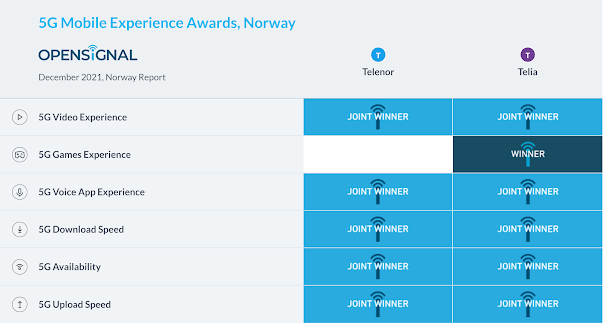
According to the December 2021 OpenSignal report the Norwegian mobile network experience landscape characterized by extreme competition. Out of six awards for the taking, five award categories resulted in a tie between Telenor and Telia, with the remaining one — 5G Games Experience — being the only category featuring an outright winner, Telia. They included the two national operators that had launched 5G commercially before the data collection period — Telenor and Telia — as ICE launched its 5G commercial network afterwards, in November 2021.

Telenor is market leader in Norway with more than 50% of the national users on its network. It has a good coverage and speeds throughout the country: Telenor Coverage map. 4G/LTE is available for prepaid. Starting in 2019 Telenor will gradually shut down their 3G network to be switched off by 2021. For data you need a 4G device now on B3 (1800 MHz), B7 (2600 MHz) or B20 (800 MHz).

Telenor Norway and Ericsson have entered into a joint innovation cooperation to create new 5G-powered opportunities in areas such as entertainment, autonomous transport, smart factories and remote healthcare. According to Ingeborg Øfsthus, CTO of Telenor Norway:

“5G is more than a new network, it is a bridge into the future. 5G will have a strong positive impact on society. Through our innovation collaboration we will pave the way for both services critical for society and commercial services that will drive the digitalization of Norway. Telenor has speeded up our building of the future 5G network in Norway. The full modernization of the mobile network in Norway is an ambitious undertaking, and the new technology will give Norwegians access to products and services that have never before been available. With 5G we get fiber optic speed over the mobile network.” 

Telenor Norwary’s 5G network was commercially launched on 13 March 2020. The 5G service was initially launched in Oslo, Bergen, Stavanger and Sandnes.

Telia Norge, formerly called NetCom is Norway's runner up, owned by Swedish Telia Group. After the merger with Tele2, their coverage has surpassed even Telenor's according to latest network tests in 2021 but Telenor won the latest speed tests.

Telia Norge has confirmed that its 3G network has now been fully shut down – in line with plans announced back in 2018. With the operator having initially switched off its UMTS infrastructure in the Trondelag region and further south, it had retained 3G connectivity in more rural and remote regions to the north. Now, however, in a press release confirming the complete closure of its 3G network, the MNO noted that, having switched off its final 2100MHz 3G base station in June 2021, its last 900MHz 3G base station was confirmed as having been switched off November 2021. 

Telia recently passed the milestone of 1000 5G sites in Norway as Ericsson continues to support the communications service provider in achieving nationwide 5G coverage by 2023.

The strategic partnership, which has already seen successful trials demonstrate the game-changing capabilities of 5G carrier aggregation, enables Telia Norway to be at the forefront of 5G and continue to set the bar high. The next goal is to add to the 1.5 million Norwegians who already have access to 5G and provide half of the country’s population with 5G coverage this year.

Multiple cities and municipalities around Norway have gained access to Telia’s 5G network since May 2020, when the Norwegian service provider’s first 5G network opened in Lillestrøm. Telia Norway’s subscribers with access to the network will be able to reap the benefits of higher speeds, increased capacity, and better coverage as eastern Norway becomes the next planned recipient of Ericsson and Telia’s 5G ambitions.

Ice Group, is the third mobile operator in Norway, said it has captured a 10% share of the mobile market after five years of operation and is targeting a 20% market share in the medium term with the aim of reaching 25% in the long term.

Ice, which gained 4G spectrum in 2013 and acquired Network Norway from Telia in 2015, has been on a mission to break the longstanding duopoly of Telenor and Telia.

Ice had more success in Norway's first 5G auction in 2019, gaining 2x10MHz of 700MHz frequencies and 2x15MHz of 2.1GHz spectrum, spending NOK337 million ($38 million) in total. In May 2020, it then spent NOK1.58 million ($178,905) on new frequencies in the low 10GHz and 38GHz bands.

Ice has decided to accelerate its 5G rollout with the aim of reaching 75% population coverage, although without specifying a timeline. The operator currently has a national roaming agreement with Telia, and is also building their own mobile network. They have added 62 new smartphone base stations, bringing the total to 3,133. Ice has added 246 new smartphone base stations in 2021 to date, with a goal of between 300 and 500 for the year as a whole.

Thursday, 10 February 2022

Nordics are Winning the Mobile Networks Experience Race

As an outsider, it is always confusing as to which countries are Nordic and which are Scandinavian. Tripsavvy nicely explains this as: In short, Iceland, Norway, Sweden, Finland, and Denmark are all Nordic countries with Scandinavian roots, but typically, you will only find Danish, Norwegian, and Swedish people referring to themselves as Scandinavian. In the mobile industry though, Iceland doesn't seem to be included in Nordic countries while reporting speeds, etc. 

Opensignal recently announced "Global Mobile Network Experience Awards 2022". As can be seen in the chart in the Tweet below, quite a few entries from the Nordic operators.

Back in January, Tefficient nicely showed how the four Nordic countries compare over population and 5G population coverage with Venn diagrams.

There is definitely a lot of work that still needs to be done but it's interesting to see how Nordics are punching well above their weight.

Related Posts:

Wednesday, 29 September 2021

Telenor Norway says 5G is the Key Enabler for Modernization going forward

In the recently concluded 5G World Summit 2021, Ingeborg Øfsthus, CTO of Telenor Norway provided a Holographic Service Provider Keynote on "Innovate, modernize and decommission, - moving Norway from legacy technology to high speed broadband with 5G, FWA and fiber"

Her talk was full of interesting facts about Norway and Norwegians. As a matter of comparison, UK for example is 3/4th the size of Norway while the population is roughly 12 times. This does not mean that the people out there expect anything less than the best from their operators. 

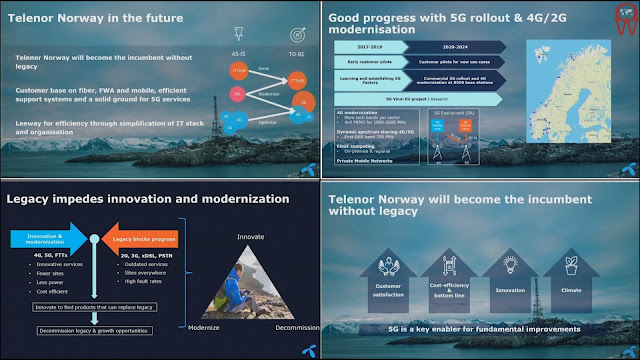
This is a reason that Telenor has embarked on a journey to modernize their network (fixed and mobile) and phase out the legacy. There is an ongoing program to get rid of the copper network that has served the country well for over 160 years.

Users in urban and sub-urban areas can get fiber to their premises, be it home or business. The mobile network is being upgraded to 5G with 3G being shut down end of 2021. A small chunk of 2G will remain for fallback, roaming and IoT purpose. This whole modernization should be completed by 2024.

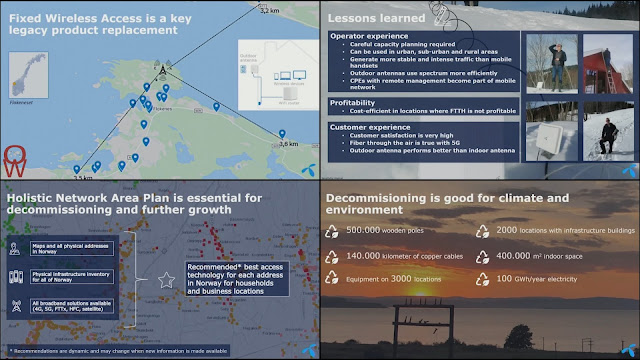
While Fiber will be available for most of the users, some rural and hard to reach areas may have to rely on Fixed Wireless Access. To ensure that good speeds are available to FWA as well as mobile users, granular planning is done to decide what kind of internet service would be offered in each area. In case of some very remote locations, Satellite broadband is provided as well.

As can be see in the picture above, Telenor has managed to stretch the C-band FWA as far as 3.6 kilometers. This of course requires line of sight outdoor antennas that have to be planned and installed by professional RF engineers. 

Telenor considers all of these equipment to be part of the network so as to ensure a fantastic quality of experience to the end users. FWA is treated as fiber through the air by the end users. 

As the old copper network is decommissioned, it is allowing a lot of power to be saved and indoor space to be reclaimed. Some of these old infrastructure is also a threat to wildlife as it's old and can fall down. 

The main challenge is also to retain the customers while doing this transition from legacy to modern infrastructure. Telenor aims to retain at least 60% of the existing customers and 70% of the revenue. The approach using fiber and FWA is profitable and the best approach going forward. 

Related Posts

Wednesday, 12 June 2019

Ice - bringing 5G to Norway


Norway has a population of 5.4 million with a mobile market dominated by Telenor Mobil and Telia, the only two operators with national coverage. Telia Norway has 2.3 million mobile subscriptions, while Telenor roughly 3.1 million mobile subscriptions.Both Telenor and Telia have outstanding 4G availability across the rest of the country, and as a result, Norway had the highest percentage of 4G use of any of the Scandinavian countries.

Ice is the third network upsetting this duoply, a much recent entrant, having only started commercial sales in 2015. They had 422 thousand smartphone subscribers as of 30 June 2018 and operate their own 4G network in some regions of the country, most notably major cities such as Oslo and Bergen, and claim to cover around 80% of the population with their own infrastructure. 

Norway has completed an auction of mobile spectrum in the 700 MHz and 2.1 GHz bands. The smallest operator Ice was the biggest spender, acquiring frequencies in both bands, and Telenor and Telia also bought licences for the 700 MHz band. In total, the auction raised NOK 735 million (€75 million / $85 million).

Ice acquired the 2x15 MHz offered in the 2.1 GHz band for the minimum price of NOK 75 million (€7.7 million / $8.7 million) as well as 2x10 MHz in the 700 MHz band for NOK 262 million (€26.8 million / $30.4 million). The operator is still building out its mobile network in Norway and noted that the new frequencies are a "bonus" not included in its original plan. As a result of the opportunities with the 700 MHz band, it will be able to reach the target of 95 percent population with fewer base stations, reducing capex in 2019 and 2020 compared to previous estimates. 

Telia spent NOK 217.9 million (
€22.3 million / $25.2 million) on 2x10 MHz in the 700 MHz band, and Telenor acquired the other 2x10 MHz in the 700 MHz band for NOK 180 million (€18.4 million / $20.9 million).

The 700 MHz spectrum will be available from 01 November 2019 and is expected to be a key component of 5G network roll-outs as well as boosting 4G capacity. The operators will be required to cover 40 percent of the population within five years with speeds of a minimum 5 Mbps with the new frequencies. 


Ice is is now building a 5G-ready network inn urban areas across Norway based on Nokia AirScale Radio Access technology, with approximately 1000 5G-ready base stations already deployed.
“With ice, Norway is at the forefront of the development of 5G network and services. ice is building a brand new 5G-ready mobile network with Nokia, one of the world’s leading suppliers of mobile technology. We continue to invest in and expand our national 4G network, even as we prepare for the next generation of mobile networks. We will always ensure Norway gets top quality services, and we look forward to exploring the new services we can introduce with 5G technology.” 
says Eivind Helgaker, CEO of ice Group.

And until 5G can be deployed in Norway, Ice subscribers will still benefit from optimized 4G performance, coverage and capacity due to the technology upgrade. Under the same agreement, Nokia will also further expand ice’s current 4G network towards nationwide coverage.

Ice has also started to modernize its core network, moving to Nokia’s 5G-ready Airframe cloud-native core technology. Virtualizing the core network infrastructure will enable ice to develop new services faster than currently possible. The cloud-native core network will also prepare ice to support future 5G-based service deployments.

“5G is not just approaching fast – it is here already. With the deployment of Nokia 5G-ready RAN and Cloud Core technology, ice is making a big step towards 5G and, together, we are ready to unleash its power. As a long-standing partner and network supplier of ice we have a deep understanding of the network and a long track record of successful projects. We look forward to continuing to support Ice on their journey.” 
says Pekka Sundstrom, CBT Head at Nokia.

Ice have already delivered the highest levels of Consistent Quality in testing across all operators in the Nordics, delivering a high quality cellular connection capable of delivering HD video calls more than 90% of the time.

For users outside of ICE’s own coverage, the network has a roaming agreement with Telia. According to Tutela’s data, ICE subscribers are on Telia’s network around 1/3rd of the time.

When roaming on Telia’s network, Ice users do benefit from Telia’s superior coverage, although data speeds appear to be a little slower for Ice users compared to Telia users. Ice users see download speeds 17% slower than Telia users in the same areas, although the speeds are still far in excess of the consistent quality threshold.


Ice, also has the least geographic coverage of any operator in Norway, but scores the best for consistent quality at 90.5% -- which is also the highest score for any operator in Scandinavia. The industry-leading consistent quality may be explained by Ice mostly building out its network in urban areas; in rural areas, where consistent quality is typically lower, customers instead roam onto Telia’s network.


Further Reading:

Friday, 7 June 2019

Telia 5G Strategy and Services


Telia is without doubt the leading European operator on 5G. They have partnered with Nokia among others for the introduction of 5G in Scandinavian countries like Finland and Sweden.

Telia' s 5G network which operates on test frequencies issued by the Finnish Communications Regulatory Authority was launched on September 2018. However 5G growth is of course dependent on availability of standard-compliant 5G devices, like modems, tablets and mobile phones by terminal manufacturers.    


Here we are looking at some of Telia's innovative and exciting collaborations, bringing 5G technology to the daily lives of people in Scandinavia.


One such initiative is the autonomous robot that will help carry out service tasks at Helsinki Airport after being connected to Telia Company's third 5G network in Finland. The robot, yet to be named, will oversee airport operations and also study the flow of passengers through the T2 terminal.

Telia and airport operator Finavia, which is Telia's first 5G customer, will research how staff and passengers react to the robot through real-time video feeds.  The robot will be connected to a Nokia 5G base station operating in the 28GHz band. This will be the first time in Finland that millimetre waves have been used publicly and Finavia is Telia's first 5G customer.

Telia Finland 5G Program Director Janne Koistinen said:
 "5G will start with enterprise customers, especially for industrial automation and remote control. The low-latency connection and massive capacity of 5G will serve the airport well with its masses of passengers and data, and with the focus on security and fluency of services."
Wile Heikki Koski, Chief Digital Officer, Finavia, said: 
"The robot can deliver real-time video stream from the terminal and enable for example monitoring the terminal area through remote or autonomous control and see that everything is running as it should. The robot can also guide passengers in the terminal, and we aim to try different use cases during the project."

Another project has been this driverless electric truck which has began daily freight deliveries on a public road in Sweden on May 15 2019, in what developer Einride and logistics customer DB Schenker described as a world first.

Einride's T-Pod is 26 tonnes when full and does not have a driver cabin, which it estimates reduces road freight operating costs by around 60% versus a diesel truck with a driver.

Besides Schenker, Einride has orders from German grocer Lidl, Swedish delivery company Svenska Retursystem and five Fortune 500 retail companies, underpinning its ambition to have 200 vehicles in operation by the end of 2020. Freight operators are under pressure to reduce delivery times, cut emissions and face a growing shortage of drivers.

The T-Pod has permission to make short trips – between a warehouse and a terminal – on a public road in an industrial area in Jonkoping, central Sweden, at up to 5 km/hr, documents from the transport authority show.

Robert Falck, the CEO of Swedish startup Einride, said the company was in partnership talks with major suppliers to help scale production and deliver orders, and the firm did not rule out future tie-ups with large truckmakers. Falck said Einride would apply next year for more public route permits and was planning to expand in the United States.

The T-Pod is level 4 autonomous, the second highest category, and uses a Nvidia Drive platform to process visual data in real time. An operator, sitting miles away, can supervise and control up to 10 vehicles at once.

However they are constrained by the rollout of 5G technology, vital for electrification, this was lagging. For Schenker's pilot with Einride, Ericsson and Telia had to construct two new towers.


Nokia’s 5G networking equipment is also involved with Telia in the development of self-driving vehicles. Nokia has been working for some time on LTE based car communications and is a member of the 5G Automotive Association (5GAA), a strong proponent of 3GPP’s cellular-based technology called “cellular vehicle to everything” (C-V2X). This will enable the wide variety of communications that will be needed for the autonomous cars to run freely in our cities.

Nokia is busy not only with the creation of phones but also new 5G radios and software but with some other quite useful technologies.  Nokia has been testing together with Telia, and a company Sensible 4, a self-driving vehicle called Juto. Finnish people will know know that Juto is a word for a reindeer who always finds its way to home despite the weather condition. That word is an appropriate name for the self-driving vehicle that uses the 5G network to communicate with Nokia command center in real time.Nokia is doing tests with Juto on the streets of Espoo, and may expand to other cities in Finland. 


Telia has also partnered with Odeon in the development of the 5G cinema: so that big and little screens can share the same streaming technology.  Odeon is now operating the world’s first 5G movie theater, displaying films that have been transferred over a live 5G network.

As Odeon told ZDNet, the theater has found that livestreaming of theatrical films “works excellently” over 5G, though Odeon is largely using 5G to transfer the films to its own servers for repeated playback.


The distinction is critically important as it demonstrates that responsive, high-bandwidth 5G wireless could be a viable alternative to local storage, even in commercial settings where buffering or audiovisual degradation would be problems for hundreds of viewers at once. While 4G LTE networks may struggle to maintain fluid 720p video streams, theatrical films typically run at 4K or greater resolutions with far less compression.

Livestreaming 4K or higher-quality video at respectable frame rates is incredibly bandwidth-intensive, but Telia’s 5G network is up to the task. In its Odeon tests, Telia is achieving 2.2Gbps speeds, between 5 and 20 times the bandwidth of typical consumer 4G networks, and faster than the theater’s wired internet lines. That’s enough to let the cinema’s 5G hardware address its own downloading needs, as well as offering guest Wi-Fi access inside the building.


There are also positive implications for the speed of video distribution. In the past, theaters received physical reels of film that needed to be manually loaded into projectors for viewing, then rewound for subsequent playback, a process that was more recently replaced by less time- and space-consuming digital film distribution. With 5G, distribution can be instantaneous: Telia’s and Odeon’s observed 7-8 millisecond network response times are around one-fifth of 4G’s latency, which could allow theatergoers to participate in real time with live concerts or other events broadcast from remote locations.


Telia's 5G test network in Oslo has also made it possible to explore opportunities for individuals and families as well. At the home of a family of five, Telia and Get have set up what might be Norway's most modern home. The house has been filled with smart solutions from Futurehome, for example, accessing the latest entertainment from Get - all connected to the network through the 5G pilot.


“The family gets an easier, safer and more enjoyable everyday life. We like to call it everyday magic," says Torbjørn Aamodt, Product Director at Get and future head of Telia Consumer Home. 
"This family is far ahead of the rest of us, with a home filled with clever things connected through 5G. It is something the rest of us will not experience for several years, but it's really fun to see what we will get with the latest technology.”
Moreover, industrial applications of 5G will be one of the most important drivers for development and commercialization. One of the industries that will benefit greatly from the new technology is the construction industry. Telia cooperates with AF Group Bispevika, which will be one of the first to test 5G on one of its housing development projects. ¨

Telia Norway will contribute with mobile technology to help realize the ambitions of a site filled with sensors, phones, robots, artificial intelligence and expanded reality (AR)

According to Lars Petter Fritzsønn, Project Director of AF Byggfornyelse:

"The AF Group project in Bispevika is a lighthouse project and we are pleased to be among the first to use 5G. Today, efficient work processes at such a construction site are challenging, if the infrastructure is not yet available.”​
We look forward to following the progress of all these groundbreaking projects. What other Telia projects have you heard of? 

Thursday, 18 April 2019

Telia: Largest Operator in Nordic & Baltic Region


Telia Company has been around for a while. The following is from about the company page:

KEY FACTS AND FIGURES

  • Founded in 1853
  • The share is listed at Nasdaq Stockholm and Nasdaq Helsinki
  • Approximately 483,000 shareholders
  • From Norway to Turkey, we are present in, Denmark, Estonia, Finland, Latvia, Lithuania, Moldova, Norway, Sweden, Turkey.
  • 24.0 million subscriptions
  • 20,400 employees


Like every other operator, Telia did a lot of tests and pilots on 5G last year. Here are a few notable announcements:


12 Apr 2018: Telia, Nokia and Intel bring 5G to the factory floor
12 Sep 2018: Telia Company and Stora Enso bring 5G and AR to the forest industry. The solutions were tested at Stora Enso’s Oulu mill in Finland where real-time information is being used in mill maintenance.
24 Sep 2019Estonia’s first 5G network to go live. Telia Company, Ericsson and Tallinn University of Technology, TalTech, have joined forces to launch Estonia’s first 5G pilot network at the university campus by year-end.
20 Nov 2018Telia opens 5G network in Finnish city of Oulu. A world-class industrial 5G ecosystem will be built in the Nuottasaari industrial area in Oulu, Finland, and with Telia launching a pre-commercial 5G network in the city
03 Dec 2018: Telia and Finavia bring 5G robot to Helsinki airport. Helsinki Airport becomes the first 5G airport in the world as Telia launches a 5G network and together with Finnish airport operator Finavia introduces a 5G-powered robot project.
18 Dec 2018Telia Norway opened its first 5G test network in Norway, marking the beginning of next generation’s mobile networks in the country. First up to try it out is the Odeon movie theatre in Oslo, which is now the world's first 5G cinema.

Here is a video of 5G launch in Oslo, Norway


Here are Telia 5G 2019 objectives


Looks like Telia is just getting started with 5G with a lot more things in the pipeline.