Last year, India became the most populous country in the world. India's population stood at slightly over 1.428 billion, edging past China's population of 1.425 billion people. India and China's combined population is one third that of the whole world. As a result it won't come as a surprise that the operators with most data consumption in their networks are the ones from India and China.
At the end of Q1 2024, Reliance Jio was the operator with largest mobile data traffic flow through its network. China Mobile was just behind.
Here's an interesting stat too: The monthly usage per AirFibre (FWA) subscription is 390 GB, 30% *higher* than for a JioFiber subscription. https://t.co/MGamLJE6xm
As Tefficient reported, Jio says that 5G's share of traffic is 28%, the rest being 4G as it doesn't have 2G/3G network. Another interesting stat was that the monthly usage per AirFibre (FWA) subscription was 390 GB, 30% higher than for a JioFiber subscription.
You can do a comparison with Q4 2022 numbers available here.
Finland’s telecommunications market is among the more progressive in Europe, with operators having been at the forefront in deploying technologies and with the regulator being among the first to auction spectrum for 5G use. These efforts have been supported by the government which is working towards its target of providing a broadband service of at least 100Mb/s by 2025. 5G services were available to more than 40% of the population by early 2021, and take-up among subscribers has been strong although most will remain with LTE in the short term.
The country enjoys one of the highest broadband and mobile penetration rates in the region, with customers able to make use of the latest iterations of technologies including DOCSIS3.1, LTE-A, 5G, and GPON fibre infrastructure.
Just as Finland was in the forefront of LTE developments in Europe, so has it emerged as one of the pioneers in 5G. The auction of spectrum in the 700MHz and 3.5GHh bands has enabled network operators to extend the availability of LTE services nationally and to prepare for 5G services. Spectrum in the 2.5GHz band was auctioned in mid-2020 and has since enabled the MNOs to widen their 5G footprint considerably.
Finland has three national network operators: Telia (by the Telia Group, formerly called Sonera), Elisa (prepaid packages under Saunalahti brand) and DNA (by DNA Oyj, part of Telenor Group)
2G is on 900 and 1800 MHz, 3G on 900 and 2100 MHz, 4G/LTE on 700 (B28), 800 (B20), 1800 (B3) and 2600 (B7) MHz. In the less populated northern and eastern parts of the country Telia and DNA share one common network called Yhteisverkko covering more than “half of Finland’s total geographical area" and serving more than "15% of the population". In 2020 all three networks started 5G NR on 3500 MHz (n78) mostly in the cities and is so far only offered on some 5G plans of Telia and Elisa on prepaid.
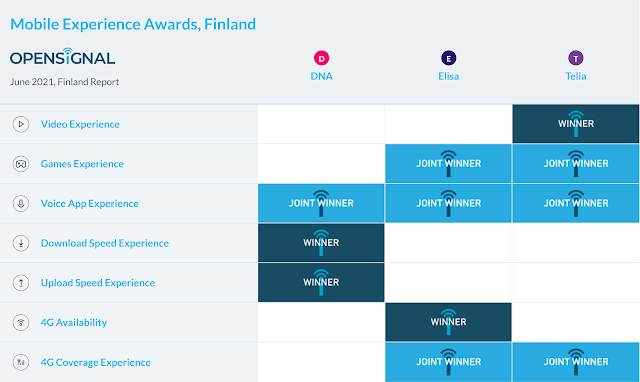
All three operators have a very good coverage and high speed at low prices even in remote and rural areas. Because of the heavy data usage in Finland, 5G becomes very important. According to OpenSignal in 2021, 5G was available to about 11% of Finns and had an average download speed of 200 Mbit/s. In 4G availability all three networks are close at around 93% and download speeds of 37 Mbit/s. DNA featured as the fastest mobile network for both average download and upload speeds, while sharing the victory in Voice App Experience. Elisa solely won 4G Availability, while sharing Games Experience, Voice App Experience and 4G Coverage Experience. Telia solely won Video Experience, while sharing the victory in Games Experience, Voice App Experience and 4G Coverage Experience.
All three national mobile operators in Finland are busy deploying their 5G networks in the country, as they all secured the same amount of spectrum in the recent 700 MHz, 3.5 GHz and 26 GHz 5G spectrum auctions.
Finland consumed 37% of all mobile data in the Nordics & Baltics in 2020 https://t.co/XGxwIDChmu
Telia, rebranded from Sonera in 2017, has the most customers in Finland and its coverage on 3G and 4G is equal to Elisa. In 2018 4G/LTE reached 98% of population. Telia has opened its 5G network to some prepaid plans in 2022.
In November 2021, Telia claimed to have launched the Nordic and Baltic regions’ first commercial Standalone 5G core network in partnership with Nokia.
Nokia noted that the rollout included its cloud packet core and registers, which allow subscriber data to be consolidated into a common repository using a distributed and flexible architecture. Telia Finland is also reportedly using Nokia’s RAN. This network was initially launched in 20 geographical areas across Finland with more rollout in future that will lower latency and include network slicing capabilities.
Elisa Saunalahti is Elisa's consumer sub-brand, which has very good coverage and speed in Finland. For 3G it mostly uses the 900 MHz band (in contrast to 2100 MHz in the rest of Europe), but it is still supported by almost all modern devices. In 2017 B28 on 700 MHz was added for LTE in rural areas. 5G was opened in 2022 for some prepaid plans.
In January 2022 Elisa has confirmed that it has doubled its 5G footprint in the twelve months since January 2021, and now covers four million Finns with its fifth-generation infrastructure. As such, 5G connectivity is now available in a total of 153 locations – equivalent to more than 70% of the population.
In a separate announcement, Elisa has highlighted the level of 5G adoption within its user base. Ville Valkama, Elisa’s Business Director for Consumer Customers, revealed: ‘In 2021 5G phones became commonplace in Finland. The share of 5G models in the phones we sell is already approaching 90%.’
DNA is the 3rd operator in Finland, yet it offers comparable coverage and very high speeds at good rates: coverage map. In 2019 the majority of DNA shares were sold to Telenor from Norway. Unlike Telia and Elisa, 5G is not yet offered by DNA for prepaid, only for subscriptions.
DNA has announced that all of its 5G base transceiver stations (BTS) are now connected to a core network that supports Standalone (SA) 5G architecture. Kimmo Liikonen, DNA’s Director of Core and IP Networks, commented: ‘For our customers, the implementation will take place in stages during 2022, as long as the last quality assurance and design work has been done. We are also looking forward to the sale of terminals that fully support the Standalone 5G network, which are not yet widely available.’
In August 2021, DNA announced that it was planning to shut down 3G by the end of 2023 freeing up spectrum for 4G and 5G network connections. Also, in December 2021, Finnish Transport and Communications Agency Traficom announced an invitation to submit bids for three spectrum licenses for 700 MHz frequency bands which will be technology-neutral. Although 3G shutdown and technology-neutral spectrum auctions are not directly related to 5G, they are certainly positive steps towards releasing valuable spectrum for 5G deployment.
Telecoms tech developers from Japan and Finland are planning to work collaboratively on the development of 6G technologies, an area becoming increasingly influenced by Chinese companies. The Nikkei writes that Nokia will join the effort and that Japan’s ‘Beyond 5G Promotion Consortium’ will sign the agreement soon with Finnish group ‘6G Flagship’. The accord will be formally announced at the Global Digital Summit 2021, an event the paper has organised with Japan’s Ministry of Internal Affairs and Communications (MIC).
Japan’s Beyond 5G Promotion Consortium aims to commercialise sixth-generation communications technology in the 2030s, and includes the University of Tokyo and domestic telcos NTT Corp, NTT DOCOMO, KDDI (au), SoftBank Corp and Rakuten Mobile. 6G Flagship, meanwhile, is led by Finland’s University of Oulu. Talks are also said to be underway to draw in a US counterpart, with the likes of Cisco Systems and Intel touted as possible candidates.
The analyst first Tefficient whose motto is to "Measure, compare and improve competitiveness within telecoms" recently published this chart on their Twitter. It nicely shows that the data usage is growing while the costs are generally getting lower.
Canada has always been an exception and a leader in expensive data plans. It doesn't look like it will change any time soon.
2 million views of this one tweet is a whole lot. A majority from Canada - but sometimes we wish for the countries in the opposite corner of the chart to be as keen to view, share and comment. Operators in that corner might need some ❤️ https://t.co/zOeUPrivS0pic.twitter.com/LshEgtTgCq
For more details see Tefficient’s 31st public analysis of the development and drivers of mobile data that compares 45 countries from all regions of the world. You can also download the detailed analysis in PDF here.
The analysis firm Tefficient, posted this chart in one of their Tweets. As you can see that China Mobile is the leader, followed by Reliance Jio and then China Unicom, China Telecom, Airtel and Vi (Vodafone Idea).
The largest operators in the world when it comes to data traffic: China Mobile in solid lead, Airtel India with fastest y-o-y growth (52%), China Unicom with the slowest (9%) - overtaken by China Telecom (47%). pic.twitter.com/aVDN4FLN6Y
As you can see, Bharti Airtel, India and China Telecom are also enjoying huge traffic growth.
Last year, Tefficient had also reported the absolute number up to 1H 2020. Vodafone Group (excluding vi) is the next highest carrier of the data traffic followed by Telkomsel Indonesia, Telenor group, MTS Russia, AIS Thailand, 3 Group Europe, Zain Group, XL Indonesia, Indosat and 3 Indonesia.
Of course not everyone agrees with all the numbers
If I read the TRAI report correctly Indian operators carried 76,319 PB in 2019. See chart below. If I add the Jio, Airtel & Vodafone Idea volumes shown in your chart I get 76,285 PB. Do the 120 million BSNL subs have zero data usage? Jio's 44,560 PB number is probably wrong. pic.twitter.com/SZmefBxLi9
The Saudi Arabian Communications and Information Technology Commission (CITC) has released the statistics for mobile data & voice calls from Hajj this year. While the majority of activity is centered around Makkah (Mecca), Medina (Madinah) becomes highly active too. To give an idea of why this is important, see this picture below
The city of Makkah is always full of people but during Hajj time, around 4-5 million people gather in a small area. This is the most challenging network deployment because people are always on their smartphones, talking, live streaming, video calling, etc. There is also no end time. This continues generally round the clock.
The use of Information and Communication Technology services (ICT), during this season of Hajj 1440-2019, witnessed a significant rise; the average number of subscribers reached nearly 7.4million per day, the number of voice calls exceeded 309 million hours, and the total data consumption during the entire season exceeded 30.2 thousand terabyte, with a rise of 26% compared to last year, according the statistics issued by CITC about the ICT services consumed in Makkah Almukarramah, Al Madinah Almunawarah and Holy sites throughout Hajj season 1440-2019. Implementation of daily measurements showed that the Internet average download speed is 44.83 Mbps in Makkah Almukarramah with a rise of 69% compared to last year. While in Madinah it reached 48.14 Mbps with a rise of 54% compared to last year, due to availability of advanced infrastructure for communication networks and massive increase of their capacity.
The statistics also included average of daily data consumption per person; the average rate reached (299.12 MB / subscriber) compared to daily global data consumption rate per person (180 MB / subscriber), noting that the most popular applications are (in order): YouTube, Snap Chat, Facebook, WhatsApp, Instagram.
The statistics additionally mentioned that average Internet download speed reached (45.61) in Makkah, achieving an improvement rate of (71.79%) compared to last year. The number of domestic calls reached (22.7 millions) while international calls reached (7.6 millions ) with success rate of 99.06%.
Note that the two pics above are from CITC tweet below.
Grameenphone's annual report had some interesting details about the network footprint expansion, especially the 2G and 3G network. Here are the details:
Bangladesh Mobile Sector At A Glance Bangladesh has made significant progress in growing its economy and improving the lives of its people in the last few years. The country is now working to reach upper-middle-income country status by 2021- the year that marks the 50th anniversary of its independence. It has been able to maintain a sustained economic growth rate of 7.86% in the last fiscal year. Backed by this impressive economic growth, the Telecom sector of the country has made remarkable progress throughout 2018. At the end of 2018, there were 88 million unique mobile subscribers in Bangladesh, making it the fifth largest mobile market in Asia Pacific and ninth largest in the world. With subscribers owning on average 1.8 SIM cards, there were a total of 159 million connections in 2018, representing connection penetration of 94.5%. The Data market has also seen significant growth of around 15% and the total mobile internet connections stood at 87 million. With 45.3% unique mobile internet subscriber, there is still potential for further growth in data services. 2018 was an eventful year for the Telecom Industry in Bangladesh. A lot of initiatives have been taken and implemented by the Government and from the Industry side as well. The Government was very keen to introduce 4G service in Bangladesh and 4G licences were offered in the beginning of 2018. All the Mobile operators launched 4G services in the 1st Quarter of 2018. At the end of the year, the 4G subscriber base reached 5.5 million, with 3G and 2G subscriber base at 61 million and 89 million respectively.
The Government released more spectrum through the auction process in the 900, 1800 and 2100 MHz band and the long expected Technology Neutrality was sold to operators across the spectrum band upon payment of a one-time fee. Mobile Number Portability (MNP) was another agenda of Government that has been implemented in the 4th quarter. The country has sent its own satellite into orbit. A test trial of 5G network was also run in 2018. Grameenphone Grameenphone recorded a healthy growth of its subscriber base and correspondingly of reported usage. The Company acquired 7.4 million new subscribers, an 11.3% YoY growth. Adding 5.9 million internet subscribers to its network, Grameenphone closed the year with 37.1 million internet subscribers, which is 19.0% higher than that of the previous year. 51.0% of our total subscribers are using internet services on the fastest internet network in the country. One of the most important foundations upon which we deliver services to our customers is our network. In 2018, Grameenphone made significant investment in new 4G technology, spectrum acquisition and network capacity building. The Company invested BDT 34.0 billion to rollout more than five thousand 4G LTE sites, to expand 2G and 3G coverage, to effect capacity enhancement, as well as to build higher IT readiness. In total the Company has invested BDT 347.4 billion in Bangladesh since inception. As one of the largest contributors, Grameenphone contributed BDT 84.2 billion to the national exchequer in 2018 which represents about 63.4% of Grameenphone’s total revenue for the year. By the end of 2018, the total contribution to the state by Grameenphone since inception reached BDT 669.5 billion. With continued network modernisation, we reached over 5,000 4G sites at the end of the year, covering 54.6% of our sub-base under 4G. 20% of our daily traffic is now carried over the 4G network. In the quarter we rolled out 429 new 4G, 497 new 3G and 404 new 2G sites. At the end of the year we reached 14,521 2G sites and 14,687 3G sites.
In 2018, we launched our high-speed 4G LTE network. Data consumption has almost doubled since 2017 and 20%+ of our data volume is now being carried on the 4G network. 7 million unique users latched onto 4G LTE, which has an average speed of ~10 Mbps. Grameenphone acquired new spectrum, a 4G licence and Tech neutrality on existing spectra. It was the first to launch 10MHz LTE immediately after licence was awarded by the regulator. By the end of 2018, Grameenphone rolled out ~ 5,009 LTE sites all across the country which has led the rapid growth in data consumption. In 2018, Grameenphone reached the 72 million subscribers milestone, a true testament of the trust the people of Bangladesh have in the Company. Grameenphone was the first operator to launch a 4G network in 2018. This is a result of Grameenphone’s determination to serve its customers in the best possible way, ushering in new avenues for empowering societies by building and strengthening the country’s communication and connectivity with the rest of the world. Despite the fiercely competitive market, Grameenphone continued to contribute to its iconic status in the Bangladesh communications industry. Overall, the year was marked by significant changes in the industry. Among these, Grameenphone closed 2018 with 3.4% year-on-year revenue growth over 2017. Strong drive in all segments of the business recorded consolidated revenue of BDT 132.8 billion for 2018. In the same timeframe, Grameenphone earned a yearly average Daily Subscription & Traffic Revenue of BDT 336.9 million, which is 7.0% up from that of 2017. The Company ended the year with 72.7 million subscribers, which represents a 11.3% sub base growth from last year.
In the framework of significant investment in new 4G LTE technology, spectrum acquisition and network capacity enhancement, data revenue continued its strong pace during the year to record 21.0% YoY growth. Rapid rollout of 4G data networks, fast proliferating mobile applications along with affordable smartphones in the market enabled internet to enter the customers’ everyday lives in newer ways. With more than five thousand LTE sites, Grameenphone received the recognition of the fastest internet network in the country by Ookla, the global leader in internet testing and ended the year with 37.1 million internet subscribers. 2018 also resonates Grameenphone’s passion for driving its vision towards inclusive empowerment of communities by leading the growth of technological services that are relevant and affordable to communities.
During the recent world cup, Grameenphone subscribers were able to watch Bangladesh matches on their phone. Here is an advert promoting it. We will soon find out what impact this made on the subscriber growth.
Three UK has consistently touted itself as a network built for data, for the next generation of users. In past many of the speakers from Three UK have consistently said that 98% of the network traffic is data.
98% of Three's network traffic is data - 430 terabytes a day over 3G HSPA network - Erol Hepsaydir #BBTM
Though I have not heard this figure being mentioned recently, I wont be surprised if its still the same or even more, considering VoLTE is data too.
In a recent presentation, Prof. Dr. Erol Hepsaydir, Head of RAN and Device Strategy & Architecture, Three UK talked about the Three UK network transformation and the move from 4G to 5G.
Based on the analysis in Ofcom's Mobile Data Strategy, published in June 2016, Three UK estimates that its customer will use on average 56 GB per month by 2025. This is higher than expected of many other networks but that is because as a smaller network, Three UK has the spare capacity available to spoil their users. Their data packages are very generous too.
I have a feeling that the data use will probably be higher than 56 GB in 2025, partially because of many news apps and services that are being developed with 5G in mind. We will have to wait and see.