Showing posts with label Operator China Mobile. Show all posts

Monday, 7 July 2025

China Mobile's PQC Strategy Advances BASIC6 and 6G Security Vision

China Mobile continues to demonstrate a forward-thinking approach to innovation, especially as it prepares for the security demands of future networks. Its recent white paper on post-quantum cryptographic (PQC) migration in telecommunication networks, published through GTI, outlines both the challenges and roadmap for ensuring security resilience in the quantum era. This work aligns strongly with the operator's broader BASIC6 sci-tech innovation strategy, where 6G and security sit alongside big data, AI, integration platforms and computility networks as core pillars of future readiness.

As quantum computing capabilities evolve, current cryptographic systems face a growing threat. The white paper details how quantum algorithms like Shor's and Grover's could undermine widely used encryption and authentication schemes such as RSA, ECDSA and Diffie-Hellman. While symmetric encryption can be strengthened through increased key lengths, public key systems will require fundamental change. This poses a particular concern for telecom networks, where secure identity, signalling integrity and encrypted communication are vital.

The analysis examines vulnerabilities across key network components, including the 5G core, signalling, bearer, transport and synchronisation networks. Each of these relies on a combination of cryptographic mechanisms that will need to be assessed and upgraded to support quantum-resilient algorithms. China Mobile explores how NIST-approved PQC schemes like CRYSTALS-Kyber and Dilithium can be integrated, though this shift brings practical issues such as increased key sizes, protocol field expansion and processing latency.

Migration to PQC in telecom environments is not straightforward. Beyond technical integration, there are questions of industry alignment, certificate management, hardware support and standardisation. China Mobile points out that new certificate formats must accommodate hybrid cryptography while remaining compatible with legacy systems. Moreover, real-time services, especially at the edge, may suffer from the computational overheads of post-quantum cryptographic algorithms. This makes algorithm selection critical depending on scenario requirements.

These considerations are closely connected with China Mobile's larger push towards future network architectures. Under the BASIC6 umbrella, the company is laying the groundwork for 6G systems that integrate communications, computing, intelligence and sensing. Their work includes development of testbeds, international standardisation contributions and advanced platforms like the computility network, which is already managing over 60 EFLOPS of computing capacity nationwide. With quantum computing systems, quantum-secure communication prototypes and endogenous security now in place, post-quantum cryptography is a natural continuation of this broader effort.

The operator's leadership in 6G standards within 3GPP and ITU, combined with its role in defining the first global 6G requirements and scenarios, places it in a strong position to shape how PQC becomes a core feature of next-generation mobile infrastructure. Post-quantum security is not just about reacting to a threat. It is a foundational design choice that must be embedded from the outset of 6G network development, supporting trust, resilience and regulatory compliance across use cases.

China Mobile's approach provides a model for how national carriers can combine practical migration planning with strategic innovation goals. PQC integration will require deep collaboration across the ecosystem, from chipmakers and protocol developers to equipment vendors and standards bodies. But for operators aiming to deliver world-class secure information services in the 6G era, these efforts are already becoming a competitive necessity.

This important work builds on several topics already covered in detail on the Free 6G Training Blog, including post-quantum cryptography, quantum network architecture and 6G security. As the quantum age approaches, ensuring that security evolves alongside performance and scalability is one of the most pressing challenges for operators worldwide.

Related Posts

Tuesday, 28 January 2025

China Mobile's Fine-Granularity Segmentation Solution for 5G Network

At the 41st GTI Workshop, held from November 24-26 in Nanning, Guangxi, industry leaders gathered to discuss emerging trends and challenges in the telecom sector. Among the standout contributions was China Mobile’s presentation on its innovative "Built-in Micro-Segmentation Plus" solution for fine-granularity segmentation in 5G networks.

Jie Ma, Project Manager at China Mobile, outlined how this approach addresses escalating security challenges in increasingly decoupled and virtualized telecom environments. The evolution from 2G to 5G has seen continuous security advancements, including user authentication, signalling encryption, and network equipment security assurances. Yet, 5G's service-based architecture introduces new risks due to decoupled hardware, software, and virtualization layers, leaving networks vulnerable to lateral movement attacks.

China Mobile highlighted how the traditional security measures, such as firewalls and SDN gateways, provide perimeter protection but fail to address internal threats within a security domain. The decoupling of hardware, virtualization, and services in 5G—and even more in future 6G networks—exponentially increases the internal attack surface.

To mitigate these risks, China Mobile proposed the "Built-in Micro-Segmentation Plus" solution, which:

  • Monitors and Segments Internal Traffic: Enables segmentation at virtual machine (VM), container, and service levels, isolating unauthorized traffic and preventing lateral attacks.
  • Real-Time Attack Awareness: Integrates advanced traffic visualization and monitoring capabilities, identifying 15 types of potential attacks.
  • Policy-Driven Security: Uses a central management centre to define and enforce granular security policies across the network.
  • Enhanced Reliability: Incorporates features like hot backup, disaster recovery, and automated failure detection for uninterrupted service.

This innovative approach enables fine-granularity segmentation that extends security beyond the domain perimeter into the internal network fabric, addressing gaps left by traditional solutions.

In 2023, China Mobile successfully piloted the solution, validating capabilities like asset management, security policy management, and critical file tampering detection. The company plans to expand deployment across 200,000 virtual machines in its 5G core network by the end of 2024, aiming to set a benchmark in securing next-generation telecom infrastructure.

The presentation from China Mobile is embedded below and the slides can be downloaded from here:

China Mobile’s "Built-in Micro-Segmentation Plus" exemplifies how operators can proactively tackle the security challenges posed by 5G and beyond. By integrating advanced segmentation and attack awareness capabilities, the proposal strengthens the telecom ecosystem’s resilience against evolving threats.

As the telecom industry moves forward, this solution not only highlights the importance of innovative security strategies but also underscores the collaborative efforts needed to secure the digital future.

Related Posts

Friday, 20 September 2024

A Billion for China and China Mobile

As of September 2023 (last year), China had an estimated 750 million active 5G subscriptions. The share of the four operators, all of which have the Chinese government as a majority shareholder, is as shown in the picture above.

China Mobile, the world’s largest operator in terms of subscribers, surpassed the 1 billion subscriber mark at the end of July, according to the carrier’s latest available data. In the 5G segment, the Chinese carrier ended July with 527.9 million network customers, with a net addition of 13.7 million during the month. It ended the first half of the year with a total of 2.3 million 5G base stations, after adding 351,000 base stations in the period.

According to their latest monthly subscriber stats, China’s ‘big three’ telcos – China Mobile, China Telecom and China Unicom – between them chalked up more than 20 million 5G net adds in July alone.

China Mobile is the country’s 5G growth engine, notching an additional 13.7 million subs during July. It took the operator’s 5G customer base to just under 528 million, which accounts for more than half of its total mobile subscriptions of just over 1 billion: China Mobile snagged its one billionth mobile subscriber in June.

China Telecom and China Unicom report the number of ‘5G packages’ rather than active 5G subscribers (which is the statistic that China Mobile now reports). This skews upwards China’s 5G number since those signed up to a 5G package (data bundle) can’t necessarily access 5G services, either due to insufficient network coverage or the lack of a suitable smartphone.

Putting that quibble to one side, China Telecom and China Unicom reported 5G package gains of 3.1 million and 2.9 million subscribers respectively during July. At the end of the month, China Telecom had nearly 340 million on 5G packages, accounting for 81% of its total mobile subscriber base. China Unicom had 279 million 5G package subscribers at that time, which, like China Telecom, represents around 81% of all its mobile subscriptions.

Related Posts

Friday, 16 August 2024

World's Largest Mobile Networks by Data Traffic - Q1 2024

Last year, India became the most populous country in the world. India's population stood at slightly over 1.428 billion, edging past China's population of 1.425 billion people. India and China's combined population is one third that of the whole world. As a result it won't come as a surprise that the operators with most data consumption in their networks are the ones from India and China.

At the end of Q1 2024, Reliance Jio was the operator with largest mobile data traffic flow through its network. China Mobile was just behind. 

As Tefficient reported, Jio says that 5G's share of traffic is 28%, the rest being 4G as it doesn't have 2G/3G network. Another interesting stat was that the monthly usage per AirFibre (FWA) subscription was 390 GB, 30% higher than for a JioFiber subscription.

You can do a comparison with Q4 2022 numbers available here.

Thursday, 4 November 2021

China Mobile Talks About Orchestration and Automation


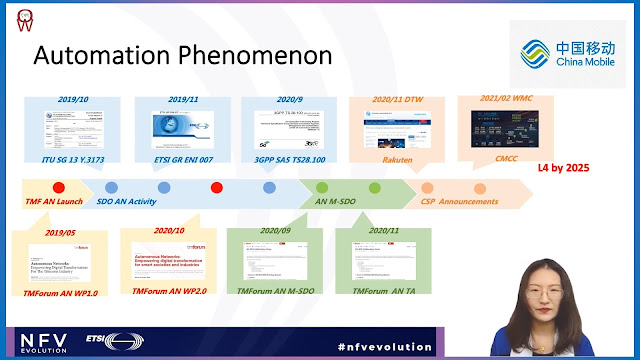
At the ETSI NFV Event back in April, Dr. Lingli Deng, China Mobile presented a talk on "From Orchestration Towards Automation". The abstract of the talk says:

Autonomous network proposes to optimize user experience, automate management operations, and maximize resource efficiency by simplifying network architecture, encapsulating autonomous domains, and providing closed loops for business/network operation control, and clarifies the target architecture and implementation path for network intelligence.

The autonomous network puts forward two dimensions of space and time requirements for the network management system of telecom operators:

On the one hand, the hierarchical, domain, and closed-loop autonomous architecture and cross-layer business-driven interaction of autonomous driving networks require operator network management systems to achieve functional enhancements ("addition") and interface simplification ("subtraction") in the spatial dimension.

On the other hand, the introduction of AI technology in autonomous driving networks and the complexity of network management itself require operators to achieve continuous iteration and gradual improvement in the time dimension of their network management system ("spiral upward").

In this speech, we will share China Mobile's autonomous network goals, approach, related practice, and overall thinking about the obstacles we are facing and proposed way forward, especially from the perspective of industrial collaboration, and the progress and next steps of ETSI NFV related work.

In particular, as an essential part of network management plane, MANO will need to be enhanced not only with simplified intent/policy interfaces, but also providing basis for enabling a complete zero-touch close loop (including VNF configuration), as well as the DevOps mechanism for AI models and/or analytics microservices embedded with network elements

The talk is embedded below:

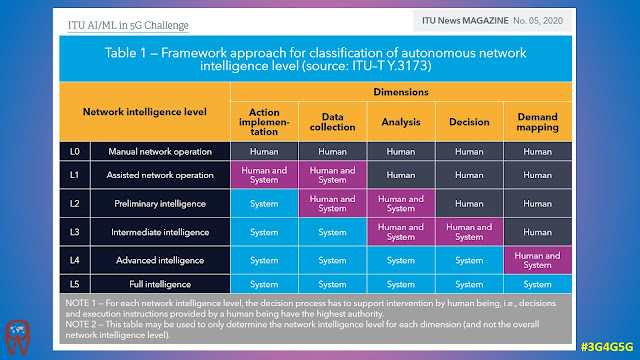
In the ITU News MAGAZINE last year, researchers from China Mobile Research Institute contributed an article on "A standards round-up on autonomous networks". The article provides a detailed list of specifications in various groups including ITU, 3GPP, ETSI, etc.


Quoting from the magazine:

There are discussions among standards development organizations (SDOs) about the level of autonomous capabilities in networks

The study of autonomous network levels (ANL) can provide reference and guidance to operators, vendors and other participants of the telecommunication industry for autonomous networks, standardization works and roadmap planning.

Since industrial convergence is the key for reducing the cost for any single vendor or single network operator, building an open collaboration platform for cohesively developing both a reference implementation for case-agnostic functional architecture and standardized external or internal interfaces would be the easy way for communication service providers (CSPs) to kick off and stay in the converged direction towards network autonomy.

For example, a rule-based policy engine could be one of the common functional modules to support both timed control tasks in Level 1, imperative closed loops in Level 2, and adding intent-to-rule translation modules in Levels 3 and 4.

The article starts on page number 23. You can download from here.

Related Posts

Sunday, 28 March 2021

World's Largest Mobile Networks by Data Traffic - March 2021

The analysis firm Tefficient, posted this chart in one of their Tweets. As you can see that China Mobile is the leader, followed by Reliance Jio and then China Unicom, China Telecom, Airtel and Vi (Vodafone Idea). 

As you can see, Bharti Airtel, India and China Telecom are also enjoying huge traffic growth.

Last year, Tefficient had also reported the absolute number up to 1H 2020. Vodafone Group (excluding vi) is the next highest carrier of the data traffic followed by Telkomsel Indonesia, Telenor group, MTS Russia, AIS Thailand, 3 Group Europe, Zain Group, XL Indonesia, Indosat and 3 Indonesia.

Of course not everyone agrees with all the numbers

We will provide updated ranking when it is available. 

Sunday, 14 February 2021

Top 20 Telcos Worldwide in Q3 2020, Based on Capex by MTN Consulting


Matt Walker, Chief Analyst at MTN Consulting shared this chart on LinkedIn

The following are some interesting points from the discussions:

  • This does not include spectrum.
  • China Unicom is 12th with $1,862M in 3Q20 capex spend. Vodafone Idea spent only $140M in capex in 3Q20, which would rank it #72 on our list of 138 telcos. 
  • Reliance Jio was just outside the top 20 (#23) for 3Q20, based on $730M in estimated capex spend. 

More details about the report here

Related Posts:

Sunday, 7 February 2021

China Mobile on The Next Phase of 5G: Progress, Challenges, and Opportunities


China always makes the news when it comes to the number of base stations and the vastness of the mobile network deployment. According to Tefficient, China will soon have 10 million mobile base stations. Of these, 718K are 5G equipped.

According to a recently posted lecture from IEEE 5G World Forum back in September, Dr. Chih-Lin I of China Mobile showed that there were 480k+ 5G capable base and the number of users that have a 5G capable phone or subscription exceeded 130 million. 

Back in April 2020, we looked at China Mobile's 5G+ network in detail here. There has been a lot of progress as over 200 5G devices were available back in October and over 400 5G application trials were conducted.

Remote surgery is one of the applications I take an exception with and have detailed it here and here. It looks like China Mobile is using 5G for a lot of medical use cases. Some of these are detailed in the pictures above and more details is available in the video below.

Finally, it is good to see that China Mobile sees 6G as Open & Smart. They are one of the founding operators of O-RAN Alliance so they definitely have a vision for open. AI is expected to play a big role in 6G networks and hence Smart.

At the IEEE 5G World Forum 2020 Virtual event, Dr. Chih-Lin I delivered her presentation embedded below. Chih-Lin I is one of the authorities driving the transformation. As China Mobile’s chief scientist, she is one of the experts helping to create a faster, greener, and healthier 5G world. You can find her complete bio here.

Her talk is embedded below.

While slides from this talk were not shared, Dr. Chih-Lin I delivered a very similar presentation to the Open Networking Foundation (ONF). The slides from that are available here and the video from that is here.

Related Posts:

Wednesday, 22 April 2020

China Mobile Establishing "5G+" Competitive Advantages


China Mobile is the world's largest mobile operator by subscriber numbers. There is roughly a difference of around 400 million subscribers between them and Vodafone Group, next on the list. According to the latest numbers published in the Interim 2019 report that covers a period of up till June 2019, they had 935 million, of which, the total number of 4G customers reached 734 million. Tefficient reported a total of 942 million subscribers at the end of Feb 2020.

The total number of 4G base stations in the first half of 2019 was 2.71 million including a net addition of 300,000, providing robust support for the development of large volumes of data traffic business. By the end of 2019, China Mobile planned to set up more than 50,000 5G base stations in China and launch 5G commercial services in more than 50 cities.

According to the report, China Mobile is working on implementing the following comprehensive “5G+” plans:

5G+4G. We will drive 5G and 4G technology and resource-sharing, and nurture synergies between the 5G and 4G network coverage and business operations. We will leverage the 4G base station sites and transmission facilities to build out our 5G network in a cost-effective manner. Our plan for this year is to set up more than 50,000 5G base stations in China and launch 5G commercial services in more than 50 cities. At the same time, we will play a more significant role in the next phase of setting international standards for 5G (Release 16). We will coordinate industry efforts to carry out research on fundamental 5G technology in order to ensure the continued advancement of this technology.


5G+AICDE. We will assimilate emerging technologies such as AI, IoT, cloud computing, big data and edge computing into 5G in order to combine connectivity with digital services. In addition, we will build out our service capability in areas including industrial IoT designated network slicing, one-stop cloud network convergence, secure and reliable big data services and telecommunications-grade edge computing. Centred around 5G, we will build a ubiquitous digital infrastructure, launch new capabilities and applications, develop new use cases and nurture more new businesses. Our goal is to become a leading new smart city operator.


5G+Ecology. We will establish an all-encompassing 5G open ecology that nurtures a 5G system by connecting partners throughout the information and communications industry chain, key verticals, innovative powers in society, high-performing technology and research institutes, and other telecommunications operators. Through our 5G Innovation Centre, 5G Device Forerunner Initiative, 5G Industry Digital Alliance and 5G Multi-media Innovation Initiative, we will drive, with our partners, the development of 5G devices, the innovation of 5G applications and the creation of 5G premium content. In addition, we will launch the BEST commercial plan, which aims to reinforce the “Basic service”, provide premium “Enabling services” and strengthen “Specialised services” so that we can march into the “Time of 5G” with our partners.

5G+X. Building on the foundation of the three “5G+” initiatives above, we will develop a “5G+X” strategy, where “X” stands for the wider application of 5G in a plethora of industry sectors and the mass market. On the one hand, we will launch innovative and integrated 5G applications to promote digitisation across sectors such as agriculture, industry, transport, healthcare, city administration, finance and education. On the other hand, for general customers, we will launch 5G ultra high definition videos, games and ring videos to satisfy customers’ appetite for a better digital life. We have accumulated more than 60 use cases of 5G across verticals, such as smart power grids, smart factories, smart ports, autonomous driving in certain designated areas, emergency rescue missions, remote medical treatment, smart campuses and high-definition cloud-based games. The 4G era has already improved people’s lives, and the 5G era will transform our society, bringing opportunities for development that have never been possible before. 5G will become the foundation for all-encompassing smart connections. In this historic moment, we will strive to maintain our competitive advantage and set the benchmark for the global telecommunications industry. We will continue to enhance the value of China Mobile surrounding “5G+”

Dr. Chih-Lin I, China Mobile, presented '5G++ the Journey Continues' at 5G World Forum Dresden, 2019 where she paints an immersive picture of what the network looks like from 4G changing lives to 5G changing society. She further discusses the timeline and trials beyond today’s 5G environment, including China’s spectrum status, licensing, standards and the all-encompassing capabilities from entertainment to medical services to open-source architecture, that the cutting edge 5G has to offer. Some of these things may be a bit outdated but there are a lot of insights in the talk


Related Posts:

Wednesday, 19 February 2020

China Allocates Shared Spectrum for Indoor Use, CBN gets Third Spectrum for 5G Network

China's Ministry of Industry and Information Technology (MIIT) has granted licenses to China Telecom, China Unicom and China Broadcasting Network (CBN) to share 5G spectrum for indoor coverage in the latest push to commercialise the new mobile technology. The 3 operators will share the 3.3GHz to 3.4GHz band for indoor coverage. The intention is that this will reduce China Mobile's monopoly as it has already got a a big chunk of spectrum in 2.6GHz as well as 100 MHz in 4.9 GHz band.

A report in International Finance states:

China Broadcasting Network (CBN) has received approval to deploy a 5G network across 16 cities using a spectrum in 4.9GHz band. It plans to have a nationwide coverage by 2021 after it signed a deal with State Grid last year. 

CBN is a broadcasting company headquartered in China. The telecom provider’s initial deployment will cover major cities such as Beijing, Guangzhou, Shanghai and Shenzhen among 12 others. 

In last October, CNB started trialling standalone technology on the 700MHz band in Shanghai. The telecom provider is working on an investment worth $35.8 million for its 5G network. 

CBN received its commercial 5G licence in June when the country’s big three telecom operators also received the licence. The operators are China Mobile, China Unicom and China Telecom. 

China Mobile received a licence for 260MHz of spectrum across 2.6GHz and 4.8GHz bands. China Telecom and China Unicom each received 100MHz in 3.5MHz band — and they operate jointly for their 5G deployments. 

Mobile World Live reported yesterday that China Mobile is reaching 7 million 5G subscribers soon. Joseph Waring reported:

China Mobile, the largest operator in the world, signed up 6.7 million 5G users in the space of three months, with 74,000 base stations deployed in 50 cities by end-January, C114.net reported.

It reportedly installed 24,000 5G base stations in January.

The subscriber numbers quoted would place China Mobile as the largest 5G player in the world. In November 2019 it set the aggressive target of signing up 70 million 5G users by end-2020.

This report contains this nice picture of spectrum allocation to the operators in China, it's not up to date but still quite detailed.
(click to enlarge)

Related Posts:

Thursday, 30 January 2020

AIS Thailand, Preparing for a 5G World


Leading  Thai mobile operator Advanced Info Service (AIS) have announced they have developed various solutions for 5G tech adoption after a year of collaboration with their partners.

These solutions potentially serve several major industries, including innovative technologies like robotics, remote control vehicles, 3D holograms, digital health, connected drones and smart logistics.

AIS have been operating 5G testbeds in all five geographic regions of Thailand, collaborating with universities,global vendors, operators, innovative tech developers partners and the telecom regulator.

A anonymous source in the telecom industry disclosed AIS's partners on 5G tech include China Mobile, the world's largest mobile operator by subscription base, and Japanese mobile operator NTT DoCoMo.

Wasit Wattanasap, head of nationwide operations and support at AIS, said the proper time for commercial 5G use cases in the country depends on when related industries are ready to adopt the high-speed internet network and the ecosystem involved. Mr Wasit said several industrial players have talked with AIS about collaboration on 5G tech adoption in the future.

AIS recently launched a 5G tech showcase at Samyan Mitrtown shopping mall.

The showcase was held to educate the public about the benefits of 5G technology in various fields of application. Mr Wasit said 5G will enhance internet speed, boost the capability of IoT device connectivity and ensure a fast, stable and responsive network.

Five innovative features linked to 5G tech are on display at the mall. They consist of 5G 3D holograms, 5G video calls, robotics, remote control vehicles and connected drones.

Mr Wasit said it's the first time for 5G hologram 3D technology to be showcased in Thailand.


This technology will be useful when applied to business meetings, distance education, medicine, agriculture, and fashion and entertainment jobs, as well as in developing games.


The demonstration of remote driverless vehicle technology via 5G is a collaboration of the Digital Research and Innovation Institute, Prince of Songkla University and AIS.

The presentation showcased the potential of the 5G network with high speed, low latency and fast response times.

Remote-control drones will also be demonstrated between Bangkok and Nakhon Ratchasima, giving an idea of how unmanned flying vehicles can be operational in the 5G era with high speed and low latency, Mr Wasit said.

The drone can be controlled remotely via a mobile network.


AIS and SCG (a leading business conglomerate in the ASEAN region) have also jointly launched the country's first 5G use case for industry, offering trial remote-controlled forklifts via 5G tech on the 2600-megahertz spectrum range.

The trial used two forklifts for SCG's routine operations in Saraburi, controlled from headquarters in Bangkok's Bang Sue district.

The number of connected forklifts for remote operation is expected to increase soon. Other 5G use cases are also projected to rise.

Through the cooperation, SCG was able to operate the forklift, manoeuvring pallets from point A to point B accurately in real time.

The development serves as a model for other industries to follow. AIS and SCG signed a deal for joint R&D for the application of 5G technology to other projects. They also commit to jointly develop workers' skills in line with digital development.

Related Posts:

Sunday, 3 November 2019

China's Synchronized 5G Launch


As reported by Mobile World Live:

China’s three major mobile operators officially launched 5G services in parts of 50 cities, claiming the largest rollout in the world just six months after the government issued licences.

The three operations deployed about 86,000 5G base stations and expect to have more than 130,000 by year-end. Market leader China Mobile aims to install 50,000 sites by end-December, while China Unicom and China Telecom each target about 40,000.

China Unicom claimed ubiquitous 5G coverage in 14 cities and 28,000 base stations.

All three operators announced similar packages with different speed tiers. Users without a 5G device can still subscribe to the 5G plans to take advantage of the larger data allowances.

China Mobile, for example, offers five plans with two speed tiers: speed limits of 500Mb/s and 1Gb/s. Monthly prices range from CYN128 ($18.10) for 30GB (low tier) to CNY598 for 300GB (high tier).

It’s giving 30 per cent discounts to existing customers, who have subscribed for three to five years. The company said it already registered 10 million customers to 5G packages.

China Unicom, the third largest operator in the country, claimed ubiquitous coverage in 14 cities, with plans to have service in 40 cities by the end of the year.

Chen Zhaoxiong, vice minister of Industry and Information Technology (centre), kicked off the launch with representatives from the three operators at PT Expo China in Beijing today (31 October).


Arjun Kharpal, China Technology Correspondent at CNBC pointed out in the tweet above that China Telecom has changed its app logo to “Hello 5G”.


Mike Dano from Light Reading points out in his tweet that China mobile is selling 5G 30% cheaper as compared to 4G, which will simulate demand for 5G networks.

Picture Source: Dean Bubley on Twitter

The picture above shows summary of 5G Spectrum that has been allocated to the operators. Both China Telecom and China Unicom has 100MHz in the 3.5MHz band (C-band), while market leader China Mobile has 160MHz of spectrum in the 2.6GHz and another 100 MHz in 4.8GHz band. China Broadcasting Network (CBN), which was established in 2014 by the National Radio and Television Administration (NRTA) to consolidate the country’s fragmented cable-TV industry also has 100 MHz in 3.3GHz band.

Related News:


Related Posts:

Friday, 6 September 2019

Zong Pakistan Yearns for 5G Despite Poor 3G / 4G Coverage


Despite being on the  back foot in the West, the Chinese technology giant Huawei has been quietly strengthening its foothold in the massive South Asian market. Both Huawei and ZTE are the main suppliers of the radio access network (RAN) in Pakistan. Huawei has up to 60 percent of the RAN market share, with ZTE capturing virtually all the remainder.


Huawei have very much convinced the South Asian nations with a flourishing middle class to adopt their 5G technology. Huawei are already well established in Pakistan, Bangladesh, and Sri Lanka alhtough they have yet to  take off in India.


Pakistan, which has a population of 217 million, has 161 million mobile phone subscribers including 69 million 3G / 4G users. Pakistan’s most popular data network and a pioneer of mobile internet connectivity is Zong , they have provided Huawei with the foothold it was looking for locally. 


With Zong having 12,000 4G sites across Pakistan, they announced a partnership for digital transformation early this year. Zong 4G and Huawei will be integrating Artificial Intelligence (AI) and big data to provide consumers with fast, uninterrupted connectivity.

China Mobile Pakistan (CMPak), branded as Zong 4G , has now achieved another milestone by successfully conducting 5G trials in the country. This achievement has made the Chinese telecom company the first and only local mobile operator to do so.

Zong CMPAK has been delivering the many firsts of the telecom industry in Pakistan; for instance, being the first to launch 4G in Pakistan, first to cross the prolific mark of 12,000+ 4G towers and the first to reach the more 13 million 4G customers mark and 34.71 million mobile phone subscribers overall. 

Zong has now become the first operator to conduct successful 5G trials to play a leading role in transforming the digital landscape of Pakistan. Zong believes that 5G will bring more profound and long-term changes to Pakistan’s economic transformation, social progress, and people’s livelihood improvement in future. 5G is expected to revolutionise key sectors such as healthcare, agriculture and education in Pakistan. It will have a significant impact on Pakistan's economic transformation, social progress and create new avenues of entertainment.       

With a commitment to develop the digital ecosystem in Pakistan, Zong has always been at the forefront to offer innovative, state-of-the-art and most advanced services and solutions to its valued customers. As the pioneer of 4G services in Pakistan, Zong has already established itself as Pakistan’s largest network with more than 13 million 4G customers and 12,000 4G sites. During the event, the Secretary IT, PTA chairman, Economic & Commercial Counsellor, Chinese Embassy along with the dignitaries tested Zong’s 5G network.


According to industry sources, 5G service in Pakistan will be 100 times faster than the current levels while network will be 10 times faster than existing broadband connections available in the country. 5G home routers speed has been recorded at 4 gigabytes per second, which means that it can download a 50 GB file in just two minutes. 

However some industry gurus are cautious and believe Pakistan is likely to take longer time to enter into 5G business because the penetration of 3G / 4G has only reached 32.72 percent by June 2019.

Jazz, a part of Veon, has around 60 million mobile phone users in Pakistan. Telenor has 44 million mobile phone customers, according to statistics from Pakistan Telecommunication Authority (PTA). 


Mobile phone users on 3G and 4G network are facing poor network performance. Local mobile operators, under the regulation, have to maintain data rates of 256 kbps for 3G and 2 Mbps for 4G in Pakistan, Matt Walker said in a research report from MTN Consulting.


Jazz has achieved an average download speed of 17.13 Mbps and average upload speed of 10.74 Mbps during Q3-Q4 2018, Speedtest report from Ookla said.


Zong has achieved an average download speed of 17.13 Mbps and average upload speed of 10.74 Mbps during Q3-Q4 2018.


Telenor has achieved an average download speed of 7.72 Mbps and average upload speed of 3.81 Mbps during Q3-Q4 2018.


Ufone has achieved an average download speed of 4.43 Mbps and average upload speed of 2.29 Mbps during Q3-Q4 2018.


The currency in Pakistan has been devalued by more than 40 percent to its value of January 2018. During January 2018 the exchange rate was USD 1 to PKR 110 and now in August 2019 it is hovering around PKR 160.


This is impacting the telecom sector in the country. Reduction in profit margins, decrease in available Capex for new investments as nearly all equipment is imported and increase in Opex are the main issues due to the devaluation of PKR.


Mobile operator revenue in Pakistan reached PKR 488750 million in 2017-18 as compared with PKR 464111 million in 2016-17.


Pakistan Telecommunication Authority said telecoms Capex has reached $670 million in 2017-18 as compared with $635 million during 2016-17.


Therefore Pakistan operators may well not be ready for making investment in 5G network. They may try to expand 4G network coverage and may take another 3-4 years to look for additional revenue streams from 5G.


Related Posts:

Tuesday, 5 March 2019

Current IMT Spectrum Allocation in China

A nice slide summarising IMT spectrum allocation in China can be seen below.

Presentation Source


According to Mobile World Live back in December,

China’s government allocated 5G spectrum in the mid-band frequency range to the three state-owned mobile operators, preparing the way for large-scale network testing in 2019 and the launch of commercial 5G services in 2020, China Daily reported.

Both China Telecom and China Unicom received 100MHz in the 3.5MHz band (also known as the C-band), while market leader China Mobile obtained 260MHz of spectrum in the 2.6GHz and 4.8GHz bands, the Ministry of Industry and Information Technology revealed.

Sunday, 27 January 2019

World's largest mobile networks by subscriber numbers - Jan 2019

Here is a list of top 10 mobile networks by subscribers. The list is very dynamic as some operators grow while others shrink. The best example of operator that has been growing rapidly, overtaking others is Reliance Jio.


1. China Mobile, China, 925 million [1]

2. Vodafone Group, UK, 536 million [6]
Note: Vodafone Idea, India has 422 million subscribers [2]

3. Bharti Airtel Group, India, 413 million [4]
Note: Airtel India has 329 million subscribers [3]

4. China Unicom, Hong Kong, 315 million [1]

5. China Telecom, China, 303 million [1]

6. Reliance Jio, India, 280 million [6]

7. América Móvil Group, Mexico, 279 million [5]

8. Telefónica Group, Spain, 272 million [7]

9. MTN Group, South Africa, 221 million [9]

10. Veon Group, Netherlands, 211 million [8]
10. Orange Group, France, 211 million [10]*

* = added later

[1] https://www.mobileworldlive.com/asia/asia-news/china-telecom-narrows-subs-gap-to-unicom/
[2] https://discover.vodafone.in/about-us/home?section=consumer
[3] https://www.airtel.in/about-bharti/equity
[4] https://www.airtel.in/about-bharti/about-bharti-airtel?icid=footer
[5] http://q4live.s22.clientfiles.s3-website-us-east-1.amazonaws.com/604986553/files/doc_financials/quarterly/2018/3Q18.pdf
[6] https://www.mobileworldlive.com/asia/asia-news/jio-profit-surges-on-continued-subs-gains/
[7] https://www.telefonica.com/en/web/shareholders-investors/financial_reports
[8] https://veon.com/Global/Files/Reports/3Q18/Q3%202018-Full%20announcement.pdf
[9] https://www.mtn.com/MTN%20Service%20Detail%20Quarterly%20Quarterly%20Trading%20Upd/MTN_Q12018_Results.pdf
[10] https://rai2017.orange.com/orange2017-content/uploads/2018/05/orag_1802135_ra_150x210_gb_mel.pdf

Sunday, 21 October 2018

China Mobile’s Targeted Poverty Alleviation System


From GSMA's 2018 Mobile Industry Impact Report: Sustainable Development Goals:

China has the largest agricultural sector in the world, and for the millions of people living in rural areas, agriculture is a way of life. However, there are still more than 30 million rural people living in poverty. To combat this, the Chinese government’s "targeted poverty alleviation strategy" aims to eradicate absolute poverty for all rural residents by 2020.

Introduced at the beginning of 2016, China Mobile’s Targeted Poverty Alleviation System (TPAS) consists of two parts: a mobile poverty application and a big data management & analytics platform. Through the system, government anti-poverty staff can use smartphones to collect information on rural families in poverty (to understand their health, diet and drinking conditions) to enable the government to manage poverty alleviation work more effectively. Concurrently, information and resources from NGOs and the government is shared (via the app) among the rural population, so that people can learn about poverty alleviation policies, apply for jobs, and access vital information (such as health advice or educational opportunities). China Mobile’s TPAS also enables rural poverty families to market and sell their agricultural produce through e-commerce channels, helping them to generate an income.

Impact: To date, China Mobile’s targeted poverty alleviation platform has been applied in 60 cities and counties in 10 provinces (namely Chongqing, Hunan, Henan, Anhui, Shanxi, Liaoning, Shannxi, Yunnan, Jiangxi, Ningxia) covering 7.18 million impoverished people and serving 710,000 poverty alleviation cadres. By 2020, China Mobile aims to cover 10 million impoverished people in China, to provide intelligent tools and link thousands of welfare resources to government staff, and help the government run targeted poverty alleviation policies.

Further Reading:

Sunday, 2 September 2018

Global Top 20 Telcos by Revenue


Source: Global 100 Total Telecom via Elena Neira

AT&T, Verizon, China Mobile and NTT have maintained their top four positions in 2017 while Softbank has slipped one place to let Deutsche Telekom become the fifth largest operator by revenue. Other top 20 players by revenue include Telefónica, Vodafone, China Telecom, América Móvil, Orange, Comcast, China Unicom, KDDI, British Telecom (BT), Charter, Altice, Telecom Italia, Telsta and KT

Related posts:

Thursday, 28 June 2018

APAC's 32 largest operators ranked by revenue


You have probably seen the map above. It shows there are more people in this circle than outside. Its also where many huge telecom operators are located. Well, Asia-Pacific or APAC is much bigger than what you see above. See this pic below.

Total Telecom just published a list of 32 top operators in this region by revenue. Here is the list.

Mobile In Tokyo makes a good point (tweet below) that even though Japan is roughly 1/10th of China by population, the 3 Japanese operators generate 37% of revenue in Asia.

In other interesting analysis in the article:

India contributes the most operators to the Asia 32 table with five representatives, but its revenue share is just over 5%, down slightly on the previous report. As detailed in the full Global 100 report, India's telcos are experiencing more than their fair share of difficulties, with Reliance Communications and Tata Communications both pulling out of retail telecoms on the back of fierce competition from newcomer Reliance Jio Infocomm. Jio will also be a newcomer to the Global 100 in the next report. It generated revenues of 239.16 billion rupees in the year to the end of March 2018, which equates to around €3 billion and would afford it 22nd place in the current Asia-Pacific ranking and 65th in the full Global 100.

There was a newcomer to the current Asia 32 table in the form of Malaysia-based Axiata, which ranks 17th in the Asia-Pacific and 51st in the overall Global 100. There were previously just 31 representatives of the Asia-Pacific region in the Global 100.

The region's overall revenue total came in around €1 billion higher than in the previous ranking, with the Asia 32 together generating €502.3 billion. The Asia-Pacific accounted for 36% of total Global 100 revenues, down from 38% two years earlier.

You can read the complete article here.

Total Telecom's Global 100 report is available here.

In related news, according to Telecom TV:

Asia Pacific is on track to become the world’s largest 5G region by 2025, led by pioneering 5G markets such as Australia, China, Japan and South Korea, according to the latest edition of the GSMA’s Mobile Economy report. Launches of commercial 5G networks in these markets beginning next year will see the Asia region reach 675 million 5G connections by 2025, more than half of the global 5G total expected by that point. Asia’s move to state-of-the-art mobile broadband networks reflects the mobile ecosystem’s growing value to the region’s economy. According to the report, Asia’s mobile industry added $1.5 trillion in economic value last year, equivalent to 5.4 per cent of regional GDP.

The latest GSMA Mobile Economy report is available here.

Thursday, 2 November 2017

The 4G explosion in China

The popularity of 4G mobile services in China continues to increase and subscriber growth shows no signs of slowing down. In fact China has built the world's largest 4G network within just four years and is aiming to add 2 million 4G base stations, mainly for townships and villages, by 2018. China began a campaign aimed at faster and more affordable Internet connection in 2015 resulting in a total of 950 million 4G network users as of the end of September 2017, according to figures from the Ministry of Industry and Information Technology (MIIT).


Served principally by three mobile network operators, China’s mobile sectors are largely divided along technological lines. China Mobile - currently the largest operator by subscribers focuses on the locally-developed TD-LTE 4G standard.  While rivals China Unicom and China Telecom have gone for a mix of TD-LTE and frequency division duplex LTE (FDD-LTE). 

According to Shang Bing, chairman of China Mobile the operator has pursued a strategy of 'Big Connectivity' and invested about CNY450 billion ($66 billion) over the last three years to build  the world’s largest 4G network. Its 4G user base reached 583 million in May 2017, with 4G penetration at 67.5 per cent. “One in four 4G users in the world is a China Mobile user.” It has deployed 1.6 million 4G base stations, or about 30 per cent of the global total, Shang said. Its 4G coverage will reach 99 per cent of the population by the end of the year, when its LTE base station count rises to 1.77 million.

China Telecom’s 4G user base doubled last year to 122 million, with LTE subscribers accounting for 57 per cent of its mobile connections and deploying 1.05 million base stations, while China Unicom’s 4G subs rose from 44.1 million at end-2015 to 104.5 million, representing 40 per cent of its customer base, with 770,000 base stations.


How 4G has helped change and improve lives in China

So why is 4G so important? Probably because it is a vital foundation for all that is to come:

"Future technologies, including 5G, the internet of things and AI (artificial intelligence) will drive society into the era of the internet of everything. The development of 4G has brought about the prosperity of mobile internet and changed people's lives," 

says  Li Zhengmao, vice-president of China Mobile. Industry pundits insist that 4G has been the greatest achievement in the national information technology sector during the past five years in rural and urban areas.But then the benefits of 4G are not limited to urban areas. Rural regions in China have also been opened up by the service. In Huanggang, Hubei province, farmers can sell their produce online through e-commerce sites, and buy crucial equipment safer and quicker through the network. China Telecom has spent 200 million yuan ($29.46 million) to roll out 1,300 base stations in Huanggang.

The decision has increased 4G coverage rates from 35 percent to 93 percent. It has also helped local farmers with vital agricultural information, as well as alleviating poverty through online education.

Even after all this progress, VoLTE is still long way away. According to a report in summer, China Mobile targets 17% VoLTE penetration this year. China Mobile group vice-president Mr.Liu Aili had said back in 2015, "VoLTE network deployment is the one of the most difficult project ever, the implementation complexity and workload is unparalleled in history"

Its not unreasonable to think that since China has the world's largest 4G market it is the  country that will lead the world in the development and utilization of 5G.