Showing posts with label Region MENA. Show all posts

Thursday, 25 September 2025

Libya’s Mobile Industry Amid Recovery and Change

In recent years, Libya has faced significant challenges in rebuilding its economy and infrastructure after the civil war and ongoing political unrest. The telecom sector was hit particularly hard, around a quarter of the country’s mobile towers were destroyed or looted in the aftermath of the 2011 uprising. Efforts to restore services were repeatedly delayed by political and military instability, especially during the decade when rival governments in Tripoli and Tobruk failed to agree on a unified national reconstruction strategy despite numerous mediation attempts.

The formation of a UN-brokered Government of National Unity in March 2021 brought cautious optimism, though it was intended only as an interim solution ahead of the presidential and legislative elections scheduled for December that year.

Even amid political deadlock, some progress has been made in reviving the telecom network. Mobile operators have collaborated to expand LTE coverage in the south, a development made possible by improved political stability. Previously, telecom towers were frequent targets in the conflict, making such cooperation difficult.

There are two main mobile operators in Libya: Libyana and Almadar Aljadeed. Both are state-owned. Libyana has a market share of over 55% and Almadar Aljadeed at 44%, according to Media Landscapes. Overall mobile coverage in Libya extends to about 90% of the population, concentrated in urban regions along the coast; but geographic coverage remains limited, less than 20% of the country's land area. The mobile market is supported by some of the lowest tariffs on the continent.

According to GSMA Intelligence, Libya had 14.6 million mobile connections at the start of 2025. It is important to note that many people use more than one mobile line, so the number of connections often surpasses the size of the total population. For instance, a person may keep one line for personal communication while maintaining a second for work. The growing use of eSIM technology in recent years has made it even easier for individuals to manage multiple connections.

Based on GSMA Intelligence data, mobile connections in Libya were equal to about 197 percent of the country’s total population in January 2025. The number of connections has also continued to grow. Between early 2024 and the beginning of 2025, Libya added 299 thousand new mobile connections, representing growth of just over 2 percent. At the same time, GSMA Intelligence reports that 92.9% of all mobile connections in the country now qualify as “broadband.” This means they are capable of connecting through 3G, 4G, or 5G networks.

However, it is important to understand that a broadband-capable connection does not always translate to actual mobile internet use. Some subscriptions are limited to voice and SMS services only, so this figure should not be treated as a direct measure of internet adoption.

Established in 2004, Libyana was Libya’s first GSM operator and quickly became a market leader. The company holds the largest share of the market, with over 6.3 million subscribers across government institutions, businesses, and individuals. It recently expanded its services to include 4G+ and VoLTE coverage in most Libyan cities and is currently testing 5G technology. While praised for its widespread network, Libyana struggles with an oversubscribed network and its internet service is considered the least reliable among the available options.

Almadar Aljadeed (Almadar) is the second-largest operator, holding 44% market share. It is known for its competitive rates, extensive coverage, and more stable and flexible connections compared to other options, according to Media Landscapes. Almadar recently introduced H+ services, seen as a positive step for the industry. 

5G is in early stages, with planning and trials by both major operators.

Rural expansion is being explored through solar-hybrid towers and VSAT aggregation, supported by multilateral funding to close the digital divide.

Libya’s mobile industry is shaped by the state-managed duopoly of Libyana and Al-Madar with overlapping strengths and constraints. Libyana's affordability and reach make it popular among the masses, while Al-Madar appeals to those seeking stability and premium offerings.  Though infrastructural and geographic gaps remain, especially in rural areas, expanding international links and emerging private players are promising signs of sector maturation.

Tuesday, 24 June 2025

Rising Demand and Competition in Algeria’s Mobile Sector

Algeria, the largest country in Africa, has a fast-growing telecommunications sector shaped by strong state involvement, a youthful and increasingly connected population, and rising demand for mobile internet. Despite regulatory complexities and infrastructure challenges, mobile operators are competing to improve coverage, increase speeds and launch innovative digital services.

The mobile market in Algeria is dominated by three major operators: Mobilis (ATM Mobilis), which is state-owned; Djezzy (Optimum Telecom Algeria), a privatised operator with majority state ownership; and Ooredoo Algeria, a subsidiary of the Qatari Ooredoo Group.

According to GSMA Intelligence, there were 54.8 million cellular mobile connections in Algeria at the start of 2025. It is common for individuals to use more than one mobile connection, often splitting usage between personal and professional needs. The growing use of eSIMs has made this even easier. Mobile connections in Algeria were equivalent to 116 percent of the total population in January 2025. This figure had risen by 3.0 million, or 5.8 percent, over the previous year.

Of these connections, 91.4 percent are classified as broadband, meaning they access the internet via 3G, 4G or 5G networks. However, broadband-capable devices do not always translate to mobile internet usage, as some plans may include only voice and SMS services.

Mobilis holds the largest share of Algeria’s mobile market at 43.7 percent. As the state-owned operator, it plays a central role in national connectivity. Mobilis launched GSM services in 2003 and was the first to introduce 4G LTE in 2016. With strong government backing, it focuses on reaching both urban centres and rural areas. The operator offers a full suite of services including prepaid and postpaid voice, SMS and data plans. It has invested heavily in network upgrades and has been preparing for 5G with successful trials and a commercial rollout expected later in 2025.

Recent tests have shown Mobilis achieving speeds of up to 1.2 Gbps with low latency, demonstrating its ability to meet global performance benchmarks. These trials featured use cases such as virtual tourism, cloud gaming and augmented reality experiences. Alongside its mobile efforts, Mobilis is also expanding its fibre-to-the-home (FTTH) offerings through partnerships with local microenterprises, supporting broader national digital inclusion goals.

Djezzy, established in 2001, commands a 30.84 percent market share. Known for its innovation and wide reach, Djezzy has played a major role in expanding Algeria’s 3G and 4G footprint. The operator offers a variety of competitively priced data plans, particularly attractive to value-conscious users. It has also been involved in 5G trials as it looks to modernise its network and stay ahead of evolving consumer demands.

Ooredoo Algeria holds a 25 percent market share but consistently ranks high on digital service quality. The latest Opensignal report highlighted Ooredoo’s strengths in download and upload speeds, network consistency and video experience. Its portfolio includes data-rich plans aimed at younger users as well as solutions for business customers. The company is actively preparing for 5G through partnerships with global technology providers.

Ooredoo is also participating in the Universal Telecommunication Service project, a government-led initiative to extend coverage to remote and underserved regions. As part of this programme, the operator is working to deploy more than 1,200 new sites across rural Algeria, delivering essential voice and data services to communities that were previously unconnected or poorly served.

The mobile landscape in Algeria remains highly competitive, with all three operators striving to enhance service quality and expand their networks. This competition has helped to keep prices attractive while driving continuous improvements in infrastructure and user experience.

Algeria’s mobile ecosystem is evolving rapidly. With growing demand for data, nationwide 4G expansion and the expected arrival of commercial 5G services, the market is set for further transformation. Government initiatives to promote digital inclusion and the operators' sustained investment in technology suggest a strong trajectory for mobile connectivity across the country.

Related Posts

Wednesday, 7 August 2024

Djibouti to Start Experimenting with 5G Soon

Djibouti, located on the Horn of Africa, is a small but strategically significant country known for its diverse culture, historical sites, and unique landscapes. Presently, Djibouti remains one of the few countries where the national telecommunications company, Djibouti Telecom, holds a monopoly over all telecom services, including fixed lines, mobile, internet, and broadband. This lack of competition has stifled the market's potential. Despite Djibouti's strategic location as a hub for international submarine cables, with Djibouti Telecom being a partner in at least eight of them, telecom service prices remain high and unaffordable for many, hindering market growth.

The government has long planned to privatize Djibouti Telecom, but these plans have faced repeated delays. However, the successful experience of neighbouring Ethiopia, which recently ended Ethio Telecom's monopoly by licensing the Global Partnership for Ethiopia consortium (led by Safaricom), has provided encouragement. The Djibouti government aims to sell a minority stake in Djibouti Telecom, maintaining some decision-making control while attracting the financial support and management expertise of a foreign operator. This initiative is part of a broader strategy to modernize the country's economy. 

The population of Djibouti stood at 1.14 million in January 2024. Data from GSMA Intelligence shows that there were 553.8 thousand cellular mobile connections in Djibouti at the start of 2024.

However, note that many people around the world make use of more than one mobile connection – for example, they might have one connection for personal use, and another one for work – so it’s not unusual for mobile connection figures to significantly exceed figures for total population. GSMA Intelligence’s numbers indicate that mobile connections in Djibouti were equivalent to 48.4 percent of the total population in January 2024. The number of mobile connections in Djibouti increased by 28 thousand (+5.3 percent) between the start of 2023 and the start of 2024.


Djibouti Telecom, operational since 1999, has established itself as the leading international carrier in eastern Africa. Currently, it is developing a regional hub to offer a comprehensive portfolio of voice, data/IP, and capacity services over state-of-the-art network infrastructure. Its customer base includes telecommunications service providers, multinational organizations, international carriers, mobile and fixed telephony operators, internet service providers, and major government and private sector clients.

According to Mohamed Ahmed Mohamed, Director of International Business at the FSD-owned Djibouti Telecom, this prominent national operator, a cornerstone of the economy, reported an EBITDA of around $100 million this year. He explains that Djibouti may lack natural resources such as oil, gas, or precious metals, but it aims to cultivate a different kind of wealth. Leveraging its strategic location at the intersection of the Red Sea and the Indian Ocean along the Europe-Asia maritime route, Djibouti has capitalized on its geographical advantage. He explains: 
"Over the past fifteen years, we have invested $200 million in twelve submarine cables, transforming our territory into a key exchange point connecting Europe, the Middle East, Asia, and Africa, All submarine cables heading to Europe pass through the Red Sea, potentially through our country. By establishing operations here, carriers can seamlessly switch cables and reach various global destinations. Currently, Djibouti Telecom serves over 50 telecom operators with connections to more than 90 countries."
The latest investment, the Sea-Me-We-6 cable, spans 19,200 km from Singapore to Marseille. This cable aims to enhance network performance and support emerging technologies like cloud computing and artificial intelligence. Djibouti Telecom is already in discussions about additional projects, such as the 12,000 km Peace submarine cable linking Europe and Asia.

Djibouti’s twelve submarine cables are safeguarded by a monitored protective corridor. Once onshore, they connect to four autonomous energy stations, which are monitored around the clock.

Mohamed Ahmed Mohamed further states: 

"Investment in submarine cables has provided a foundation we can now capitalize on. This allows the country to foster a digital economy, encouraging the establishment of start-ups and data centres. However, to remain competitive, we must address the high cost of electricity, currently 23 cents per kWh."

The investments align with the Djibouti government's strategy to transform the country into a digital hub.

According to Mariam Hamadou Ali, the head of the Ministry of Digital Economy and Innovation, along with their  port activities, the information and communication technology sector presents an unprecedented opportunity to diversify our economy and stimulate innovation in new areas. 

This ministry is a first for Djibouti, a strategically significant nation in the Horn of Africa. And their  submarine cable infrastructure places them at the forefront of African countries in terms of international connectivity, solidifying our position as a strategic centre for global data and information exchange.

Currently, the digital sector accounts for 8% of Djibouti’s GDP, encompassing submarine cable infrastructure, telecommunications, fintech, and e-commerce. This share is expected to grow notes Minister Ali, who recently visited Marseille, France, to draw inspiration from the city, which has quickly become a hub for cable networks in Europe.

She elaborates: 
"We have launched initiatives to attract investment in data centres similarly. These data centres will meet local data storage and processing needs and serve regional and international companies, further establishing our position as a regional digital hub." The government's 'Djibouti Smart Nation' program includes 150 projects with a total investment of $850 million."
To encourage competition, stimulate innovation, and improve service quality, the Djibouti government has been considering opening up the capital of Djibouti Telecom. This move aims to modernize and expand its infrastructure, enhance service quality, and boost market competitiveness.

Opening Djibouti Telecom’s capital will attract national and international private investment, enabling modernization and service improvement explains Minister Mariam Hamadou Ali. This strategy is crucial for one of the country's economic pillars capable of operating internationally, akin to the port sector.

Simultaneously, the government supports introducing a new operator in Djibouti's telecommunications market. Minister Ali  emphasises bringing in new players will increase competition, spur innovation, and better meet consumer needs with a wider variety of services and more competitive rates. She highlights the significant progress in internet connectivity, which rose from 6% in 2012 to 61% by 2022.

The government intended selling up to 40% of the company to an international investor by the end of 2022. However this has not yet transpired. 

However Minister Ali remains optimistic about the future. 
"In the next ten to fifteen years, I envision Djibouti evolving into a dynamic and prosperous digital hub, characterized by a thriving digital economy, world-class connectivity, and an innovative, inclusive society."

In late 2013 Djibouti Telecom finally unveiled its 3G service throughout the country and as of 2017 has unveiled 4G+ service. As of August 2021, 2G network covered 95% of the population, 3G network covered 80% and the 4G network covered 75% of population.

The Djiboutian government aims to bring mobile phone and broadband internet coverage to 100% of the population by 2027. During Mobile World Congress 2024, The Minister of Communication in charge of Posts and Telecommunications met with the Director of Huawei's East Africa region and discussed the possibility of a partnership for the deployment of 4G or 5G relay antennas in rural areas in order to combat the digital divide across the territory.

Wednesday, 24 July 2024

Orange Africa & Middle East (OMEA) to Reach Net Zero by 2040

Orange Africa and Middle East (OMEA) covers 17 countries containing 18,000 employees and 149 million customers. Every 3 out of 10 Africans are Orange customers. In 2023, OMEA generated €7 billion in revenue. Today, more than 90 million customers in 17 countries have opened an Orange Money account. While 2G & 3G is still extremely popular in Orange markets, 4G has been launched in 17 countries and is available to more than 60 millions customers.

Recently OMEA published "Seeds of change": Orange Africa and Middle East 2023 Corporate Social Responsibility Report. It's available here.

On their website detailing the reduction of carbon footprint, it says:

At Orange, the transition to renewable energies is a major priority. That’s why we’re launching numerous initiatives in Africa and the Middle East to help reduce our CO2eq emissions to reach our target of net zero by 2040. These include moving to solar to power our infrastructure, mini-grid solutions, and solar kits for companies and communities.

Orange Africa and Middle East publishes "Seeds of change", its 2023 Corporate Social Responsibility (CSR) Report, which illustrates our actions in the region. Reducing our energy consumption, developing our use of renewable energies and strengthening our transition to a circular economy are the pillars of our initiatives. We are constantly innovating with all stakeholders for a positive impact and for the benefit of individuals, society and the planet.

In Africa and the Middle East, where electricity is an essential issue, we resell surplus energy generated by our own solar farms to surrounding communities at an affordable price. This essentially converts our telecom equipment into mini grids (small solar farms), where consumption and payments can be controlled remotely.

We’re also developing various renewable energy projects that enable us along with Energy Service Company (ESCO) partners to equip our telecom towers with solar systems. Today, 10 Orange countries in the Africa and Middle East region are benefiting: Burkina Faso, Cameroon, Central African Republic, Côte d'Ivoire, Guinea Bissau, Guinea Conakry, Liberia, Madagascar, Senegal and Sierra Leone.

In Morocco and Tunisia, we’ve launched major solarization programs along with partners. We now produce 3.4 MWp of solar energy to supply data centers in seven of our countries in the region. More than 8,000 sites, or nearly 20% of our sites in Africa and the Middle East, are solarized.

We have also designed a range of services so that everyone can adapt their electricity to their needs and budget, such as our popular solar kit offer.

These programs, which are extending to other countries this year, reduce fuel consumption by up to 80%, depending on the site, powering our mobile phone infrastructure while avoiding more than 330,000 metric tons of CO2eq each year.

In Jordan, we’ve completely changed our electricity supply model and now use our own solar resources to the tune of 60 GWh. Commissioning three solar farms in 2019 generated enough power to cover 52% of Orange Jordan’s electricity needs in 2023 on a full-year basis. In terms of Jordan’s CO2eq emissions, this corresponds to 22,863 metric tons of CO2eq avoided in 2023 (scopes 1 & 2).

Our circular economy approach prioritizes mobile device collection and recycling, both of which require special treatment in countries where there’s a lack of national waste treatment, such as in Africa and the Middle East. Not only are we trying to extend the lifespan of electrical and electronic equipment, but we’re also aiming to collect 100% of the volume of electrical and electronic equipment waste from mobile phones sold in Africa and the Middle East by 2030.

We’ve partnered with the UN to introduce a circular economy for mobile and network equipment waste in Egypt, helping to develop local infrastructure and skills. E-waste in Egypt accounts for 20% of the total e-waste in Africa so the Egyptian government is looking at boosting its recycling rate by 25% by 2030 while ensuring the safe disposal of hazardous waste. The first mobile refurbishment center will launch in 2024 to help strengthen the skills of locally recruited technicians.

In the absence of efficient local recycling channels, the waste is collected and sent back to France to be recycled according to European environmental standards. Since 2010, Orange has partnered with the social cooperative organization Les Ateliers du bocage to open mobile waste collection workshops in three African countries (Burkina Faso, Cameroon and Côte d'Ivoire). These workshops have now dealt with more than 2 million mobile phones while creating job opportunities in the area.

You can learn more about OMEA in the video embedded below:

Related Posts

Friday, 10 May 2024

Tunisia is Ready to Launch 5G in 2024

Tunisia has one of the most sophisticated telecom infrastructures in North Africa. Penetration rates for mobile and internet services are among the highest in the region. A number of regulatory measures and infrastructure projects have been instituted in recent years as the government continues to extend broadband infrastructure to remote areas and develop a digital economy.

Supported by the Digital Tunisia 2020 program, the MNOs have built extensive LTE infrastructure, and have trialled 5G services, though commercial services are not expected to be launched before 2023.

The political events of 2021 have put into question the country’s economic recovery. Although the economy was severely impacted by the collapse of the tourism sector in 2020, it returned to growth in 2021. Nevertheless, there is high unemployment and emigration, as well as continuing economic pressure on households. These factors have in turn held back the potential for revenue growth in the telecom sector.

Operators Ooredoo and Orange Tunisie are also licensed as fixed-line operators and have launched DSL and FttP services. In addition, a dozen public and private ISPs compete in this sector, supported by a nationwide fibre backbone network and international access via submarine and terrestrial fibre.

There are three mobile network operators in Tunisia: Tunisie Télécom (TT), Ooredoo (formerly Tunisiana) and Orange Tunisie.

All 2G is on 900 and 1800 MHz, 3G in the populated areas on 2100 MHz up to HSDPA speed like in Europe, 4G/LTE started in 2016 in major towns on all three providers in 800 and 1800 MHz (B3, B20) and gives theoretical speeds of up to 150 Mbps.

In late June 2022, a Tunisie Telecom executive said that the operator is planning to shut down its 3G network and refarm its spectrum as its 3G users are rapidly migrating to 4G. The operator intended to launch VoLTE to allow it to transfer voice traffic from 3G to 4G. However, no timeline was given for the 3G network shutdown. Refarming 3G spectrum would allow Tunisie Telecom to improve the mobile experience of its 4G users.

The Tunis Afrique Press agency says that spectrum auction process is expected to take place between July and August of this year. Licenses will be awarded in September. 5G marketing is likely to be carried out soon after – in November.

A sectoral committee representing the National Telecommunications Authority (INTT) and the National Frequency Agency (ANF) was created in May 2023 to prepare for the transition. The ministry claims it has consulted with relevant stakeholders with experience in other countries.

During a press conference organized to reveal the roadmap for the launch of 5G, the ministry indicated that the call for tenders for operators would be launched at the end of April after validation by the Council of Ministers.

Three licenses will be granted to operators; Tunisia Telecom ; Ooredoo Tunisia and Orange Tunisia, which each consist of 5MHz duplexed in the 700MHz band and 100MHz in the 3.5GHz band as entry tickets.

In a second phase, each operator will also have 60MHz TDD in the 2.6GHz band.

As for the millimeter band; 26GHz, the ministry specified that it would later announce the parts of the spectrum which will be allocated to operators.

The licenses extend for a period of fifteen years each and should be awarded in September 2024. Thus around November, operators will have the opportunity to launch the marketing of 5G offers.

A representative of the INTT explained that there are 16 million SIM cards in Tunisia, and that Tunisians' data consumption increased fivefold between 2016 and 2023, from 600,000 to 1.7 million.

About 90.8% of Tunisians use mobile phones, 65% own smartphones, 72% use fixed internet, and 88% are active on social media, figures that are said to underline the need for 5G rollout. on.

According to the OpenSignal October 2022 report Tunisia’s mobile network experience continues to be hard fought, with only three out of nine awards being won outright (the same number seen in the last report). Ooredoo still has the largest haul of awards, successfully defending its outright win for Core Consistent Quality, while being a joint winner in six categories — including all three experiential awards (Video Experience, Games Experience and Voice App Experience) and both coverage awards (Availability and 4G Coverage Experience). Orange is a joint winner in five categories, including Upload Speed Experience where our users observed a three-way tie. Tunisie Telecom wins two awards outright (Download Speed Experience and Excellent Consistent Quality and is a joint winner for Video Experience (alongside Ooredoo) and Upload Speed Experience.

Ooredoo Tunisia leads the market with a 40.9% share as reported by the National Telecommunications Authority (INT). Moreover, the commercial deployment of 5G and 5.5G in North Africa is anticipated to boost Ooredoo's revenues.  

Ooredoo Group has announced a partnership with Nokia that will see its networks enhanced in Algeria and Tunisia, and forged an agreement with Huawei to adopt its technologies and wireless offerings, including 5G, in some of its MENA operating companies. In March 2023, the group inked a new partnership deal with Nokia to make its network 5G-ready in both Tunisia and Algeria. In Tunisia, Ooredoo began the first technology tests as early as December 2020.

Nokia will also upgrade the existing radio network for Ooredoo Tunisia and expand it with the addition of new radio sites. Upgrades will include deployment of Nokia’s AirScale portfolio, including base stations supporting multiple generations of radio technology from 2G, 3G and 4G to 5G; massive MIMO Adaptive Antennas for urban and wide-area coverage; dual-band Remote Radio Heads (RRH); and the AirScale indoor Radio (ASiR) small-cell service for seamless indoor coverage. 

Orange Tunisie is the smallest of the main operators. Last year they launched a project for the progressive solarization of their mobile network, in partnership with International Telecom Services (ITS.COM). The goal is to deploy solar panels on more than 1,000 sites, thereby reducing the operator's carbon footprint. This project aims to produce renewable energy to power Orange Tunisia's low-voltage radio stations, thus contributing to the country's energy transition.

Ultimately, Orange Tunisia's mobile network should reach a rate of 15% of renewable energy in its overall consumption, with the objective of reducing its carbon footprint by nearly 3,550 tonnes of CO2 equivalent by 2025. This project is part of Orange Tunisia's strategy in terms of social responsibility and ecological transition, in accordance with the Sustainable Development Goals (SDGs).


According to their website state-owned Tunisie Telecom has more than 6 million subscribers in fixed and mobile telephony. making it the largest operator in Tunisia’s growing telecoms market.

Tunisie Telecom (TT) is currently embarking on an ambitious all-optical network transformation program with longstanding strategy partner Huawei.

TT, as a No.1 service provider, is transforming to provide a high-quality home broadband experience

“ADSL technology is no longer meeting user high-speed requirements” asserts Oussama Samet, TT’s Chief Network Officer.

Samet, speaking to Telecoms.com at the recent Huawei Global Ultra-Broadband Forum held in Dubai, reported that TT held a 50% share in the county’s fixed broadband market, serving more than 1.3 million households with a mixture of xDSL and FTTH products. The days of copper-based broadband access in TT’s network are numbered, however.

Aside from rising traffic volumes and greater demand for high-quality connectivity, other drivers for TT’s all-optical transformation are increased use of cloud services, industry vertical digitalization and cloudification. The operator also wants to be prepared for the impact of 5G-Advanced on underlying networks.

By using existing civil works, TT is looking to extract as much cost‑efficiencies as possible in terms of FTTH rollout, service delivery and O&M. “This strategy has helped us double the number of homes passed with fiber by the end of 2023 and we’re on track to reach 500,000 households by 2025,” said Samet. “This will improve the average bandwidth to 30Mbit/s, and maybe up to 50Mbit/s, by the end of 2025 and greatly enhance the customer experience."

For more information on Tunisia's 5G plans please watch: 

Related Posts

Thursday, 31 August 2023

United Arab Emirates has a Fantastic 5G Experience but Coverage Needs to Improve

The UAE has a strong mobile market, dominated by Etisalat and du. Both are majority-owned by the government. In a bid to attract additional foreign investment, it was resolved in early 2021 that the stake held by foreigners in the two companies could be increased.

The U.A.E. was the fastest 5G market globally in Q2 2023 according to Ookla's Speedtest Intelligence data, with growing competition between the nation’s two network operators helping to drive overall performance in the market to reach a median download speed of 557.63 Mbps. etisalat by e& was the fastest 5G operator globally with a median download speed of 680.73 Mbps.

Etisalat and du have deployed LTE networks providing national coverage, while the 5G penetration rate is the second highest globally after China. This has underpinned growth in the mobile broadband sector, and has enabled the strong development in the take-up of rich content and applications, as well as m-commerce. To help increase the capacity of 5G networks in coming years, and so keep up with data demand, the government has allowed for the GSM networks to be closed down and for spectrum and other assets to be re-purposed for 5G by the end of 2022.


According to the most recent Open Signal report  Etisalat remains top for award hauls. The operator takes home the greatest number of award wins, with nine outright victories and one shared win, a change from the last report when it was the sole victor in seven categories and shared first place with du in a further four. Du manages a respectable six first place finishes, five outright wins and its shared win with Etisalat for 5G Voice App Experience.

There has been a lot of focus on 5G in the United Arab Emirates, with both operators announcing partnerships with equipment vendors in February 2023. Du has partnered with Huawei to develop 5.5G (or 5G-Advanced) technology. They are expecting it to offer greatly improved data speeds, lower latency and increased energy efficiency. Not to be outdone, Etisalat has chosen Nokia to upgrade its existing 5G network, with the vendor providing services for replacing existing equipment and implementing automated transport slicing. Along with this, in late February 2023 Etisalat launched its commercial 5G standalone access (SA) network. The operator expects that the SA network will offer enhanced performance for business and residential customers

Both Emirati national operators have turned their attention to satellite connectivity, with du demonstrating what it claims to be the first satellite-enabled 5G backhaul in the Middle East, using SES's satellites in January 2023. Since then, Etisalat announced that it has launched a 5G satellite solution, partnered with Eutelsat. Using satellite technology would bring access to remote areas with low terrestrial connectivity, and it will be interesting to see how these technologies develop.

The Telecommunications and Digital Government Regulatory Authority (TDRA) in the United Arab Emirates (UAE) has announced the completion of the second phase of testing of 5G-Advanced services in the 6GHz band. The regulator is working with local service providers Etisalat and Du on the trial, with the aim of achieving 10Gbps download speeds using 400MHz of spectrum in the 6GHz range. The TDRA’s director general, Majed Sultan al-Mesmar, commented: 
‘The exponential number of internet users, and the scientific advances witnessed by the world today, require new speeds to accommodate the increasing load on networks and keep up with the high specifications of emerging technologies on the world stage such as metaverse applications, to name a few. Having attained a speed of 10Gbps … this new, globally unprecedented speed will lead to faster data transfer, ushering in a new era of high-quality streaming and seamless cloud services. The trial will also enhance the IoT by providing the infrastructure necessary to simultaneously handle multiple connected devices, while ensuring seamless and reliable connectivity.’

Meanwhile in May 2023 Du completed a successful demonstration of 5G Voice over New Radio (VoNR) technology to showcase its 5G Standalone (SA) capabilities. The trial was carried out in conjunction with equipment partners Huawei and Nokia.

Saleem AlBlooshi, Chief Technology Officer at Du, said: 
‘The successful demonstration of 5G network VoNR capabilities represents a significant milestone at a time when the digital sector is entering a new era. It enables unprecedented simultaneous voice and data transmissions and provides incredibly rapid connectivity transmission rates.’

Du claimed eight million mobile subscriptions and 559,000 fixed broadband subscriptions at the end of June 2023, up 8.0% and 18.3% year-on-year, respectively.

While 5G speeds, rollout and adoption increasing rapidly, according to OpenSignal, 5G availability is still low for both the operators and has a lot of scope for improvements. With the rapid rate of deployment, this number is surely bound to go up in the coming years.

Related Posts:

Tuesday, 4 April 2023

Little Progress on 5G in Egypt


Egypt’s mature mobile market has one of the highest penetration rates in Africa. Progress in the adoption of mobile data services has been hampered by the lack of sufficient spectrum. To address this, the regulator in September 2020 made available 60MHz in the 2.6GHz band, though the spectrum was not allocated until late 2021. The additional spectrum will go far to enabling the MNOs to improve the quality of mobile broadband services offered. Further 5G trials are to be held later in 2022, focused on the New Administrative Capital.

The international cable infrastructure remains an important asset for Egypt, which benefits from its geographical position. Telecom Egypt has become one of the largest concerns in this segment, being a participating member in numerous cable systems. In mid-2021 the telco announced plans to build the Hybrid African Ring Path system, connecting a number of landlocked countries in Africa with Italy, France, and Portugal. The system will partly use the company’s existing terrestrial and subsea cable networks.

Egypt also has the biggest mobile phone market in Africa with 4 network providers: Vodafone Egypt, Orange (formerly: Mobinil), Etisalat and WE (by Telecom Egypt).

Telecom Egypt rebranded its retail business to WE in 2017 with the launch of its mobile offering. Since 2017, this operator has expanded nicely, and users have more than doubled since the end of 2019. Market research company Omdia estimates that at the end of June 2022, the operator had about a 10% share of the Egyptian mobile market.

Telecom Egypt owns a 45% stake in Vodafone Egypt, which is the country's biggest mobile operator with almost 42% market share. Orange Egypt has about 26% market share and Etisalat almost 22%.

According to the most recent Open Signal report on Egypt, it's evident that WE is the dominant operator when it comes to national mobile network experience in Egypt. The operator wins five out of the 10 awards outright — Video Experience, Games Experience, Download Speed Experience, Excellent Consistent Quality and Core Consistent Quality. In addition, WE also shares the top spot alongside Etisalat in Upload Speed Experience, as well as Availability, there is a three-way split between Etisalat, Vodafone and WE. Meanwhile, Vodafone is the only other operator to achieve outright wins; it leads in Voice App Experience, 4G Availability and 4G Coverage Experience.

However, our results also reveal that there is a lot of room for improvement across all national operators.


Vodafone Egypt is the largest mobile network operator in the North African nation and holds a 43% revenue market share, and has 43 million consumer and enterprise customers. The operator is also Egypt’s largest mobile wallet provider through Vodafone Cash, according to the national telecoms regulatory authority.

Vodacom’s acquisition of a 55% stake in Vodafone Egypt was concluded in December 2022 on the basis of a €577m ($622m) cash offer and the issuance of more than two million shares. The deal, worth R43.6bn, the largest in the South African network operator’s history, has resulted in parent Vodafone increasing its shareholding in Vodacom to 65.1% from 60.5%.

The transaction means Vodacom’s population reach in the African market now exceeds 500 million. Egypt is Africa’s third most populous nation, with a population exceeding 110 million.

Orange was previously the biggest mobile provider in Egypt back in the days when it was still called Mobinil. In 2016 they were rebranded to the Orange label. They offer a good coverage in the country and 4G/LTE has started in 2017 on 1800 MHz (B3) in major towns and resorts.

The National Telecom Regulatory Authority (NTRA) has allocated new frequencies to Orange Egypt, offering 30MHz in the frequency space of 2,600MHz with a Time Division Duplex (TDD) system.

The new frequencies were allocated in return for USD 440 million, to be used for providing mobile phone services in the Arab Republic of Egypt. The frequencies can be used for both 4G and 5G deployments.

Etisalat Misr is the third operator in terms of market share. 

Etisalat Misr has selected Ericsson to modernise its Business Support Systems (BSS), with it claimed that the transformation will see the upgrade and modernisation of the former’s BSS platform to support data and VoLTE traffic growth, 5G readiness and IoT.

It was noted that the agreement will equip Etisalat Misr with a range of upgraded capabilities across all its business operations in the customer, product, and service management domains and for customers, enterprises, partners, network technologies and events. Ericsson BSS will reportedly enable Etisalat Misr to further spur innovation and enhance customer satisfaction with more flexibility. A press release regarding the agreement also noted that it will secure capacity expansion for VoLTE using Ericsson Cloud VoLTE technology, with this expected to enable a superior customer experience for ‘several millions of users’.

Telecom Egypt is the state-owned landline monopolist. In 2016 it acquired a LTE license and the network has been started in autumn 2017. They provide 4G/LTE at first "experimentally" on Bands 1 and 8 (900, 2100 MHz). 2G and 3G coverage is done through roaming agreements with Orange and Etisalat. The country’s long-awaited 4th mobile network is branded as WE.

Related Posts

Tuesday, 20 September 2022

Iraqi Operators Trying to bring 4G/LTE to the Masses


Iraq continues to face a number of political and economic challenges, though increasing civil stability has made it easier for mobile and fixed-line operators to rebuild telecom services and infrastructure damaged during the last few years. The government was minded to extend the licenses held by the MNOs for an additional three years to compensate for the chaos and destruction caused between 2014 and 2017 when Islamic State held sway in many areas of the country. However, this plan was scuppered by opposition among some politicians, who asserted that the market needed more competition rather than extensions of existing licenses.

The three major MNOs are Zain Iraq, Asiacell, and Korek Telecom, which together control over 90% of the mobile market. The operators have struggled to develop LTE services, partly because of issues related to damaged infrastructure but also partly due to wrangles with the government and regulator concerning the conditions of their licences. With the availability of LTE services being very low, there is little change for 5G to be available in the short term. In the meantime, most services are still based on GSM and 3G, except in the Kurdish region where LTE is more widely available.

In the most recent Open Signal report on mobile network experience of Iraqi users, Asiacell wins the lion’s share of awards, winning both speed awards (Download Speed Experience, Upload Speed Experience), all three of the experiential awards — but sharing Games Experience with Zain — and all of the Coverage awards (Availability, 4G Availability and 4G Coverage Experience. On the other hand, Zain picked up both Consistency awards — Excellent Consistent Quality and Core Consistent Quality. Zain also places second in almost all of the award categories that Asiacell wins outright, with the only exception being Availability where it had to settle for third place behind Korek. Korek does not claim any awards this time — either solely or jointly — but placed second in Availability and both Consistency categories.

Asiacell describe themselves as leading the change with their nationwide fast, reliable, and secure 4G+ data speed coupled with award-winning coverage serving more than 16 million customers at 21000 points of sales and outlets throughout the country thanks to their extended advanced network of 7200 LTE sites. 

Asiacell in August 2021 signed a five-year deal with Nokia to upgrade its microwave network to address growing capacity demands and provide reliable, low-latency connectivity. Under the agreement, the Finnish vendor will replace or modernise legacy equipment, deploying around 3,000 network links across the country. Nokia will supply products from its ‘Wavence’ microwave packet radio portfolio, which it claims will improve cost efficiency and performance, adding that its ultra-broadband transceivers will enable Asiacell to provide ‘fibre-like’ connectivity in areas where fibre cannot be deployed.

Commenting on the deal, Asiacel CEO Amer Sunna was quoted as saying: ‘We are pleased to extend our partnership with Nokia by trusting them with yet another project. Improving network performance and enhancing the end-user experience has always been our top priority and having Nokia as a strategic partner is helping us achieve this. By leveraging Nokia’s global scale, we look forward to building a future-proof network that will help us meet the growing mobile traffic demand in Iraq.’

Korek Telecom proclaims themselves the fastest growing mobile operator in Iraq, offering the largest and most reliable mobile network. Their network covers the entire country and its cutting edge technology ensures they match the best network quality with best in class services. Serving the 18 provinces of Iraq, Korek offers a comprehensive range of wireless communications services bringing the freedom of mobility to consumers, businesses and government users.

Zain Iraq works to provide the best and most modern telecommunications services to the Iraqi customers and to provide exclusive and innovative offers to its subscribers, specifically after launch 4.5G+ services as the first telecom company in all parts of Iraq through a cooperation with its global technology partners certified for the latest technologies and communication solutions

Zain Iraq’s vision for the year 2022 is centered on creating partnerships with the youth, providing them with products and services that can help them communicate with the world.

Zain Iraq’s 2021 revenue reached USD 769 million, and EBITDA amounted to USD 312 million, reflecting an EBITDA margin of 41%. Net profit reached USD 42 million for the period. The operator’s customer base increased by 2% to reach 16.4 million customers. It should be noted that the Iraqi dinar devaluation also impacted Zain Iraq’s revenue by USD 172 million for the year.

Zain has launched a virtual 5G-ready network in Iraq, under the name Oodi, with US-based digital commerce company Matrixx Software. Zain, based in Kuwait, says that Oodi uses out-of-the-box software capabilities to provide Iraqi customers with complete flexibility, transparency and ease-of-use.

Ali Al-Zahid, CEO of Zain Iraq, said: “Our number one priority is to provide our customers with the best and most advanced services.” According to Google Translate, “oodi” means “friendly”.

Al-Zahid added: “Delivering upon those promises requires forging partnerships with forward-thinking companies that can make the future of mobile services and customer experience a reality.”

Zain said customers can create their own plan, and can see account balances, services and spending using the software.

Related Posts:

Wednesday, 24 August 2022

Qatar Continues its Regional 5G Leadership


Qatar is considered one of the regional leaders in terms of its telecoms maturity; having one of the highest fixed and mobile penetrations in the Middle East region. Qatar has also become one of the more progressive countries globally in terms of its progress towards 5G.

Due to its mature telecom sector Qatar has been able to absorb the additional data demands made on it during the pandemic. Mobile services based on LTE are universally available, and this has helped the two operators Ooredoo Qatar and Vodafone Qatar to migrate to 5G. In combination with a strong fibre rollout, the country is aiming to provide gigabit services nationally.

A desire to rapidly transition their customer bases to 5G has boosted 5G Availability in the market, and has helped Qatar climb to second place in Ookla’s Speedtest Global Index™ as of July 2022.

5G services are largely based on 3.5GHz spectrum made available following an auction in early 2019.

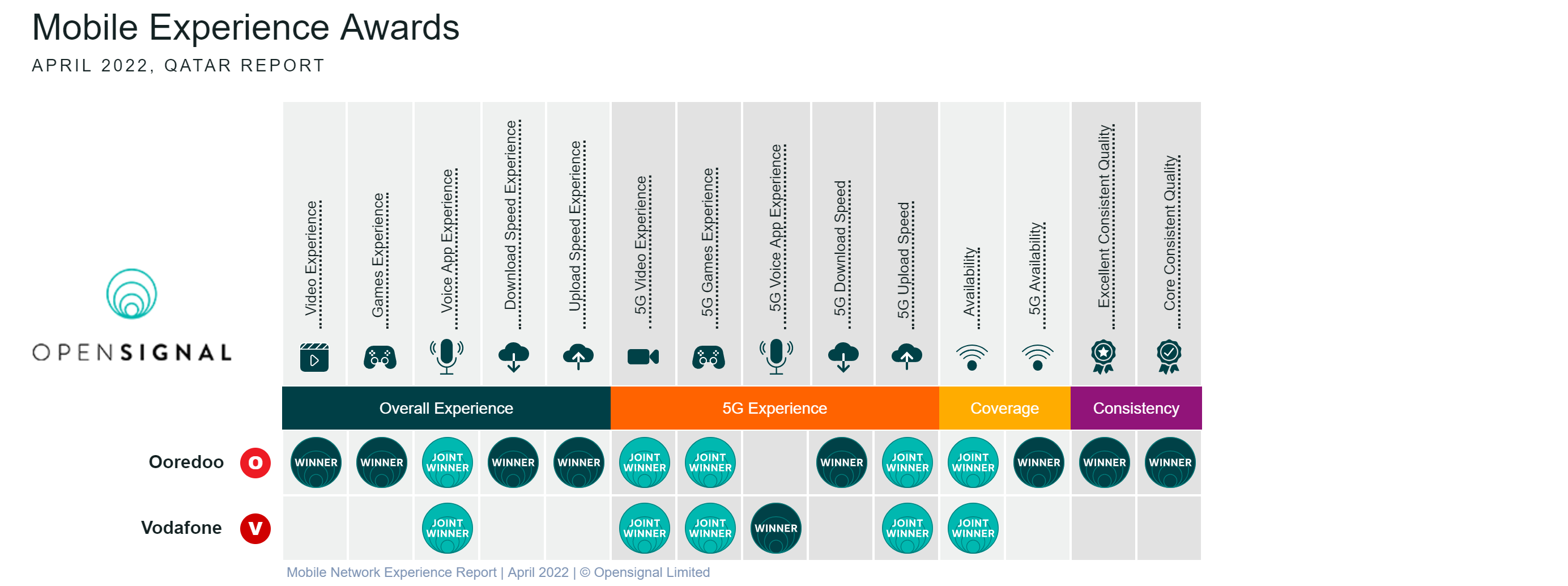
In Opensignal's latest Qatar Mobile Network Experience report  both the 5G experience and the overall experience together are analyzed for the first time in one report. Also, two new awards were added that quantify the consistency of the experience on both Qatar's national operators.

Ooredoo leads across most mobile experience categories in Qatar based on Opensignal’s awards table as it wins eight awards outright — four awards in the Overall Experience section, 5G Download Speed, 5G Availability as well as both Consistent Quality awards — compared to Vodafone’s sole outright win in 5G Voice App Experience. The two Qatari operators share the remaining five awards, including 5G Video Experience and 5G Games Experience.

Qatar’s mobile operators continue to explore innovative 5G solutions to improve the mobile experience of their users. In December 2021, Vodafone trialed its mmWave spectrum-based 5G network services with the aim of unlocking new functionality for consumers and businesses, while Ooredoo in March 2022 announced the successful implementation of a ‘world first’ 5G Indoor shareable solution using Ericsson’s kit aimed at enhancing the immersive experiences at stadiums and venues.


Ooredoo (Arabic أريدو), formely Qtel, is the market leader in Qatar with more than 2/3 of all customers in the country. It has the best coverage and speeds in the country.

Ooredoo Qatar and Ericsson have announced the successful implementation of a ‘world first’ 5G Indoor shareable solution, achieving data speeds of 1.5Gbps. The Ericsson Indoor Connect 8855 solution, part of the Ericsson Radio Dot System, has been commercially deployed in stadiums across Qatar ‘to enhance the immersive experiences of international tournaments’. The multi-operator, multi-vendor solution has full band support and 4×4 MIMO capability, enabling several communications service providers to deliver indoor 5G experiences to their subscribers with beyond-gigabit speeds. Ooredoo is an official service provider for the upcoming FIFA men’s football World Cup in Qatar in November-December 2022.


Vodafone is the no.2 in Qatar, but as long as you stay mainly in centers, it's the slightly cheaper alternative. 4G/LTE is available in Doha, Pearl and West Bay. In 2018 Vodafone sold its Qatari branch to its joint venture partner Vodafone & Qatar Foundation. The now Qatari operator has the approval to stick to the Vodafone brand for at least 5 more years.

Ookla reported that Vodafone Qatar’s resurgence as a stronger competitor to market leader Ooredoo Qatar has taken place at a key juncture for the Qatari market — the arrival of 5G. Qatar’s Communications Regulatory Authority (CRA) amended the mobile licenses held by Vodafone Qatar and Ooredoo Qatar in early 2019. The new licenses included harmonized terms and conditions for both companies, authorizing each to utilize 100 MHz of C-band spectrum (3.5 GHz) and committed them to roll out commercial 5G networks before the end of 2020 in all densely populated areas. It also required they provide coverage of all primary roads and highways as well as all venues associated with the up-coming FIFA World Cup. This was updated in May 2022 to plan the allocation to both operators of additional spectrum in the C-band as well as high frequency (26 GHz) spectrum by 2023, while their license obligations require their 5G networks to cover 99% of Qatar with minimum download speeds of 100 Mbps by 2024.

Vodafone Qatar announced in August 2019 that ‘all Vodafone SIM cards are now 5G-ready’. All Vodafone customers, on any of its prepaid or postpaid mobile plans, have the chance to access 5G mobile connectivity with a compatible device. Currently, two compatible smartphones are available in Vodafone stores, namely the Huawei Mate 20 X 5G and Xiaomi Mi 5G. The operator’s 5G network is live in dozens of residential locations across Qatar including Al Waab, Abu Hamour, Al Azizya, Al Mamoura, Al Rayyan, Umm Salal Muhammed, Khartiyat, Al Hilal, Muntazah, Muraykh and Al Sadd.

Vodafone Qatar has claimed the country’s ‘first successful trial of mmWave spectrum-based 5G network services, displaying peak data speed capabilities of 8.1Gbps (downlink)/734Mbps (uplink), with the aim of unlocking new functionality for consumers and businesses, in areas including mobile broadband, fixed wireless and industrial applications such as IoT and Augmented Reality (AR). CEO Hamad Bin Abdulla Al-Thani said: 
‘The potential of mmWave technology industries and use cases is huge, and it will pave the way for the future of 5G and connectivity. The results of this trial will enable Vodafone Qatar to continue working to roll out mmWave technology for the benefits of its consumer and business customers alike. Looking ahead, one of the most exciting prospects for mmWave is the facilitation of 360 degree streaming of 8K videos around major sporting or entertainment events … We’re always working to make our GigaNet network bigger, faster and stronger than ever before for the benefit of our customers, and mmWave is an important part of this evolution.'

Related Posts:

Sunday, 17 July 2022

Mali has to focus on 4G coverage improvement before 5G discussions can be taken seriously

Mali’s topography includes large tracts of sparsely populated desert, with many settlements being hard to reach and thus rendering it difficult and expensive to provide effective fixed or mobile networks.

Security issues have also been a concern, leading to delays in building the national backbone network. Following a coup in 2012 large areas in the north of the country were taken over by Islamic militants. The coup of September 2020 unsettled politics, and was soon followed by a second coup. The coup leaders put off holding the promised elections, and this in turn contributed to the February 2022 decision by France and other European governments to end their military support against the militants. Many areas of the country have remained generally ungovernable.

Compounding these difficulties is the fact that underinvestment in fixed-line networks has meant that telecom infrastructure is barely adequate to serve consumer needs in most towns and is largely absent in most areas of the country. In addition, a combination of poverty, high illiteracy, and low PC use has led to a very low take-up of fixed-line internet services. In common with many other countries in the region, Mali has taken to mobile networks for voice and data services. Mobile networks account for about 98% of all telecom connections. Despite these challenges, there has been progress in fixed-line connectivity, particularly during 2020 and 2021.

Orange Mali entered the market as the second mobile and fixed-line operator in 2003, and soon became the dominant provider. The duopoly with the national telco, Sotelma, continued until late 2017 when Alpha Telecom (after much delay) launched mobile services. A fourth mobile licence was secured by Mobilis, owned by Algérie Télécom, at the end of 2019.

Mali’s landlocked location makes it dependent on neighbouring countries for international bandwidth, which has kept internet prices high. Improvements in this sector can be expected from the recent arrival of several new international submarine cables in the region, while Orange Group has also been engaged in building a terrestrial network linking the capital cities of eight countries in the region, including Bamako.

Orange Mali owned by French Telecom is the current market leader. The company was extremely successful when it entered the market as the 2nd mobile and fixed-line operator in 2003. They quickly amassed more than 80% market share, offering converged fixed, mobile and broadband internet services.

At the end of 2016, Orange Mali’s network covered about 95% of the population and 46% of the country and had a base of 11 million active mobile subscribers, of which more than 99% were prepaid customers. Their uses mainly cover voice, mobile internet and mobile payment services. Only around 20% of the population have 3G coverage with speeds up to 42 Mbps like in Bamako and other regional capitals. In 2017 Orange Mali renewed its license and received permission to launch 4G/LTE services. It already trials 4G/LTE in Bamako, that is to be expected to be commercially launched by 2018.

Like in most parts of Africa mobile networks double as a payment system. Started in 2010, Orange Money service had 3.5 million customers at the end of 2016.

Orange Mali has claimed the country’s first 5G network tests, presenting its progress at a pilot project launch event on 7 July 2021 attended by government officials including Harouna Mamadou Toureh, the Minister of Communication, Digital Economy & Modernisation of the Administration. Agence Ecofin reports that Orange has begun testing 5G technology in Mali’s capital city Bamako and other regions. 

Some months back, Intelsat announced that it has been selected by Orange Mali to bring 3G and 4G connectivity to hard-to-reach areas in the country. The press release highlighted that this agreement ‘marked a first in Francophone West Africa – the successful deployment of 4G networks over satellite, judged to be the optimal solution given the size of the country and the logistics involved’.

Malitel (recently rebranded to Moov Malitel) operated by SOTELMA is the old state telecom provider and first mobile network in the country since 1989. It was privatized in 2009 and now owned: 50% by Maroc Telecom, 20% by local investors, 20% by the Mali government and 10% by staff.

In user numbers and coverage Malitel is in the 2nd position in Mali right now caring for about 41% of the mobile market as well as for a rather limited landline system.

Their 3G coverage is restricted to the towns of Bamako and Kati, Kayes, Koulikoro, Sikasso, Segou, Mopti and Kenieba, the mines of Loulou, Tabakoto, Gounkoto, Sadiola, Siama and Morila as well as Diboli on the border to Senegal. Outside these areas there is only coverage with GPRS at 54 Kbit/s. 4G/LTE has been started at the end of 2018.


In 2012 a 3rd license was issued to Alpha Telecom Mali, but commercial operations have not started until 2017 and the local counterpart has defaulted in the meantime. Finally, in October 2017 the network was launched in Bamako under the brand of Telecel and at year end 3G was added.

In 2018 the first phase of its network deployment was completed. With the cellco having focused its initial efforts on reaching the southern parts of the country, it now covers locations including Kati, Sikasso, Segou, Kayes, Koutiala and Koulikoro. Telecel is now preparing to begin the next phase of its network rollout, covering Mali’s northern and central areas. So far it can't be recommended for travellers because of its restricted coverage, but can be useful locally.

Algerie Telecom subsidiary Mobilis is poised to become the latest player to dip its toe in Mali’s telecommunication market, having been awarded an operating licence to deploy services nationwide. The award – which includes rights to offer 2G, 3G and 4G services – was confirmed by Modibo Arouna Toure, Mali’s Minister of the Digital Economy and Communication, under a provisional agreement with the government. Full terms are yet to be negotiated

Tuesday, 14 June 2022

Iran Overcoming Barriers to Launch 4G and 5G

The Islamic Republic of Iran’s telecom infrastructure has suffered from sanctions in recent years, which prevented the import of equipment and devices and encouraged widespread smuggling, with a consequent loss of tax revenue. To address this, the government introduced a device registration scheme, and bolstered the capacity for domestically manufactured mobile phones.

Operators have invested in broadening the reach of their LTE networks, which has increased network capacity and improved the quality of mobile broadband services. The country is also looking to 5G, with services having been launched by MCI and MTN Irancell in early 2021. The sector is still hamstrung by the paucity of spectrum, though the government is addressing this with plans to auction spectrum in the 3.5GHz band for 5G use.

Iran is keen to grow its Iran’s digital economy and the National Internet Network (NIN) is pivotal to Iran’s fixed broadband infrastructure plans and overall Smart City progress.

From a broad perspective, Iran offers significant opportunities for growth in the telecoms sector. The country has one of the largest populations in the Middle East, and there is a high proportion of youthful, tech savvy users having considerable demand for both fixed and mobile telecom services.

Currently Iran has 3 major GSM operators: Hamrah-e-Aval = 'the first operator' or MCI (2G, 3G, 4G), Irancell (2G, 3G, 4G) and RighTel (3G, 4G).

With all 3 featured operators 2G/GSM is on 900 and 1800 MHz, 3G on 2100 MHz. 4G/LTE has started with Hamrah Aval, Irancell and RighTel on 1800 MHz. According to user experience the GPRS service was unreliable and download speeds pretty slow. As a general rule, 4G is available in big cities and 3G in mid-sized ones, while there's very basic coverage in rural places, if at all.


Irancell is an Iranian telecommunications company that operates Iran's largest 2G-3G-4G-4.5G-5G mobile network, and fixed wireless TD-LTE internet services. It is the first provider of 5G internet in Iran.  It is the 32nd largest company in Iran. Currently, MTN Group holds a 49% percent stake in the Irancell consortium, while Kowsar Sign Paniz (KSP) holds the other 51% of shares.

On 3 December 2014, Irancell officially launched Iran's first 4G LTE network in nine cities. The License was granted as on a national basis and includes the overall geographical coverage of Iran.
Irancell made countrywide coverage with FD-LTE and TD-LTE. As of December 2021, Irancell has 50.4 million active subscribers.

MTN Irancell has launched the country’s first commercial 5G service, though it is currently only available in one area of Tehran. The firm had previously been testing 5G services at three locations in the capital. A report from PressTV says Irancell is planning to expand network coverage to the cities of Mashhad, Shiraz and Kish ‘in the next few weeks’. Iran’s Communications Regulatory Authority (CRA) recently announced plans to award 5G licences in the 3.5GHz band, while rival MNO Mobile Communication Company of Iran (MCI) is expected to announce its own commercial 5G launch in the near future.

MTN Irancell has admitted having difficulty taking money out of Iran due to the sanctions, but it says it is able to convert earnings to loans to MTN Irancell, which is allowing Iran’s second largest mobile operator to continue investment in its fixed and wireless networks.


Hamrah-e-Aval, in Farsi: همراه اول‎, in English: the first operator, is still the market leader in Iran. It is owned by the Mobile Telecommunication Company of Iran, better known as MCI. In 2015 they began with their 3G network, that they call Notrino. Though being still number one in the country, they lag behind Irancell in 3G/4G coverage. In late 2015 they started with 4G too, being only available to 10% of MCI customers so far.

State-owned MCI  has expanded its 5G coverage with a launch on the island of Kish, off the coast of southern Iran. The launch coincided with the KITEX 2022 International Exhibition which has been taking place this week on the island. MCI first introduced 5G services in Tehran in March 2021.

MCI is the longest-established and biggest mobile operator in Iran, claiming some 60 million subscribers or about 71 percent of the country.

RighTel is the 3rd operator in Iran. It was granted a 3G license in 2011 and it had a monopoly on 3G 2011-2014 in the country. Rightel works great in certain parts of large cities, but has horrible (or non existent) coverage in smaller cities and many rural areas. Many people thought its prices were too high, and the speeds given were much slower than what was advertised. High speed internet also caused some cultural controversies, leading RighTel to restrict selling its SIM cards to those 18 and older.

RighTel has just over 5 million subscribers

A report from Iran’s official IRNA news agency says that more than 35,000 villages have been connected to high speed internet networks over an eight-year period under a project to improve rural services. PressTV cites IRNA as saying that 35,519 remote villages had access to broadband services as of March 2020, up from virtually zero eight years before. A further 17,000 villages have received internet access but at lower speeds. The government introduced legislation in 2017 requiring the country’s two main cellular operators, MCI and MTN Irancell, to expand their networks to more rural regions. Landline phones have reached four million households in 47,000 villages, according to the report.

Iran’s Minister of ICT says he expects the country’s National Information Network (NIN) project to be complete within four years. A report from the Financial Tribune cites Isa Zarepour as saying: ‘After around two decades of foot-dragging, it is finally time to give the initiative one last push.’ The NIN scheme was first proposed by the government in 2005, but work did not start until 2013. The aim is to establish a closed national intranet of locally made, government endorsed Islamic content, which will sit alongside the World Wide Web. Critics say, however, that the government could use it to replace the wider internet, effectively cutting off many citizens from the outside world.

Related Posts: