Showing posts with label Technology VoLTE. Show all posts

Tuesday, 4 July 2023

Operators in Kyrgyzstan Cautiously Test 5G!

The Kyrgyz Republic, known as Kyrgyzstan, has the highest levels of mobile penetration across Central Asian (CA) countries — 159.9% with 2.94 SIMs per unique mobile subscriber, according to GSMA Intelligence. Despite being the second poorest country across CA, Kyrgyzstan came first regarding 4G Availability (the proportion of users of 4G-capable devices who spend most of their time on 4G networks). The National Development Strategy of the Kyrgyz Republic 2018-2040 is one initiative that facilitates digital transformation to hasten the country’s economic development. The State Communications Agency (SCA) stated in its annual report for 2021 that a total of 2,049 settlements across the country were covered by 4G LTE mobile networks at the end of 2021, equivalent to 96% of the country’s 2,130 officially registered cities, towns and villages. 2G mobile network technology extended to 2,088 locations (98%), while 3G networks were present in 2,081 (97%). Overall, 42 settlements (1.9%) were outside mobile network coverage, some due to a lack of power transmission lines.

Beeline Kyrgyzstan, Megacom,  and O! (Kyrgyztelecom) are the major mobile operators in the country. Megacom Kyrgyzstan, run by the state-owned Alfa-Telecom has started its rebranding campaign to MEGA following Megacom ownership transfer to the state-owned Kyrgyzstan State Development Bank. The operator announced that it expanded and upgraded its 2G, 3G, and 4G networks in seven regions and the capital of the Kyrgyz Republic. It plans to continue network coverage expansion across remote areas of Kyrgyzstan.

MEGA currently claims roughly three million mobile subscriptions, and its CEO Nurlan Mamytov stated that its strategic goals for 2023 include expanding the active user base, deploying at least 200 additional base stations in twelve months, upgrading network quality and data/internet speed, modernising existing technical infrastructure, further expanding the distribution/sales network, developing fintech services, and ‘creating favourable conditions for attracting large investments’.

In April of this year Mega launched Kyrgyzstan’s first VoLTE calling service. The IP-based 4G mobile voice service is available to compatible handset owners in all areas covered by MEGA’s LTE network, its press release claimed. VoLTE calls are provided at no extra charge to the user, with the cellco highlighting the technology’s benefits including fast call set-up time, high-definition sound quality and simultaneous high speed 4G mobile internet/voice connections.

Beeline is the biggest competitor of MegaCom in the country. They recently announced plans to leverage its parent group VEON’s partnership with satellite provider OneWeb to ‘become the first mobile operator in Kyrgyzstan capable of providing continuous communication and high speed internet to the most remote areas of the country, even those areas that have not had access to the network until now.’ Beeline said that the partnership with OneWeb will enable the elimination of digital inequality, ensure continuous communication in emergency situations ‘and increase the rate of economic growth of the population’ using high speed, low-latency satellite internet connectivity.

O! by Nur Telecom is the smallest of the three operators. Starting in Bishkek, Osh and Jalal-Abad, it offers 4G/LTE on 800 and 2600 MHz (B7 and 20). This has now spread to the country side and 97% of the population are covered in 2020 by LTE.

O! reported in August 2022 that they had conducted measurements of 5G data speed ‘which for the first time in Kyrgyzstan accelerated to 1.5Gbps.’ The company’s technical director Anton Kovalenko noted that ‘the launch of 5G into commercial operation is not far off, but it is too early to talk about a mass commercial launch, the transition will be phased.’ He added: ‘If [customers] are looking for a new smartphone, then in my opinion, it already makes sense to turn your attention to devices with support for the latest technology.’

5G in Kyrgyzstan is being tested in the n77 and n78 (3400MHz-3800MHz) frequency ranges, and will initially be integrated with existing 4G networks. O! expects its eventual 5G network to provide data speeds around ‘ten times faster than 4G’ with ‘average speed of 150Mbps-200Mbps.’

The mobile telecommunications sector in Kyrgyzstan is experiencing a dynamic phase with continuous efforts to improve network coverage, enhance service quality, and offer competitive pricing, mobile operators are striving to provide residents and visitors with an excellent mobile experience. As the industry evolves, customers can expect more advanced services, increased connectivity, and a vibrant mobile ecosystem in Kyrgyzstan.

Related Posts

Thursday, 9 March 2023

Nepal is Taking Right Steps in Direction of 5G


Unfortunately Nepal's telecom sector has several topographical and economic constraints which have impeded efforts to expand network infrastructure and improve the quality of service for end-users.

The fixed line market remains underdeveloped, and as a result most traffic is channelled via mobile networks. Fixed broadband penetration remains very low, though to address this the government has initiated several programs as part of the Digital Nepal Framework and the wider Optical Fibre Backbone Network Expansion Project, started in 2012. Supported by the Rural Telecommunications Development Fund, the programs include building out fibre backbone infrastructure and using this to provide broadband to schools and community centres nationally.

Operators have also invested in fibre networks, and competition in the market is intensifying. Cheap fibre-based services launched by CG Net in mid-2021 prompted responses from other ISPs to provide faster and more competitively priced offers.

Nepal’s mobile market is relatively developed, with a focus on LTE. In 2021, the regulator considered a range of spectrum bands which could be used for 5G.

Nepal has three GSM mobile operators: Nepal Telecom (state owned), Ncell (owned by Axiata) and Smart Cell (by Smart Telecom, limited coverage on 2G, 4G/LTE; no 3G).

2G is on 900 and 1800 MHz and 3G on 2100 MHz. In 2016 the government of Nepal begun the process of converting existing wireless licences to technology neutral permits, enabling operators to use their current 900 MHz for 3G and free their 1800 MHz (B3) frequency holdings to offer 4G/LTE services. 4G/LTE has been launched by all three providers in 2017. Due to its mountainous territory, coverage can be very spotty and data speeds extremely slow outside the Kathmandu central valley or Pokhara.


Nepal Telecom (NTC) is the state owned, national provider in Nepal. It has a monopoly on landlines and broadband, but competes with Ncell for mobile customers. 

NTC uses 900 Mhz for 2G and 2100 Mhz for 3G. Simultaneously, it runs a CDMA network too which will be switched off by 2021. GSM-coverage is slightly lower than Ncell. Until 2017 only about 60 3G sites have been installed and on air including Banepa, Bhaktapur, total 59 sites in Kathmandu and 1 site in Pokhara.

4G/LTE has started as first provider in Nepal in 2017 on 1800 MHz (B3) only in the Kathmandu Valley and Pokhara only opened for prepaid. NTC signed 40,000 LTE users in two weeks alone. In 2019/20 the 4G network was expanded and it has 4G coverage at these locations.

Nepal Telecom has a total of 18.95 million mobile broadband users where 7.26 million are 3G users, 11.55 million are 4G users and 136,573 are EVDO users. Just last year Nepal Telecom (NT) marked its 18th anniversary by announcing the commercial launch of VoLTE services, enabling customers with a compatible handset to enjoy high definition voice calling over its 4G network and simultaneous use of voice and high speed data services.

Nepal Telecom had originally planned to kick off 5G trials in mid-July 2021, but the timetable was delayed after a change of government prevented assignment of the additional spectrum resources required. Having finally been granted a testing permit and 60MHz of frequencies in the 2600MHz band the following November, NT then encountered further problems with equipment delivery, while plans to finally start the trial last month were thwarted by the extremely low number of compatible devices. The operator intends to launch test networks in all seven provinces of the country by the end of its current financial year (mid-July 2023).

Ncell is the no.2 in Nepal with a total of 8.88 million mobile broadband users where 1.93 million are 3G users and 6.95 million are 4G users.

Its 2G is on 900 and 1800 Mhz and reaches 90% of population, 3G is on 2100 Mhz in about 20 of the biggest towns. Ncell Coverage Map. Ncell is the better provider in the country, but there are still many areas uncovered and don't expect high speeds.

The start of their 4G/LTE was further delayed in 2017 by taxation issues and was finally launched in June 2017 on 900 and 1800 MHz in the Kathmandu Valley, including the areas of Nagarkot, Banepa and Dhulikhel. In summer 2017 the cites of Biratnagar, Birtamode, Damak, Dharan, Bharatpur, Hetauda, Birjung, Bhairahawa, Butwal and Nepalgunj were added to the 4G/LTE network. In 2019 seven of the country’s provinces and over 1,000 locations nationwide are covered, making it Nepal’s most extensive 4G network.

In September 2022 they announced the commercial launch of their VoLTE service, providing customers with superior quality HD voice and faster call connectivity. The new service is activated free of charge and is currently available on selected Samsung, Vivo and Huawei handsets. Customers enabling the service will receive 100 bonus minutes of on-net talk time valid for 28 days. Launched in June 2017, Ncell’s LTE network has been expanded to areas of more than 70 districts and now covers approximately 85% of the country’s population.

Smart Telecom is the third telecom operator in the country, they only has 2G and 4G services in its Smart Cell brand. They have a total of 127,551 subscribers to their 4G service.

They are on 2G/GSM on 1800 MHz. In 2017 a license to use 4G/LTE was granted to Smart and in October 2017 Smart has finally launched its long-awaited 4G/LTE service, with the company stating that it is now live in Kathmandu, Lalitpur, Bhaktapur and Pokhara. The new 4G service offers customers speeds of up to 70 Mbps. Smart Telecom has been granted 10 MHz of frequencies in the 1800 MHz (B3), while its two competitors Nepal Telecom (NT) and Ncell have only been allocated 5 MHz each in this spectrum band.

Related Posts:

Wednesday, 13 April 2022

4G and 5G to Power Kenya's Broadband Ambitions

Kenya’s telecom market continues to undergo considerable changes in the wake of increased competition, improved international connectivity, and rapid developments in the mobile market. The country is directly connected to a number of submarine cables, and with Mombasa as a landing point for LIT’s newly completed East and West Africa terrestrial network, the country serves as a key junction for onward connectivity to the Arabian states and the Far East. The additional internet capacity has meant that the cost of internet access has fallen dramatically in recent years, allowing services to be affordable to a far greater proportion of the population. In parallel, the sector’s regulator has reduced interconnection tariffs and implemented a range of measures aimed at developing further competition.

Numerous competitors are rolling out national and metropolitan backbone networks and wireless access networks to deliver services to population centres across the country. Several fibre infrastructure sharing agreements have been forged, and as a result the number of fibre broadband connections has increased sharply in recent years.

Much of the progress in the broadband segment is due to the government’s revised national broadband strategy, which has been updated with goals through to 2030, and which are largely dependent on mobile broadband platforms based on LTE and 5G.

Kenya has currently has four network operators: Safaricom, Airtel, Telkom and Faiba 4G.

2G is on 900 and 1800 MHz and 3G on 2100 MHz on all three providers. 4G/LTE has started in 2014 with Safaricom on 800 (B20) and 1800 MHz (B3) and has started with Airtel on 800 MHz (B20).In 2017 Faiba launched its 4G-only network in a very limited area of the country. 

Coverage is pretty good, except for the very remote areas in the north, but mobile towers are sometimes overload, which leads to slow speeds. But the mobile network is rapidly being expanded.

Safaricom has been ranked as having the best network in Kenya – for data and calls – after independent network tests from global company Umlaut.

Umlaut's mobile benchmarking unit analyzed the mobile networks of Kenya to rank their performance. It measured smartphone voice and data performance based on extensive "drive tests" – from major metropolitan areas to smaller cities and connection roads, which it did between September 24, 2020, and October 26, 2020.

Umlaut found Safaricom to be the only mobile operator to deploy voice-over-LTE (VoLTE) services across the country including in rural areas, therefore contributing to the operator achieving the best call set-up time. In the tests, Safaricom achieved average download speeds up to 58.5 Mbit/s and average upload speeds up to 36.4 Mbit/s.

Safaricom said in a statement that its top performance in mobile data was due to its deployment of 4G carrier aggregation, which made it the only operator to exceed 20MHz in data upload tests.

"4G Carrier Aggregation enables Safaricom to combine its 4G bandwidth on both the 1800 and 800 frequency bands. In turn, this means Safaricom's 4G customers can establish more than one simultaneous connection to network masts thus achieving more than 150% the speeds of a typical 4G connection," 

The mobile operator has been aggressively expanding its 4G coverage with a goal of having 100% of its network on 4G. Safaricom is also by far the biggest operator in Kenya with over 35.6 million customers and about 65% market share at the end of 2020, according to statistics from market research company Omdia.

Safaricom announced the launch of 5G trials in March 2021 for both individual and enterprise customers in Nairobi, Kisumu, Kisii and Kakamega. As part of the trials, the operator plans to expand the number of 5G sites to more than 150 across nine towns over the next twelve months. The primary objective during the trial period will be to establish if customers can access speeds of up to 700Mbps, with plans to offer speeds of up to 1Gbps in coming months. Nokia and Huawei have been chosen as the two technology partners to implement the rollout of Safaricom’s 5G network.

Safaricom has also signed a multi-year contract with satellite provider Intelsat to modernise its network and expand LTE coverage. Under the deal, Intelsat will provide cellular backhaul and satellite and enterprise connectivity services.

Airtel, owned by Indian Bharti Airtel is the second provider in the country. In 2017 Airtel is set to begin trialling a 4G/LTE network in the capital Nairobi and will be expanded to 45 other sites in major towns, including Mombasa and Kisumu within the year. In 2018 it bought their license on band 20 (800 MHz) and in May Airtel announced the commercial launch of 4G/LTE services.

Airtel Kenya has recently received a ten-year frequency licence comprising 2×10MHz of spectrum in the 2100MHz band. Airtel agreed to pay USD10 million for the licence, which will be valid until 2032. In respect of settlements regarding its 2015-2025 operating and spectrum licence, Airtel will pay a total of USD20 million in four instalments over the next three years.

Established as a telecommunications operator in April 1999, Telkom is 60 per cent owned by Helios Investment Partners, with the remaining stake held by Kenyans through the Government of Kenya. Telkom has 4,152 km of its own terrestrial fibre cabling, serving as a key conduit for broadband connectivity, inland. Telkom Kenya also owns a 22.5% stake in TEAMS, a 5,000km undersea fibre optic cable through Fujairah, UAE, and a 10% stake in LION2, another 2,700km undersea fibre optic cable through Mauritius. It also owns a stake in the East African Submarine System Cable (EASSy) and manages the National Optic Fibre Backbone Infrastructure (NOFBI), on behalf of the Ministry of ICT, an inland fibre optic cable network running through Kenyan counties. 

Telkom Kenya has signed a Memorandum of Understanding (MoU) with Ericsson and systems integrator NEC XON to deploy an additional 2,000 4G LTE base stations across the country by 2023. In a press release, Telkom Kenya confirmed the USD100 million modernisation project will deliver a four-fold increase in its 4G mobile footprint, reaching ‘the majority of citizens across Kenya’. In so doing, the company hopes to deliver improved service availability as it looks to bridge the digital divide and provide Kenyans with an enhanced customer experience. The nationwide rollout is part of Telkom’s long-term network expansion strategy, announced in August 2020, when it underwent a strategic reorganisation.

Faiba 4G by triple-play provider Jamii Telecommunications Ltd. (JTL) started in December 2017 in a very limited area a 4G-only network on 700 MHz (Band 28). There is no fallback to 2G or 3G and all voice services are provided through VoLTE.

At launch, Faiba boasts of 300 base stations with a target of achieving 1000 stations by 2020. JTL says that Faiba customers can achieve up to 72 Mbps speeds. Faiba is so far available in the following areas: Nairobi, Mombasa, Nakuru, Eldoret, Kisumu and Thika.

Related Posts:

Monday, 22 April 2019

Reliance Jio Announces Progress, Amid Decreasing ARPU

Back in October we wrote about Jio reaching 250 million subscribers, now it has announced over 300 million subscribers up to March 2019. In fact their Q4 financial results summarises the results nicely, as can be seen in the picture below.

In summary:

  • Total subscriber base stands at 306.7 million
  • ARPU 126.2 (roughly US $1.8)
  • Average data consumption 10.9 GB/ user/ month.
  • Wireless Data Consumption across network was 956 crore GB (9560 Petabytes) during the quarter 
  • Average Voice 823 minutes of VOLTE voice/ user/ month
  • Jio network carried ~71% of 4G data traffic in India during CY18

One of the strategies that Jio has adopted is to bring connectivity to even the most remote locations. In a way they are forced to do this as they do not have legacy networks and rely on VoLTE for voice. VoLTE only works reliably with a proper 4G coverage.

In addition to providing voice & data, Jio is bringing unique Apps for not just keeping customers updated and in-control of their package, service and spending but also entertainment which is a must have nowadays for any service to succeed. Smart feature phones using KaiOS is letting them bring new users who are too reluctant to transition to smartphones.


OpenSignal report on India Mobile Network Experience, April 2019 pointed out that:

The story of Jio's network expansion is remarkable. Jio has been a fully-fledged 4G operator for less than three years, but has completely disrupted the market with its rapid network rollout and unlimited data plans. In our first report on the India market two years ago, Jio scored an outstanding 91.5% 4G Availability. Six months later the operator had passed the 95% mark, and its score has been steadily growing ever since.

To put this in context, Jio's winning 4G Availability score of 97.5% is the highest we have ever recorded at country level in any of our reports. In the U.S., two operators have scored over 90%, while in Taiwan four are over this mark — but none in either market have yet passed 95%. Even in the Netherlands, arguably Europe's most advanced mobile market, all the operators have 4G Availability scores over 90%, but only one has passed 95% — and only just, reaching 95.2% — while Japan has two operators over this benchmark. In a country with the sheer geographical size and population base of India, where the landscape ranges from huge cities to high mountains and vast agricultural plains, Jio's achievement of reaching 97.5% 4G Availability in such a short time is truly astonishing.

Jio has themselves committed to achieve all-IP 4G LTE network population coverage of 99% shortly. We will wait and see when this will happen but in the meantime, Reliance Jio has plenty to celebrate.

Thursday, 19 July 2018

Malaysia: Challenges of 4G


It has been more than 5 years since 4G LTE was officially rolled out in Malaysia. Today, there are six 4G LTE operators in the country and the cost of data is so much more affordable than before. The mobile operators are – Maxis, Celcom Axiata, DiGi, Webe, U Mobile and Yes. In May 2017 Celcom Axiata carried out what is claimed to be Malaysia’s first 5G trial. The test was also said to have demonstrated futuristic 5G use cases, such as robotic control, connected environment, virtual reality, Internet of Things (IoT) applications and 4K video streaming.


Although 4G technology is available 74.88% of the time to Malaysians, its speed leaves much to be desired. According to a report by OpenSignal, a company that specialises in wireless coverage mapping, the 4G speed in the country is only 14.83Mbps.

With that, OpenSignal ranks Malaysia as one of the lowest 20 countries in the list which was led by Singapore at 44.31 Mbps while India being ranked last due its 6.07 Mbps download speed.


However,  LTE availability in Malaysia was more promising. The report pointed out that the LTE connectivity in the country can be accessed 74.88% of the time throughout Q4 2017. While it is better than Algeria which occupy the bottom of the list due its 40.94% rating, Malaysia is nowhere near South Korea whereby users were able to achieve LTE connection 97.49% of the time.


According Open Signal test results regarding the highest 4G/3G download speeds and the lowest latency for both 4G and 3G among operators: Maxis comes out on top overall. 


Coming in at second place is Yes. When it comes to 4G, Yes records an incredibly high 93.18% availability followed by Maxis at 80.45%. OpenSignal notes that 4G availability isn’t a representation of geographic or population coverage, but rather how often its users are connected to a 4G network. It is worth mentioning that Yes itself runs on a pure 4G network so if it goes out of coverage, there’s no 3G or 2G network to fall back on. Yes also records the highest overall average download speed of 19.03Mbps and it isn’t surprising since its users are connected only on 4G, while other telcos have samples measured on 3G.

If we look at the rest, Celcom (16.15Mbps) takes 3rd place followed by Digi (11.77Mbps) on 4th and U Mobile (7.2Mbps) at 5th place for 4G downloads. Webe (or now known as UniFi) is ranked the lowest at 6.76Mbps. When it comes to 3G, 2nd place goes to Celcom (2.9Mbps) followed by U Mobile (2.78Mbps) and Digi (2.58Mbps).

You can read the full OpenSignal report here.

Thursday, 22 February 2018

Bahrain: Mobile Networks Overview


The liberalised telecoms market of Bahrain continues to develop at a rapid pace. Telecommunications industry revenues are increasing, mobile penetration is very high and mobile data is growing faster than voice. There are now over 2.6 million mobile subscriptions in the Kingdom and penetration sits at around 180%.

Consumers are benefiting from competition which has led to a decline in prices for services. Roaming costs have also reduced and will continue to do so for the next few years. The unlicensed mobile sector, led by handset devices has resulted in a revenue growth.

With mobile subscribers accounting for the majority of broadband subscriptions in Bahrain, the operators are focusing heavily on improving mobile infrastructure. LTE networks are well established, and the operators are now establishing new services like VoLTE, LTE-A, M2M and preparing for the advent of 5G in the future.


Batelco is one of three major mobile operators in the country with 1.14 million connections, excluding M2M, equating to an estimated market share of 34 per cent.

Batelco once enjoyed a monopoly in Bahrain, but now competes within a crowded market. It faces major competitors including Kuwait’s Zain and the Saudi Telecom Company-owned VIVA, along with a slew of smaller operators and internet providers. They’re all competing for a market of about 1.4 million people.

For Muna Al Hashemi CEO of Batelco Bahrain, turning Batelco into a digitally-oriented telecom while simultaneously keeping ahead of the competition is a multifaceted undertaking. “We are transforming our culture, our mode of operation [and] our infrastructure,” says Al Hashemi.

From an infrastructure perspective, Batelco signed a deal earlier this year with telecoms technology provider Ericsson to pursue updates to its mobile network. It’s also continuing to invest in expanding its fiber optic network across the country. Simultaneously, the telecom is preparing for transformative technology that hasn’t yet arrived.

Although some mobile operators in MENA have yet to introduce 4G, Batelco is already exploring the next frontier in connectivity. 5G mobile network technology is still a few years away, but Deloitte estimates that by 2021 the 5G subscriber base in the GCC will reach around half a million, and will grow across the region to become the standard by 2025.

Al Hashemi says the telecom conducted the first successful 5G trial in Bahrain in May 2017, with help from Ericsson. Held at Batelco’s headquarters, the test demoed to a live audience how the technology could be used in IoT applications.


She estimates that 5G should be ready for commercial use in Bahrain sometime in 2019 at the earliest. According to Ericsson’s 5G Business Potential Report, 5G technology could create $600 million in business opportunities in Bahrain.


VIVA Bahrain is a fully owned subsidiary of the Saudi Telecommunications Company (STC) 
Through its HSPA+ network upgrade in 2011, VIVA became the first operator in Bahrain to provide speeds of up to 42 Mbps to its broadband subscribers and to test successfully and showcase its 4G/LTE network in early 2012, officially launching 4G/LTE services to customers in January 2014.

VIVA was launched as Bahrain’s third mobile operator in March 2010. Despite entering a highly saturated mobile market (128% penetration at the time), VIVA was able to garner substantial market share and achieve market leadership within just two years, setting a new benchmark for a late entrant in the mobile and broadband segments.

Viva Bahrain,  is currently the country’s largest mobile network operator (MNO) by subscribers. Their VoLTE technology has been made available to customers using a selection of Samsung devices, enabling these subscribers to access higher-quality voice calls and faster data speeds over Viva’s 4G LTE network. According to TeleGeography’s GlobalComms Database, Viva Bahrain launched 4G services in January 2014 and introduced its LTE-A network in July 2017, while at June 2017 the company held a market-leading share of 42.2% of mobile subscribers in the Kingdom.

 The company’s success can be attributed to the trust and support of the local community and in line with its mission to ‘Make a positive difference to the local community’ by promoting a knowledge based society and participating in community development programs’, VIVA Bahrain created VIVA Jusoor. This Corporate Social Responsibility (CSR) programme is dedicated to the development and execution of sustainable projects to benefit the local community by connecting people and facilitating a free exchange of experiences, ideas and information.


Zain Bahrain a telecom innovator focused on enhancing customer experience, reported a 22% surge in its customer base during 2016, from 795,000 to 971,000 customers at the end of the year. The leap in new customers was attributed to innovative products and services rolled out by the operator, which offer a fully integrated futuristic digital lifestyle. Zain Bahrain also benefited from growing awareness of the strong connectivity and speeds of its world class 4G LTE network. 

“Zain Bahrain’s profitability in such a highly competitive market landscape speaks volumes about the merit of its market strategy,” said Zain Bahrain’s Chairman, His Excellency Shaikh Ahmed bin Ali Al Khalifa. “And the fact that Zain Bahrain’s customer base continues to grow in the face of this intense competition speaks of the quality of the user experience on our network.” 

"Despite the intense competition, Zain Bahrain has managed to position itself well for the long term, with a higher share of the market as consumers responded to our many marketing initiatives during the year. We remain committed to our core values of excellence and innovation, and look forward to crossing the one-million customer mark in in the near future, while creating increased value for our shareholders.”  

Zain Bahrain’s cutting edge 4G LTE network saw a 35% expansion, with 87 new sites added to provide higher speeds and better indoor coverage to fixed wireless customers. A total of 44 new sites were also added to enhance the 3G and LTE mobile network coverage across the Kingdom. A high-end IMS based next generation Core Network was introduced to provide better call quality for fixed and enterprise customers.

In line with its commitment to innovation and enhancing customer experience, Zain Bahrain rolled out the Kingdom’s first ‘Truly Unlimited Social Media’ prepaid and postpaid packages under which customers were not billed for data used through social media applications beyond their initial subscriptions.

Zain Bahrain recently announced it expects to launch commercial 5G by the end of 2018. 


Friday, 15 December 2017

Disruptive Reliance Jio on the road to 4G leadership

Continuing from our earlier post on India in October.

According to this BGR news report:
2017 was a significant year for Indian telecom during which 4G became the new norm. Usage exploded riding primarily on Reliance Jio — the 15-month old network that is already the world’s fastest-growing telco — and the effects trickled down to other operators too. Nearly 4 million TB of 4G data has been consumed by Indians this year, according to a TRAI estimate. Consumers relished swathes of data sometimes “effectively free” and sometimes at incredibly low prices, and hordes of first-time smartphone buyers were inducted into the world of mobile data. The year came to be defined by the stiff price war between incumbent telcos and disruptor Jio.
According to this tweet by Neil Shah, Counter Point:


4G LTE subscriptions: 135 Million
Data Consumption : 10GB per month / user
VoLTE calls : 626 minutes per month / user
Video Consumption: 14 hrs per month / user


A similar picture was reported by Tefficient:
These customers generated 3780 petabyte of mobile data. It's by far the biggest network in the world. The graph suggests that might be around 80% of India's total - Q3 isn't reported by the others yet. Per subscription, that is 9,6 GB per month which means that Jio might challenge the global usage leaders of the world - 3 Austria, DNA and Elisa Finland and FarEasTone and Taiwan Mobile from Taiwan.


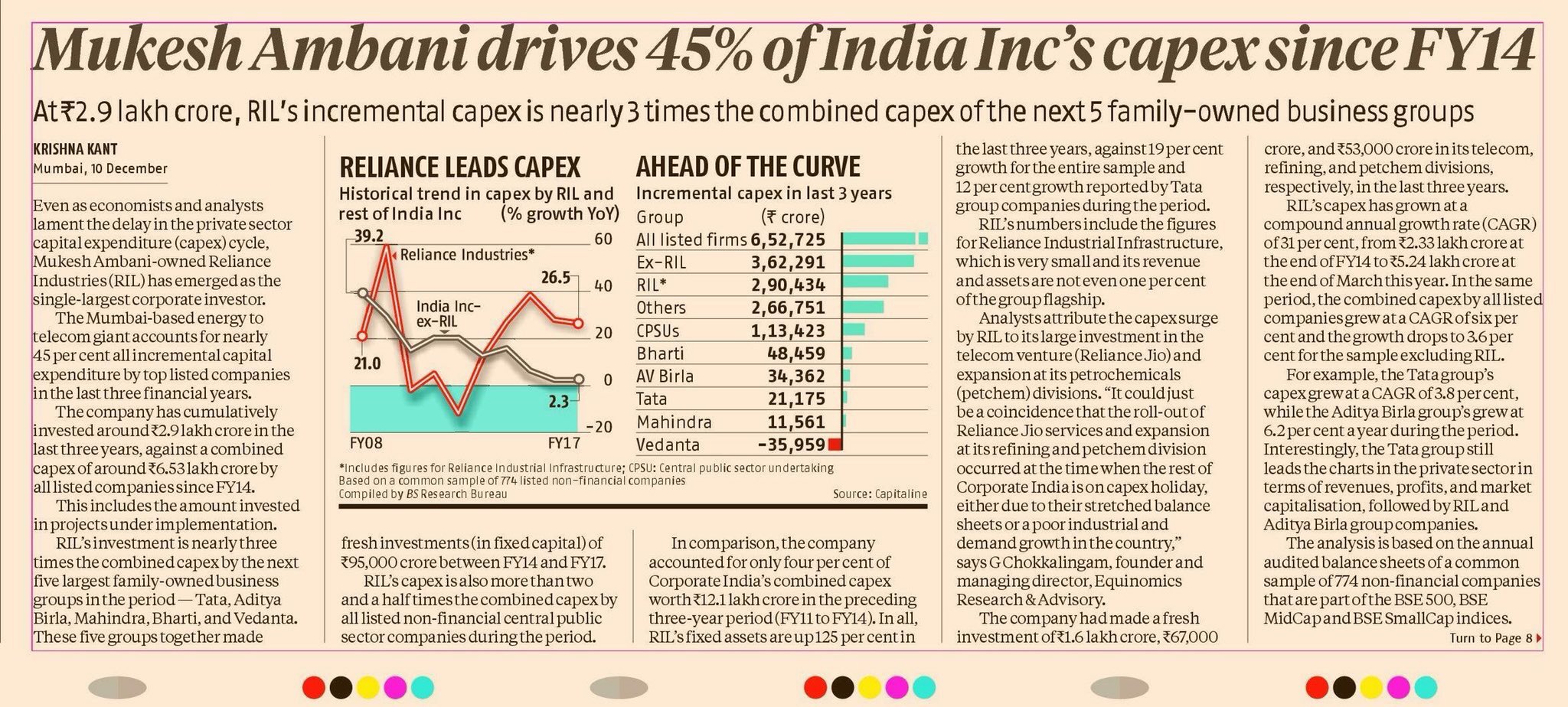
Its interesting to note that no only are Reliance Jio's users the highest data consumers in the world, its also driving India's infrastructure building activity. According to the newspaper report below, Reliance Industries has been responsible for 45% of capex spend in India in the last 3 years.


According to GadgetsNow:
India's current mobile data subscriber penetration stands at 40 per cent which is expected to double to 80 per cent by 2022, according to Crisil's predictions. 
"LTE services have taken the leading role in the unprecedented increase of data users in the past year, in large part thanks to Jio," the report said.
The 3G4G Small cells blog has a post on small cells rollout in India here. In addition, Tareq Amin, Senior Vice President, Reliance Jio Infocomm recently spoke in the TIP summit. His talk is embedded below.


One could argue that rolling out 4G can only be considered successful if the end users can reliably make use of it. According to Opensignal blog:

As we saw in our latest State of LTE report, published in November, LTE availability in India is remarkable: users were able to connect to an LTE signal over 84% of the time, a rise of over 10 percentage points from a year earlier. This places India ahead of more established countries in the 4G landscape such as Sweden, Taiwan, Switzerland or the U.K. 
... 
While LTE availability saw a meteoric rise, the same cannot be said of 4G speeds. In our latest State of LTE report, India occupied the lowest spot among the 77 countries we examined, with average download speeds of 6.1 Mbps, over 10 Mbps lower than the global average. 
A key reason for the strikingly low speeds is the rapid increase in 4G users across all the networks. As 4G adoption rose, and more and more consumers subscribed to 4G services, the networks experienced congestion, resulting in a decrease in average download speeds across the board. 4G users on the networks of Idea, Vodafone and Airtel all witnessed a drop in average 4G download speeds over the course of 2017. 
Meanwhile Jio trended the opposite direction in 4G speed. In our April report Jio had the slowest 4G speed in our India tests, but as soon as Jio’s freebie plan ended in April 2017, we recorded an astonishing 50% increase in their speed (from 3.9 Mbps to 5.8 Mbps) over the course of six months, which still placed Jio at the lowest end of the speed spectrum but with a significantly narrower gap.

When it comes to mobile internet speeds, where 3G and 4G LTE are considered together, India comes in the 109th place in the world according to data collected by Ookla.
Doug Suttles, co-founder and general manager at Ookla said, “Both mobile and fixed broadband internet in India are getting faster, that’s good news for all Indian consumers no matter which operator or plan they use to access the internet. India still has a long way to go to catch up with countries that have top speeds around the world, however, we at Ookla are highly optimistic about the capacity for growth that is available in the Indian market and looks forward to watching how the market grows in this coming new year.”


2018 may probably be the year India gradually transitions from being a developing 4G country to become a full-grown 4G power.

Thursday, 2 November 2017

The 4G explosion in China

The popularity of 4G mobile services in China continues to increase and subscriber growth shows no signs of slowing down. In fact China has built the world's largest 4G network within just four years and is aiming to add 2 million 4G base stations, mainly for townships and villages, by 2018. China began a campaign aimed at faster and more affordable Internet connection in 2015 resulting in a total of 950 million 4G network users as of the end of September 2017, according to figures from the Ministry of Industry and Information Technology (MIIT).


Served principally by three mobile network operators, China’s mobile sectors are largely divided along technological lines. China Mobile - currently the largest operator by subscribers focuses on the locally-developed TD-LTE 4G standard.  While rivals China Unicom and China Telecom have gone for a mix of TD-LTE and frequency division duplex LTE (FDD-LTE). 

According to Shang Bing, chairman of China Mobile the operator has pursued a strategy of 'Big Connectivity' and invested about CNY450 billion ($66 billion) over the last three years to build  the world’s largest 4G network. Its 4G user base reached 583 million in May 2017, with 4G penetration at 67.5 per cent. “One in four 4G users in the world is a China Mobile user.” It has deployed 1.6 million 4G base stations, or about 30 per cent of the global total, Shang said. Its 4G coverage will reach 99 per cent of the population by the end of the year, when its LTE base station count rises to 1.77 million.

China Telecom’s 4G user base doubled last year to 122 million, with LTE subscribers accounting for 57 per cent of its mobile connections and deploying 1.05 million base stations, while China Unicom’s 4G subs rose from 44.1 million at end-2015 to 104.5 million, representing 40 per cent of its customer base, with 770,000 base stations.


How 4G has helped change and improve lives in China

So why is 4G so important? Probably because it is a vital foundation for all that is to come:

"Future technologies, including 5G, the internet of things and AI (artificial intelligence) will drive society into the era of the internet of everything. The development of 4G has brought about the prosperity of mobile internet and changed people's lives," 

says  Li Zhengmao, vice-president of China Mobile. Industry pundits insist that 4G has been the greatest achievement in the national information technology sector during the past five years in rural and urban areas.But then the benefits of 4G are not limited to urban areas. Rural regions in China have also been opened up by the service. In Huanggang, Hubei province, farmers can sell their produce online through e-commerce sites, and buy crucial equipment safer and quicker through the network. China Telecom has spent 200 million yuan ($29.46 million) to roll out 1,300 base stations in Huanggang.

The decision has increased 4G coverage rates from 35 percent to 93 percent. It has also helped local farmers with vital agricultural information, as well as alleviating poverty through online education.

Even after all this progress, VoLTE is still long way away. According to a report in summer, China Mobile targets 17% VoLTE penetration this year. China Mobile group vice-president Mr.Liu Aili had said back in 2015, "VoLTE network deployment is the one of the most difficult project ever, the implementation complexity and workload is unparalleled in history"

Its not unreasonable to think that since China has the world's largest 4G market it is the  country that will lead the world in the development and utilization of 5G.