Showing posts with label Operator MTN. Show all posts

Tuesday, 29 April 2025

How South Africa’s Mobile Operators Are Shaping the Future of Connectivity

South Africa has one of the most dynamic and competitive mobile telecommunications markets on the African continent. With millions of subscribers and evolving infrastructure, the country's mobile operators play a crucial role in driving connectivity, digital inclusion and economic growth.

Data from GSMA Intelligence shows that there were 124 million cellular mobile connections in South Africa at the beginning of 2025. For perspective, many individuals make use of more than one mobile connection, so it is not unusual for mobile connection figures to significantly exceed the total population. For example, the same person might have one connection for personal use and another for work. The rise of eSIMs has made this even easier in recent years.

GSMA Intelligence’s numbers indicate that mobile connections in South Africa were equivalent to 193 percent of the total population in January 2025. Looking at trends over time, the number of mobile connections increased by 5.2 million (4.4 percent) between the start of 2024 and the beginning of 2025.

Meanwhile, GSMA Intelligence data suggests that 97.5 percent of mobile connections in South Africa can now be considered broadband, which means they connect via 3G, 4G or 5G networks.

However, devices connected to broadband mobile networks do not necessarily use mobile data. For instance, some subscription plans may only include access to voice and SMS services. Therefore, this broadband figure should not be considered a proxy for mobile internet usage.

South Africa's main mobile operators are Vodacom and MTN, the dominant players, with Vodacom holding the largest share, followed by MTN, Telkom and Cell C.

In Opensignal’s latest analysis of the mobile network landscape in South Africa, MTN leads in seven out of 13 metrics, including Download Speed Experience, 5G Availability, and 5G Video and Games Experience. Vodacom achieves top scores in Consistent Quality, 5G Download Speed, 5G Upload Speed, Coverage and 5G Coverage Experience, followed by Cell C and Telkom.

Vodacom South Africa, the country’s largest operator, reported 50.7 million mobile subscribers at the end of December 2024. It has introduced a cloud-based phone to reduce the cost of smartphone access and to accelerate the migration of customers from legacy networks to modern 4G services on what it describes as the country’s most reliable network.

The device, manufactured by South African firm Mobicel, is intended to lower the barrier to smartphone use and to encourage users to move from 2G or 3G to 4G. The Mobicel S4 4G Cloud Phone is a thin-client device with 48MB RAM, 128MB ROM, a 2.8-inch screen and a 1000mAh battery. It relies on the cloud to run applications typically associated with more powerful smartphones, such as YouTube, TikTok and Facebook. Vodacom describes this as a 'smartphone lite' experience. The device is not exclusive to Vodacom and is priced at R249, or approximately US$13.93.

Vodacom was the first operator in South Africa to launch mobile 5G services in May 2020, starting with selected areas in Johannesburg, Pretoria and Cape Town. This early deployment was enabled by temporary emergency spectrum allocated during the COVID-19 pandemic.

Initial performance across the first five 5G clusters in Gauteng showed average download speeds of 154 Mbps, upload speeds of 14 Mbps and latency of around 31 ms, a strong starting point for next-generation connectivity.

Today, Vodacom’s 5G network covers over 50 percent of the South African population, with continued expansion. The company is investing approximately R10 billion annually into its network, focusing on optimising existing infrastructure, deploying new spectrum for improved coverage and capacity, and building new sites to extend its national footprint.

Vodacom has also announced increased investment in the Free State and Northern Cape provinces to enhance network speed and signal quality, particularly in rural areas.

MTN's official quarterly update for the end of September 2024 put its total users in South Africa at 39.2 million.

MTN South Africa launched its commercial 5G network on June 30, 2020, activating 100 sites across major cities including Johannesburg, Cape Town, Bloemfontein, and Port Elizabeth. 

More recently MTN, in partnership with Huawei, successfully completed South Africa’s first 5.5G network trial at MTN’s head office in Johannesburg.

The trial featured Huawei’s SingleRAN ultra-wideband active-antenna units, combining hybrid beam-forming technology with flexible dynamic beam management and inter-FR carrier aggregation to push network performance to the next level. Using spectrum in both the millimetre wave and C-band, made available through a trial license, the test ran on a 5G standalone (SA) setup. MTN reported a peak download speed of 8.6Gbps during the trial, showcasing the future potential of next-gen connectivity.

5.5G, often viewed as a stepping stone between 5G and 6G, promises 10 times the performance of current 5G networks. This includes dramatic improvements in speed, latency, and massive IoT capacity, all while reducing energy consumption per terabyte of data transferred.

MTN has also launched the Icon 5G smartphone with ZTE, priced at just 2,499 rand, or about $138.This move is another strategic effort to bring next-generation mobile technology within reach for more South Africans. The affordably priced Icon 5G smartphone is designed to accelerate the transition from legacy 2G and 3G networks to faster, more efficient 4G and 5G connectivity. As the country pushes forward with its digital transformation goals, MTN’s partnership with ZTE highlights the growing importance of global tech collaborations. By delivering faster internet speeds and lower latency, MTN is addressing the needs of a market that’s hungry for reliable, cost-effective internet, playing a key role in narrowing the digital divide.

In the latest Open Signal Report MTN wins the 5G Availability award, with the 5G users on its network connecting to 5G on average for 11.5% of the time. Having superfast 5G download speeds are only useful when users have a 5G connection. 5G Availability compares the amount of time the 5G users spend with an active 5G connection, the higher the percentage, the more time users on a network spend connected to 5G.

MTN has also announced plans to invest more than $100 million by mid-2024 in generators, batteries, and renewable energy solutions. This effort aims to mitigate the impact of ongoing power outages, ensuring network stability and service continuity despite South Africa’s persistent energy challenges.

Telkom South Africa is seeing significant growth in its mobile subscribers, and is edging closer to the country's two biggest operators, Vodacom and MTN.

Telkom has also announced plans to sell its tower infrastructure, joining rivals MTN South Africa and Cell C in this strategic shift to focus on core business operations. With this move, Vodacom will be the only major mobile operator in South Africa that continues to own its tower infrastructure. This trend reflects a broader industry focus on streamlining business operations by offloading non-core assets.

These plans reflects the company's enhanced operational efficiency and successful monetization of its digital infrastructure asset base. according to Serame Taukobong, Group Chief Executive Officer:

“Our continued investment in our extensive fiber network and mobile infrastructure is now delivering the competitive advantage we anticipated, propelling our data-led strategy to ensure future-readiness,”

 The operator's infrastructure investments continue to deliver significant operational results. Mobile subscribers grew by 24.6% year-on-year, surpassing 22.7 million, while mobile data subscribers increased by 19.6% to 14.6 million, driving a 12.7% rise in data revenues. Openserve’s fiber infrastructure also showed strong performance, with homes passed and connected growing by 11.4% and 18.1%, respectively, maintaining a market-leading home connection rate of 49.7%. Additionally, IT revenues sustained steady growth, highlighting the effectiveness of the company's connect-led strategy.

The smallest of the South Africa operators Cell C has been trying to increase their market share, but only had 7.7 million mobile subscribers at the end of May 2024.

According to the latest Open Signal Report Cell C users have seen the biggest increases across Overall Experience metrics compared to the last report. The quality of experience streaming on-demand video on Cell C has improved by 25%, while the average download and upload speeds have grown by 30% and 53%, respectively. These improvements are particularly significant given that Cell C has not been investing in its own network infrastructure due to severe financial difficulties in recent years. These challenges led to the company's recapitalization and the establishment of new wholesale and roaming agreements with MTN and Vodacom.

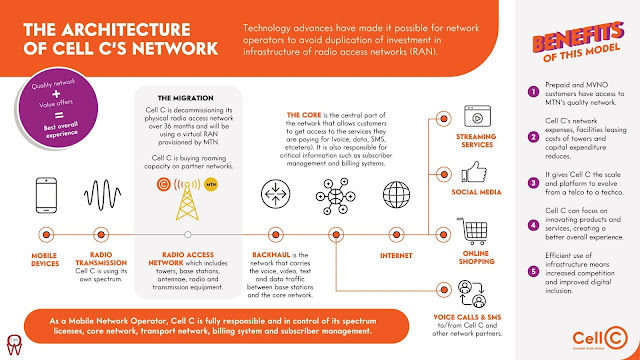
As part of this transition, Cell C deactivated its physical tower network and Radio Access Network (RAN). MTN now provides Cell C with a virtual radio access network for its prepaid and mobile virtual network operator subscribers, while Cell C’s contract customers roam on Vodacom’s network. However, Cell C continues to use its own spectrum and retains full control over the customer experience. Additionally, Cell C is currently testing 5G with network partners Vodacom and MTN, with plans to launch it soon.

Cell C has spent the past 18 months deploying a Mocn – multi-operator network core – roaming system, which has allowed it to create a virtual representation of its network on top of either MTN or Vodacom’s infrastructure.

We can clearly see with the ongoing investments from major operators, a great deal of progress is being made and 5G has the potential to bridge the digital divide, drive economic growth, and position South Africa as a leader in next-generation connectivity on the African continent.

Related Posts

Thursday, 13 January 2022

MTN highlights the OSS Challenge and Integration with Transport Network

At Layer123 conference, Lloyd Mphahlele, General Manager-Group Technology, responsible for Transport and OSS tools at MTN group, talked about the transforming of the OSS in which he highlighted integration with the operator OSS and management environment as a key challenge that must be addressed to move forward.

In his talk, he covered:

  • The OSS challenge
  • MTN Approach
  • MTN Journey and Use Cases
  • The Road Ahead

The presentation emphasised the Transport Network integration with OSS and touched on the announcement made in partnership with TIP last year regarding MTN Uganda deploying TIP DCSG at scale to advance network automation.

The video of his talk is embedded as follows:

Related Posts

Wednesday, 27 October 2021

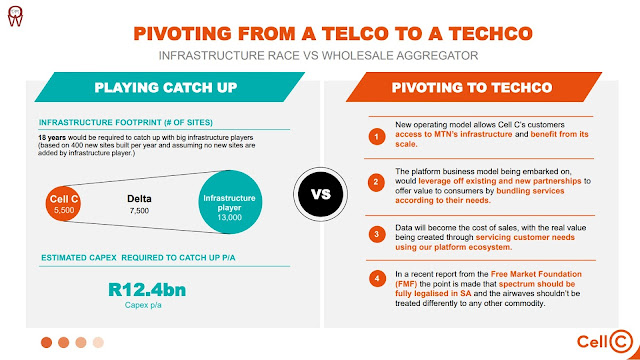
South African MNO, Cell C, is Transitioning from Telco to Techco

If you can't beat them, join them says the old proverb. The South African MNO Cell C has taken this seriously. A news article back in September said:

In a bid to give its customers access to world-class network quality, excellent service and innovative value offers, Cell C has over the last eight months deactivated 39% of its physical radio access network (RAN) towers with 100% migration in the Eastern Cape, Free State, Northern Cape and Limpopo. 

Over the next four months, Cell C plans to decommission a further 5% of its towers, with a focus on parts of Kwa-Zulu Natal and Mpumalanga. 

Rather than spending billions building network infrastructure to compete with its fellow mobile giants, the company concluded roaming agreements with network partners like MTN and Vodacom to use the spare capacity that they have on their networks. 

Prepaid customers will roam on the MTN network, whilst post-paid customers will be on the Vodacom network. 

We see a dual approach by Cell C here. Rather than putting all their eggs in a single basket, they have spread their risk portfolio.

In our blog post last year, we saw that both MTN and Vodacom has similar coverage and capabilities. This would mean that Cell C subscribers will win regardless of whichever network they are on.

With Vodacom, it looks like Cell C is using a roaming agreement and will act like a Thick MVNO. We have explained the different types of MVNOs here but if you prefer to watch a video then see here.


The approach with MTN, based on the above slide shared by them seems to be a combination of MVNO and MORAN. To understand what MORAN is, read here or watch the video here. Cell C explained it as follows back in June:

Cell C has successfully decommissioned 34 percent of its physical Radio Access Network (RAN) sites, while seamlessly migrating prepaid and Mobile Virtual Network Operator (MVNO) customers to roam solely on its partner network, MTN, via a virtual RAN.

The initial Cell C and MTN roaming agreement from 2018 provided coverage in areas outside of the main metros. The decommissioning of sites in these provinces means that where Cell C customers previously moved between Cell C and MTN towers, they will now only roam on MTN’s network through the virtual radio network provisioned for Cell C, which has wide network coverage. 

Based on technology advances it is possible for network operators to avoid duplication of investment in RAN infrastructure. In this model, Cell C will decommission its physical RAN, which includes towers, base stations, antennae, radio and transmission equipment, while MTN will provision a virtual RAN.  Cell C will use its own spectrum on this virtual RAN and manage the customer experience.  As a mobile network operator Cell C is still responsible for its spectrum licenses, core network, transport network, billing system and subscriber management.

While Cell C continues to refer to the arrangement as 'virtual RAN', it shouldn't be confused with vRAN / Open RAN. It would be interesting to see how this arrangement works and if this will continue for 5G going forward.

Cell C's FY 2020 annual results presentation slides and video may be worth a watch. 

Related Posts

Thursday, 16 July 2020

High Data Prices in South Africa means Great 4G coverage but Poor Subscription Rates


South Africa may well have one of the most advanced telecom infrastructures on the African continent. There is has been considerable investment from  municipal providers as well as from mobile network operators all aimed at improving network capabilities. The focus in recent years has been on backhaul capacity and on fibre and LTE networks to extend and improve internet service connectivity.

South Africa has 4 network operators: Vodacom, MTN, Cell C and Telkom (formely 8ta).The 900 MHz and 1800 MHz frequencies deliver 2G for all operators with 3G offered on 900 MHz and 2100 MHz except for Telkom using 850 MHz. 4G/LTE was launched in 2012 on 1800 (B3) MHz in major centres by Vodacom and MTN and more recently on 2300 MHz (TD-LTE, B40) and 1800 MHz (B3) on Telkom and 2100 MHz (B1) and 1800 MHz (B3) on Cell C.


So basically the telecom landscape is characterised by a duopoly where Vodacom and MTN command more than 70 per cent of the market share by connections. Market penetration of mobile connections stands at more than 165 per cent, smartphone penetration at 60 per cent of total connections and 4G population coverage at 95 per cent in 2020. However, 4G only accounts for 30 per cent of total mobile connections. The high data tariffs, which  result in consumers purchasing either short term or limited data bundles, have resulted in low 4G uptake. Also a large part of the South African population is digitally illiterate, having limited or no understanding of basic aspects of digital such as connectivity, devices and skills. Some industry sources estimate the number at 80 per cent. Lower digital literacy rates further discourages the uptake of LTE services.

Source: Cable.co.uk

Lack of adequate spectrum in the market is argued to be the contributor to high data tariffs. In the absence of adequate spectrum, operators have to invest more in existing bands to densify and increase the coverage.

The COVID-19 (coronavirus) pandemic (accompanied by lockdowns and remote working) resulted in surging in data traffic globally. For its part, South African operators like Vodacom experienced 40 per cent growth in data traffic, while MTN experienced 56 per cent growth from February to April.

To ease congestion and create capacity for new data traffic requirements, the South African telecoms regulator ICASA announced a temporary allocation of spectrum in various bands (700MHz, 800MHz, 2300MHz, 2.6GHz, and 3.5GHz) until November. Vodacom leveraged the opportunity to launch its 5G services on the 3.5GHz spectrum in several cities. MTN followed the move and launched on the last day of the quarter adopting a dynamic spectrum sharing model in various frequencies (700MHz, 2100MHz, 3.5GHz and 28GHz).

Due to the 4G experience in the market and the challenges of data costs and digital literacy it is expected that consumer 5G uptake will be slow and only account for only 8 per cent of the total mobile connections by 2025.


Vodacom is the biggest mobile provider in South Africa and is 50% owned by UK-based Vodafone. It’s the market leader with the most customers, a good coverage at the highest prices.

Vodacom launched Africa’s first standards-based, commercial 5G service in Lesotho in August 2018 using 3.5 GHz spectrum. They have also demonstrated the same network capabilities at an event in South Africa, using a temporary test spectrum license in the 3.5 GHz band. Apparently their network is 5G-ready and it will launch 5G services in South Africa as soon it gains access to the required spectrum.


MTN is the main rival of Vodacom. MTN launched 4G/LTE in 2014 and covers 90% of population in 2018. MTN is the only provider that roams in Swaziland, if you should travel there.

MTN has recently won the Open Signal Video Experience and Download Speed Experience awards  which the operator tied with Vodacom in August 2019  and has now tied Upload Speed Experience and Latency Experience — which MTN was losing to Vodacom six months ago. MTN has also retained the lead in 4G Availability. On the other hand, Vodacom won the two new metrics — Voice App Experience and 4G Coverage Experience.

MTN has also made significant improvements across the board, taking the lead in three of the seven award metrics. Vodacom also showed improvements, but the operator has conceded ground to MTN across all of the metrics that are present in both this report and our previous one, with the distance between the two operators changing in the favor of MTN. Telkom and Cell C are still lagging behind, but showed improvements across all of these metrics, save for Cell C in 4G Availability, which saw the operator’s score decreasing by 1.5 percentage points.


MTN South Africa has also trialled various cases of 5G in cooperation with Ericsson and Huawei, which the company said showed great promise for mobile and fixed solutions. During these trials, MTN demonstrated downlink speeds of up to 1.6 Gbps and uplink speeds of up to 520 Mbps. MTN South Africa has also successfully launched a live 5G indoor solution at Kyalami Grand Prix Circuit and International Convention Centre.The mobile operator has already rolled out 5G sites on existing spectrum where they don’t interfere with other deployed systems.

Cell C is the 3rd operator in South Africa. It claims to cover 98% of population, but still has gaps in certain areas. Cell C started a price war in 2011 by undercutting its rivals, but most operators now offer comparable price plans. Cell C is only cheaper when you use their confusing portfolio of bonuses.

Cell C used to roam on the Vodacom network outside areas of their own coverage for free, but this applied to 2G and 3G only, not to 4G/LTE. In 2018 Cell C announced it has entered into a far-reaching roaming agreement with MTN in order to complement Cell C's own mobile network. The agreement will see MTN providing both 3G and 4G services to Cell C in areas where Cell C has chosen to purchase coverage rather than self-build, mainly outside of the main metro areas.

4G/LTE was rolled out in Gauteng and Durban on 2100 MHz (B1) to be spread to 1800 MHz (B3) in other centers of the country. After the new roaming deal with MTN Cell C says its network service offering is at 99% 2G coverage, 96% 3G coverage and 80% 4G/LTE coverage of the population.

Finally Telkom is a South African-based telecommunication company and the fourth network in the country. It entered the market in 2010 and was called '8ta' before, but has been rebranded into Telkom. It offers the lowest rates for data in the country of any network operator while it coverage is less too.

While it has limited coverage, mainly in the cities, it currently roams on the 2G and 3G networks of MTN, but not on MTN's 4G/LTE. Telkom's 4G/LTE is on the rare TD-LTE 2300 MHz (B40).

In November 2018 Telkom signed a new roaming agreement with Vodacom. Telkom customers will be able to roam on Vodacom's 2G, 3G and 4G networks from 2019. Telkom has had a roaming agreement in place with MTN for 2G and 3G services and will conduct a phased transition from the current roaming agreement. This process will concluded in June 2019 when its contract with MTN expired. Telkom South Africa has announced that it plans to switch off its 2G network nationwide at the end of 2019.

Related Posts:

Saturday, 21 September 2019

MTN: Connecting Rural Africa

I wrote about MTN on the Small Cells Blog last year, where Babak Fouladi, Technology and Information System (Group CTIO) at MTN delivered an insightful talk. In addition to providing a lot of valuable insights on how they plan to tackle rural connectivity, they talked about their RFP for Rural, Ultra-rural and Ultra-ultra-rural sites.


In the latest TowerXchange, Navindran Naidoo, Group Executive, Network Design & Planning, MTN Group explained this and a lot of other details. The article is available here. I will just look at what he said specifically about this RFP below:

The RFP is an attempt to source full turnkey vendors for our different categories: rural, ultra-rural and ultra-ultra rural. The RFP should close in September. 

We are interested in the role that independent telecom tower companies (towercos) can play in enhancing rural connectivity. Leasing space on towers could be an important enabler of investment in rural and ultra-rural areas. However, the leasing model is unlikely to be operable in ultra-ultra rural areas where low ARPUs will be unable to support more than one operator. Sharing infrastructure is an option for reducing the cost of roll-out and opex too. 

I cannot comment on how the pricing structure and economics of the sites will work, as we are waiting to see what is proposed in the responses to our RFP.

There are a few ways we identify and categorise sites, such as determining the distance from the urban areas we already serve. We can use satellite imagery to complement that and identify the best areas to serve, as we cannot rely on census information in these areas. 

For backhaul we expect to use a variety of technologies. In rural sites we have specified microwave backhaul as these sites should not be too far away from our existing network. For ultra-ultra-rural sites, we have specified optimised Very Small Aperture Terminal (VSAT) backhaul. Ultra-rural sites will see a mixture of the two solutions. 

The towers will also differ from site to site. At normal rural sites, shareable macro towers will be used; at ultra-rural sites we expect shorter towers of between 10m and 20m. While at ultra-ultra rural sites, we are leaving the details of the structure to our vendors to propose depending on what they think will work best.

We don’t only need sites which have a low-cost bill of materials, but we need structures with minimal maintenance and a quick implementation timeline. It should take up to a week to erect a rural site, but our ultra-ultra rural sites should be complete in a day or two. 

Site availability will differ to what we expect for our core sites. At rural sites we are proposing > 98% availability; at ultra-rural sites > 95%; and we will wait to see what our vendors propose for ultra-ultra rural sites. At these most rural sites we need to keep maintenance and repair visits to a minimum, so while we expect to use solar power and battery back-ups at our rural and ultra-rural sites, we may opt for solar-only sites at our most remote sites. Eliminating diesel generators cuts maintenance and refuelling, cutting batteries from our most remote sites further simplifies the maintenance of the sites and eliminates sites going down due to battery theft. 

Most rural sites, with their larger towers and more demanding initial specification could be upgraded, but ultra rural and ultra-ultra rural would require complete rebuilds. But that would be an excellent problem to have.

We think offering data and internet connectivity is essential. Even at our ultra-ultra rural sites we want to be able to offer at least 3G levels of connectivity. 

Our CHASE programme helps us focus on what matters for our users: Coverage, Handsets, Affordability, Services and Education. We have to ensure sufficient data coverage in low-income areas; affordability of handsets and data services; bundle together the correct services for our customers; and enhance digital literacy and awareness so that people can make the most of the services we deliver. 

The complete article is here.

Related Posts:

Tuesday, 3 September 2019

Africa: The Race For No. 2 Operator

MTN is the largest mobile operator group in Africa with roughly 168 million subscribers, but who is number 2?

Airtel just crossed 100 millions subscribers in Africa and many news sites have started calling them the second largest operator group in the region. Livemint for example reported:

Bharti Airtel’s Africa arm has crossed the 100-million customer mark across its operations in the continent, the company said in a statement on Wednesday.

This is significant for the company, which entered the continent in 2010. Airtel Africa is currently the second-largest mobile operator in Africa by the number of active subscribers; South Africa’s MTN is the largest.

Airtel Africa is the holding firm for Bharti Airtel’s operations in 14 countries in the continent across three regions — Nigeria; East Africa, comprising Kenya, Uganda, Rwanda, Tanzania, Malawi and Zambia; and the rest of Africa, including Niger, Gabon, Chad, Congo Brazzaville, the Democratic Republic of the Congo, Madagascar and Seychelles. Nigeria alone accounts for almost half of its earnings before interest, taxes, depreciation and amortisation (Ebitda).


According to this Bloomberg article, back in July 2019, Airtel was the 4th largest by subs numbers.

  • MTN 167.7 million 
  • Orange 120 mil 
  • Vodacom 110 mil 
  • Airtel 98.9 mil

There is a small caveat though. While MTN does not include Middle East, Orange does. Again, Vodacom includes Safaricom in which it has around 35% stake. Vodafone, Vodacom’s parent (64.5% stake), had an additional 49.3 million customers in its operations in Egypt and Ghana at the end of June. If we include Vodafone, Vodacom and Safaricom, it would be going head-to-head with MTN for the top place.

The Guardian, Nigeria has a good summary of the top 4 mobile operators in Africa here.


Related Posts:

Sunday, 27 January 2019

World's largest mobile networks by subscriber numbers - Jan 2019

Here is a list of top 10 mobile networks by subscribers. The list is very dynamic as some operators grow while others shrink. The best example of operator that has been growing rapidly, overtaking others is Reliance Jio.


1. China Mobile, China, 925 million [1]

2. Vodafone Group, UK, 536 million [6]
Note: Vodafone Idea, India has 422 million subscribers [2]

3. Bharti Airtel Group, India, 413 million [4]
Note: Airtel India has 329 million subscribers [3]

4. China Unicom, Hong Kong, 315 million [1]

5. China Telecom, China, 303 million [1]

6. Reliance Jio, India, 280 million [6]

7. América Móvil Group, Mexico, 279 million [5]

8. Telefónica Group, Spain, 272 million [7]

9. MTN Group, South Africa, 221 million [9]

10. Veon Group, Netherlands, 211 million [8]
10. Orange Group, France, 211 million [10]*

* = added later

[1] https://www.mobileworldlive.com/asia/asia-news/china-telecom-narrows-subs-gap-to-unicom/
[2] https://discover.vodafone.in/about-us/home?section=consumer
[3] https://www.airtel.in/about-bharti/equity
[4] https://www.airtel.in/about-bharti/about-bharti-airtel?icid=footer
[5] http://q4live.s22.clientfiles.s3-website-us-east-1.amazonaws.com/604986553/files/doc_financials/quarterly/2018/3Q18.pdf
[6] https://www.mobileworldlive.com/asia/asia-news/jio-profit-surges-on-continued-subs-gains/
[7] https://www.telefonica.com/en/web/shareholders-investors/financial_reports
[8] https://veon.com/Global/Files/Reports/3Q18/Q3%202018-Full%20announcement.pdf
[9] https://www.mtn.com/MTN%20Service%20Detail%20Quarterly%20Quarterly%20Trading%20Upd/MTN_Q12018_Results.pdf
[10] https://rai2017.orange.com/orange2017-content/uploads/2018/05/orag_1802135_ra_150x210_gb_mel.pdf

Sunday, 24 June 2018

Ethiopia: Finally opening up


Ethiopia’s state owned telecommunications company, Ethio Telecom is currently Africa's largest mobile operator.
According to IT Web’s report with over 57 million mobile subscribers as at November 2017, Ethio Telecom had beat MTN Nigeria to become Africa’s largest in terms of its mobile customer base.

A sector expert was quoted to have said:
“Ethio Telecom of Ethiopia is now the largest mobile operator in Africa in terms of subscriptions, with 57.34 million mobile subscriptions at end-2Q17. Ethiopia is also one of the very few African countries that has not liberalised its telecoms market and introduced competition, so Ethio Telecom has a monopoly,” 
An expansion drive costing over $1.6 billion in the last few years has contributed greatly to this success. According to a statement on their website: 
"The expansion project has also significantly improved quality of services, with customers enjoying 3G wireless services by upgrading the 2G network across all regions covering all over the country; with also 4G LTE, super-fast services, launched in Addis Ababa. Over the past few years, Ethio Telecom has been transforming itself to meet its vision of becoming a world class operator and our journey so far shows we are on the right track.”

The company reports that 64.4 million of its customers are mobile phone subscribers, and 1.2 million are fixed line users. The company's internet service users have also reached 16 million. Ethiopia is Africa’s second most populous nation behind Nigeria and the numbers are believed to have played a significant part.

The other reason for this success is the strictly regulated economy of Ethiopia and the government til date has not liberalized the telecoms sector resulting in Ethio Telecom having a monopoly as the state-owned and only operator

However the currently government under Prime Minister Abiy Ahmed is attempting to open up the economy and has announced plans split state-run monopoly Ethio Telecom in two and gradually sell shares in both entities to top telecoms companies in a bid to increase competition.The PM has said: 

“…If Somalia with 12 million population has four telecom operators, Ethiopia with over a hundred million population has to also open its doors to multiple telecom operators,” 
Under the plan, a total stake of between 30 per cent to 40 per cent in Ethio Telecom will be sold to operators, provided they are rated as top ten players globally.

The Ethiopian government also routinely cuts the internet mainly for political but also academic reasons.To forestall the leakage of key university entrance exams, the authorities blocked the internet in the past. Activists have slammed the government repeatedly for cutting off the internet because they wanted to control the spread of information and materials relating to anti-government protests and human rights abuse.

A more privatized sector and less governmental interference will hopefully prevent this. 

Both MTN and Vodacom see potential for growth in the Ethiopian market. An MTN spokesperson states:
"MTN has long held the view that Ethiopia offers great opportunities for growth, both for the people of Ethiopia and for the businesses that could serve them, through the liberalisation of the telecommunication market in that country. MTN is excited by the potential opening up of the Ethiopian market as it would be a natural fit for MTN's existing and extensive Pan-African footprint. MTN's licence to provide value-added services in Ethiopia was recently renewed and we continue to maintain an office in Addis Ababa. Ethiopia presents many exciting telecommunication opportunities and we look forward to further discussions with that nation's authorities on potential partnerships and opportunities."
MTN operates in 22 countries across Africa and the Middle East, and Vodacom operates in five African nations.

While Vodacom have said
"Ethiopia is an attractive market so it follows that there would be interest. Naturally, this is dependent on what might become available and if it fits within our investment parameters." 
However PM Ahmed Abiy also clarified the conditions for selling shares in the state telco: 
“Certain amounts of shares will be sold gradually in 10, 20, 30 years. We are not giving it up in one go, it is not possible.”
Ethiopians will be offered 5% in the new companies, and between 30% and 40% will be sold to telecoms operators that are top-10 players globally. There’ll be at least a year or two of “intensive study”, he said in televised comments. 

Tuesday, 21 November 2017

South Africa: Progress and Problems

South Africa’s mobile networks are all growing their subscriber numbers, with Telkom the latest network to reveal its most recent figures.

Telkom’s interim results for the six months ended 30 September 2017 show it had 4.3 million active mobile subscribers.

This comprises 3 million prepaid and 1.3 million post-paid users.
The table below details the latest available subscriber numbers for South Africa’s mobile networks.

Vodacom40.0 million
MTN30.9 million
Cell C“Over 16 million”
Telkom4.3 million

According to Telkom their operating revenue was down by 0.6% compared to last year, reaching R20.1 billion.

“The first half of the year was characterized by a tough economic environment and increased competition. Even though South Africa exited the technical recession in the second quarter of the year, business confidence remains very low.”

 Despite the tough conditions, Telkom’s mobile division showed strong growth.
“The mobile business growth trajectory continued in the period with strong growth in active customers and stable ARPUs, resulting in an increase of 43.2% in mobile service revenue,” said Telkom.
“The strong mobile growth which boosted the group’s performance was underpinned by an expansion of our network, distribution, and the launch of innovative products which were well received by our customers.”
“We are pleased that our mobile business received the MyBroadband Best Mobile Broadband Provider of the year award, in the best value for money category.”
Source

Market leader Vodacom’s priority must be defending its market share in an increasingly competitive environment. According to Equities analyst Irnest Kaplan  they must offer consumers more value, beyond simply “selling megabytes”. So-called over-the-top players — companies like Facebook and Google — are profiting from the data pipes Vodacom sells; the company needs to develop value-added services of its own, such as quality content, that subscribers are prepared to pay for. Without this, there’s the risk that consumers will simply shop around for the cheapest data rates

He said Vodacom, and the other mobile operators, are in a powerful position in that consumers carry their products in their pocket all day.

 “They should do more to leverage that. It’s hard for them because they are operators and not app developers, but people carry their products all the time, they know where you are all the time — there must be amazing apps they can offer.” Source


Moreoever all the South African operators face issued due to the  impasse over new spectrum allocation. Vodacom may be forced to cut spending in rural areas to densify its network in the more populated urban centres because of this “spectrum crunch”.

This issue needs to be sorted as soon as possible. Technology is the driver of economic growth. Spectrum is vital for the roll-out of new technologies and innovation, which will drive economic growth, create jobs and allow South Africa to take advantage of the Internet of things and the other technologies.


Meanwhile Ericsson and MTN will start a 5G trial in South Africa during the first quarter of 2018.


The companies signed a memorandum of understanding at AfricaCom 2017 to collaborate on the rollout of 5G technologies in South Africa.

MTN will trial a range of 5G use cases and applications as a proof-of-concept for South Africa in its laboratory, which will lead to commercial deployment in the future.
The companies said they will collaborate to identify 5G use cases in industries such as mining, transportation, agriculture, manufacturing, and utilities.


“5G gives us the opportunity to rethink our business and address previously-untapped value chains” 
said Giovanni Chiarelli, CTIO at MTN South Africa.Source

Wednesday, 2 July 2014

Afghanistan Mobile Operator Overview

As of March 2014, the penetration rate in Afghanistan was estimated at 89% over a population estimate of 29.8 million.
The country's telcom regulator is the Afghanistan Telecommunications Regulatory Authority (ATRA). 
Last week at an event in Washington, DC, Amirzai Sagin – Afghan Minister of Communications and Information Technology – said that in the last 12 years Afghanistan has come a long way in terms of developing the ICT sector (Information and Communications Technology). Today, there are five major telecom companies, and approximately 60 internet providing companies operating in Afghanistan. More than 90 percent of the Afghan population has access to mobile services, and 22 million of them own at least one mobile phone. The number of internet users continues to increase as the cost of internet has decreased from $1,000/mb in 2002 to $22/mb today. In addition, the Ministry has started issuing National Electronic IDs, which is a centralized system for avoiding fraud. At the end of his keynote address, the Minister said something very important that Afghanistan has the capacity to carry out the next presidential election, which will be in five years, via mobile phones.

All five mobile operating companies (Etisalat, MTN, AWCC, AfTel, and Roshan) are offering their own mobile money product. In 2008 Roshan began the use of the M-PAISA mobile money service. These products include mobile wallet technology, where customers can store their money digitally as opposed to using cash. Roshan’s M-PAISA operates in 6 major cities with 17,000 active users. The users portfolio is about to reach $79.5 million by the end of 2014. Most Afghans receive their monthly salary through their mobile phones, and relatives send money via phone from one province to another.

Last week at an event in Washington, DC, Amirzai Sagin – Afghan Minister of Communications and Information Technology – said that in the last 12 years Afghanistan has come a long way in terms of developing the ICT sector (Information and Communications Technology). Today, there are five major telecom companies, and approximately 60 internet providing companies operating in Afghanistan. More than 90 percent of the Afghan population has access to mobile services, and 22 million of them own at least one mobile phone. The number of internet users continues to increase as the cost of internet has decreased from $1,000/mb in 2002 to $22/mb today. In addition, the Ministry has started issuing National Electronic IDs, which is a centralized system for avoiding fraud. At the end of his keynote address, the Minister said something very important that Afghanistan has the capacity to carry out the next presidential election, which will be in five years, via mobile phones.

All five mobile operating companies (Etisalat, MTN, AWCC, AfTel, and Roshan) are offering their own mobile money product. In 2008 Roshan began the use of the M-PAISA mobile money service. These products include mobile wallet technology, where customers can store their money digitally as opposed to using cash. Roshan’s M-PAISA operates in 6 major cities with 17,000 active users. The users portfolio is about to reach $79.5 million by the end of 2014. Most Afghans receive their monthly salary through their mobile phones, and relatives send money via phone from one province to another.


Source


Roshan’s network now covers 60% of Afghanistan’s population. A third of the country’s subscribers are Roshan customers, giving it the largest market share of the five mobile network operators in the country. And there is plenty of room yet to grow. Though the Afghanistan Telecom Regulatory Authority puts telephone penetration at 72%, Ladak says the proportion of people with  phones is probably half that. Afghans, like their counterparts in the rest of the poor world, own more than one SIM card to take advantage of different rates and packages. 
That should mean there are millions of Afghans yet to connect.

Foremost among these, perhaps, is that 3G data and services such as ringtones and caller tunes make money, even in a very poor country.  
When Roshan launched 3G services last year, the demand took it by surprise. Perhaps it shouldn’t have: Afghans, like anyone else, enjoy entertainment and music. Some 600,000 subscribers, or 10% of Roshan’s total customer base, now use 3G. Their top destinations are—yes—Facebook, YouTube and news websites. 

Mobile networks cover 88.5% of Afghanistan’s population.