Showing posts with label Vendor Ericsson. Show all posts

Thursday, 22 January 2026

Automation and Data Driven Network Optimization in Swisscom’s Mobile Strategy

At Ericsson’s rApp DevCon 2025, Swisscom provided a clear view of how automation and data driven network optimisation are becoming core elements of mobile strategy rather than isolated technical initiatives. In a keynote delivered by Francesco Pellegrini, Product Owner for Radio Network Optimisation at Swisscom, the emphasis was on how long term investment in automation, analytics and innovation supports not only network performance, but also the sustained delivery of a high quality mobile customer experience.

For Swisscom, automation is closely tied to its ambition to offer the best possible mobile experience across Switzerland. This ambition has guided network decisions for more than a decade and is reflected in the operator’s consistent top rankings in independent benchmarks. Rather than treating these results as an endpoint, Swisscom views them as a baseline that must be continuously defended as network complexity increases. Data driven insights and automated decision making now play a central role in translating customer experience expectations into concrete network actions.

Advanced analytics allow Swisscom to better understand how customers experience the network in real conditions and to prioritise optimisation accordingly. Automation then becomes the mechanism that allows these insights to be acted upon at scale and with consistency. As mobile networks evolve, with new spectrum layers, denser deployments and growing 5G usage, traditional manual optimisation approaches are no longer sufficient to maintain efficiency or performance.

Swisscom’s journey towards automated radio network optimisation started several years ago with early self organising network capabilities such as antenna tilt optimisation in LTE. Over time, this expanded into a broader portfolio of automation use cases, including open loop optimisation driven by customer experience data and AI supported solutions for performance analysis. Centralised optimisation algorithms for 5G mobility and the introduction of closed loop automation further strengthened this approach. Today, much of the 4G network is optimised through automation, while 5G tuning is already at an advanced stage.

Pellegrini highlighted that achieving this level of automation required more than deploying new tools. One of the main challenges was introducing innovation while continuing to operate one of the highest performing networks in the market. This demanded changes in processes and mindset, particularly within radio optimisation teams. Engineers increasingly moved away from manual, vendor specific tools towards programmable, data centric workflows that support repeatability and scale.

The next phase of Swisscom’s mobile strategy builds on this foundation through its expanded partnership with Ericsson. A key component is the integration of the Ericsson Intelligent Automation Platform into Swisscom’s existing automation framework. This enables coordination between existing use cases while providing access to a standardised rApp environment and to the wider ecosystem. Just as importantly, it allows Swisscom to leverage data already available within its internal data lake to support more advanced optimisation and automation scenarios.

In radio network optimisation, Swisscom is already working with several AI enabled rApps, including anomaly detection, root cause analysis and antenna optimisation capabilities. At the same time, the operator is exploring the development of its own rApps, with radio optimisation as the starting point. The ambition, however, extends beyond optimisation alone. Network deployment and network healing are also seen as key areas where automation can deliver measurable benefits, particularly through zero touch approaches that accelerate cell acceptance and improve network health monitoring.

A central enabler of this strategy is the evolution of skills within Swisscom’s engineering teams. Radio engineers are increasingly expected to combine deep domain expertise with capabilities in coding, data handling and AI. While radio knowledge remains the foundation, closer collaboration with internal data science teams is becoming essential. This balance allows Swisscom to develop more sophisticated automation use cases without diluting its core engineering strengths.

The keynote also underlined the importance of open ecosystems in sustaining differentiation. Swisscom sees value in combining vendor developed rApps with innovations from a broader community, enabled by a standardised automation platform. This approach supports experimentation, accelerates innovation and reduces dependency on bespoke integrations, all while maintaining control over network performance and quality.

Swisscom’s experience illustrates that automation and data driven network optimisation are not short term initiatives, but long term strategic capabilities. As network complexity continues to grow, the ability to combine customer experience insights with intelligent, coordinated automation will be critical to maintaining leadership. Swisscom’s mobile strategy shows how these elements can be embedded into daily operations, positioning the operator to continue delivering a high quality mobile experience in an increasingly demanding environment.

The embedded keynote video provides additional depth and context, offering valuable insight into how Swisscom is translating automation concepts into real world operational practice.

Related Posts:

Tuesday, 7 October 2025

CelcomDigi’s Journey Toward AI-Powered Autonomous Operations for Enhanced Customer Experience

CelcomDigi is taking bold steps towards transforming its network operations with the goal of creating a fully AI-powered, autonomous environment. At FutureNet Asia 2025, the company outlined its ambition to evolve beyond traditional network management and place customer experience at the centre of its operational strategy.

As one of Malaysia’s largest operators, serving over 20 million customers and running the country’s most extensive mobile and fibre network, CelcomDigi sees network intelligence and resilience as national priorities. Mobile connectivity has become the backbone of Malaysia’s digital economy, underpinning everything from education and healthcare to e-commerce and industry. Customer expectations are now focused less on basic coverage and more on the quality of experience, whether that means smooth video streaming, consistent gaming latency or reliable digital payments.

To meet these expectations, CelcomDigi has identified three major challenges that must be addressed. The first is the growing complexity of networks as new services such as IoT, network slicing and smart industry solutions are introduced. The second is the demand for real-time responsiveness, with customers expecting zero downtime and instant performance. The third is the ongoing paradox of rising data traffic without equivalent revenue growth, which puts pressure on costs and efficiency.

CelcomDigi believes that the way forward lies in AI-driven autonomous operations. By 2028, the company aims to achieve level four autonomous operations, supported by closed-loop systems, predictive intelligence and generative AI. The transition involves moving from reactive processes towards predictive, self-diagnosing and self-healing networks that can assure customer experiences at scale.

The operator is already making progress on this roadmap. Working closely with Ericsson, CelcomDigi has deployed AI platforms that enable predictive maintenance, automated fault detection and real-time root-cause analysis. Processes that previously took hours can now be resolved in minutes, and continuous optimisation ensures 24/7 network performance. Examples already live on the network include nationwide AI-powered root-cause analysis, closed-loop traffic balancing with significant efficiency improvements, and intelligent change management that boosts success rates. Even everyday applications such as WhatsApp calls are being enhanced through AI-driven quality optimisation, reflecting how closely network performance is tied to customer experience.

These initiatives are delivering measurable results. The operator reports higher availability, fewer call drops, smoother video streaming and faster recovery times. Improvements in customer experience are also reflected in stronger satisfaction scores.

Looking ahead, CelcomDigi’s vision is a zero-touch, customer-centric network that runs seamlessly in the background. The company sees autonomous operations not only as a means of simplifying complexity and reducing costs, but also as a way to differentiate connectivity, support innovation and sustain market leadership in Malaysia’s fast-growing digital economy.

You can watch the full session in the video below. For more insights like this, make sure to follow FutureNet World, where industry leaders regularly share their strategies for the networks of tomorrow.

Related Posts: 

Tuesday, 5 August 2025

Telstra’s Bold Journey to RAN Autonomy and Beyond

At the recent rApp DevCon 2025 hosted by Ericsson, Gavin Spain, Group Owner of Wireless Network Strategy at Telstra, delivered a keynote that set out an ambitious and compelling vision for the future of RAN autonomy. As operators around the globe seek to simplify operations and reduce cost in increasingly complex networks, Telstra’s strategy places autonomy at the heart of network transformation.

Telstra has set clear targets: level 3 RAN autonomy within three years, and level 4 by 2030, as defined by TM Forum standards. Achieving this will demand deep changes across technology, process, systems, and tools. But more than just a transformation project, Gavin Spain framed autonomy as a strategic necessity to meet rising expectations and scale networks efficiently. For Telstra, autonomy is not about buzzwords but about delivering adaptability, optimisation and self-healing capabilities across its vast and varied network landscape.

With tens of thousands of 4G and 5G sites, spanning dense cities to remote regions, Telstra faces a highly diverse RAN environment. Rather than seeing this as a burden, Telstra views variability as an opportunity. Automation at the cell level enables a granularity of control not possible through manual approaches. Autonomy can unlock previously inaccessible value from the existing infrastructure and allow dynamic, performance-driven decisions at scale.

Central to this transformation is Telstra’s four-year agreement with Ericsson, a cornerstone investment of 800 million Australian dollars. This will upgrade the RAN with Open RAN-ready hardware, integrate 5G Advanced software, and crucially, adopt Ericsson’s Intelligent Automation Platform (EIAP) to power rApps and enable intelligent, programmable networks.

Telstra’s early focus is on two operational journeys: streamlining the planning, design and deployment of network infrastructure, and improving performance management and optimisation. This includes energy efficiency use cases, where Telstra is applying machine learning to find the right balance between performance and consumption. The long-term vision extends well beyond 5G. As future generations like 5G Advanced and 6G arrive, the complexity and costs will only grow. Programmability and intelligence must evolve with them.

Gavin Spain also highlighted the key architectural elements required to make this vision a reality. These include open and standardised interfaces to encourage portability and innovation, conflict resolution frameworks to manage competing app intents, integration of AI/ML pipelines to support closed-loop optimisation, seamless support for both traditional and virtualised RAN, and certification frameworks to ensure rApp quality and reusability.

Beyond the technology, the keynote emphasised economics. Operating mobile networks is increasingly expensive, while revenues per user remain flat or in decline. This puts pressure on operators to lower TCO and improve efficiency. For developers, this presents an opportunity. Even small improvements, such as reducing energy consumption by 1% or minimising truck rolls, can translate into significant cost savings. rApps that can deliver this type of value are well-positioned to scale across the global ecosystem.

Gavin encouraged developers to understand operator challenges, build with purpose, and iterate rapidly. He highlighted that the value of AI is not just in rApps themselves, but also in how developers can use AI tools to speed up development and testing. With the network domain evolving rapidly, speed and bold ambition will be essential.

The call to action was clear: no single player can deliver autonomy alone. Operators, vendors, standards bodies, and developers must collaborate closely. Operators like Telstra will contribute use cases and domain expertise. Vendors like Ericsson will provide platforms. Standards bodies ensure interoperability. And developers will bring the innovation and execution speed required to translate vision into reality.

Telstra has already begun migrating legacy Self Organising Network functions to EAIP. Initial use cases include configuration automation, anomaly detection, and intent-based optimisation. These are the first steps on a much longer journey, one that aims to reshape how networks are designed, deployed, and operated for the next decade and beyond.

Telstra’s message to the ecosystem is simple: collaborate, move fast, and focus on real-world value. With the foundations being laid today, the path to RAN autonomy is no longer just a concept but a concrete roadmap for intelligent, adaptive and customer-centric networks of the future.

The video of Gavin Spain’s keynote at rApp DevCon 2025 is embedded below. It is well worth watching for a deeper understanding of Telstra’s strategy and the broader opportunities for developers and partners across the ecosystem.

Related Posts: 

Thursday, 22 May 2025

Malaysia Builds Momentum in 5G and Mobile Growth

Malaysia has a robust telecommunications infrastructure and a competitive mobile market. According to GSMA Intelligence, Malaysia had 43.3 million cellular mobile connections at the start of 2025. It is important to note that many individuals use more than one mobile connection, such as one for personal use and another for work, so the total number of mobile connections often exceeds the population. The growing adoption of eSIMs has further simplified the use of multiple connections on a single device.

In fact, GSMA Intelligence data shows that, as of January 2025, mobile connections in Malaysia were equivalent to 121% of the country’s total population.

Looking at recent trends, mobile connections grew by 474,000, an increase of 1.1%, between the start of 2024 and early 2025. Additionally, 99.0% of mobile connections in Malaysia are now classified as broadband, meaning they connect through 3G, 4G, or 5G networks.

However, it is worth noting that not all devices on broadband-capable networks actively use mobile data. Some connections may be limited to voice and SMS services only, so this broadband percentage should not be interpreted as a direct indicator of mobile internet usage.

As part of its broader economic development efforts, Malaysia has actively promoted open competition in the telecommunications sector. This approach has led to high penetration rates in both mobile and mobile broadband services, along with near-universal LTE coverage. Since the launch of 5G in 2022, adoption has grown rapidly, with 5G making up 38 % of all mobile broadband subscriptions by September 2024.

The major mobile operators in Malaysia are CelcomDigi, Maxis, U Mobile, YTL Communications (YES), and Unifi Mobile. These operators have been actively involved in the rollout of Malaysia's national 5G network and are key players in the country's telecommunications landscape. 


To maintain consistent 5G service quality, Malaysia’s mobile operators continue to utilise the state-owned 5G network operated by Digital Nasional Berhad (DNB). In May 2023, Malaysian authorities announced plans to transition to a dual 5G network model once DNB reached 80% population coverage, a milestone that was achieved in December 2023.

This shift marked a significant policy change, including the revocation of a 2021 ministerial directive that had previously appointed DNB as the sole entity responsible for Malaysia’s 5G rollout.

DNB was established by the government in 2021 as a special-purpose vehicle tasked with developing the national 5G infrastructure. Its network, deployed by Ericsson, is currently used by private telcos to deliver 5G services to consumers and businesses.

As of now, the major mobile operators in Malaysia provide 5G services through DNB’s state-run network. These include CelcomDigi, Maxis, YTL Communications (Yes 5G), and U Mobile. Each of these operators, except for Telekom Malaysia which had its equity deal cancelled, holds a 16.3% equity stake in DNB. The Ministry of Finance retains a 34% share.

CelcomDigi holds a 30.1% market share in the Malaysian telecommunications sector. This is a significant increase from 2023, following the merger between Celcom and Digi in November 2022. The merged entity has become the largest telecommunications company in Malaysia, surpassing its closest rival, Maxis.

Currently, it serves over 20 million customers, two-thirds of the Malaysian population, through 6.7 million postpaid and 13.4 million prepaid subscribers. CelcomDigi operates the widest 4G network, covering over 96 % of the population nationwide from approximately 24,000 network sites and has an extensive fibre network of around 15,000 kilometres.

CelcomDigi and Ericsson have signed a Memorandum of Understanding to introduce AI-driven network analytics across CelcomDigi’s infrastructure, aiming to enhance operational efficiency as 5G adoption continues to rise in Malaysia. As part of the agreement, both companies will collaborate on the development of intent-based autonomous networks, integrating AI and automation to improve network performance and efficiency. They also plan to explore the use of AI in building advanced 5G service assurance solutions, with the goal of delivering more reliable and tailored connectivity experiences for both businesses and consumers.

According to Ericsson, Malaysia registered 18.2 million 5G subscriptions as of the end of 2024, which equates to a market penetration rate of 53.4%.

CelcomDigi also signed a Memorandum of Understanding with ZTE to collaborate on integrating AI technologies into its telecommunications infrastructure. The companies plan to explore AI-driven solutions such as new calling, intelligent deep packet inspection for smarter network traffic management, and intelligent operations and maintenance to automate network monitoring and maintenance using AI-powered predictive analytics.

Maxis is the second largest operator in Malaysia. Maxis operates one of the most reliable 4G LTE networks in the country, reaching over 95% of the population. With Malaysia's ongoing 5G rollout under the DNB single wholesale network model, Maxis was initially cautious in adopting the new structure. However, in 2023, Maxis signed an access agreement with DNB, enabling it to begin offering 5G services.

According to Opensignal, Maxis was the first Malaysian operator to win the Reliability Experience award. It also won the Consistent Quality award with 67.3% of tests, closely followed by Digi with 67.1%. Since the last report, Maxis’ Consistent Quality score has improved by 11 percentage points.

U Mobile, despite being a smaller operator, has announced plans to build Malaysia's second 5G network, aiming to rival the first built by DNB. The decision follows government approval for a second 5G network in a move to end the monopoly previously held by DNB. U Mobile has chosen Chinese vendors Huawei and ZTE as technology partners for this project.

The enterprise-grade 5G network will support 5G Advanced and network slicing from day one, enabling tailored services for industries like healthcare, transport, and smart cities. U Mobile’s rollout emphasises improved indoor 5G coverage and prioritises key locations such as transport hubs, medical centres and data centres. U Mobile has stated it will continue working with DNB to ensure quality of service during the transition.

Unifi Mobile is a Malaysian internet mobile network operator and a subsidiary of the national telephone company, Telekom Malaysia. Unifi performed well in the recent Opensignal report, winning the 5G Download Speed Award with speeds of 290.3 Mbps. In the previous report, there had been a three-way tie but Unifi has now emerged as the sole winner. Unifi also won the 5G Video Experience Award with a score of 77.7 on a 100-point scale, more than two points higher than Digi.

Yes Mobile is operated by YTL Communications Sdn. Bhd., a subsidiary of YTL Corporation Berhad, a leading Malaysian infrastructure conglomerate. Launched in November 2010, Yes Mobile was the fifth mobile operator in Malaysia and distinguished itself by deploying an all-IP, all-4G network from the outset.

In December 2021, Yes Mobile became the first operator in Malaysia to launch 5G services, branded as Yes FT5G. This rollout was facilitated through a partnership with DNB. Yes Mobile's 5G services initially covered areas such as Kuala Lumpur, Putrajaya, and Cyberjaya.

The Yes network is built with an all-IP architecture, making it the first and only all-4G and all-IP network provider in Malaysia capable of offering unique services such as user ID-based unified communications and session concurrency for mobile data and telephony services. Yes operates its own network infrastructure in Malaysia, with close to 5,000 base stations and an all-4G network footprint reaching over 85% of the population.

As Malaysia continues to expand its 5G infrastructure, mobile operators are in active competition and are poised to integrate next-generation technologies into their offerings.

Related Posts: 

Tuesday, 13 May 2025

How O2 Telefónica is Redefining the Network with NaaS and Open APIs

At O2 Telefónica Germany, the “network of the future” is no longer a distant vision, it’s becoming an operational reality. Under the leadership of Matthias Sauder, Director Networks, the operator has made substantial strides in transforming its end-to-end infrastructure to meet the demands of a highly agile, programmable, and customer-focused future.

At the FutureNet World conference in London (7–8 May 2025), where leading telco and tech stakeholders gathered to explore network automation and AI in telecoms, Sauder shared how O2 Telefónica’s evolution journey spans radio, transport, core, data centres, and cloud landing zones, all underpinned by a strategy that prioritises automation, flexibility, and openness.

The transformation began with a foundational goal: enhancing radio network quality. Once considered the underdog in a three-operator market, O2 Germany set out to radically improve performance by embracing agile practices and reshaping internal structures. Inspired by the Spotify model, the company introduced agility not just in project management but also in technical delivery. This included frequent software release cycles for radio, positioning itself as a global leader in rapid deployment and continuous integration.

A key initiative known as Tech Strategy 25 laid the foundation for modernising radio, transport, and core networks. Today, over 80 percent of the strategy has already been executed. With a largely cloud-native core in place, O2 Telefónica is among the pioneers of this architectural shift. Its collaboration with Ericsson produced one of the world’s first cloud-native digital cores, while a parallel effort with Nokia deployed core services for one million users in a public cloud environment.

The rationale behind both cloud-native and public cloud approaches is clear. Legacy architectures no longer support the operational agility or cost efficiency needed in today’s competitive telecom landscape. Cloud-native systems enable advanced capabilities such as continuous integration, continuous delivery, and seamless in-service software upgrades (ISSU). O2 Telefónica has shown these upgrades can be executed without disrupting live customer services, challenging the long-standing perception that such practices are too risky for telco-grade reliability.

Beyond infrastructure, the company’s future network model hinges on the integration of open APIs and Network-as-a-Service (NaaS) capabilities. These aren’t abstract concepts, they’re practical tools enabling agility, programmability, and new revenue streams. Open APIs expose network functions to external developers and partners, unlocking opportunities for co-creation and monetisation that were previously out of reach.

This openness also extends to industry partnerships. A standout example is the company’s collaboration with Siemens, which now leverages O2's slicing capabilities to deliver tailored network services to its own customers. These kinds of arrangements demonstrate how NaaS, built on secure and standardised APIs, can unlock vertical-specific innovation.

But transformation isn’t just about technology, it’s also about mindset and culture. Simplifying and standardising network configurations (for example, reducing radio setups from over a hundred to just two) and promoting a service-centric approach are part of a broader shift. The focus is firmly on use cases and customer value, avoiding the trap of deploying technology for its own sake. Every new system or tool must demonstrate end-to-end value.

O2 Telefónica also recognises that data, rather than AI alone, is the foundation of intelligent automation. Without a robust data strategy, ambitions around AI, closed-loop automation, or service orchestration are unlikely to succeed. The company’s investment in OSS transformation and data-driven operations is laying the groundwork for intelligent networks that can scale, adapt, and optimise in real time.

As the line between network and IT continues to blur, O2 Telefónica is aligning its BSS, OSS, and IT systems with its network strategy. This integrated approach supports holistic innovation and positions the company to deliver services with faster time to market and greater cost efficiency.

The transformation journey shared by Matthias Sauder is more than a technical roadmap, it’s a call for industry-wide disruption. With revenues flat and operational costs rising, embracing NaaS, open APIs, and cloud-native infrastructure is no longer optional. It’s the only viable path for telcos to stay competitive, innovative, and relevant in a software-defined, platform-centric future.

Sauder’s full presentation at FutureNet World provides deeper insight into this journey. You can watch it below:

Monday, 11 December 2023

AT&T's Plans on Open RAN and 6G

AT&T was in news recently for their announcement about acceleration of Open and Interoperable Radio Access Networks (RAN) in the United States. According to their press release: 

This industry-leading move, in collaboration with Ericsson, will further the telecommunications industry efforts and help build a more robust ecosystem of network infrastructure providers and suppliers. AT&T’s spend could approach roughly $14 billion over the 5-year term of the contract with Ericsson. 

AT&T’s Open RAN plan is for 70% of its wireless network traffic to flow across open-capable platforms by late 2026. The company expects to have fully integrated open RAN sites operating in coordination with Ericsson and Fujitsu, starting in 2024. This move away from closed proprietary interfaces will enable rapid scaling and management of mixed supplier hardware at each cell site.  Beginning in 2025, the company will scale this Open RAN environment throughout its wireless network in coordination with multiple suppliers such as Corning Incorporated, Dell Technologies, Ericsson, Fujitsu, and Intel.

At the Brooklyn 6G Summit (B6GS), Chris Sambar, who leads AT&T’s Network organization and teams responsible for designing, engineering, building, and operating AT&T’s next generation mobile and fiber networks, gave a keynote on "Network: The Innovation Platform". The narrative of the talk says: 

Today’s 5G build is the foundation of 6G. Flexible and open architecture being developed and fine-tuned with 5G will be central to 6G, and maintaining a customer-centric, forward-looking mindset will be critical as we scale and deploy technologies such as Stand Alone core, edge computing, AI, and NTN integration. Implementing the lessons learned in the 5G era and ensuring we have end-to-end alignment across the 6 pillars of our architecture will be vital to making 6G a success.

RCR Wireless provides a concise summary of the talk here:

AT&T has spent $40 billion on spectrum in the last few years; Verizon has spent more than $50 billion; and T-Mobile US had to acquire another major operator to get its spectrum holdings. With 5G not even at its midway point and the industry already trying to figure out what they might have to spend on 6G, “it can’t be a bottomless-pit industry,” he said.

That said, Sambar did also discuss the promise of 6G for extended and virtual-reality immersive experience for training public safety and military members, and the potential of better network-focused AI and ML to save network operators “hundreds of millions or billions of dollars” if things like self-optimization of networks can be done better and faster. That in itself represents a major challenge. Sambar says that he has thousands of employees in network operations, between AT&T’s wireline and wireless networks and “hundreds” of algorithms that do very simple if-then work and essentially send tickets to humans when a scenario comes up that fits its if-then criteria. If one of those algorithms breaks, he said, “we have to go figure out where it is, what server it’s sitting on, what’s wrong with it and how do we fix it. I would love a machine to manage that for me”—or even better, to stitch the capabilities of multiple algorithms together for more efficient and effective AI/ML applicability to network operations.

The video of the talk is embedded below, thanks to IEEE TV:

Related Posts: 

Tuesday, 21 March 2023

Jio Platforms (JPL) is Flaunting their 5G Wares

In the world where we talk about just two or three major mobile network infrastructure vendors, challengers are rising, either using Open RAN/Networks as their base, innovations as a leverage or the might of a huge population to ensure their network infrastructure has been tested in the most extreme of scenarios. Jio Platforms (JPL) is probably relying on all the three conditions listed above. 

Jio Platforms Ltd. is an Indian technology company and a subsidiary of Reliance Industries Limited, headquartered in Mumbai, India. Jio Platforms has an end to end 5G solution consisting of 5G Radio, a complete 5G Core Network, AI/ML ATOM platform for 4G/5G, MANO for cloud CNF orchestration, ACI for cloud infrastructure deployment as well as the Cloud-native OSS Platforms.

In addition to these core platforms, Jio Platforms has also created its own cloud-native probing solutions for radio and core networks, simplifying network debugging and not requiring any systems integration with probe providers. To enable a SaaS-based model, JPL has also developed a sophisticated array of BSS solutions.

The entire product line is cloud native and can be deployed either on a public cloud or a private cloud.

In the recently concluded MWC 2023, Jio Platforms sponsored quite a few tracks and spoke in some as well. Aayush Bhatnagar, SVP of Technology at Jio Platforms gave a fantastic presentation in the track, '5G Advanced, Ready for Take-Off!'. His talk is embedded below:

Video courtesy of 6G World

While Jio relied on Airspan (for small cells) and Samsung for 4G/LTE networks, for 5G Jio has partnered with Ericsson, Nokia, Samsung, Cisco, Microsoft, etc.

Ericsson's press release mentioned that it will supply: Ericsson’s energy-efficient 5G Radio Access Network (RAN) products and solutions (from the Ericsson Radio System portfolio) and E-band microwave mobile transport solutions will be deployed in the 5G network for Jio.

Nokia's press release mentioned that it will supply: Equipment from its AirScale portfolio, including base stations, high-capacity 5G Massive MIMO antennas, and Remote Radio Heads (RRH) to support different spectrum bands, and self-organizing network software.

Telecom TV has a good summary of Jio Platforms presentation from DTW2022 (a version of their presentation video is available here). The JPL speakers mentioned that the company always had in mind that it wouldn’t be developing platforms, cloud-native functions and applications just for itself – it always had the broader market within India, and beyond, in mind. This was the reason they adopted a platforms-as-products (PaPs) strategy to its R&D.

It's yet to be seen how equipment from JPL interworks with ones from Nokia, Ericsson and everyone else. Right now Reliance Jio is busy launching 5G in more and more cities. The speeds, quality of experience and reliability will be the judge of their network and and a catalyst for adoption of Jio Platforms.

Related Posts: 

Thursday, 16 March 2023

5G to Help Greenland Connect Over Vast Distances

Greenland, an island of just 56,000 people, is part of the Kingdom of Denmark but has broad autonomy. Greenland has, by law, only one service provider for telecommunications and the Internet, TELE Greenland, which is fully owned by the Greenlandic Home Rule government. TELE Greenland provides switched telephone and data, land mobile communications, and VHF and MF shore-to-ship communication. This type of monopoly is not uncommon in Greenland.

The state-owned TELE Greenland A/S Group was the main telecommunication and postal provider in Greenland and its headquarters are in Nuuk. It also operated the only mobile network in the country. TELE Greenland A/S was rebranded as Tusass in 2021 and all phone and postal services are under the Tusass label now. Tusass is Greenlandic slang for "talk to you later".

2G and 3G is on 900 MHz, 4G has started 2013 in Nuuk on 800 MHz (band 20) and is in these towns in 2015: Nuuk, Qaqortoq, Ilulissat, Sisimiut, Maniitsoq, Aasiaat and airport Kangerlussusuaq. Every settlement with more than 70 inhabitants has at least 2G coverage, but most areas of the country are uninhabited. Detailed coverage maps you can find here. At the end of 2018 their 4G/LTE coverage has risen to 92% of the population.

Ericsson has been contracted by Tusass to build a 5G network in Greenland, initially covering three towns. A further 10 towns, including Greenland’s capital Nuuk, are set to follow next.

Deploying Ericsson equipment and Netgear routers, Tusass intends to bring high-speed wireless internet to the sparsely populated island without resorting to expensive and hard-to-deploy cables.Tusass says it plans to invest around 1 billion Danish crowns ($131.3 million) to secure and expand Greenland's infrastructure and improve communication.

According to Jenny Lindqvist, head of Northern and Central Europe, Ericsson, a 5G network will help those living in Greenland “connect over vast distances,” a necessity in a country considered to be the least densely populated territory in the world. Only 56,000 people live in Greenland’s 2.16 million square kilometers.

“From a broad perspective, this partnership serves the digitalization of Greenland, from enabling use cases for control of critical infrastructure and remote devices to bringing new entertainment services for the people,” Lindqvist said. “Regardless of how challenging the project is or extreme the weather conditions, Ericsson remains committed to create a wireless Greenland together with Tusass.” 

In December 2022 Tusass revealed that it is planning to shut down its 3G services in 2023, in line with global trends. Tusass said that it took the decision to discontinue the technology ‘because spare parts are no longer produced, because support services are no longer provided and new technologies surpass the efficiency and quality of the old ones’. The operator disclosed that it will notify customers at least three months before the fixed shutdown date.

Tuesday, 29 March 2022

3G and 4G form the Backbone for Oman's 5G and Mobile Internet Growth

For many years Oman’s mobile market was a duopoly between the incumbent telco Omantel and its challenger Ooredoo Oman. In February 2021, Vodafone Group and Oman Future Telecommunications consortium secured a license to operate the Sultanate’s third network, with services being under the Vodafone Oman brand. 

Oman has a modern mobile sector which comprises substantial coverage of both 3G and LTE networks. In February 2021 Omantel launched commercial 5G services, while Ooredoo Group has a five-year framework agreement with Ericsson to develop its 5G platform across the Group’s ten markets, including Oman. The Covid-19 pandemic has caused a spike in mobile data traffic, which prompted Omantel to upgrade a number of sites from 3G to LTE, as well as build a number of additional 5G sites.

While Oman’s fixed broadband infrastructure penetration is considered low, it is being improved with the building of fibre-based networks as part of Oman’s Vision 2040 program.

Oman has also established itself as an important communications hub in the Middle East, with access to numerous submarine cables including the 2Africa submarine cable, which should become available during 2023-2024. The 9,800km Oman Australia Cable running from Muscat to Perth, with the potential for a branch line to Djibouti, is making progress and is expected to be completed in December 2021. This additional infrastructure will provide considerable additional bandwidth.

Regarding bands: 2G/GSM is on 900 MHz, 3G/UMTS on 900 and 2100 MHz. 4G/LTE started in 2013 on 1800 MHz (B3) on Omantel and Ooredoo and is available on prepaid. Ooredoo added 800 MHz for FD-LTE (B20) and Omantel started TD-LTE on 2300 MHz (B40) too.

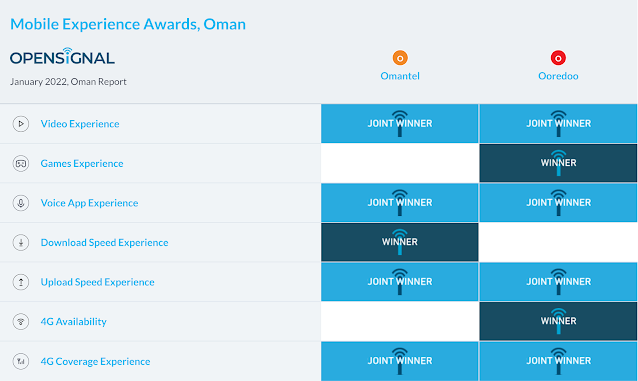
According to the recent Open Signal report (which only surveyed Ooredoo and Omantel), these two operators were joint winners in four out of seven categories due to statistical ties. Of the two, Ooredoo has the most outright wins, being the sole winner of both the Games Experience and 4G Availability awards, while Omantel is the outright winner of the Download Speed Experience award.


Omantel is the Sultanate’s incumbent telecoms operator and primary provider of internet in the country on landline and ADSL. It's mostly state-owned and market leader in mobile networks too. In 2018 it reached 56% of the market. It has the best coverage and speeds and most customers. It's mobile branch is also known as Oman Mobile. Its 4G/LTE reaches most populated areas.

In June 2021 Omantel and Ericsson announced the completion of a 5G millimetre wave (mmWave) proof of concept (PoC) trial that will enable the Omani operator to meet the increasing demand for high-quality connectivity as well as facilitate new use cases. When rolled out, 5G mmWave will greatly enhance the user experience at mobile broadband hotspots and home broadband (fixed wireless access [FWA]), as well as enable low-latency industry applications like Augmented Reality (AR). The trial delivered multi-gigabit speeds with eight cell carrier aggregation functionalities using Ericsson’s Streetmacro 6701 mmWave solution and advanced 5G software features. The trial used a carrier bandwidth of 800MHz at 26GHz, with 5G in Non-Standalone (NSA) mode of operation.

Omantel has also formed a memorandum of understanding (MoU) with the South Korean operator LG Uplus to expand its 5G offerings using edge technology. Included within the scope of the MoU is Augmented reality (AR), Virtual Reality (VR), Multiview, Timeslice solution and any potential business cooperation opportunities on XR platforms.

Ooredeoo is the 2nd provider in the country still giving good coverage in 3G and 4G: 3G 4G coverage maps. 3G covers 90% of the population and has reached 96% coverage of the Sultanate’s population with its ‘SuperNet’ 4G/LTE mobile network in 2019.

Ooredoo from Qatar has acquired the majority of the operator which was called Nawras before and renamed it to Ooredoo in 2014. It's the no.2 slightly behind Omantel at 46% share of the market in 2018. Generally Ooredoo has lower prices than Omantel at a slightly lower coverage.

In June 2021 Nokia and Ooredoo announced the introduction of super-fast and reliable 4G and 5G fixed wireless (FWA) access throughout Oman. Work to deploy the Nokia FastMile 4G FWA solution throughout the country commenced in February 2021. The scope of work initially saw 15,000 homes and businesses connected. In addition, 3,000 homes in city centers will soon get Nokia FastMile 5G FWA.

Vodafone has become the third operator in the sultanate. Vodafone Oman launched in January 2022. Their plans include bringing a next-generation 5G network and cloud services to Oman and then, its spokesperson said, moving into ecosystems that reach far beyond telecommunications.

Local reports suggest that the government initiated the bid for a new mobile operator to improve communication services, generate fresh job opportunities for Omanis, and enhance the country’s GDP. It’s not too surprising therefore that Vodafone Oman is highlighting a focus on employing Omanis and a local partnership ecosystem across key sectors. Vodafone will provide services through 3,500 authorized distributors and a comprehensive network. 

The entry of a new player could also usher in some price competition, potentially benefiting consumers in a market where, according to some reports, internet access is seen as being high compared to other countries in the region. The country, whose population is around five million, is said to have nearly 1.2 million postpaid and 4.7 million prepaid mobile subscribers.

Vodafone received the licence to operate in Oman in 2019. Formal approval of Vodafone as the third operator was given a year ago.

Vodafone Oman also recently signed an agreement with Ericsson to deploy, operate and maintain a new 4G and 5G core and radio access (RAN) greenfield network.

Ericsson will supply a complete core network solution based on Ericsson Cloud Core, NFVI and Cloud VoLTE as well as an end-to-end transport network solution. The greenfield network includes other Ericsson Radio System products and solutions such as the antenna-integrated radio and Ericsson Spectrum Sharing. The end-to-end solution range will deliver a cost-efficient, energy-efficient, and flexible layered architecture design to support 5G from network launch. Vodafone customers will also benefit from Ericsson Voice over LTE (VoLTE) services.

Related Posts:

Thursday, 10 March 2022

Singapore is a 5G leader in Southeast Asia


The Covid-19 pandemic had a significant impact on Singapore’s telecom sector in 2020, pushing down penetration rates and delaying several major infrastructure projects due to production and supply chain disruptions. The good news, at least, is that the overall effect on the sector has been relatively modest compared to other industries that effectively collapsed under the shutdown. Telecommunications remained an essential service during the period, with many people even needing to upgrade their services and plans to enable a shift to working and schooling from home. Singapore’s modern infrastructure and capacity weathered the storm well.

Most telecom operators suffered financially, with declines in revenue and profit as subscribers tightened their belts and reduced discretionary spending. The downturn was roughly in line with the retraction in the Singapore economy. All the major players continued to provide services, and to proceed with their investment programs, particularly in 5G networks (with a focus on standalone). The operators are voicing strong optimism for the coming months as travel restrictions are reduced and economic activity starts to bounce back. While forecasting should be viewed as a very risky activity in such uncertain times, there is a high degree of confidence across the industry that penetration rates in Singapore will quickly return to pre-Covid-19 levels.

Singapore continues to push ahead with its 5G rollout. 5G networks and services are expected to form the backbone of growth in the telco sector over the coming years as service providers seek new ways to engage customers in a market that is otherwise already saturated.

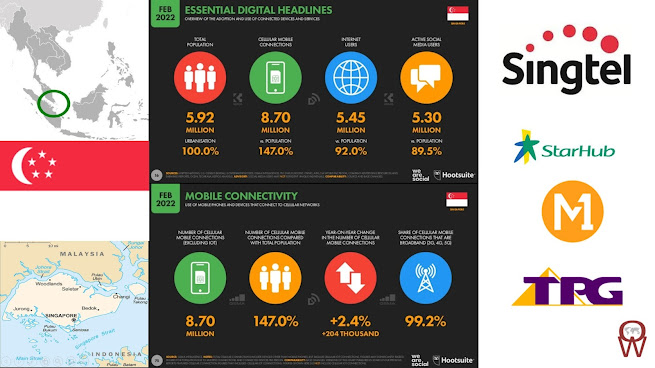
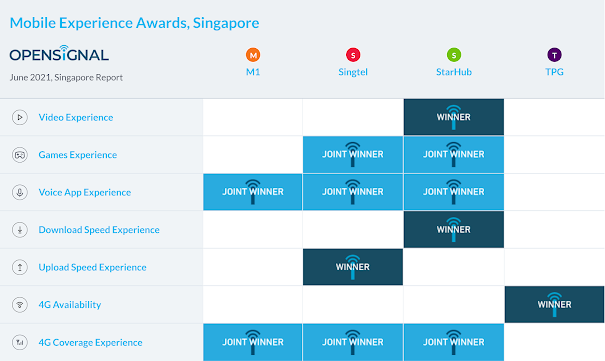
Singapore currently has 4 mobile operators, Singtel Mobile, StarHub, M1 and TPG Telecom (4G-only).

Singtel is the market leader, Starhub is in second position, M1 is in third and TPG is in fourth. Coverage and speed is excellent in the city on the three major networks. No 2G is available, 3G on 900 and 2100 MHz, and 4G/LTE has started on all three providers on 1800 MHz (band 3) and 2600 MHz (band 7). 900 MHz (band 8) and 2500 MHz (band 41) were later added, and from 2019 spectrum on 700 MHz (band 28) is added for 4G/LTE.

5G trials were started by Starhub in August 2020 on 2100 MHz (n1) and by Singtel in September 2020 on both 2100 MHz (n1) and 3500 MHz (n78), and quietly commenced commercial operations on the three major operators in early-2021 when 3500 MHz (n78) was also added for 5G for Starhub and M1, but is currently not open for prepaid.

The coverage and speeds in this city state are superb by all three providers. 4G/LTE covers all of the city outdoors and the MRT (= metro, subway). Note that for Singapore you'll need to bring a 3G/4G device as 2G is switched off. 2G/GSM networks of all three providers were shut down on April 1, 2017. There is no 2G coverage anymore. So bring a 3G or 4G/LTE capable device. The sale of 2G-only mobile devices has been banned from January 2017 or retailers could be given a penalty. 


Singtel Mobile by the Singtel Group is the biggest provider in town and has a market share of about 45%. The Singapore Telecommunications Ltd. is one of the largest mobile network operators in Southeast Asia. It has a coverage of 99% for 3G and 4G/LTE: Singtel 3G 4G. 4G/LTE is on 900, 1800 and 2600 MHz, bands 3, 7 and 8.

Singtel is ramping up its 5G standalone (SA) deployment in Singapore, by expanding the network and developing new 5G use cases in partnership with Ericsson. In a press release the Swedish vendor said it is powering Singtel’s 5G SA network with 5G radio access products and cloud-native dual-mode 5G Core network solutions. The pair hope to deliver high-quality connectivity for outdoor coverage in densely populated areas and help drive strong indoor-mall coverage across the city-state. Ericsson went on to say ‘the COVID-19 pandemic has fuelled the need for better connectivity indoors, due to the numerous travel and lock-down restrictions’. The deployment builds on a long-standing relationship between the two companies, including with Singtel’s initial wave of 5G rollouts.

In September 2021 Singtel confirmed that its 5G network now covers over two-thirds of Singapore, with new 5G sites added in densely populated areas like Choa Chu Kang, Punggol, Sembawang and Tampines. In addition, the mobile operator has expanded its 5G indoor coverage to more major shopping malls island-wide such as Funan, West Mall, Tampines Mall, Northpoint City and Waterway Point. In April 2021 Singtel revealed that as part of its 5G ‘push’, it had deployed hundreds of 5G SA sites across the city-state, in areas such as Orchard Road, the Central Business District, Harbourfront and Sentosa. With work ongoing to boost in-building coverage in Ngee Ann City and selected Singtel Shops across Singapore (having already begun the process at VivoCity), Singtel confirmed that in readiness for commercial launch, it had begun offering 5G SA compatible SIM cards. The cellco’s 5G SA sites run on 3.5GHz spectrum, enabling it to deliver ultra-fast speeds and swifter response times.

StarHub by local StarHub Ltd. is the 2nd provider in Singapore giving good speeds and coverage in 3G and 4G/LTE reaching a nationwide coverage. StarHub is the local partner of Vodafone and is the only provider to offer VoLTE (branded as HD Voice+) on prepaid. 4G/LTE is on 1800, 2100, 2500 and 2600 MHz, bands 1, 3, 7 and 41.  StarHub's 5G standalone network has also been very successful: 

 M1 (previously known as MobileOne) is the 3rd largest national provider in Singapore. Coverage on 3G and 4G is on par with the other two providers. 4G/LTE is on 1800 and 2600 MHz, bands 3 and 7.

 M1 launched its 5G Standalone network in July 2021 via what it terms ‘an exclusive market trial, allowing both its existing and new mobile customers to enjoy the enhanced benefits of the … technology’. In a press release the operator confirmed that customers can experience ‘true’ 5G by signing-up for a ‘5Go Plus Booster’ plan both online or in-store. As part of this, the carrier is running an exclusive launch promotion giving users ‘at least three months of free access to the True 5G experience, following which they can continue to enjoy the service at a discounted price starting at SGD5 per month, until the end of 2021’.

The operator’s new 5G SA network currently covers about 50% of the city-state including the Central Business District (CBD), Marina Bay Financial Centre, key town centres and high data usage areas such as Ang Mo Kio, Bishan, Chinatown, Clementi, Orchard Road, Pasir Ris, Paya Lebar, Sengkang, Tampines and Woodlands. Going forward, M1 plans to extend coverage to 75% of Singapore by the end of 2021 with full coverage completed by the end of 2022 – eclipsing the regulator’s requirements of 50% coverage by that date.

In 2016 the bidding auction for a 4th operator was started. The winner was named with TPG Telecom from Australia, founded by Malaysian billionaire David Teoh. It was allocated spectrum in the unusual 900 MHz and 2300 MHz bands (8 and 40) to provide only 4G/LTE services which started in 2020.

According to Mobile World Live TPG Telecom has two years to reach 50 per cent coverage with an SA 5G network and five years for nationwide. It holds spectrum in the 900MHz and 2.3GHz bands won as part of its market entry in 2016. It has also been provisionally awarded 2 (two) 5MHz paired lots of spectrum in the 2.1 GHz band for a price of S$31m. 

Related Posts:

Saturday, 10 July 2021

Singtel shows the power of Standalone 5G

Singtel announced the launch its 5G Standalone (SA) network in May, offering customers early access to the most advanced 5G connectivity globally. Compared to 4G, 5G SA delivers twice the responsiveness, 30% faster uploads, and strengthened authentication and encryption capability. With much greater bandwidth and near-instant responses, 5G SA will enable revolutionary applications like self-driving cars, real-time immersive entertainment, and massive IoT (Internet of Things) connections.

This infographic shows all the things 5G Standalone can do.

In addition, Singtel also produced a series of 5G videos explaining the benefits of 5G from Standalone point of view.

The press release highlights:

Since last September, Singtel has been operating Singapore’s fastest 5G NSA network under a market trial, offering 5G speeds of up to 1.2 Gbps. Within a year of receiving its 5G licence, Singtel has now turned on 5G SA and deployed over a thousand 5G sites across Singapore in strategic locations such as Orchard Road, the Central Business District, Marina Bay, Harbourfront and Sentosa, as well as major residential areas including Sengkang, Punggol, Pasir Ris, Jurong East, Woodlands, and more. It is the only telco in Singapore to roll out in-building 5G, covering popular malls such as VivoCity and Ngee Ann City, and will continue to expand its indoor 5G footprint in the coming months.

On the enterprise front, Singtel is focused on accelerating 5G innovation and 5G adoption, launching Genie, the world’s first portable 5G-in-a-box platform and expanding its 5G ecosystem with 5G Multi-access Edge Compute trials in collaboration with Microsoft Azure and Amazon Web Services.

All consumers in Singapore can trial 5G’s ultra-fast speeds and ultra-low latency at Singtel’s 5G experience zones in selected Singtel Shops, UNBOXED and UNBOXED Lite on Orchard Road.

Related Posts:

Tuesday, 20 April 2021

Bahrain has 100% 5G Coverage


The telecommunications sector in Bahrain is vibrant and progressive and it contributes about 4% a year to the Kingdom’s GDP. Bahrain attempted to drive further growth in the telecoms sector in 2020 by ensuring it is competitive and adaptable to market dynamics. It has the added pressure of coping with the impact from the global Covid-19 outbreak and ensuring provision of adequate Internet services and applications to home-based citizens.

The major telecoms operators include Batelco, STC Bahrain and Zain Bahrain. The industry is regulated by Telecommunications Regulator (TRA) which has been working hard to resolve any regulatory or spectrum hurdles in readiness for 5G. This government support, along with proactive operators, resulted in Batelco launching the first commercial 5G network in Bahrain in mid-2019.

Batelco also undertook a significant operational restructure in 2019 and launched Bahrain’s National Broadband Network operated by BNET. Bahrain’s telecommunications industry is guided by its Fourth National Telecommunications Plan which focuses on fibre-optic infrastructure deployment and establishing affordable prices for high-speed access.

Overall, the mobile broadband sector is poised for growth with 4G networks in place and a high mobile subscriber penetration paving the way for adoption.

The three mobile operators as mentioned are Batelco, Zain  and STC (formerly Viva). 2G/GSM is on 900 and 1800 MHz, 3G/UMTS on 2100 MHz and 4G/LTE on 1800 MHz (band 3) has started on all three operators. 4G/LTE is available on prepaid. All providers cover already 99% of the country by 4G/LTE in 2016 and give average download rates of more than 20 Mbps. The three competitors are very much neck on neck.


Zain based in Kuwait is the second carrier in Bahrain with a good coverage and similar prices. All prepaid data are on 4G/LTE too.

Zain Bahrain has selected Ericsson’s dual-band 4T4R AIR 4455, an antenna-integrated radio solution to boost its 4G and 5G coverage in Manama.

The deployment of Ericsson AIR 4455 enables 5G through Ericsson Spectrum Sharing. Increasing capacity and user data rates; as well as strengthening Zain Bahrain’s network operations with a tailored solution designed for street macro coverage in dense urban centers.

Ericsson's AIR 4455 solution offers Zain Bahrain the opportunity to seamlessly bring connectivity to urban centers. As part of Ericsson Radio System, the street macro deployment solution is an integrated part of the network, with feature parity and end-to-end performance.

Ultimately, Zain Bahrain will now serve dense, high foot-traffic areas in the country with improved 4G and 5G data rates, enhancing user experience. Additionally, Ericsson street macro solutions align with Bahrain Economic Vision 2030 to improve technology provisions and the Telecommunications Regulatory Authority’s (TRA) objective to minimize the visual visibility of 4G and 5G sites in Bahrain.


STC formerly called Viva is the 3rd and newest carrier coming from Saudi Arabia. It has the reputation of having the best network (LTE-Advanced/4G+) and lowest rates in the Kingdom. In December 2019 it was rebranded to STC for Saudi Telecom Company with a new logo. 


Batelco is the national provider and the only landline/ADSL provider in the country. As in most cases, it has 2nd best coverage and is the most expensive at the same time.  Batelco has informed customers that its 2G network will be phased out by 31 December 2019.  

Batelco has announced in October 2020 that it has successfully activated 5G coverage across Bahrain.

The 5G coverage is available in all four governorates covering 95 percent of the nation’s population. This, says Batelco, makes it the first operator to have national 5G coverage in Bahrain – and positions Batelco among the leading operators in the Gulf Cooperation Council (GCC), a political and economic alliance of six countries in the Arabian Peninsula: Bahrain, Kuwait, Oman, Qatar, Saudi Arabia and the United Arab Emirates.

Although Bahrain is not big (it covers an area estimated at  765.3 square kilometres) the rollout does seems to have happened quite quickly. It was in March last year that Batelco signed a partnership agreement with Ericsson to build a national 5G mobile network over a period of two years.

In June 2019, Batelco announced that it was the first operator in Bahrain and among the first in the region to deliver commercial 5G network services for its customers.

In January this year, Mobile Magazine reported that according to Bahrain’s Ministry of Transportation and Telecommunications, two of the country’s three mobile operators now have full coverage, prompting a new wave of opportunities for streaming, gaming and supply chain technologies. 

Related Posts: