NTT Docomo has been at the forefront of Beyond 5G and 6G research, exploring how emerging technologies will shape the future of mobile networks. In this post, I’m sharing insights from two recent keynotes by NTT Docomo executives, highlighting their vision for AI, Big Data, and next-generation connectivity.
6G Promotion and AI Utilization – Takaaki Sato, Brooklyn 6G Summit
Takaaki Sato, Senior Executive Vice President at NTT Docomo, delivered a keynote at the Brooklyn 6G Summit, discussing "6G Promotion and Prospects for AI Utilization." His talk explored how AI will be deeply integrated into 6G networks, moving beyond the siloed approach seen in 5G. Watch the keynote below:
AI-Native 5G Evolution and 6G – Takehiro Nakamura, FutureNet Asia 2024
For a more technical perspective, Takehiro Nakamura, Chief Standardization Officer at NTT Docomo, spoke at FutureNet Asia 2024 on "AI-Native 5G Evolution and 6G." His presentation delved into the role of AI and Big Data in network evolution and how 6G will leverage advanced technologies to enhance efficiency and performance. Watch his presentation here:
The Path to 6G: AI, Big Data, and the IOWN All-Photonics Network
A key theme in both keynotes was the convergence of AI and Big Data, which were largely separate in 5G but will be deeply intertwined in 6G. NTT Docomo envisions this integration—along with the IOWN All-Photonics Network—enhancing human experiences and driving innovation.
As the industry moves towards 6G, it’s clear that AI and network intelligence will play a foundational role in shaping next-generation connectivity. What are your thoughts on NTT Docomo’s vision? Share your comments below!
On March 7, 2023, KDDI launched αU (Alpha–U), a metaverse and Web3 service, and introduced to its customers a new world where anyone can become a creator and to support the new generation of users who effortlessly move between the real and virtual worlds. The name αU comes from the Greek letter alpha (α), which symbolizes the beginning of something new, and the letter U, which stands for user. This reflects KDDI's goal of creating a new digital world that is accessible to everyone and that offers new opportunities for interaction and engagement.
αU is designed to be a comprehensive platform that offers a wide range of features and services for the Web3 era, including the metaverse, live streaming, and virtual shopping. Users can create their own avatars, their own virtual communities, explore virtual worlds, participate in a range of games and activities and interact with other users in real-time. The platform also offers a range of tools for content creators, including the ability to create and sell digital items and experiences.
This service eliminates the boundary between the real and virtual worlds, allowing users to enjoy everyday experiences such as attending live music performances, enjoying art, having conversations with friends, and shopping―anytime, anywhere. By collaborating with domestic and international partners, KDDI will provide support introducing Japanese creators and content to the world. Their aim is to build a creator economy in which creators can produce value and be compensated for their work.
One of the key features of αU is its integration with Web3 technologies, which are designed to provide a more decentralized and transparent digital environment. The platform uses the Ethereum blockchain to enable secure transactions and to create a digital economy that is controlled by users rather than centralized authorities.
KDDI in partnership with Geometry Ogilvy Japan, had previously launched Virtual Shibuya, an urban-linked metaverse, in May 2020, and Digital Twin Shibuya, which links real and virtual spaces, in October 2022 as part of its continuous initiatives to expand urban experiences by utilizing 5G communications and AR/MR technologies.
Yasushi Arikawa, senior creative director, creative head of experience at Geometry Ogilvy Japan, explains that the initial version of the project was already under way before Covid hit, but it accelerated the need to create a virtual space as the city locked down;
“Having discussed the feasibility of implementing the experience in the real city, we then pivoted, and in May 2020 ‘Virtual Shibuya’ was born, a virtual platform that would itself reinvent the city of Shibuya. The city was locked down, and for those who could not go out ‘Virtual Shibuya,’ easily accessible with a smartphone, was immediately accepted as a new entertainment experience. The highly successful launch event attracted more than 53,000 visitors."
"In October 2020, after the second and third waves of Covid, we hosted ‘Virtual Shibuya Halloween’ in a safe and secure virtual space to discourage people from visiting the huge ‘Halloween in Shibuya’ event that usually attracts one million visitors a year and represents Shibuya Ward. Several programs were held, including Trick or Treat content with digital incentives, avatar contests, talk shows and music concerts, which were successful in attracting more than 410,000 visitors.”
Mr Arikawa elaborates:
For the past three years, Virtual Shibuya has offered this new form of entertainment enabled by technology, such as live music performances from artists, talk shows featuring anime and manga characters, and other urban-linked experiences that are anchored in a virtual space.
αU will evolve this from a traditional public space for experience to a space for communication.
Geometry Ogilvy Japan, also created a virtually produced film to showcase aU. This 30-second clip which showcases four artistic illustrations made by GenZ artist Mayu Yukishita, The AI and a virtual singer tell a story about the concept of “Already, one world” that blends the real and virtual worlds, takes us beyond the “uncanny valley” to an emotionally charged story
KDDI is also working in collaboration with Google Cloud on αU. Google Cloud’s Immersive Stream for XR product creates high-definition virtual entertainment experiences. Immersive Stream for XR allows users to engage in an immersive, interactive, and photorealistic experience, without downloading an app so they can immediately engage with content on any device.
The implementation of these technologies will promote further collaboration between KDDI and Google's technical teams in the future. Their aim is to create use cases that lead to innovation and new consumption and experience behaviors, such as the realization of the Metaverse Web3 service "αU”, a world where anyone can become a creator and leverages content distribution on platforms like YouTube.
The launch of αU is a significant milestone for KDDI and for the wider metaverse and Web3 community. The platform offers a range of innovative features and experiences, and it has the potential to become a major player in the growing digital economy. As the platform evolves and expands, we can expect to see new and exciting applications emerge, and we can look forward to a future where the digital and physical worlds are more closely connected than ever before.
A recent survey conducted by ICT Research Institute, Inc., Japan, came to a conclusion that the quality of communication across Japan was at a very high level when compared to other developed nation while at the same time the costs were very reasonable and much lower than other countries.
ICT Research Institute survey on mobile data plans compared Japan, USA, UK, France, Germany and Korea. Report found Japan GB fees ranged $15~$60, well below combined averages, and noted highest rate of 4G adoption and customer satisfaction [Jpn] https://t.co/cPYq6sMnOlpic.twitter.com/Q8h9MXLz4O
The following is an extract from the press release (in Japanese, translated by Google translate):
In the summer of 2018, the government pointed out that there is room for a 40% price cut, giving the impression that mobile phone charges in Japan are high, but after that, mobile phone operators have introduced new rate plans one after another. It seems that the new rate system of Japanese MNOs (mobile network operators) has taken root in the past year, including online-only plans.
The purpose of this survey was to understand the current state of communication charges in Japan, including a comparison with "communication quality," which is emphasized as an important core infrastructure.
The subjects of the survey were his MNOs in six countries, Japan, the United States, the United Kingdom, France, Germany, and South Korea, and the smartphone charges for each country were as of December 1, 2021. In December 2021, we conducted a web questionnaire survey for Japanese mobile phone users. This survey is positioned as a sequel to a similar survey announced by the Company in July 2020.
As a result of the survey, the average monthly smartphone charges for the six countries as of December 1, 2021 are 3,538 yen, 5GB 3,895 yen, 20GB 4,614 yen, and unlimited 7,097 yen for a data capacity of 2GB. Overall, fares in Japan and the United Kingdom were low, and fares in the United States and Germany were high.
Japan has the lowest monthly charge of 2GB (1,477 yen) and 20GB (2,445 yen) among the six countries, and the United Kingdom has the lowest monthly charge of 5GB (2,222 yen) and unlimited (3,777 yen) among the six countries. .. Japan is second only to the cheapest data capacity category, and the United Kingdom is second only to the cheapest data capacity category.
The United States is the highest among the six countries in the 2GB, 5GB, and 20G categories, and Germany is at a high level overall, exceeding the average rate of the six countries in all data capacity categories.
In the previous survey (announced in July 2020), Japan's tariffs were "medium level" among the six countries, but in this survey they have dropped significantly to the lowest level among the six countries. It turned out that there was.
In this survey, we referred to the survey data of Agoop Co., Ltd. in order to compare the communication quality of each country. According to this network connection rate result, Japan has the highest 4G connection rate of 99.4% among the six countries. South Korea was followed by 96.0% and the United States at 93.1%.
Not only is Japan the top 4G connection rate, but the 3G connection rate is also 0.3%. The ratio of "out of service / timeout" is only 0.3%, and it can be said that the communication quality is the highest among the six countries.
The results of the three European countries have lower 4G connection rates than the three countries of Japan, the United States and South Korea. About 10% are connected by 2G or 3G communication method, and the ratio of "out of service / timeout" is also relatively high.
It should be kept in mind that this is a very small sample of countries and most importantly it is missing China, which would make some of these comparisons very tricky.
We have highlighted many firsts of Japanese operator NTT Docomo in many different posts in our blogs. For the regular readers of our blogs, it won't come as a surprise that NTT Docomo announced that they have already 10,000+ base stations based on O-RAN principles and the number is expected to exceed 20,000 by March 2022.
In fact NTT Docomo is also trying to export their know-how, partners and ecosystem to other interested operators. To highlight how this would work, they had also published a 5G Open RAN Ecosystem (OREC) Whitepaper back in June as can be seen in the Tweet above.
In not just the RAN virtualization where Docomo leads. Back in 2016, Docomo introduced world's first multi-vendor network virtualization technology to LTE packet service. By March, the core network virtualization adoption rate had increased to 56%. It is expected to reach the 100% target by the end of FY 2024.
At 5G Techritory conference, Takehiro Nakamura, SVP and GM of 6G-IOWN Promotion Department at NTT Docomo Inc., presented the 5G Status in Japan, most with regards to NTT Docomo. His talk contained some interesting nuggets and is embedded below, for as long as the talk is available online.
In addition, please check out all the posts below providing interesting insights from NTT Docomo.
We have often written about NTT Docomo in this and other blogs. Even though Docomo doesn't shout a lot about their achievements, they are one of the pioneers of many new technologies and innovations, not just in Japan but in the world.
Now that the main architecture of 5G is ready and the industry focus is on 6G, NTT Docomo has detailed their 5G journey and achievements in the latest NTT Docomo Technical Journal here. In addition to highlighting their approach, innovations and journey, these articles also show how the current 5G ties to NTT Docomo's vision that was set in 2014/15.
In addition to the vision and innovation, they have done numerous trials with many different partners (see the videos and related posts below) to make sure that the visions do translate into reality. The tables above lists all the technology and field trials. Some of these are in the videos below.
You can read the latest issue of the NTT Docomo Technical Journal here.
For more details, please check the posts below. If there is anything interesting we have missed, please add it in the comments below.
5G made an official debut in Japan back in April but as Rakuten is a new operator, it was not ready with its 5G network back then. Now they have just launched their 5G network and plan to shake the market with their innovative plans and approach.
Tokyo, September 30, 2020 – Rakuten Mobile, Inc. today announced the launch of its 5th generation mobile communications system (5G) service and a new and enhanced “Rakuten UN-LIMIT V” service plan which offers customers access to 5G services for the same 2,980 yen monthly fee as the previous “Rakuten UN-LIMIT 2.0” plan. From today, existing subscribers of the Rakuten UN-LIMIT 2.0 service plan will be able to use 5G services for no additional cost, in 5G service areas with a 5G-compatible device.
Mickey Mikitani, Chairman and CEO of Rakuten, Inc., and Representative Director, Chairman and CEO of Rakuten Mobile, Inc. commented, “Less than six months since full-scale commercial launch of the world's first fully virtualized mobile network, today Rakuten Mobile takes another step forward to transform the mobile industry: We're offering customers 4G and 5G combined in one simple plan – Rakuten UN-LIMIT V – at the same low price as 4G.
Our network technology is built to meet the ever-evolving needs of our customers – and with transformational innovation, we are passing on significant savings to our customers. As we move forward to expand 4G and 5G coverage, we aim to reduce the household cost of mobile services. This is also about encouraging consumer spending across other services and goods, contributing to the sustainable health of Japan's national economy.
Today, we're one step closer to transforming telecommunications and building a brighter future for everyone.”
Rakuten Mobile built the world’s first end-to-end fully virtualized cloud-native mobile network and launched full-scale commercial carrier services on the network in April 2020. The network architecture allows for substantial reductions in capital investment and operating costs, enabling the operator to offer the Rakuten UN-LIMIT V service plan, which includes both 4th generation mobile communications system (4G) and 5G services, for the same monthly fee of 2,980 yen. By leveraging the synergies between 5G and various offerings from the broad portfolio of Rakuten Group businesses to develop engaging new content and services, Rakuten Mobile aims to provide customers with a next-generation mobile experience.
Along with the launch of the new Rakuten UN-LIMIT V plan, the company also unveiled the “Rakuten BIG,” a new original 5G smartphone from Rakuten Mobile. In addition to this new product, users of the AQUOS R5G smartphone that went on sale in June 2020 will be able to use Rakuten Mobile’s 5G service after installing a software update to be released by Sharp Corporation from 3:30 p.m. on September 30.
Now offering 5G: Rakuten UN-LIMIT V
With Rakuten UN-LIMIT, Rakuten Mobile’s aim is to offer a service plan without complex terms and conditions – a plan that is simple, intuitive and easy-to-use for all customers, whether they are in Japan or traveling internationally. For 5G, Rakuten Mobile will continue its one service plan strategy by updating its Rakuten UN-LIMIT 2.0 service plan, which launched in April 2020 and offers subscribers unlimited data and calls for a monthly fee of 2,980 yen, to Rakuten UN-LIMIT V, which offers 5G services in addition to 4G. Starting today, the one plan offered to customers will be Rakuten UN-LIMIT V.
Current Rakuten UN-LIMIT 2.0 service plan customers who wish to use 5G services can now upgrade their service plan to Rakuten UN-LIMIT V on the “My Rakuten Mobile” app or through the Rakuten Mobile website. For other customers, service plans will be automatically upgraded to Rakuten UN-LIMIT V starting October 12, 2020*8. New applicants for the Rakuten UN-LIMIT V plan are also eligible for the campaign offering 3 million subscribers the first full year of service free of monthly fees launched in March 2020.
Overview of the service plan
- Plan name: Rakuten UN-LIMIT V
- Monthly fee: 2,980 yen
- Launch date: 3:30 p.m. on September 30, 2020
- Rakuten Points: Users will earn 1 Rakuten Point for every 100 yen spent on their Rakuten Mobile bill. Rakuten Mobile subscribers will also earn an additional +1% point-back incentive through the Super Point Up (SPU) program for purchases on Rakuten Ichiba.
Rakuten Mobile’s fully virtualized 5G mobile network
Rakuten Mobile’s 4G network is the world’s first fully virtualized cloud native mobile network. In its 5G network, excluding the core network, all 5G network functions, such as the virtualized OpenRAN, cloud and OSS, are run on the Rakuten Communications Platform (RCP), a telco platform that is based on containers for more flexible and stable development. Rakuten Mobile’s telecommunications platform utilizes equipment and software from trusted partners.
Rakuten Mobile’s network offers Non-Stand Alone (NSA) 5G service from September 30, 2020. Stand Alone (SA)*9 5G service is planned for launch in the second quarter of 2021.
About the 5G service area
- Service area: Parts of Tokyo, Kanagawa, Saitama, Hokkaido, Osaka and Hyogo (as of September 30, 2020) *For more details, please see the official site*2. Rakuten Mobile will continue to expand the service area.
- 5G transmission speed:
As of September 30, 2020: Maximum download speed: Approx. 870Mbps / Maximum upload speed: Approx. 110Mbps
As of November 2020 (planned): Maximum download speed: Approx. 2.8Gbps / Maximum upload speed: Approx. 275Mbps
- 5G-compatible devices: Rakuten BIG, AQUOS R5G *Please see the device specifications for more details on the maximum transmission speeds for each device.
You can also read Rakuten blog on this topic here and details of their new 5G device, Rakuten BIG here. You can find the detailed specifications of the smartphone here.
Japan: "Rakuten is off to a slow 5G start... The rock-bottom 5G prices might entice more consumers, but they may unsettle investors already gloomy about the 5G sales opportunity" - https://t.co/3mXDvDjdR5
There are still a lot of unanswered questions as the tweet above shows with details in this Light Reading article here.
The Mobile Network on the other hand has a technically detailed article here that provides information on different vendors, ecosystem partners and the different chipsets by Qualcomm and Intel in use.
This is an interesting slide in that there's this question around which enterprises Rakuten Mobile will target w/ its 5G offering. Well, to start with, their own. pic.twitter.com/oIGQHp2xX1
Some other interesting articles around this launch include this on Linked from Dean Bubley, article from Telecom TV and finally this Light Reading article that is questioning Rakuten's investment in Altiostar and if it is worth $250 million.
Here is the complete video from the 5G launch that Rakuten kindly shared on their YouTube channel
A question I often see people ask is how many cell towers / base stations are there worldwide? Surprisingly this information is not as easy to obtain as you may think initially. We can use this chart from a Light Reading webinar as a starting point:
Many years back someone explained a rule of thumb to me. There is on an average 1 site for every 1000 subscribers. With roughly 8 billion subscribers, this will amount to 8 million sites.
Omdia statistics from above says that there are 7 million physical sites and 10 million logical sites. As there are many sites hosting infrastructure from multiple operators, the number of logical sites are more than the number of physical sites.
In addition there will be small cells mounted on lamp posts, side of the buildings, indoors, etc. that generally may not be included in the count mainly.
When it comes to base stations, there is a debate on what is included. For example on a tower hosting multiple operators, each of them will have their own Baseband Unit (BBU), so this is multiple base stations. If for an operator, there are multiple generations of technologies and within each of these generation, multiple frequencies, sectors, etc. Do they count as a single base station or multiple?
Then there are towers and masts. Wikipedia nicely explains that "The terms "mast" and "tower" are often used interchangeably. However, in structural engineering terms, a tower is a self-supporting or cantilevered structure, while a mast is held up by stays or guys."
So coming back to 5G, how many base stations have been rolled out in the major markets?
Japan
In an earlier post on NTT Docomo, we pointed out that Docomo coverage is forecast to increase from 500 base stations in 150 locations to 10,000 sites (in about 500 cities) by June 2021 and 20,000 by March 2022.
According to Tefficient, Rakuten had 5739 LTE base stations on air at the end of June. The three incumbent operators have roughly 200000 LTE base stations each.
.@Rakuten_Mobile had 5739 LTE base stations on air at the end of June. Within that coverage area, Rakuten's UN-LIMIT customers have unlimited mobile data, outside of it limited data over au's network. The three incumbent operators have roughly 200000 base stations each. pic.twitter.com/ZpZBh7pH3q
Back in December last year, Global Times reported, there are currently approximately 6 million 4G base stations worldwide, more than half of which are in China and about 300,000 in the US. Why does China have so many base stations? This is because of a nation-level project in China in 2003. The project required that more than 95 percent of remote mountainous areas should be covered with communication signals and the fees must not be higher than those in urban areas.
In an earlier post we reported, the total number of 4G base stations in the first half of 2019 was 2.71 million including a net addition of 300,000, providing robust support for the development of large volumes of data traffic business.
European 5G observatory reported that China intends to have 600,000 5G base stations by the end of 2020. According to RCR wireless, Chinese telcos have already deployed over 20,000 5G base stations in Shanghai.
According to Tefficient, China Mobile had 188k 5G base stations in June 2020. So China then had a total of 398k 5G base stations
China Mobile had 188k 5G base stations in June 2020. So China then had a total of 398k 5G base stations - assuming that China Broadcasting Network hasn't yet built any (anyhow to partner with China Mobile). https://t.co/S1KYNHgWRf
There is no shortage on posts about NTT Docomo on this blog and other sister blogs. Not only are they innovators and trend setters, they have pioneered quite a few technologies that have gone mainstream after many years of them trying it out.
While Docomo launched their 5G network only recently, they have been working on it for a very long time, since 2010. They have published an article on this in the latest instalment of their Technical Journal here. The following is just some selective extract:
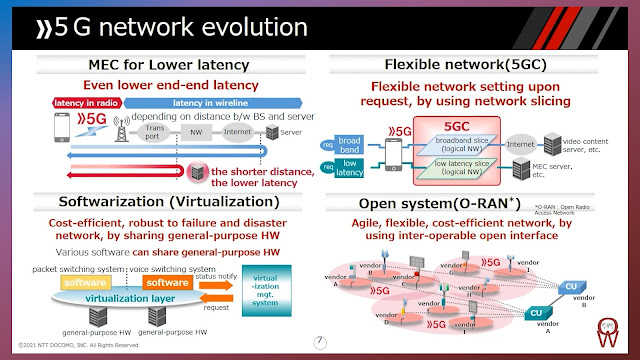
Prior to launching its 5G commercial service, NTT DOCOMO began basic 5G studies in 2010 and commenced high-frequency-band trials in 2014. Then, after contributing to early formulation of 3GPP standards for 5G in collaboration with major global mobile enterprises, NTT DOCOMO launched its 5G pre-commercial service in September 2019 creating many solutions together with co-creation partners. Going forward, NTT DOCOMO plans to construct and roll out 5G service areas successively starting with major train stations/airports and stadiums in urban and regional areas as well as various types of facilities with partner collaboration in mind. High Speed and Large Capacity: The 5G system will provide much higher broad- band data transmission compared with the existing system. It will realize high-definition video including Virtual Reality (VR) and Augmented Reality (AR) experiences while enabling users to enjoy high-presence video and services as a familiar part of life. The maximum receive speed will be 3.4 Gbps achieved through the use of various technical advances such as high-order Multiple Input Multiple Output (MIMO) technology and the combining of many frequency bands. This value corresponds to the maximum receive speed at the time of the 5G commercial service launch as shown in Table 1, but NTT DOCOMO will continuously improve transmission speed through a variety of technical approaches including higher spectral efficiency. Low Latency: In 5G, low latency will enable high-real-time control. For example, it can contribute to even higher levels of automation by determining current running conditions of plant facilities and machines and controlling and operating them in real time. Also in 5G, the radio transmission unit has been shortened to one-half to one-eighth that of 4G depending on the frequency band, and the timing for confirming delivery has been positioned immediately after data transmission. These technologies combined are expected to achieve low latency in the radio interval compared with 4G. In addition, the adoption of Multi-access Edge Computing (MEC) is expected to achieve low latency on an end-to-end basis. NTT DOCOMO has achieved its 5G service through a non-standalone format in which terminals connect to the mobile network through both the NR and eLTE radio access systems. Specifically, it has leveraged the know-how obtained in deploying an Advanced Centralized Radio Access Network (Advanced C-RAN) in LTE to provide high-speed communications through Dual Connectivity (DC), which uses two radio access systems in an area in which both NR and eLTE (eLTE is defined as an LTE communication specification conforming to 3GPP Rel. 15 or later.) can be used. A system configuration diagram of the 5G service is shown in Figure 2.
Up to now, specifications for interconnecting base station equipment (signal send/receive rules) differed from vendor to vendor without sufficient consideration given to international standards. This situation made it difficult to interconnect base sta- tion equipment of different vendors so the usual approach was to interconnect base stations from the same vendor. However, in the 5G launch period, in which expansion of the 5G area would take place while using the existing 4G network, this approach would limit the vendors of 5G base station equipment that can be selected to vendors of 4G base station equipment. To solve this problem, the Open Radio Access Network (O-RAN) Alliance that NTT DOCOMO has been participating in promoted the international standardization of interoperability specifications between base stations thereby unifying interoperability specifications across 4G and 5G base station equipment and enabling multi-vendor connections. These interoperability specifications have made it possible to deploy newly developed 5G base stations without having to rely on 4G base-station vendors and to achieve a speedy 5G rollout while using existing 4G assets.
NTT Docomo, maybe the largest operator in Japan, however they recently announced a drop in profit and revenue for the past financial year but in response, detailed for the first time a plan to grow their 5G network. There 5G expansion plans are both aggressive and ambitious.
The operator, which launched 5G service last month, said it signed up 14,000 5G users at end-March and targets 2.5 million subs by March 2021 and 20 million three years later.
Coverage is forecast to increase from 500 base stations in 150 locations to 10,000 sites (in about 500 cities) by June 2021 and 20,000 by March 2022. Despite lagging behind the United States and South Korea, which introduced their versions in April last year, the new wireless service available in the 150 locations in Japan covers 29 of the nation's 47 prefectures.
Their 5G plans for its next fiscal year ending 30 March 2021 include promoting Open RAN technology and deploying millimeter wave, as well as expanding the range of 5G smartphones, which stood at six devices at launch. It also mentioned pursuit of new experience and sensory services, e.g., music, gaming, video, sports, etc and value creation suited to remote‐work society (medical / education / manufacturing, etc.)
Docomo's 5G plans for current financial year include O-RAN and mmWave on the network side. pic.twitter.com/weW48oD9wU
Docomo's 5G plans for its next fiscal year ending 30 March 2021 include promoting O-RAN (see Open RAN terminology) technology and deploying mmWave, as well as expanding the range of 5G smartphones, which stood at six devices at launch.
NTT Docomo has delivered Japan's fastest speeds for both downloads and uploads for the last two years. Operators in Japan have received an ideal amount of spectrum for 5G services. NTT Docomo 5G service is achieving a maximum data rate of 3.4 Gbps in downlink currently which is expected to increase to 4.1 Gbps in June. Of course these are theoretical maximum values and no individual user can expect to receive this.
If you follow the 5G developments closely, you may have thought that 5G was available in Japan for a while. NTT Docomo has been talking about 5G for the last 5 years. Finally, 5G has launched commercially in the country.
Three out of four Japanese mobile service providers launched 5G services on three successive days at the end of March 2020. The fourth local player Rakuten Mobile is expected to follow in June 2020.
The three Japanese incumbents @docomo, @au_official and @SoftBank are all launching 5G this week. Here a comparison of their premium 5G plans. KDDI's au takes a wholehearted step into unlimited with two plans at launch (adding a third unlimited in June with 2 more services). pic.twitter.com/gEG9PHgJY3
NTT DoCoMo launched Japan’s first 5G smartphone service on March 25, 2020. The network is live in 150 areas in Japan covering 29 of the nation’s 47 prefectures. Customers can get 1 GB of data at 1,980 JPY (16.8 EUR) or 100GB of data at 7,650 JPY (62 EUR) per month, excluding taxes.
According to the operator, the network will continue to expand throughout June, ultimately reaching 500 cities by March 2021, and will have an initial maximum downlink data rate of 3.4 Gbps, followed by a speed of 4.1 Gbps expected in June. In addition, the uplink will start at a 182 Mbps peak, before increasing to 480 Mbps. NTT Docomo anticipates it will have 10,000 base stations by the end of June 2021, and 20,000 by the end of March 2022.
While KDDI launched 5G mobile services in 15 of Japan’s 47 prefectures on March 26, 2020. The operator said it aims to install 10,000 base transceiver stations by 31 March 2021 and another 10,000 BTS by the end of March 2022. Customers can get unlimited data and 30 GB for tethering at 3,460 JPY (29 EUR) per month, 60 GB for tethering at 4,260 JPY (36 EUR), and 80 GB for tethering at 5,460 JPY (46 EUR). Last plan includes streaming from Netflix, YouTube Premium and Apple Music.
SoftBank turned-on its 5G network on March 27, 2020. 5G mobile services are available in selected areas in seven prefectures across Japan for an additional charge of 1 000 JPY (8 EUR) per month. The operator aims to install over 10,000 5G base stations by the end of March 2023 and expects population coverage to reach 90% by the end of 2021.
KDDI and SoftBank had in 2019 cemented a 5G network sharing agreement, by establishing a joint venture to oversee build-out of the technology in rural areas. In a joint statement, the companies said the 50:50 joint venture 5G Japan would oversee “mutual use” of their existing base stations along with construction design and management of new sites. At time they explained joint trials were being readied in Asahikawa City in Hokkaido, Narita City in Chiba prefecture and Fukuyama City in Hiroshima prefecture.
On its newly inaugurated website, 5G Japan explained the higher frequency bands being used for the next-generation technology, including the 28GHz and 3.7GHz bands, required a long-term commitment to, and large investment in, infrastructure construction.
KDDI and SoftBank committed to “rapidly” construct 5G networks to serve all industries with the aim to raise “Japan’s international competitiveness by contributing to its industrial development, regional revitalisation and national resilience.”
Rakuten, the new operator on the market has already garnered 2.3 million customers on its MVNO network. Rakuten Mobile made a full-scale entry into the mobile phone market on April 8, 2020, when the company turned on its 4G network. The greenfield operator plans to launch its 5G operation in June 2020.
Even as the Japanese operators make significant 5G progress, it cannot be ignored that the COVID-19 pandemic is threatening 5G deployments.
NTT Docomo announced this week that they will launch their much anticipated 5G service on a commercial basis in Japan on March 25. At the time of launch, the service will achieve a maximum data rate of 3.4 Gbps. In June the downlink will increase to a maximum 4.1 Gbps. I am assuming this is the theoretical maximum that can be achieved in their network.
DOCOMO's 5G coverage will encompass some 150 locations nationwide initially and then expand to all prefectures by June. More than 500 cities are expected to have access to DOCOMO's 5G service by March 2021. Customers who purchase a 5G-compatible smartphone from DOCOMO will be able to choose between two types of billing plans according to their data needs. At launch, DOCOMO's lineup of 5G-compatible devices will include seven models in the docomo Smartphone series and a mobile Wi-Fi® router. All models will be compatible with DOCOMO's existing LTE network. Going forward, DOCOMO is committed to steadily expanding and enhancing its 5G network service to create new value for society and to make customers' lives more convenient and fulfilling.
NTT DoCoMo announced 5G launch on 25 March 2020. New subscribers to the 5G-capable large capacity plan have unlimited data usage for the time being. Initial discounts of ¥1000 for a maximum of 6 months on the monthly fee of ¥7650 to attract new customershttps://t.co/ZOXAXIyBHh
In addition to the press release, Docomo released a whole lot of interesting material.
The first is the new 70+ pages PDF titled 'New 5G Services & Products Presentation'. This details all their services, devices, partnerships, etc. It is always a pleasure to see an operator having such an open approach, consistently. I blogged about a recent presentation from NTT Docomo that talked about their Open Innovation Cloud that is bringing together partners to offer innovative 5G applications using their infrastructure. Some of these are detailed in here too.
The second is that they have put their launch up on the YouTube channel. This is embedded below:
The third is that they have created some 5G vision adverts, the playlist is embedded below:
Finally, over the years, NTT Docomo have always been in the forefront of trying out new 5G related use cases, approaches, materials, etc. Here is another of our list embedded below that provides some more details.
In a recent Qualcomm event, the CEO of Rakuten, Mickey (Hiroshi) Mikitani and Tareq Amin, CTO of Rakuten Mobile did a joint presentation laying down the innovation that has helped create the most advanced open mobile network.
Recently, Singapore newcomer TPG Telecom selected Rakuten Mobile as its partner to run OpenRAN trials on a new network in the city state, advancing toward a 4G service launch this year.
Anyway, here is the clip from the video of Qualcomm's live stream that they did instead of MWC 2020 (that was cancelled due to coronavirus fears) that details Rakuten Mobile's innovations.
It will shock you to see the cost of our dual server that we have designed and built tighter with Quanta and Intel our entire network is 4Tx4R with advanced radio feature support include NB IOT on every node B
There was quite a bit of discussion around this as you can see from the tweet above. As it says, the whole network is 4T4R and the advanced radio feature support include NB-IoT on every Node B.
In a recent presentation in Malaysia, organised by the regulator MCMC, NTT Docomo's Takehiro Nakamura, VP, 5G Laboratories presented the 5G roadmap and preparations for launch and 5G Olympics. He also talked about the Open Innovation Cloud that is bringing together partners for creation of 5G Use Cases
In fact over 200 use cases have been co-created with the partners and the video below shows some of these use cases. The emphasis on creating the ecosystem where companies that have ideas can quickly turn them into a solution is a winner for all parties involved.
Pictures source: Financial Results for the Q3 of the Fiscal Year Ending March 2020 - Jan 2020 (link)
In a recent press release, KDDI announced (in Japanese) that it has now exceeded 10 million IoT connections that it has been providing since 2001. Initially it was all M2M but since then IoT has been introduced and the number of IoT connections, in comparison to M2M is increasing. KDDI Group as a whole will provide a one-stop system for providing IoT, including devices (sensing), network infrastructure, cloud, and data analysis that are essential for promoting IoT. Utilizing the knowledge of the IoT field that has been cultivated to date, the KDDI DIGITAL GATE business development base in the 5G / IoT era is promoting digital transformation for corporate customers in Japan and overseas.
The IoT provided by KDDI is being introduced into smart meters, connected cars equipped with communication functions in vehicles, home security, etc., making it possible to visualize signs of failure of factory equipment and waste of production costs, as well as at construction sites. Efforts are being made to protect workers from changes in temperature and sudden changes in weather, as well as in primary industries such as agriculture and fisheries. For example, the know-how related to fisheries, which relied on experience and intuition, is being used to create and accumulate data using the IoT to establish aquaculture technology, which is used for regional revitalization.
Going forward, KDDI hopes to use the services combining 5G and AI to further utilize existing fields, and further expand the IoT not only in Japan but also overseas through the IoT Global Infrastructure. KDDI IoT Portal is available here.
KDDI opened its first IoT/5G lab, called KDDI DIGITAL GATE, in central Tokyo in September 2018. This lab, which was supported by KDDI’s specialist partners, such as SORACOM, iret, ARISE Analytics and Scrum Inc., was used to co-create new businesses with customers and drive innovation.
KDDI completed nationwide coverage of LTE-M in June 2018. The IoT being developed by KDDI is being introduced into smart meters, connected cars equipped with communication functions in vehicles, home security, etc., making it possible to visualize signs of failure of factory equipment and waste of production costs, as well as at construction sites. Efforts are being made to protect workers from changes in temperature and sudden changes in weather, as well as in primary industries such as agriculture and fisheries.
For example the Toyooka City Smart Agriculture Project, uses LTE-M-connected sensors to monitor water levels in paddy fields.
The low power wide area (LPWA) provided by LTE-M connectivity was also being used to support climbers tackling Mount Fuji, Japan’s highest mountain. KDDI uses LTE-M to track the number of climbers at the starting point for an ascent (the trails can get crowded), as well as temperatures and humidity levels during the climbing season from 10th July 2018 to 10th Sep 2018.
Moreover, KDDI has also used LPWA technologies to develop a system for detecting landslides in mountainous areas, and a solution for monitoring the occupancy of toilets and for controlling the amount of water used to flush a latrine. Over time, the operator expects LTE-M to be used in a wide range of IoT applications, including highly mobile solutions for the logistics and consumer wearable sectors.
Another example of their innovative work is an aqua-culture technology project that has revived the local production of mackerel. Equipment that can measure water temperature, oxygen concentration and salt concentration on an hourly basis hour have been installed in the fishing port of Takara, Obama City. The results are transmitted to the server via KDDI's mobile line, and the situation can be grasped remotely using a tablet terminal, so informing fisherman of vital information for a good catch.
In the future KDDI intend to use their services combining 5G and AI to further utilize existing fields, and further expand the IoT not only in Japan but also overseas through the IoT Global Infrastructure.
KDDI will promote “fusion of communication and life design” and contribute to the business of corporate customers as a “company that contributes to sustainable growth of society” and create new experience value.