Showing posts with label Technology Fiber. Show all posts

Wednesday, 29 June 2022

Burkina Faso Hopes to Expand Broadband Connectivity

Burkina Faso’s telecom sector in recent years has made some gains in providing the necessary infrastructure and bandwidth to support telecom services. An IXP completed in September 2020 increased international bandwidth capacity by a third, while in mid-2021 the government was able to start the second phase of a national fibre backbone project. This will link the capital city to an addition 145 municipalities, and provide additional connectivity to terrestrial cables in neighbouring countries.

This new infrastructure is also making it possible for the government to trial telemedicine, and so address the very poor availability of medical services in almost all parts of the country. However, the government, newly elected in November 2020, is under popular pressure to address security issues. Civil disturbances erupted in November 2021 after the government proved incapable of preventing killings by militants. The activities of the militants in side areas of the country jeopardise overall security, and render it difficult for the telcos to safeguard their networks and equipment.

There are three mobile operators in Burkina Faso: Telmob, the mobile arm of the fixed line incumbent Onatel (National Office of Telecommunications), which is partially owned by Morocco Telecom and has now been rebranded as Moov, Orange Burkina Faso SA (owned by Orange Middle East & Africa (OMEA) and Telecel FASO SA (owned by a local group, Planor Afrique). The market has been competitive since 2000. Mobile access is relatively high, with 86 per cent of households owning a portable telephone, of which 97 per cent are in urban areas and 82 per cent in rural areas.116 Licenses for 3G were issued in 2012 and mobile-broadband has since been growing rapidly. Operators have also launched mobile money services since 2013.

Orange, formerly Airtel Burkina, is broadcasting 2G on 900 MHz and 3G on 2100 MHz bands with good coverage in the country (coverage map). The company has been acquired by France Télécom in 2016 from Bharti Airtel, and rebranded it to Orange in 2017. It has become the market leader in 2018 with 49% share. They started with 4G/LTE in 2019 in the capital and 5 other locations on 1800 MHz (B3).

Onatel is the partially state-owned provider, but for 51% owned by Maroc Telecom. It has now been rebranded as Moov Africa. It's mobile branch was called Telemob before. For "fixed" lines they broadcast on 2000 MHz CDMA for which no prepaid packages are available and hence not mentioned further.

The GSM signals are broadcast in the 900 MHz band for 2G and 2100 MHz for 3G. 4G/LTE started in 2019 in 35 locations from launch, including the capital of Ouagadougou: Coverage map . Onatel lost the market lead in 2018 to Orange with 46% customer share.

Telecel Faso is member of the Telecel group owned by Planor Afrique active in many West-African countries. They broadcast on 900 MHz band with 2G/GPRS, and finally caught up in 2017 by being available on 2100 MHz for 3G in Ouagadougou, Bobo-Dioulasso, Koudougou and Hounde as well. They are the smallest provider in the country with only 19% share.

In 2020 they announced the launch of 4G+ (LTE-A) mobile services which deliver download speeds of 100Mbps and upload speeds of 20Mbps, as the operator moved to match rival offerings in Burkina Faso.

Burkino Faso’s government has detailed its National Strategy for the Development of the Digital Economy, which seeks to boost connectivity in urban areas.

Local news outlet Le Faso reports that the cities of Ouagadougou, Bobo-Dioulasso, and Koudougou will be prioritized for high-speed broadband connectivity during the plan’s first phase, with the remaining regional capitals the focus of phase two.

Kisito Traore, Secretary-General of the Ministry of Digital Economy and Posts (MDENP), stated that the strategy was aimed at correcting “significant territorial disparities” in Burkina Faso’s digital infrastructure, noting that “the majority of the population has limited access to broadband and access to very high speed internet is marginal.”

TeleGeography reports that under the strategy, the Ministry aims to deliver fibre optic connectivity to all administrative buildings, companies and universities by 2030.

Related Posts:

Thursday, 20 January 2022

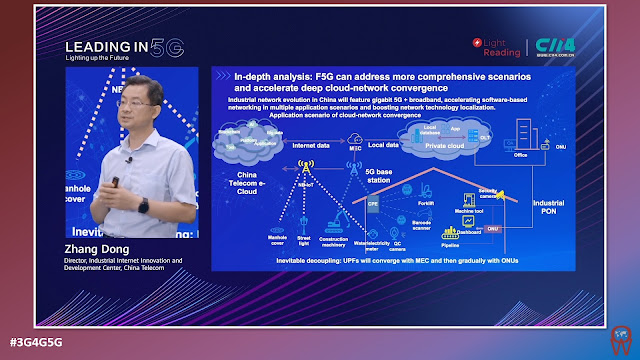
China Telecom explains Implications of Innovative Fixed 5G (F5G) Applications

Last year, Zhang Dong, Director, Industrial Internet Innovation and Development Center, China Telecom, spoke at at Light Reading’s Leading in 5G webinar series.

He said China Telecom began trials three years ago with half a dozen early adopter clients.

The base station cost was mostly paid for by the enterprises, while China Telecom sold O&M services and applications on top including big data, AI, and so on, he said.

While we see challenges like how to ensure lower latency and higher network assurance, and deal with problems like jittering, or how to simultaneously deliver 8K HD video from eight cameras, China Telecom is still making important milestones on its 5G journey.

Zhang said that after deploying more than 1000 5G use cases, China Telecom experts have identified four key categories.

The first is using 5G to enable high-speed mobility, with applications such as autonomous driving, remote control of vehicles or remote management of ports and warehouses.

The second type is those leveraging the faster 5G uplinks and downlinks. This is mostly related to video and in the future will also include various other integrated media, like AR and VR, Zhang said.

The third type of 5G use case focuses on scenarios where people and things gather, such as transportation hubs, and places with large number of people or large objects moving around.

The fourth type is deployment of 5G in hazardous environments. For example, some working environments might expose personnel to toxic gas, loud noise or other safety hazards. 5G can play an important role in ensuring safety.

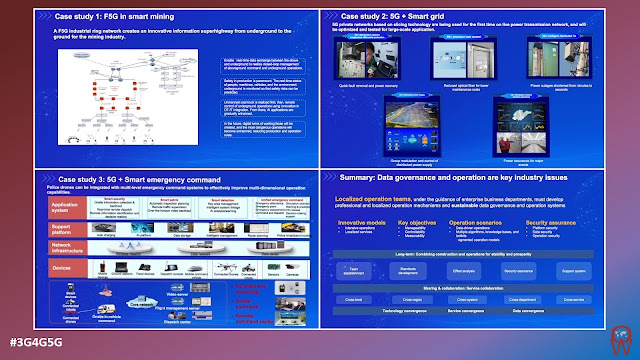
Zhang cited some of China Telecom’s collaborations in the resource and utility sectors.

One was with oil and gas giant Sinopec, which was one of the first to trial 5G because it was willing to pay for the base station rollouts and services.

Another was the Shendong Coal Group in the mining sector, which had worked with China Telecom to roll out private networks under the wells, requiring investment of over 100 million yuan ($15.6 million).

China Telecom had also partnered with Qingdao Power Grid in a project where network slicing ensured the connectivity and lower latency to support precision power distribution.

We have looked at Fixed 5G (F5G) in our blog posts here and here. During the talk, Zhang also discussed F5G. 

He highlighted that in F5G,  there's a F before 5G where this F stands for fiber connection. Fiber connections and 5G joining hands will usher in another wave of technological innovations with 5G.  Base stations already need fiber for data transmission, etc. These connections can be extended to OT industry, which would mean that the fiber connection can be used to control robots, etc. If fiber connections are deployed together with 5G, mining and other use cases in verticals will emerge in addition we know do today.

The video of his talk is embedded below:

Related Posts:

Saturday, 20 November 2021

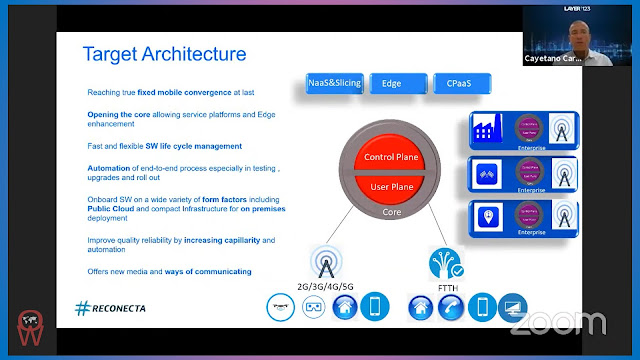
Telefonica Plans to achieve Fixed Mobile Convergence (FMC)

Many operators are working towards Fixed Mobile Convergence (FMC) to simplify their architecture and their operations. It was nice to hear Cayetano Carbajo, Director for Core, Transport and Service Platforms, GCTIO Telefónica SA at Layer 123 Conference. Kudos to them for sharing the video online (embedded below).

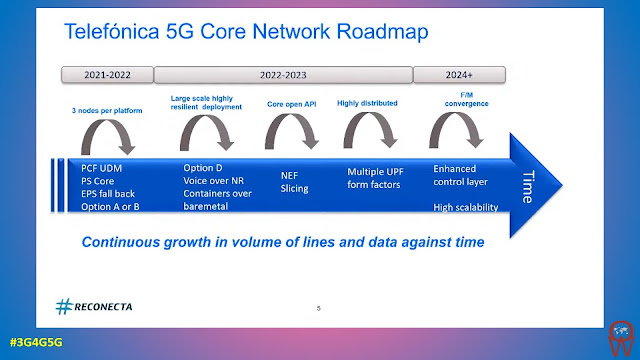
Like most other operators looking to bring the true 5G power to consumers and enterprises, Telefonica is moving to 5G Standalone architecture. It will be Cloud Native with Open Core Capabilities to develop application through API exposure. 

As can be seen in the roadmap above, Slicing will allow QoS differentiation for different types of services. The most interesting thing is that Converged Core will allow signalling for 2G, 3G, 4G, 5G and for fixed line. 

While this converged core will be containerised, there are some challenges today that they are expecting to be solved in the near future. The eventual reward is higher efficiency and a much higher level of automation.

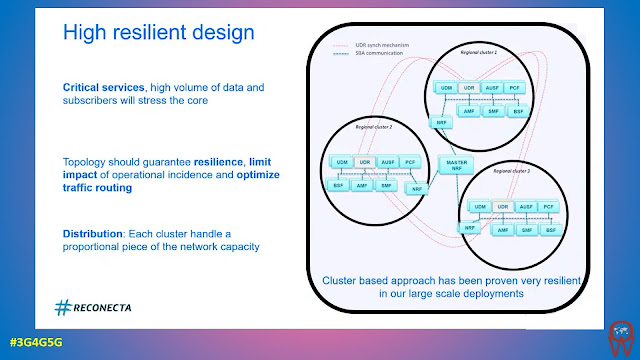
During the talk, Cayetano also discussed some technical 5G core details including their approach to increase resiliency. I highly recommend watching the embedded talk below. You may also find some of our other posts on related topics useful. They are highlighted below.

Related Posts:

Saturday, 9 October 2021

Telefonica Presents Strategy for Systems and Network Evolution

Last month, speaking at Morgan Stanley Telecoms CTO Symposium, Enrique Blanco, Global CTIO of Telefónica laid out their strategy for 'Systems and Network Evolution'. This included mobile as well as fixed line evolution.

As part of the presentation, he covered the following topics:

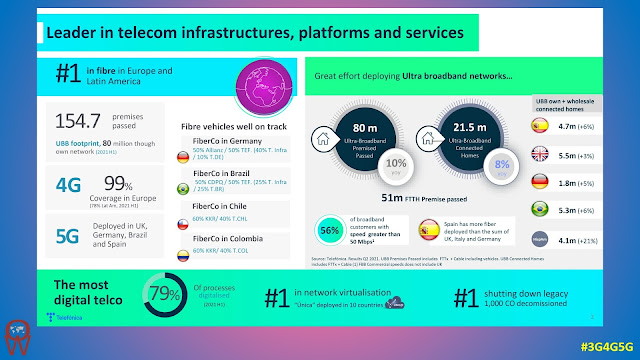
  • Evolution of Fiber technology towards 50G-PON by means of a multiservice approach
  • Providing differential customer experience through excellent Wi-Fi quality and home equipment
    • Moving forward to Wi-Fi 6, using home devices ecosystem as an open service platform at home and providing FWA solutions
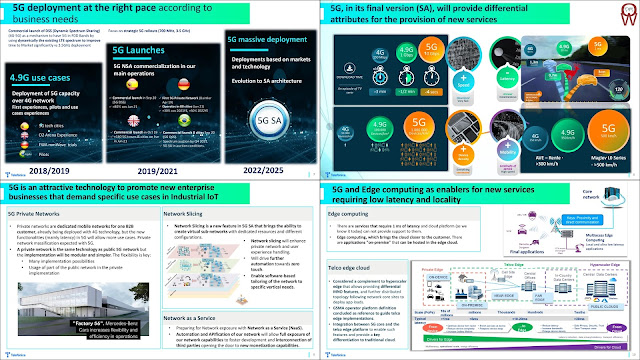
  • Completing coverage and capacity deployments of 4G networks as 5G networks are activated
  • 5G deployment at the right pace according to business needs
  • 5G, in its final version (SA), will provide differential attributes for the provision of new services
    • 5G is an attractive technology to promote new enterprise businesses that demand specific use cases in Industrial IoT
    • 5G and Edge computing as enablers for new services requiring low latency and locality
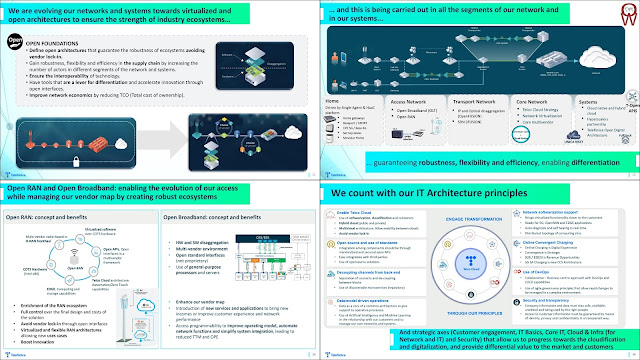
  • Evolution of networks and systems towards virtualized and open architectures to ensure the strength of industry ecosystems
    • This is being carried out in all the segments of the network and the systems
  • Open RAN and Open Broadband: enabling the evolution of our access while managing the vendor map by creating robust ecosystems
  • Follow IT Architecture principles to progress towards the cloudification and digitalization, and provide differential value to the market and customers
    • While building a new operating model where AI would be a key component…
  • Create value with 5G beyond improvement in browsing, speed and latency
  • Working with active sectors in 5G and approaching horizontal multi-sector 5G applications
  • Serving Society as a whole while supporting sustainability
  • Become leaders in cutting-edge digital services by unlocking the power of integrating technology

You can get the slides for the above presentation from here. Pablo Eguiron, CFO at Telefónica Tech also did a virtual presentation on 'The partner to fully capture the B2B opportunity' at 18th Caixabank BPI Iberian Conference. Slides from that are available here.

Related Posts: