Latvia’s telecom market continues to benefit from investment and from regulatory measures aimed at developing 5G and fibre-based infrastructure. There is effective competition in the mobile market, with extensive services based on LTE-A technologies to boost data speeds. Operators such as Bité Latvia and Tele2 Latvia have also begun transitioning their networks to support services and applications based on 5G, though with the existing capacity of LTE infrastructure a large scale 5G deployment is not expected until 2023. To facilitate this progress, the regulator in March 2021 approved an application from Tele2 Latvia and Bité to share almost half of their spectrum assets.
In the fixed-line broadband sector, the country is ranked second highest in Europe (after Iceland) for fibre coverage and take-up, closely followed by Lithuania. With this infrastructure in place, the country has also developed a sophisticated digital economy, with e-commerce and e-government services widely available.
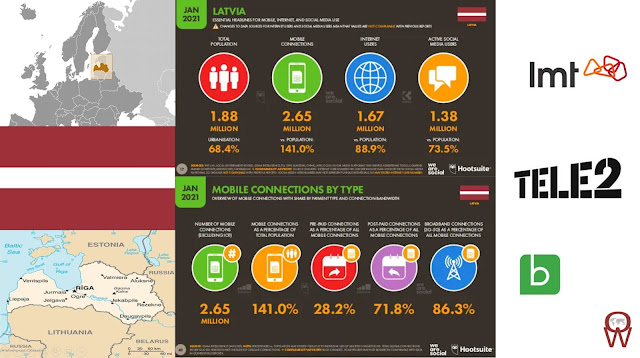
There are 3 mobile networks in Latvia: LMT, Tele2 and Bite.
2G/GSM is on 900 and 1800 MHz. Bite uses EGSM 900 (operating only on the edges of the 900 MHz band, so some old phones might not be able to cover it). 3G is on 900 and 2100 MHz with all operators. 4G/LTE is on 800 MHz (B20), 1800 MHz (B3) and 2600 MHz (B7).
In 2019 Tele2 and Bite signed a network sharing agreement for Latvia and Lithuania. The two operators’ networks will be merged, forming a joint shared network. This joint network will be built out gradually starting 2021, with the full network scheduled for completion by December 2023. Each party will hold 50% ownership in the joint venture.
The networks offer prepaid voice and data plans under different brand names like Bites Karte, LMT Karte, and Zelta Zivtiņa (on Tele2 network). Network coverage and speeds are best with LMT and Tele2, but Bite is only slightly behind and all are generally on a good level. LMT started 4G/LTE in 2011 on 1800 and 2600 MHz and covers already more than 90% of the population, 70% by LTE-A. Tele2 and Bite started in 2014 with LTE and are only slightly behind. Bite For rural areas all providers use 800 MHz now too.
LMT stands for Latvijas Mobilais Telefons and is owned by Telia and the state of Latvia. Its network has the best 3G and 4G coverage, while its 4G/LTE reaches more than 90% of population in 2016, 70% on LTE-A.
LMT have deployed a total of 100 5G base stations by the start of December 2021, with coverage available in all of the country’s regions.LMT’s 5G network is available to residential and business customers via mobile handsets, smart devices and compatible routers. According to the cellco, users in Sigulda, Adazi, Medenciems, Darziņi, Ventspils, Jauniksķile and Jelgava were the most active on its 5G network.
Tele2 is mostly on par with LMT on 2G and 3G covering 95% with 3G and 90% on 4G/LTE open for prepaid. They don't sell prepaid SIM cards under their own brand Tele2 but through the brand Zelta Zivtiņa better known as ZZ meaning goldfish.
Tele2 has selected Nokia as its 5G radio network access (RAN) partner in Estonia, Latvia and Lithuania, meaning that the Finnish vendor has become its key 5G vendor throughout the Baltics.
The operator said it now has everything in place to begin a nationwide rollout of 5G and upgrade of 4G in Latvia following the completion of the country's 700MHz spectrum auction in December 2021. It also holds frequencies in the 3.5GHz band.
Tele2 previously revealed that Nokia is its primary partner for 5G core networks in the standalone era, with deployment expected to have started during 2021. Nokia said it will deploy standalone 5G core and voice-over-5G technology for Tele2 operations in Sweden, Latvia, Lithuania and Estonia.
Bite is the smallest network in Latvia, but has good coverage and speeds in 3G on 900 MHz which is not so common worldwide. In 2016 private equity firm Mid Europa Partners sold Bite to funds affiliated with Providence Equity Partners.
Bite's 4G/LTE covers already 90% of population in 2016. Bite is the local partner of Vodafone, but its prepaid product can only be used in Latvia.
Bite established its first 5G base station in June 2019 and then in January 2021 installed additional six 5G base stations in Riga, extending the operator’s 5G coverage to areas of Old Riga, Krastmala and Kipsala. Bite invested over EUR10 million (USD12.1 million) in 5G infrastructure in 2020 and the operator has maintained that a wider rollout of the technology will take place in 2023. Any customer with a compatible device can currently use the network at no extra cost but a full commercial launch of the system is understood to be some distance away, with Bite indicating that it is waiting for the device ecosystem to mature further.
As a result Bite plans to invest 70 million euros in the development of the 5G network. Bite bought the 723-733MHz upload and 778-788MHz frequency bands in the 700MHz band, which is the most popular frequency in Europe for the construction of a 5G network. The right to use the spectrum has been granted to Bite for 40 years. Previously, this frequency was used for digital television broadcasting, but now it is used for more advanced technologies - 4G and 5G networks. Thanks to the fact that the 700 MHz frequency is able to transmit a 5G signal over a much wider area, Bite will be able to provide strong IoT, NR-Voice, uRLLC, and eMBB services.
Related Posts:
- Operator Watch Blog: LMT Explains 5G Routes Project
- Telecoms Infrastructure Blog: 5G for Defence and Autonomous Military Solutions
- Connectivity Technology Blog: First Cross-Border Drone Flight Over Mobile Network
- Operator Watch Blog: 5G and Innovation by Latvian MNO LMT
- The 3G4G Blog: Drones at Mobile World Congress 2019 and my upcoming webinar on 5G at #MWC19