Showing posts with label Technology FMC. Show all posts

Saturday, 20 November 2021

Telefonica Plans to achieve Fixed Mobile Convergence (FMC)

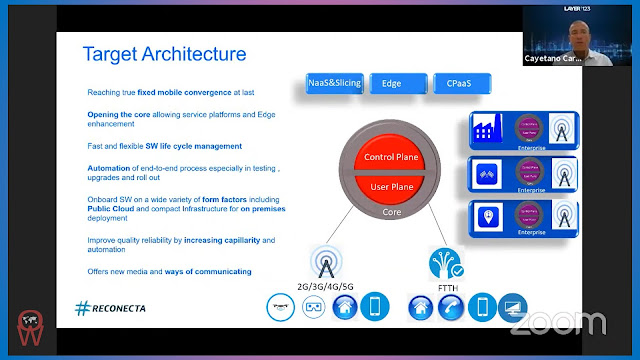
Many operators are working towards Fixed Mobile Convergence (FMC) to simplify their architecture and their operations. It was nice to hear Cayetano Carbajo, Director for Core, Transport and Service Platforms, GCTIO Telefónica SA at Layer 123 Conference. Kudos to them for sharing the video online (embedded below).
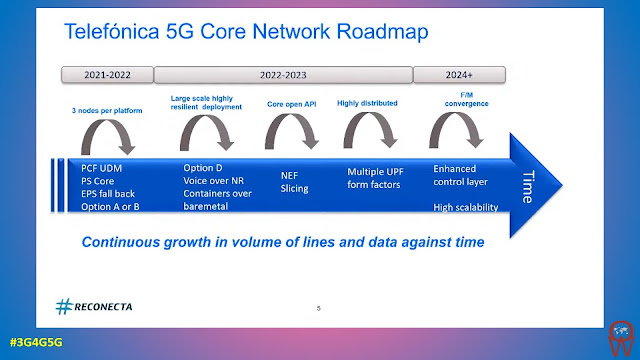
Like most other operators looking to bring the true 5G power to consumers and enterprises, Telefonica is moving to 5G Standalone architecture. It will be Cloud Native with Open Core Capabilities to develop application through API exposure. 

As can be seen in the roadmap above, Slicing will allow QoS differentiation for different types of services. The most interesting thing is that Converged Core will allow signalling for 2G, 3G, 4G, 5G and for fixed line. 

While this converged core will be containerised, there are some challenges today that they are expecting to be solved in the near future. The eventual reward is higher efficiency and a much higher level of automation.
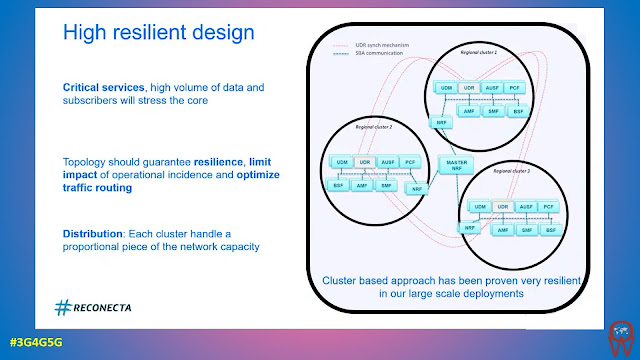
During the talk, Cayetano also discussed some technical 5G core details including their approach to increase resiliency. I highly recommend watching the embedded talk below. You may also find some of our other posts on related topics useful. They are highlighted below.

Related Posts:

Tuesday, 26 November 2019

BT's Converged Core to Launch in 2023

At last year's Total Telecom Congress, Howard Watson, BT's CTIO laid out his vision (see Tweet) where Fixed, Mobile & Wi-Fi networks work together in a converged network.


While those slides are not publicly available, a similar set of slides are available here on BT's homepage from Barclays CTO Conference earlier this year.

This year, Howard Watson was able to expand further on their vision for converged core of the future.


The slides in the tweet above gives a good idea of BT's vision of convergence where their fixed broadband customers and mobile customers from BT, EE, Plusnet & Wholesale along with Wi-Fi can get the same consistent experience regardless on where and how they access the network.

Total Telecom wrote a nice summary from the congress, part of which is reproduced below:

BT’s Hybrid Network, to be launched in 2023, will be comprised of the company’s mobile, fixed line and WIFI networks, offering customers ever present, gigabit connectivity
Consumers in the UK are increasingly intolerant of complexity, even as they begin to demand ubiquitous, gigabit capable connectivity, according to BT’s CTIO.

Speaking at the Total Telecom Congress in London on Tuesday, Howard Watson said that while consumers were essentially technologically agnostic as to how they received their connectivity, they were becoming increasingly demanding about the speed, quality and reliability of that connection.

At last year’s Congress, Watson announced that BT would be launching a fully converged, hybrid network that would offer seamless connectivity across the company’s mobile, fixed line and WIFI networks, with the aim to have all of its customers signed up to the network by 2023.

This year, Watson stressed the crucial role that WIFI and mobile connectivity would play in this hybrid next generation network.

“Whether you are connecting through fixed, mobile or WIFI, bound by intelligence and software driven common infrastructure, we truly believe we can transform the customer’s experience and deliver that seamless connectivity that they demand. We are in a unique position to do that because we are the only operator in the UK to build this type of network.”

“Making this happen is not east or trivial and we need to push the boundaries of the available technologies in terms of what they can do in terms of coverage, capability and interoperability. We need to rollout new technologies like 5G and WIFI 6 across the whole of the UK.”

BT was the first operator in the UK to launch 5G mobile network services through its mobile subsidiary, EE, which now has a 5G presence in 20 towns and cities cross the country. BT has subsequently launched 5G for its own brand customers and Watson said that EE and BT would try to provide 5G network coverage in an additional 25 towns and cities across the UK by the end of 2019.

Earlier I wrote about how the new 5G Core Architecture promoted Fixed-mobile convergence (FMC) and also another feature called Access Traffic Steering, Switching and Splitting (ATSSS) would play a key role in convergence. It is very likely that BT is moving in that direction for their converged core.

While the slides from Total Telecom Congress is not publicly available, they are present in BT's Technology’s Business Briefing here.


Related Posts:

Sunday, 25 August 2019

Jio Makes Another Set of Extremely Bold Announcements

Reliance Jio certainly knows how to stay in news, not just because of clever marketing but because of its extremely bold initiatives that is starting to make not just their competitors nervous but other industries like the cinemas, ISPs, cable companies, etc.

In the latest annual general meeting (AGM - video embedded below), their Chairman and Managing Director, Mukesh Ambani made some very interesting announcements. The complete statement is available here but here are the main points (from the report - note the CAPS is as shown in the report, not emphasized by me but the bold is by me):


  • JIO's customer base has crossed 340 million users and they are signing up more than 10 million new customers EACH MONTH.
  • The core and aggregation layers of our converged network have been 5G ready since day one
  • Jio is now Ready to kickstart FOUR more engines of CONNECTIVITY REVENUE for Jio.
    • INTERNET OF THINGS or IoT all over India.
      • JIO has developed an innovative service on its pan-India 4G network called Narrowband Internet-of-Things or NBIoT, for short.
      • Within another 2 years, it is estimated that there will be more than 2 Billion Connected IOT devices in India
      • Jio aims to connect at least 1 BILLION of these on JIO's IoT platform
      • This translates into a ₹20,000 CRORE PER YEAR revenue opportunity for JIO.
      • Jio's IoT platform will be commercially available starting 1st January, 2020.
    • HOME BROADBAND.
      • Jio Fiber, currently in preview phase with 500,000 users but will launch commercially on September 5.
      • The trial homes on average are consuming more than 100 GBs per month and this usage is increasing with each passing day.
      • Jio has drawn up a plan to reach 20 million residences and 15 million business establishments in these 1,600 towns
      • The company will offer plans from ₹700 ($10) to ₹10,000 ($140) with speeds up to 1Gbps.
      • You get a landline phone connection, at no additional cost.
      • And you get a DIGITALSET-TOP-BOX that opens up unparalleled digital experiences within your home
      • ULTRAHIGH DEFINITION ENTERTAINMENT
      • VIRTUAL REALITY content
      • MULTI-PARTY VIDEO CONFERENCING
      • VOICE-ENABLED VIRTUAL ASSISTANTS
      • INTERACTIVE GAMING
      • HOME SECURITY
      • and many other SMART-HOME SOLUTIONS
      • JIO SET-TOP-BOX to accept the broadcast cable TV signals from our LCO (Local Cable Operators) partners.
    • BROADBAND for SMALL AND MEDIUM BUSINESSES.
      • JIOFIBER enables a powerful combination of FIXED-LINE CONNECTIVITY and CLOUD APPLICATIONS leapfrogging them from NO TECHNOLOGY to having a complete line-up of cutting-edge, plug-and-play technology enabled tools.
    • (Large) ENTERPRISE BROADBAND.
      • Today cloud-based solutions provide out-of-the-box capabilities which are easier, faster and cheaper to adopt. JIOFIBER and JIO's cloud solutions level the playing field for Indian enterprises enabling them to accelerate their digital transformation and compete globally using the very same technologies that are used by global majors.
  • JIOFIBER plan STARTS WITH 100 Mbps speed and we have plans all the way up to 1 Gbps or 1000 Mbps, plans will be priced between ₹700 to ₹10,000 per month to suit every budget and every need.
    • Landline voice calls from home to any Indian operator - mobile or fixed - will be absolutely free forever.
    • Bundled landline service will let them call any network in the country for free.
    • Unlimited free calls to the US and Canada for ₹500 ($7) per month.
  • JIOFIBER plans will come BUNDLED with subscriptions to most leading premium OTT applications.
    • Premium JIOFIBER customers will be able to watch movies in their living rooms the same day these movies are released in theatres! This is called JIO FIRST-DAY-FIRST-SHOW. Jio plans to launch this service in the middle of 2020.
  • A special mobility service for our JioFiber users called JIO POSTPAID PLUS, to deliver a platinum-grade service and product experience.
    • India's first priority SIM-setup service at home, where your connection will be moved to Jio by visiting your home.
    • Seamless Data and Voice Connectivity across all your devices, both at home and outside.
    • Unprecedented Family plans – one data plan for better control on GBs and sharing within your family.
    • International roaming at a fraction of a cost with superior service experience
    • Phone upgrades at preferential rates
    • All your home solutions on your phone.
  • JIOFIBER customers who opt for our annual plans which we call JIO-FOREVER plans, will get an HD OR 4K LED TELEVISION and a 4K SET-TOP-BOX ABSOLUTELY FREE. We are calling this the JIOFIBER WELCOME OFFER.
  • JIO is already a software company.
    • JIO has over 6000 software engineers and we are continuing to attract technology talent from across India and the world.
    • JIO is also investing in a growing ecosystem of technology startups.
  • Blockchain technology all over India: Using Blockchain, we also have an opportunity to invent a brand-new model for data privacy where Indian data especially customer data is owned and controlled through technology by the Indian people and not by corporates, especially global corporations. Data is wealth and Indian wealth must remain in India
    • Over the next 12 months, JIO will install across India one of the largest blockchain networks in the world with tens of thousands of nodes operational on day one.
  • Edge computing and Virtual and Mixed Reality content: Delivering immersive content to hundreds of millions of users requires a well-integrated solution spanning connectivity, data storage and real-time computing. And we need to deploy such solutions at the edge of the network or in other words, closer to where our users are.
    • JIO is setting up a pan-India Edge Computing and Content Distribution network again starting with tens of thousands of nodes.
    • This means that your favourite content and applications will be even nearer to you. So even faster downloads and faster response times.
  • CLOUD INFRASTRUCTURE across India: To leapfrog the world, it is a national imperative to develop a nation-wide cloud computing infrastructure that is both cutting-edge and affordable. Jio and Microsoft have entered into a globally unique long-term alliance to accelerate the digital transformation of our country. 
    • As part of this alliance, while Jio sets up a network of large world-class datacenters across India, Microsoft will bring its Azure cloud platform into Jio's datacenters. 
    • When we put these two pieces together, we now have the capability to develop truly India-native solutions including Speech Recognition and Natural language understanding for all major Indian languages and dialects.

As a result of the announcements, Reliance shares went up 12% in biggest intraday rise in decade; Airtel and Vodafone shares dipped. Some cinemas have been unnerved by Reliance Jio offer, leading multiplex companies hit back saying that they will not screen films that are released on OTT simultaneously.


A fact that was announced during the demo was that the amount of fiber already laid by Jio can circle the earth 11 times.

Here is the complete AGM video


Related Posts:

Thursday, 23 May 2019

Millicom targets Leadership Position in Central America with acquisition of Telefónica Subsidiaries

Millicom announced last week that it has closed the acquisition of Telefonía Celular de Nicaragua, S.A., the number one mobile operator in the country, adding to its existing cable operation of TIGO Nicaragua. This is the first transaction to close since Millicom announced in February an agreement to acquire three subsidiaries of Telefónica in Central America in Panama, Costa Rica and Nicaragua.

Telefonía Celular de Nicaragua, S.A. adds approximately 4 million mobile customers to TIGO with a 4G network accessible to 51% of the population in Nicaragua. The transaction accelerates the execution of Millicom’s fixed-mobile convergence strategy, it helps consolidate the company’s leadership position in Central America, and it diversifies and balances the geographic footprint of the company in its mission to build digital highways that connect more users and develop communities throughout the region.

For people who are not aware, Central America consists of 7 countries, Belize, Costa Rica, El Salvador, Guatemala, Honduras, Nicaragua and Panama. Of these, Millicom is present in 5 of them with their brand Tigo.

This transaction in Panama, Costa Rica and Nicaragua will allow Millicom to accelerate its Fixed Mobile Convergence (FMC) strategy.

In Panama, after the acquisition:

  • #1 mobile operator in a four-player market with 1.6 million customers
  • 4G network covers 74% of population
  • Revenue and Adjusted EBITDA CAGRs of approximately 4% and 7%, respectively, in 2015-2018, in US dollar terms
  • 2018 revenue of $223 million and Adjusted EBITDA of $90 million, resulting in a margin near 41%
  • Dollarized economy and investment grade country increasing Millicom’s US dollar revenue sources

In Costa Rica, after the acquisition:

  • #2 mobile operator in a three-player market with 2.4 million customers
  • 4G network covers 85% of population
  • Revenue CAGR of approximately 13% in 2015-2018, in US dollar terms, drove much faster EBITDA growth over the period
  • 2018 revenue of $253 million and EBITDA of $60 million, resulting in a margin near 24%

In Nicaragua, after the acquisition:

  • #1 mobile operator in a two-player market with 4.7 million customers
  • 4G network covers 51% of the population
  • Revenue has declined at a 2.5% CAGR in US dollar terms in 2015-2018, due in part to a weaker currency and to slower overall economic activity
  • 2018 revenue of $232 million, nearly 50% of which are denominated in US dollars, and Adjusted EBITDA of $92 million, resulting in a margin near 40%

Finally, with regards to Spectrum the three countries:
Reasonable amount of spectrum is available for existing 3G & 4G services. Our assumption is that these will increase with arrival of 5G in these countries.

Source.