Showing posts with label Operator Cell C. Show all posts

Tuesday, 29 April 2025

How South Africa’s Mobile Operators Are Shaping the Future of Connectivity

South Africa has one of the most dynamic and competitive mobile telecommunications markets on the African continent. With millions of subscribers and evolving infrastructure, the country's mobile operators play a crucial role in driving connectivity, digital inclusion and economic growth.

Data from GSMA Intelligence shows that there were 124 million cellular mobile connections in South Africa at the beginning of 2025. For perspective, many individuals make use of more than one mobile connection, so it is not unusual for mobile connection figures to significantly exceed the total population. For example, the same person might have one connection for personal use and another for work. The rise of eSIMs has made this even easier in recent years.

GSMA Intelligence’s numbers indicate that mobile connections in South Africa were equivalent to 193 percent of the total population in January 2025. Looking at trends over time, the number of mobile connections increased by 5.2 million (4.4 percent) between the start of 2024 and the beginning of 2025.

Meanwhile, GSMA Intelligence data suggests that 97.5 percent of mobile connections in South Africa can now be considered broadband, which means they connect via 3G, 4G or 5G networks.

However, devices connected to broadband mobile networks do not necessarily use mobile data. For instance, some subscription plans may only include access to voice and SMS services. Therefore, this broadband figure should not be considered a proxy for mobile internet usage.

South Africa's main mobile operators are Vodacom and MTN, the dominant players, with Vodacom holding the largest share, followed by MTN, Telkom and Cell C.

In Opensignal’s latest analysis of the mobile network landscape in South Africa, MTN leads in seven out of 13 metrics, including Download Speed Experience, 5G Availability, and 5G Video and Games Experience. Vodacom achieves top scores in Consistent Quality, 5G Download Speed, 5G Upload Speed, Coverage and 5G Coverage Experience, followed by Cell C and Telkom.

Vodacom South Africa, the country’s largest operator, reported 50.7 million mobile subscribers at the end of December 2024. It has introduced a cloud-based phone to reduce the cost of smartphone access and to accelerate the migration of customers from legacy networks to modern 4G services on what it describes as the country’s most reliable network.

The device, manufactured by South African firm Mobicel, is intended to lower the barrier to smartphone use and to encourage users to move from 2G or 3G to 4G. The Mobicel S4 4G Cloud Phone is a thin-client device with 48MB RAM, 128MB ROM, a 2.8-inch screen and a 1000mAh battery. It relies on the cloud to run applications typically associated with more powerful smartphones, such as YouTube, TikTok and Facebook. Vodacom describes this as a 'smartphone lite' experience. The device is not exclusive to Vodacom and is priced at R249, or approximately US$13.93.

Vodacom was the first operator in South Africa to launch mobile 5G services in May 2020, starting with selected areas in Johannesburg, Pretoria and Cape Town. This early deployment was enabled by temporary emergency spectrum allocated during the COVID-19 pandemic.

Initial performance across the first five 5G clusters in Gauteng showed average download speeds of 154 Mbps, upload speeds of 14 Mbps and latency of around 31 ms, a strong starting point for next-generation connectivity.

Today, Vodacom’s 5G network covers over 50 percent of the South African population, with continued expansion. The company is investing approximately R10 billion annually into its network, focusing on optimising existing infrastructure, deploying new spectrum for improved coverage and capacity, and building new sites to extend its national footprint.

Vodacom has also announced increased investment in the Free State and Northern Cape provinces to enhance network speed and signal quality, particularly in rural areas.

MTN's official quarterly update for the end of September 2024 put its total users in South Africa at 39.2 million.

MTN South Africa launched its commercial 5G network on June 30, 2020, activating 100 sites across major cities including Johannesburg, Cape Town, Bloemfontein, and Port Elizabeth. 

More recently MTN, in partnership with Huawei, successfully completed South Africa’s first 5.5G network trial at MTN’s head office in Johannesburg.

The trial featured Huawei’s SingleRAN ultra-wideband active-antenna units, combining hybrid beam-forming technology with flexible dynamic beam management and inter-FR carrier aggregation to push network performance to the next level. Using spectrum in both the millimetre wave and C-band, made available through a trial license, the test ran on a 5G standalone (SA) setup. MTN reported a peak download speed of 8.6Gbps during the trial, showcasing the future potential of next-gen connectivity.

5.5G, often viewed as a stepping stone between 5G and 6G, promises 10 times the performance of current 5G networks. This includes dramatic improvements in speed, latency, and massive IoT capacity, all while reducing energy consumption per terabyte of data transferred.

MTN has also launched the Icon 5G smartphone with ZTE, priced at just 2,499 rand, or about $138.This move is another strategic effort to bring next-generation mobile technology within reach for more South Africans. The affordably priced Icon 5G smartphone is designed to accelerate the transition from legacy 2G and 3G networks to faster, more efficient 4G and 5G connectivity. As the country pushes forward with its digital transformation goals, MTN’s partnership with ZTE highlights the growing importance of global tech collaborations. By delivering faster internet speeds and lower latency, MTN is addressing the needs of a market that’s hungry for reliable, cost-effective internet, playing a key role in narrowing the digital divide.

In the latest Open Signal Report MTN wins the 5G Availability award, with the 5G users on its network connecting to 5G on average for 11.5% of the time. Having superfast 5G download speeds are only useful when users have a 5G connection. 5G Availability compares the amount of time the 5G users spend with an active 5G connection, the higher the percentage, the more time users on a network spend connected to 5G.

MTN has also announced plans to invest more than $100 million by mid-2024 in generators, batteries, and renewable energy solutions. This effort aims to mitigate the impact of ongoing power outages, ensuring network stability and service continuity despite South Africa’s persistent energy challenges.

Telkom South Africa is seeing significant growth in its mobile subscribers, and is edging closer to the country's two biggest operators, Vodacom and MTN.

Telkom has also announced plans to sell its tower infrastructure, joining rivals MTN South Africa and Cell C in this strategic shift to focus on core business operations. With this move, Vodacom will be the only major mobile operator in South Africa that continues to own its tower infrastructure. This trend reflects a broader industry focus on streamlining business operations by offloading non-core assets.

These plans reflects the company's enhanced operational efficiency and successful monetization of its digital infrastructure asset base. according to Serame Taukobong, Group Chief Executive Officer:

“Our continued investment in our extensive fiber network and mobile infrastructure is now delivering the competitive advantage we anticipated, propelling our data-led strategy to ensure future-readiness,”

 The operator's infrastructure investments continue to deliver significant operational results. Mobile subscribers grew by 24.6% year-on-year, surpassing 22.7 million, while mobile data subscribers increased by 19.6% to 14.6 million, driving a 12.7% rise in data revenues. Openserve’s fiber infrastructure also showed strong performance, with homes passed and connected growing by 11.4% and 18.1%, respectively, maintaining a market-leading home connection rate of 49.7%. Additionally, IT revenues sustained steady growth, highlighting the effectiveness of the company's connect-led strategy.

The smallest of the South Africa operators Cell C has been trying to increase their market share, but only had 7.7 million mobile subscribers at the end of May 2024.

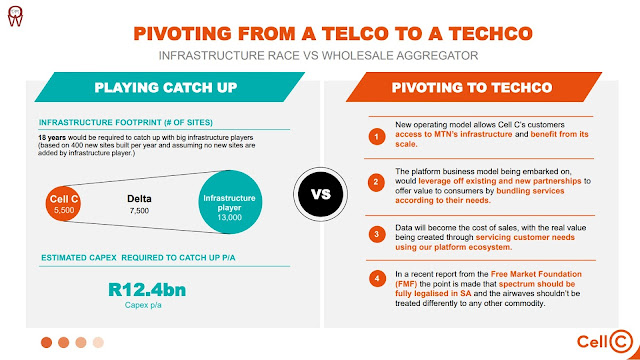
According to the latest Open Signal Report Cell C users have seen the biggest increases across Overall Experience metrics compared to the last report. The quality of experience streaming on-demand video on Cell C has improved by 25%, while the average download and upload speeds have grown by 30% and 53%, respectively. These improvements are particularly significant given that Cell C has not been investing in its own network infrastructure due to severe financial difficulties in recent years. These challenges led to the company's recapitalization and the establishment of new wholesale and roaming agreements with MTN and Vodacom.

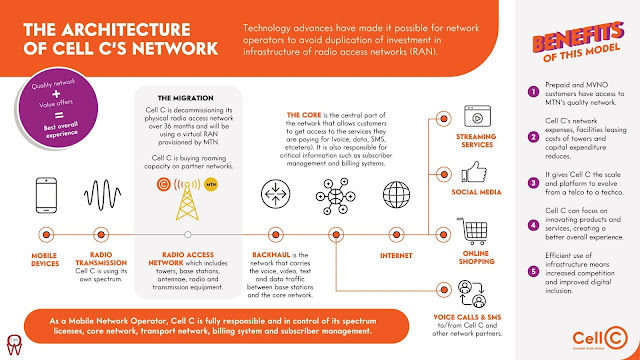
As part of this transition, Cell C deactivated its physical tower network and Radio Access Network (RAN). MTN now provides Cell C with a virtual radio access network for its prepaid and mobile virtual network operator subscribers, while Cell C’s contract customers roam on Vodacom’s network. However, Cell C continues to use its own spectrum and retains full control over the customer experience. Additionally, Cell C is currently testing 5G with network partners Vodacom and MTN, with plans to launch it soon.

Cell C has spent the past 18 months deploying a Mocn – multi-operator network core – roaming system, which has allowed it to create a virtual representation of its network on top of either MTN or Vodacom’s infrastructure.

We can clearly see with the ongoing investments from major operators, a great deal of progress is being made and 5G has the potential to bridge the digital divide, drive economic growth, and position South Africa as a leader in next-generation connectivity on the African continent.

Related Posts

Wednesday, 27 October 2021

South African MNO, Cell C, is Transitioning from Telco to Techco

If you can't beat them, join them says the old proverb. The South African MNO Cell C has taken this seriously. A news article back in September said:

In a bid to give its customers access to world-class network quality, excellent service and innovative value offers, Cell C has over the last eight months deactivated 39% of its physical radio access network (RAN) towers with 100% migration in the Eastern Cape, Free State, Northern Cape and Limpopo. 

Over the next four months, Cell C plans to decommission a further 5% of its towers, with a focus on parts of Kwa-Zulu Natal and Mpumalanga. 

Rather than spending billions building network infrastructure to compete with its fellow mobile giants, the company concluded roaming agreements with network partners like MTN and Vodacom to use the spare capacity that they have on their networks. 

Prepaid customers will roam on the MTN network, whilst post-paid customers will be on the Vodacom network. 

We see a dual approach by Cell C here. Rather than putting all their eggs in a single basket, they have spread their risk portfolio.

In our blog post last year, we saw that both MTN and Vodacom has similar coverage and capabilities. This would mean that Cell C subscribers will win regardless of whichever network they are on.

With Vodacom, it looks like Cell C is using a roaming agreement and will act like a Thick MVNO. We have explained the different types of MVNOs here but if you prefer to watch a video then see here.


The approach with MTN, based on the above slide shared by them seems to be a combination of MVNO and MORAN. To understand what MORAN is, read here or watch the video here. Cell C explained it as follows back in June:

Cell C has successfully decommissioned 34 percent of its physical Radio Access Network (RAN) sites, while seamlessly migrating prepaid and Mobile Virtual Network Operator (MVNO) customers to roam solely on its partner network, MTN, via a virtual RAN.

The initial Cell C and MTN roaming agreement from 2018 provided coverage in areas outside of the main metros. The decommissioning of sites in these provinces means that where Cell C customers previously moved between Cell C and MTN towers, they will now only roam on MTN’s network through the virtual radio network provisioned for Cell C, which has wide network coverage. 

Based on technology advances it is possible for network operators to avoid duplication of investment in RAN infrastructure. In this model, Cell C will decommission its physical RAN, which includes towers, base stations, antennae, radio and transmission equipment, while MTN will provision a virtual RAN.  Cell C will use its own spectrum on this virtual RAN and manage the customer experience.  As a mobile network operator Cell C is still responsible for its spectrum licenses, core network, transport network, billing system and subscriber management.

While Cell C continues to refer to the arrangement as 'virtual RAN', it shouldn't be confused with vRAN / Open RAN. It would be interesting to see how this arrangement works and if this will continue for 5G going forward.

Cell C's FY 2020 annual results presentation slides and video may be worth a watch. 

Related Posts

Thursday, 16 July 2020

High Data Prices in South Africa means Great 4G coverage but Poor Subscription Rates


South Africa may well have one of the most advanced telecom infrastructures on the African continent. There is has been considerable investment from  municipal providers as well as from mobile network operators all aimed at improving network capabilities. The focus in recent years has been on backhaul capacity and on fibre and LTE networks to extend and improve internet service connectivity.

South Africa has 4 network operators: Vodacom, MTN, Cell C and Telkom (formely 8ta).The 900 MHz and 1800 MHz frequencies deliver 2G for all operators with 3G offered on 900 MHz and 2100 MHz except for Telkom using 850 MHz. 4G/LTE was launched in 2012 on 1800 (B3) MHz in major centres by Vodacom and MTN and more recently on 2300 MHz (TD-LTE, B40) and 1800 MHz (B3) on Telkom and 2100 MHz (B1) and 1800 MHz (B3) on Cell C.


So basically the telecom landscape is characterised by a duopoly where Vodacom and MTN command more than 70 per cent of the market share by connections. Market penetration of mobile connections stands at more than 165 per cent, smartphone penetration at 60 per cent of total connections and 4G population coverage at 95 per cent in 2020. However, 4G only accounts for 30 per cent of total mobile connections. The high data tariffs, which  result in consumers purchasing either short term or limited data bundles, have resulted in low 4G uptake. Also a large part of the South African population is digitally illiterate, having limited or no understanding of basic aspects of digital such as connectivity, devices and skills. Some industry sources estimate the number at 80 per cent. Lower digital literacy rates further discourages the uptake of LTE services.

Source: Cable.co.uk

Lack of adequate spectrum in the market is argued to be the contributor to high data tariffs. In the absence of adequate spectrum, operators have to invest more in existing bands to densify and increase the coverage.

The COVID-19 (coronavirus) pandemic (accompanied by lockdowns and remote working) resulted in surging in data traffic globally. For its part, South African operators like Vodacom experienced 40 per cent growth in data traffic, while MTN experienced 56 per cent growth from February to April.

To ease congestion and create capacity for new data traffic requirements, the South African telecoms regulator ICASA announced a temporary allocation of spectrum in various bands (700MHz, 800MHz, 2300MHz, 2.6GHz, and 3.5GHz) until November. Vodacom leveraged the opportunity to launch its 5G services on the 3.5GHz spectrum in several cities. MTN followed the move and launched on the last day of the quarter adopting a dynamic spectrum sharing model in various frequencies (700MHz, 2100MHz, 3.5GHz and 28GHz).

Due to the 4G experience in the market and the challenges of data costs and digital literacy it is expected that consumer 5G uptake will be slow and only account for only 8 per cent of the total mobile connections by 2025.


Vodacom is the biggest mobile provider in South Africa and is 50% owned by UK-based Vodafone. It’s the market leader with the most customers, a good coverage at the highest prices.

Vodacom launched Africa’s first standards-based, commercial 5G service in Lesotho in August 2018 using 3.5 GHz spectrum. They have also demonstrated the same network capabilities at an event in South Africa, using a temporary test spectrum license in the 3.5 GHz band. Apparently their network is 5G-ready and it will launch 5G services in South Africa as soon it gains access to the required spectrum.


MTN is the main rival of Vodacom. MTN launched 4G/LTE in 2014 and covers 90% of population in 2018. MTN is the only provider that roams in Swaziland, if you should travel there.

MTN has recently won the Open Signal Video Experience and Download Speed Experience awards  which the operator tied with Vodacom in August 2019  and has now tied Upload Speed Experience and Latency Experience — which MTN was losing to Vodacom six months ago. MTN has also retained the lead in 4G Availability. On the other hand, Vodacom won the two new metrics — Voice App Experience and 4G Coverage Experience.

MTN has also made significant improvements across the board, taking the lead in three of the seven award metrics. Vodacom also showed improvements, but the operator has conceded ground to MTN across all of the metrics that are present in both this report and our previous one, with the distance between the two operators changing in the favor of MTN. Telkom and Cell C are still lagging behind, but showed improvements across all of these metrics, save for Cell C in 4G Availability, which saw the operator’s score decreasing by 1.5 percentage points.


MTN South Africa has also trialled various cases of 5G in cooperation with Ericsson and Huawei, which the company said showed great promise for mobile and fixed solutions. During these trials, MTN demonstrated downlink speeds of up to 1.6 Gbps and uplink speeds of up to 520 Mbps. MTN South Africa has also successfully launched a live 5G indoor solution at Kyalami Grand Prix Circuit and International Convention Centre.The mobile operator has already rolled out 5G sites on existing spectrum where they don’t interfere with other deployed systems.

Cell C is the 3rd operator in South Africa. It claims to cover 98% of population, but still has gaps in certain areas. Cell C started a price war in 2011 by undercutting its rivals, but most operators now offer comparable price plans. Cell C is only cheaper when you use their confusing portfolio of bonuses.

Cell C used to roam on the Vodacom network outside areas of their own coverage for free, but this applied to 2G and 3G only, not to 4G/LTE. In 2018 Cell C announced it has entered into a far-reaching roaming agreement with MTN in order to complement Cell C's own mobile network. The agreement will see MTN providing both 3G and 4G services to Cell C in areas where Cell C has chosen to purchase coverage rather than self-build, mainly outside of the main metro areas.

4G/LTE was rolled out in Gauteng and Durban on 2100 MHz (B1) to be spread to 1800 MHz (B3) in other centers of the country. After the new roaming deal with MTN Cell C says its network service offering is at 99% 2G coverage, 96% 3G coverage and 80% 4G/LTE coverage of the population.

Finally Telkom is a South African-based telecommunication company and the fourth network in the country. It entered the market in 2010 and was called '8ta' before, but has been rebranded into Telkom. It offers the lowest rates for data in the country of any network operator while it coverage is less too.

While it has limited coverage, mainly in the cities, it currently roams on the 2G and 3G networks of MTN, but not on MTN's 4G/LTE. Telkom's 4G/LTE is on the rare TD-LTE 2300 MHz (B40).

In November 2018 Telkom signed a new roaming agreement with Vodacom. Telkom customers will be able to roam on Vodacom's 2G, 3G and 4G networks from 2019. Telkom has had a roaming agreement in place with MTN for 2G and 3G services and will conduct a phased transition from the current roaming agreement. This process will concluded in June 2019 when its contract with MTN expired. Telkom South Africa has announced that it plans to switch off its 2G network nationwide at the end of 2019.

Related Posts: