Pakistan continues to lag most other Asian countries in terms of the maturity of its telecom sector. This is partly due to the poor state of its fixed-line network following years of under-investment and neglect by the state-owned incumbent telco Pakistan Telecommunication Company (PTC), with teledensity now down to almost 1%.
This lack of focus has left the door open to mobile to become the dominant platform for both voice and data. While penetration rates are low by Asian (and rest-of-world) standards, the mobile voice and mobile broadband markets have been growing at double-digit rates of late – at least in subscriber numbers. In contrast to the fixed network market, Pakistan’s mobile segment is highly competitive. The result has been continued downwards pressure to pricing and ARPU, such that mobile revenues have been unable to keep pace with the rate of market expansion as 4G LTE networks, in particular, stretch ever deeper into the more remote parts of the country.
Future growth (in market size as well as revenue) is likely to come from the wider availability of value-added services on top of the expansion of 4G LTE and (from 2023) 5G mobile networks. The Universal Service Fund (USF) continues to direct investment towards the development of mobile broadband (and, to a lesser extent, fibre-based networks) in under-served and even un-served areas of the country, with multiple projects being approved to start in 2021 and 2022.
As Pakistan strives to overcome the immediate hurdles and pave the way for 5G, Opensignal has examined the mobile network experience of users on the four nationwide mobile operators — Jazz, Telenor, Ufone, and Zong — over a period of 90 days beginning on April 1, 2022, and ending on June 29, 2022, to see how they stack up.
Pakistan's telecom industry is also facing major challenges due to ongoing power outages and economic turmoil in the country. To ensure that they can provide uninterrupted services to subscribers and cope with these challenges, telecom operators have urged the regulator — Pakistan Telecommunication Authority (PTA) — to take urgent measures. While PTA is yet to come up with an immediate solution, some operators like Jazz and Telenor are reviewing their operations and preparing to deal with the impact. In contrast, despite these challenges, Zong has continued to upgrade it's 4G network with FDD Massive MIMO solution to improve its 4G network’s capacity and spectrum efficiency. The operator has reportedly upgraded more than 170 sites since September last year.
Possibly that is why Zong wins the bulk of Opensignal's awards, winning four out of 10 categories outright (Download Speed Experience, Games Experience, Availability and 4G Coverage Experience) and jointly winning in a further four, including three awards alongside Jazz (Voice App Experience, Upload Speed Experience and 4G Availability ) and the Video Experience award alongside Ufone. On the other hand, Ufone picked up both Consistency awards — Excellent Consistent Quality and Core Consistent Quality.
Jazz Pakistan is the market leader with nearly 43 million mobile broadband subscriptions as of April 2022, having a market share of 38 percent.
Jazz has signed an agreement with fibre-based broadband provider Nayatel to connect all of its mobile sites in Lahore to fibre. The programme is expected to be completed by December 2022. In a press release from the provider, Jazz noted that the upgrade would improve capacity, reduce latency and enhance network availability. Further, the development paves the way for future technologies, such as 5G, which require low latency and high backhaul throughput. Jazz is aiming to increase the proportion of its sites that are connected to fibre to 70% over the next five years.
Jazz, jointly with JazzCash and Mobilink Microfinance Bank, has pledged Rs1 billion for flood relief efforts, the company said in a statement. The amount includes provision of emergency supplies and extension of telecom services. For immediate rollout, Jazz will work with NGOs and the government for distribution of emergency supplies including shelter, food items, and medical supplies, the company claimed.
According to Aamir Ibrahim, CEO of Jazz, there are around 1% to 2% users on their network that have 5G handsets. Even if the spectrum is provided for free, still the business case for 5G in the country is quite weak. Jazz launched 4G around eight years ago, and still, 50% of the handsets being sold today are 2G. Therefore, Jazz believe they need to focus on 4G for all before thinking about 5G for a few.
Telenor Pakistan is third in terms of market share (22%) with nearly 25 million subscriptions.
Recently they have declared a massive operating loss in the half-year ended June 30, 2022.
Telenor Pakistan, along with its parent company, Telenor Group, have pledged PKR 1.1 billion in cash and in-kind services to support nationwide flood relief efforts. Telenor Pakistan made a cash donation of PKR 100 million to UNICEF Pakistan to support them in relief efforts by providing life-saving nutrition and hygiene packs in affected areas on an immediate basis.
Irfan Wahab Khan, Chief Executive Officer, Telenor Pakistan and chairman, Telenor Microfinance Bank, said:
“In this moment of national tragedy and calamity, our thoughts and prayers are with those affected by the floods. With the support of Telenor colleagues from around the world, we are committed to supporting impacted families and communities through these testing times and will do all we can. The road of rehabilitation for the affected is long and treacherous, and we will continue to support to the best of our abilities.”
Zong Pakistan is the second largest operator with 31.3 million subscriptions and a market share of 28 percent.
Zong has commercially launched a dual-band (1800MHz and 2100MHz) FDD Massive MIMO upgrade on its 4G network in partnership with ZTE. In a statement from the Chinese vendor, ZTE notes that the solution has improved Zong’s 4G data traffic capacity by 21% and improved averaged user throughput by 40%. Zong and ZTE launched the first Massive MIMO site in Peshawar in September last year and by May 2022 the upgrade had been deployed on more than 170 sites. Zong and ZTE are planning to continue expanding the large-scale commercialisation of the FDD Massive MIMO solution to further improve 4G network capacity and spectrum efficiency.
Jazz has been quite vocal about the fact that 5G is not an option for at least the next two years and if it stands by this theory, the company won’t be bidding for the 5G spectrum anytime soon. However, Zong might be an exception to this as it has more strategic interest in Pakistan than commercial ones. Further with a cash-rich parent company in the form of China Mobile and synergies brought in by other Chinese companies like Huawei and ZTE, Zong might just take a leap of faith in the 5G spectrum.
In the wake of the recent unprecedented floods which has affected millions of people across the country, Zong 4G has announced free of cost services for all impacted areas.
Ufone is the smallest operator with 12.4 million subscriptions and 11 percent market share.
Ufone 4G acquired 1800 Mhz spectrum in 2021 and it continues to expand its 4G services in Pakistan to provide an unrivaled telecom experience to its customers. The transformation went on to raise the bar in terms of service delivery and redefined quality connectivity through its world-class voice and data services. The measures helped Ufone 4G to pull off the fastest customer acquisition in the industry during 2022. Owing to the continued modernisation and up-gradation of its network, Ufone 4G went on to register as “Pakistan’s No 01 Voice and Data Network” on Pakistan Telecom Authority (PTA)’s Mobile Networks Benchmark Report 2022.
Ufone 4G has launched an accurate weather update service ‘WeatherWalay’ to facilitate customers, especially with regard to the monsoon season and extensive flooding that has affected every province across the country.
The service has been introduced as an Interactive Voice Response (IVR), where customers can call 3392 and obtain precise details of the weather and any changes in it over periods of 24 hours, 72 hours and even a week within the city or other areas in Pakistan. Curated by a team of expert meteorologists led by Dr. Muhammad Hanif, WeatherWalay is being offered free of cost until the 30th of September to assist customers and ensure safer commutes.
Industry watchdog the Pakistan Telecommunication Authority (PTA) has announced that 96% of damaged network sites in flood-affected areas have been restored. At its peak 3,386 sites were damaged by the recent floods, but repairs carried out by the telcos, civil and military authorities and the PTA have restored 3,251 of those sites, the regulator confirmed. Only 135 sites remain offline, with those mostly located in inaccessible areas of Balochistan and Sindh but the PTA notes that other sites are active in those areas, preventing a communication blackout. The PTA added that it had recorded 120 breaks in national fibre-optic backhaul infrastructure, but all of these have now been repaired.
Its been an eventful five years for Pakistan’s mobile industry. The South Asian country has seen a dramatic increase in mobile broadband penetration and the introduction of 3G/4G services has impacted the lives of millions. In December 2017, 3G/4G subscribers in Pakistan numbered 47 Million. According to a recent report issued by Pakistan Telecommunication Authority (PTA), at the end of December 2018, there were 62 million 3G/4G Subscribers in Pakistan with penetration rate of 29.55%. That is a very significant increase indeed.
However in a country so large and populous, their mobile broadband market is still considered to be at an early stage of development with penetration well below most other Asian countries. Strong growth is predicted over the next five years to 2023, driven by further adoption of 4G and eventually 5G services. The uptake of 3G/4G has been quite impressive that has given the government and the mobile operators the confidence to look forward to 5G. Presently four mobile operators provide services to the country. Here are there most recent market shares/figures.
Jazz (created by the merger of Mobilink and Warid) is the current market leader with the largest number of subscribers. In 2016/7 they merged with Warid and adopted Warid's 4G network and offer their 4G/LTE to all of their customers as a single brand. In 2017 they received an own license for 4G on 1800 MHz (band 3). Their tagline is “Dunya ko Bataa Do” (tell the world) and their partnering with travel vlogger Eva Zu Beck to showcase their coverage and the culture of Pakistan has been a popular advertising strategy.
Norwegian owned Telenor is the third largest operator in the country. They cover more than 80% of Pakistan's population in urban and rural areas with a network of over 11,000 cell sites of which 80% are 3G and 70% are 4G enabled.
4G/LTE was started in August 2016 in Islamabad, Karachi, Lahore, Multan, Peshawar and Sawaton on 850 MHz (band 5) and has spread to other major towns. Telenor was the first network to enable VoLTE and officially launch 4.5G (LTE Advanced) in Pakistan. It has done so by aggregating two LTE bands, FDD-LTE Band 5 (850 MHz) and FDD-LTE Band 3 (1800 MHz), a portion of which has been re-farmed for LTE, it was previously used on the 2G (GPRS/EDGE) network. Telenor's new LTE-A network will initially be available in Karachi, Lahore, Rawalpindi and Islamabad.
Zong in Pakistan is owned by China Mobile Pakistan. It has a limited network on 3G in many towns but was the first to launch 4G/LTE on 1800 MHz (band 3) in the centers of 7 major cites in 2014. It presently has over 9 million 4G subscribers, more than any other network. According to Zong when it comes to 4G coverage, subscribers, internet speed and innovation, no other network can reach the heights of Pakistan’s No.1 data network. They more than 10,000 4G towers with plans in place to launch 5,000 more 4G sites in the next 3 years.
Ufone owned by Etisalat is the fourth operator in the country. It has 3G network coverage in over 9,000 locations and across all major highways of Pakistan. There is no 4G/LTE yet. A recent Pakistan Telecommunication Authority (PTA) survey found Ufone takes 5.73 seconds to connect a call, the fastest among all networks in the country.
2018 was a great year for Pakistan’s Technology industry with substantial growth and development in IT Sector and for 3G/4G penetration. Supported by growing tech-savvy population, increasing businesses and rising internet penetration, Pakistan is destined to become one of the fastest growing economy by 2030 and has the potential to be one of the leading digital economies. There is a lot of promise in the IT sector of Pakistan with young population turning to computers and other digital technologies creating a huge market for local and foreign investors.
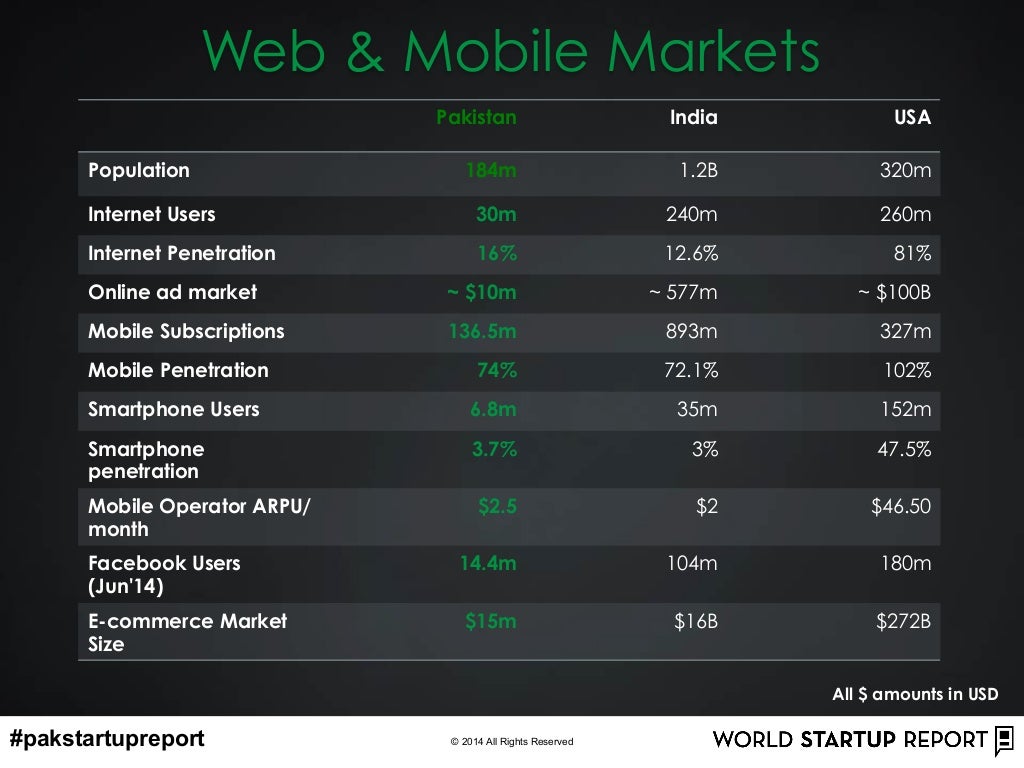
This seemingly struggling nation has one of the highest rates of cell phone usage and penetration in South Asia. Close to 140 million people have a cell phone connection in Pakistan, and they enjoy some of the cheapest service rates in the global market.
Of Pakistan’s 180 million people, 68 percent are under 30 (compared to 63 percent in India, 40 percent in the US)
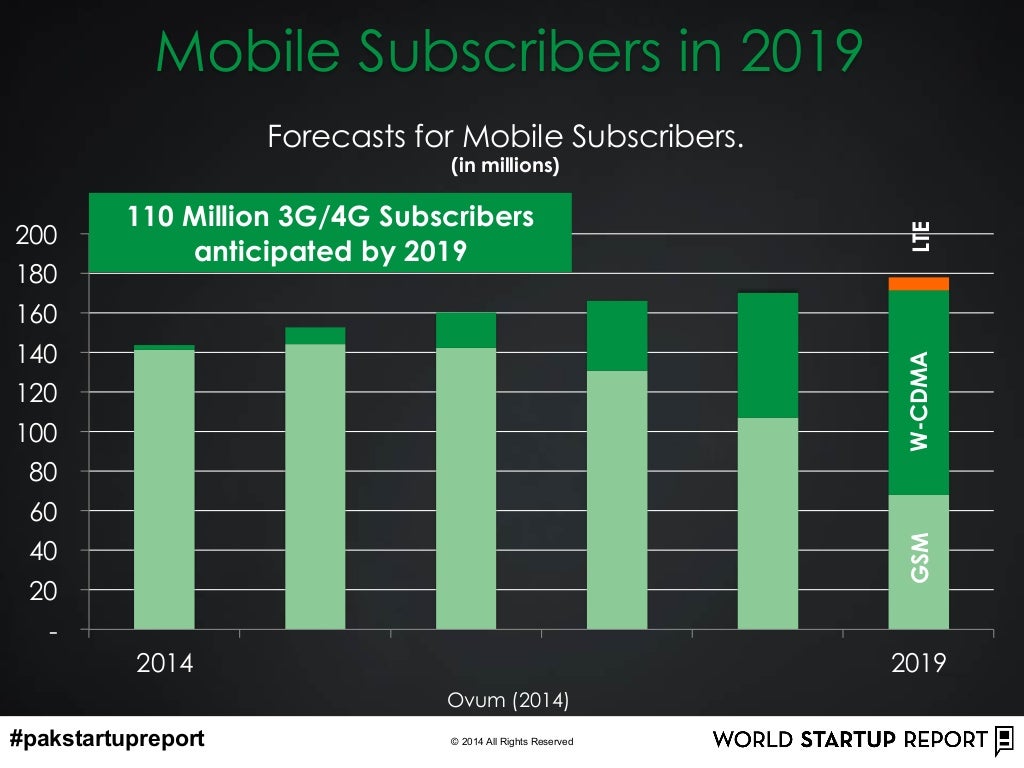
Pakistan expects to have 110 million 3G or 4G subscribers by 2019
Pakistan has the fourth largest middle class population in developing Asia
30 million internet users
6.8 million smartphone users
Mobile Internet is also widely used in Pakistan, which has led to operators introducing 3G and 4G services in the country. One of these operators, China Mobile’s Zong – the world’s largest mobile network operator – invested $516 million in acquiring 3G and 4G licenses and is currently the only operator providing the latter.
Zong is Pakistan’s fourth biggest mobile telco.
In March 2014 Zong surpassed 25 million customers, out of a total of 125 million mobile subscribers in Pakistan. Mobiilink remains number one with over 38 million subscribers, Telenor is second with 33 million, and Ufone is third with 26 million. Warid is down in fifth with 13 million.