Showing posts with label Region CIS. Show all posts

Tuesday, 22 July 2025

Resilient Networks and Future Ambitions in Azerbaijan’s Telecom Sector

Azerbaijan, located at the crossroads of Eastern Europe and Western Asia, is known not only for its rich oil reserves and cultural heritage but also for its evolving mobile telecommunications sector. While the telecom industry plays a significant role in the country’s non-oil GDP, its overall progress has been slowed by years of political instability, civil unrest, and systemic corruption.

Despite these challenges, Azerbaijan has made meaningful strides in expanding mobile connectivity and strengthening its 4G infrastructure. Mobile penetration reached 100% as early as 2011, though growth has largely stagnated since. However, mobile operators are steadily extending their LTE networks across the country. This expanded coverage, along with increased access to faster data services, is expected to fuel modest growth in both mobile usage and mobile broadband adoption in the coming years, particularly as users shift from 3G to 4G. While 5G deployment is still in its early stages, the current LTE infrastructure remains sufficient to meet most of the population’s demand for high-speed data and broadband.

According to the latest data from GSMA Intelligence, Azerbaijan had approximately 12.2 million cellular mobile connections at the start of 2025. It's important to note that this number exceeds the country’s total population, a common occurrence in mobile markets globally. Many individuals maintain multiple mobile connections, often separating personal and professional use. The growing availability of eSIM technology has further simplified managing multiple lines on a single device.

In fact, mobile connections in Azerbaijan were equivalent to 118% of the country’s population as of January 2025. This ratio highlights the widespread reliance on mobile services and suggests a mature market in terms of connectivity access.

Looking at year-on-year trends, the number of mobile connections grew by 370,000 (or 3.1%) between early 2024 and the beginning of 2025. This moderate but consistent growth reflects a combination of factors, including population mobility, the rise of connected devices (like smartwatches and tablets), and continued expansion into underserved regions.

Notably, 96.5% of all mobile connections in Azerbaijan are now classified as “broadband connections,” meaning they operate over 3G, 4G, or 5G networks. However, it's worth clarifying that a broadband-capable connection doesn’t automatically equate to active mobile internet usage. Some plans, particularly lower-cost or enterprise bundles, may provide only voice and SMS services without significant data allowances. Therefore, while broadband-capable connections indicate the potential for mobile internet access, they don't necessarily reflect actual usage patterns.

Therefore the mobile network coverage is generally good, with 4G and 3G networks estimated to have 100% coverage in 2025, according to Statista.  Opensignal's Global Network Excellence Index ranks Azerbaijan 65th overall, with an 81% 4G/5G availability.

The country has three major GSM operators: Azercell, Bakcell, and Nar Mobile.

Established in 1996 as a joint venture between the Azerbaijani government and Turkcell, Azercell is today the country’s foremost mobile provider, commanding around 48–51% market share with over 5 million subscribers.

As of early 2024–2025, its 4G network spans roughly 94–98% of both population and territory. In 2023 alone, Azercell installed 300+ new LTE base stations and modernized 1,600+ existing sites, boosting 4G coverage by ~10% and doubling average internet speeds. This ambitious project extended connectivity into reclaimed Karabakh areas, with over 150 base stations deployed in key cities such as Shusha, Agdam, Khojaly, and more.

From 2017 onward, Azercell has actively incorporated solar-powered base stations, notably in Karabakh, where 35 stations derive ~60% of their energy from renewables. In 2024, it joined the GSMA Climate Action Taskforce and became the official telecom partner for COP29 in Baku—underlining its commitment to sustainability efforts.

In 2022, Azercell launched Azerbaijan's first 5G test zone at Baku’s Fountain Square and in select locationsThey are also actively collaborating with GSMA Advanced programs, focusing on AI, IoT, and network security training for staff. Currently the 5G network remains in test/trial mode, focused on public hotspots like Fountain Square.

Bakcell serves over 3 million subscribers, positioning it as Azerbaijan's second-largest mobile operator. The operator has been named “Azerbaijan’s Fastest Mobile Network” by Ookla multiple times, three consecutive years from 2018–2019, again in 2021, and most recently for Q1–Q2 2022 . Their extensive network of ~9,000 base stations ensures coverage for 99.9% of the population and ~92.6% of the country's area.

Bakcell was among the first in Azerbaijan to introduce eSIM and VoLTE, often bundled with high-speed 4G infrastructure .Their LTE network rollout has been rapid: by mid‑2019, they had installed nearly 3,000+ 4G base stations, covering 78% of the population and 52% of the land area.

In February 2023, Bakcell officially launched its 5G test network in several central Baku locations: Fountain Square, Khagani Garden, and Deniz Mall. The pilot supports Huawei, Xiaomi, OnePlus, Poco, and Vivo devices, offering 5 GB of free trial data per hour. The trial is fully embedded within existing data packages, no added charges for users testing 5G.

Through its affiliate, AzerTelecom, Bakcell is contributing to the Digital Silk Way fiber-optic corridor: improving regional connectivity across the Caucasus and Central Asia, this aims to build a high-capacity fiber-optic corridor bridging Europe and Asia. The infrastructure includes both terrestrial and subsea routes through key countries like Azerbaijan, Kazakhstan, Turkmenistan, Georgia, and Türkiye. 

Nar (Azerfon) is the third-largest mobile operator in Azerbaijan with around 2.2 million subscribers.
It offers approximately 97–98.5% territory coverage and serves 99.7–99.8% of the population.

As of early 2025, Nar operates over 7,300–8,500 base stations, including more than 1,620–1,800 LTE sites, up from just 1,000 LTE bases in 2019. In the last year alone, 685 new 4G stations and 150+ 3G stations were added. As of recent reports, 91.5% of the population is within 4G network reach, and active 4G users total around 850,000 (about one in three Nar users).

Although Nar has not launched public 5G trials, it’s building out LTE infrastructure aggressively, strengthening its capacity ahead of future 5G deployment. Infrastructure expansion, especially in liberated regions and transport corridors, provides a solid foundation for next-gen services. With its strong customer satisfaction, regional reach, and ongoing network upgrades, Nar is well-positioned to enter the 5G space once spectrum becomes available and demand accelerates.

Azerbaijan’s mobile market reflects a blend of resilience, innovation, and regional ambition. With three strong national operators, increasing investments in LTE and 5G, and efforts to bridge the digital divide, the country is well on its way to a more connected future.

As demand for faster, more reliable mobile services continues to grow, Azerbaijan’s telecom sector will likely play a central role in shaping its broader digital transformation.

Tuesday, 4 July 2023

Operators in Kyrgyzstan Cautiously Test 5G!

The Kyrgyz Republic, known as Kyrgyzstan, has the highest levels of mobile penetration across Central Asian (CA) countries — 159.9% with 2.94 SIMs per unique mobile subscriber, according to GSMA Intelligence. Despite being the second poorest country across CA, Kyrgyzstan came first regarding 4G Availability (the proportion of users of 4G-capable devices who spend most of their time on 4G networks). The National Development Strategy of the Kyrgyz Republic 2018-2040 is one initiative that facilitates digital transformation to hasten the country’s economic development. The State Communications Agency (SCA) stated in its annual report for 2021 that a total of 2,049 settlements across the country were covered by 4G LTE mobile networks at the end of 2021, equivalent to 96% of the country’s 2,130 officially registered cities, towns and villages. 2G mobile network technology extended to 2,088 locations (98%), while 3G networks were present in 2,081 (97%). Overall, 42 settlements (1.9%) were outside mobile network coverage, some due to a lack of power transmission lines.

Beeline Kyrgyzstan, Megacom,  and O! (Kyrgyztelecom) are the major mobile operators in the country. Megacom Kyrgyzstan, run by the state-owned Alfa-Telecom has started its rebranding campaign to MEGA following Megacom ownership transfer to the state-owned Kyrgyzstan State Development Bank. The operator announced that it expanded and upgraded its 2G, 3G, and 4G networks in seven regions and the capital of the Kyrgyz Republic. It plans to continue network coverage expansion across remote areas of Kyrgyzstan.

MEGA currently claims roughly three million mobile subscriptions, and its CEO Nurlan Mamytov stated that its strategic goals for 2023 include expanding the active user base, deploying at least 200 additional base stations in twelve months, upgrading network quality and data/internet speed, modernising existing technical infrastructure, further expanding the distribution/sales network, developing fintech services, and ‘creating favourable conditions for attracting large investments’.

In April of this year Mega launched Kyrgyzstan’s first VoLTE calling service. The IP-based 4G mobile voice service is available to compatible handset owners in all areas covered by MEGA’s LTE network, its press release claimed. VoLTE calls are provided at no extra charge to the user, with the cellco highlighting the technology’s benefits including fast call set-up time, high-definition sound quality and simultaneous high speed 4G mobile internet/voice connections.

Beeline is the biggest competitor of MegaCom in the country. They recently announced plans to leverage its parent group VEON’s partnership with satellite provider OneWeb to ‘become the first mobile operator in Kyrgyzstan capable of providing continuous communication and high speed internet to the most remote areas of the country, even those areas that have not had access to the network until now.’ Beeline said that the partnership with OneWeb will enable the elimination of digital inequality, ensure continuous communication in emergency situations ‘and increase the rate of economic growth of the population’ using high speed, low-latency satellite internet connectivity.

O! by Nur Telecom is the smallest of the three operators. Starting in Bishkek, Osh and Jalal-Abad, it offers 4G/LTE on 800 and 2600 MHz (B7 and 20). This has now spread to the country side and 97% of the population are covered in 2020 by LTE.

O! reported in August 2022 that they had conducted measurements of 5G data speed ‘which for the first time in Kyrgyzstan accelerated to 1.5Gbps.’ The company’s technical director Anton Kovalenko noted that ‘the launch of 5G into commercial operation is not far off, but it is too early to talk about a mass commercial launch, the transition will be phased.’ He added: ‘If [customers] are looking for a new smartphone, then in my opinion, it already makes sense to turn your attention to devices with support for the latest technology.’

5G in Kyrgyzstan is being tested in the n77 and n78 (3400MHz-3800MHz) frequency ranges, and will initially be integrated with existing 4G networks. O! expects its eventual 5G network to provide data speeds around ‘ten times faster than 4G’ with ‘average speed of 150Mbps-200Mbps.’

The mobile telecommunications sector in Kyrgyzstan is experiencing a dynamic phase with continuous efforts to improve network coverage, enhance service quality, and offer competitive pricing, mobile operators are striving to provide residents and visitors with an excellent mobile experience. As the industry evolves, customers can expect more advanced services, increased connectivity, and a vibrant mobile ecosystem in Kyrgyzstan.

Related Posts

Thursday, 25 November 2021

Mongolia is Getting Ready for 5G and IoT

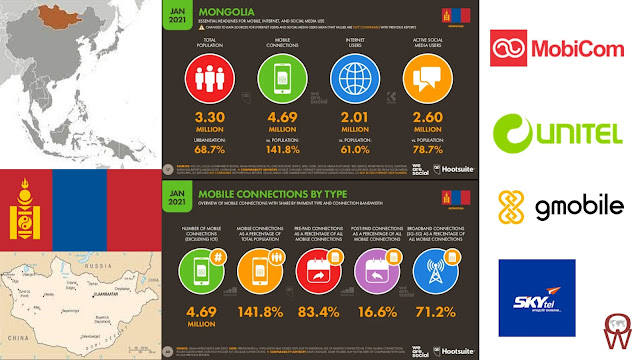
Mongolia has a population of 3.3 million but there are roughly 4.69 million mobiles, giving the penetration rate of 141.8%.

Telecommunications in Mongolia face unique challenges. It is the least densely populated country in the world and a significant portion of the population live a nomadic lifestyle. It has been difficult for many traditional information and communication technology (ICT) companies to make headway into Mongolian society. With almost half the population clustered in the capital of Ulaanbaatar, most landline technologies are deployed there. Wireless technologies have had greater success in rural areas.

Mobile phones are common, with provincial capitals all having 4G access. Wireless local loop is another technology that has helped Mongolia increase accessibility to telecommunications and bypass fixed-line infrastructure. For Internet, Mongolia relies on fiber optic communications with its Chinese and Russian neighbours.

There are four mobile operators in the country: MobiCom, Unitel, Skytel and G-Mobile.

Skytel and G-Mobile both only operate 3G networks in Ulaanbaatar and GSM-incompatible CDMA/EVDO networks in the rest of the country. 

On MobiCom and Unitel 2G is on 900 and 1800 MHz, 3G (HDSPA) on 2100 MHz. 4G/LTE started in 2016 in Ulaanbaatar city only on 1800 MHz (Band 3) and new licenses were given out for 700 MHz (Band 28).

MobiCom is the biggest Mongolian cellular operator with 1.7 million active subscribers. It was established in 1996 as a joint Mongolian-Japanese venture and is the first Mongolian cell phone service. It was founded by Mongolian Newcom Group, and Japanese KDDI. As of 2015, Mobicom held over 1/3 of the market, with network coverage of 95% of the population. 

Mobicom introduced 3G (HSPDA) networking in 2009. Its network support phones with 2100 MHz. 4G/LTE on 1800 MHz (Band 3) has been launched for all users without any surcharges and is enabled by default on all new SIM cards.

The operator has launched a 5G interoperability trial in partnership with its parent company and Telecom Infra Project (TIP). 


Unitel (Universal or United telecommunications) was founded together with South Korea in 2005 as GSM mobile phone operator. In 2010 Unitel declared that it has become 100% indigenous company (i.e. Mongolian share owners bought all share from the Korean side).

Unitel network covers approximately 88% of population. In 2009 Unitel launched its 3G network on 2100 MHz. In 2016 they started 4G/LTE on 1800 MHz (Band 3) in the towns of Ulaanbaatar, Erdenet, Darkhan City, Dalanzadgad, Tsogttsetsii open for prepaid. It has a lower coverage, but better prices than MobiCom.

GSMA Intelligence estimated Unitel’s mobile connections at 1.6 million at end-Q3, placing it in the top two of four operators in Mongolia.

The operator has secured an option to be the first in the nation to employ satellite connectivity services from specialist Lynk Global. The company expects to be able to provide satellite services to standard mobile phones in 2022, when Unitel will have a “first-to-market right” to use it within the sprawling country. 

In a statement, Unitel CEO Enkhbat Dorjpalam noted the topography, extreme weather and size of Mongolia meant it had very specialist coverage needs. The Unitel executive explained Mongolia was 1.6 million square kilometres with a population of 3.3 million spread across the country, adding “we have unique needs for coverage in our country given our nomadic lifestyle and extremely large livestock population of more than 70 million animals, which is a critical component to our society’s growth and resiliency.”


GMobile LLC was founded in April 2006. In 2008, GMobile was the first operator to introduce 3G technology in Mongolia and launched G-Internet phone service – mobile internet service based on 1X, EvDo technology. It presently only has175,000 subscribers.


Skytel Group has approximately 255,000 active subscribers the company's network functions on an HSPA+ network in Ulaanbaatar and [CDMA2000 1x] & [EVDO] network technology in the rest of the country.

Mongolia-based operator ONDO (IN Mobile Network LLC), is now the the fifth mobile operator in Mongolia, it has received a license to provide mobile services from the national telecommunications regulator Communications Regulatory Commission (CRC).

According to local media reports, ONDO is piloting the latest generation of high-speed mobile internet or 5G technology in Mongolia using cutting-edge technologies in the telecommunications industry.

The report said that ONDO plans to deploy 4G, 5G, and IoT networks, according to its new website, with an initial focus on the capital Ulaanbaatar.

Mongolia’s Communications Regulatory Commission (CRC) has awarded the country’s fifth mobile licence to ONDO (registered as IN Mobile Network), which plans to operate under the SuperNet brand. The firm plans to deploy 4G, 5G and IoT networks, according to its new website, with an initial focus on the capital Ulaanbaatar. A list of licensees published by the CRC shows IN Mobile Network’s concession expiring on 10 September 2031.

Sunday, 30 May 2021

‘Health Concerns’ delay 5G pilots in Kyrgyzstan


CIS region countries are not planning to be leaders of 5G rollouts but they have been conducting some or other pilots and trials. Commsupdate reported

Kyrgyzstan’s State Communications Agency (SCA) – a subordinate agency of the State Committee for Information Technology & Communications – has disclosed that planned launches of test/pilot 5G networks have been suspended, largely due to COVID-19, although delays were also related to a campaign to address public 5G ‘health concerns’, the regulator told the Tazabek news service, adding that the date for 5G service deployment in the country is ‘not determined’ yet.

TeleGeography’s GlobalComms Database notes that in December 2019 the Kyrgyz regulatory authorities decided to allocate frequencies in test mode for 5G mobile network operations while approving proposed measures for supporting IoT development, in accordance with the 2019-2023 Digital Transformation policy roadmap. The temporary licences permit usage of spectrum within the 3300MHz-5000MHz range.

In July 2020 the regulator underlined that cellcos do not have the right to install and operate 5G network equipment without its specific permission, although adding that if the results of 5G tests ‘are positive’, the authorities would consider the issue of holding an auction of 5G frequencies. However, also that month operators reported multiple criminal attacks on their network facilities related to public fears over 5G, and the SCA began issuing information to address the matter, including global scientific evidence supporting 5G’s safety.

Developing Telecoms added:

Kyrgyzstan’s regulator has issued two 2300MHz spectrum licences to the state-backed operator MegaCom while noting that the country’s 5G network pilots will be delayed.

MegaCom bid KGS116.87 million (US$1.38 million) for two licences in the 2300MHz-2400MHz TDD range in an auction held by the State Communications Agency (SCA), itself a subordinate unit of the State Committee for Information Technology & Communications.

The two licences will allow MegaCom to deliver coverage across Kyrgyzstan, with the notable exception of the capital Bishkek and second largest city Osh. MegaCom spent KGS77.92 million to acquire 40MHz of spectrum in the 2300MHz-2340MHz band, and KGS38.95 million for 20MHz in the 2380MHz-2400MHz band.

TeleGeography reports that MegaCom bid KGS5.56 million more than the combined reserve price for the two licences despite the SCA indicating that it was the only bidder, with a third available licence for 40MHz of spectrum in the 2340MHz-2380MHz band going unsold. The concession covered the Batken, Naryn and Talas regions and had a reserve price of KGS17.72 million.

Related Posts and Links:

Saturday, 23 January 2021

3G and 4G are Blooming in Ukraine


Ukraine has a competitive mobile market dominated by the three network operators Vodafone Ukraine (owned by MTS and using the Vodafone brand name), Kyivstar (owned by VEON) and Lifecell (owned by Turkcell). Another 4th operator is 3mob (3G only in Kyiv) roaming on Vodafone.

Mobile broadband services present a significant growth opportunity. Significant investment has been made in extending 3G infrastructure, while operators have more recently concentrated on LTE. Additional spectrum in the 2600MHz band was auctioned in January 2018, and of spectrum in the 1800MHz band in the following July, issued under 15-year licenses. All three MNOs promptly launched LTE services.

A continuing difficulty for MNOs remains the conflict with Russia, which has resulted in operators having to write-down the value of assets in disputed regions, and being forced out of Crimea as well as the Donetsk and other contested areas. Anti-Russian sentiment formed the backdrop for MTS Ukraine’s decision to rebrand as Vodafone.

However the Ukrainian mobile phone networks have improved within the last years. As one of the last countries to start 3G and 4G in Europe as late as 2015 and 2018, it now gives a reasonable coverage in populated areas at good prices. 3G was first limited to 3mob exclusively, as more bandwidth was unavailable before it was freed up for the major three operators in 2015. It now covers more than 80% of the population. The major three Kyivstar, Vodafone, lifecell provide good coverage in cities and some rural areas and would typically be your choice. 3G on 2100 MHz has been available from 2015 and covers more than 80% of the population in 2019.

Source: GSMA The Mobile Economy Russia & CIS 2020 report 

4G/LTE started as late as 2018 with the three major operators on 1800 MHz (B3) and 2600 MHz (B7). In 2020 finally spectrum on the 900 MHz band (B8) was added. At the end of 2019 each of the three networks covers 60-70 % of population by 4G. This is comparatively low for an European country, but a huge advancement within 5 years. In 2019 the three operators pledged to cover all of the country by LTE (within a not specified time period).

Kyivstar is Ukraine’s largest mobile operator by subscribers and owned by Russian VEON, formely called Vimpelcom. It has currently the best coverage in the country at the highest rates. To check coverage check here.

Kyivstar started its 4G/LTE as late as 2018 on 2600 MHz (B7), 1800 MHz (B3) to be added by 900 MHz (B8) in 2020. 

They had already provided access to 4G for almost 85% of the Ukrainian population. For the nine months of 2020, the operator has invested more than UAH 4 billion in the development of new mobile technologies. In 2021, it is planned to increase the coverage of the 4G network so that high-speed mobile Internet is available to 90% of the population.

Russian-owned MTS Ukraine took over the brand of Vodafone and started with an own 3G coverage in 2015. In 2020 already more than 71% of the population are covered by their own 3G/4G.

In 2015 MTS signed a strategic partnership with Vodafone to use their label for some products. This is mainly to conceal the Russian origin of the ownership, which is unpopular in Western parts of Ukraine. MTS was re-branded into Vodafone in major parts of Ukraine at the end of 2015. In 2017 the official company name was changed to Vodafone Ukraine. In 2019 Azerbaijani mobile operator Bakcell which is part of Azerbaijan-based oil-construction-telecom-tech conglomerate Neqsol, which also owns Azertelecom bought Vodafone Ukraine from Russia’s MTS

In 2018 all special tariffs still marketed under the MTS Ukraine brand in the Eastern Regions "not controlled by the Ukrainian army" were shifted to the Vodafone brand as well. They announced that services have been disrupted in the area controlled by pro-Russian separatists in the Donetsk and Lugansk regions after a fibre-optic backbone line of the operator was damaged there. Parts of the equipment of Vodafone Ukraine is out of order in the area. Vodafone says that it won't be able to repair the network if the damage took place in the area controlled by separatists. They have completed the switch to the Vodafone brand in November 2018. The last plans under the MTS Ukraine brand have been ended and a switch to the Vodafone tariffs is free for subscribers using old MTS tariffs.

Lifecell was called life:) until 2016. It's the third largest Ukrainian mobile phone operator and fully owned by Turkish Turkcell.  

3G started in 2015 on 2100 MHz and 4G in 2018 on 1800 MHz (B3) and 2600 MHz (B7). In 2020 Band 8 on 900 will be added. It's network is generally on par with the other major providers with LTE coverage of about 60% at the end of 2019.

3Mob (spelled as "TriMob") used to be the only provider of 3G/UMTS internet in a limited area of the country until 2014. In 2015 3Mob and Vodafone signed a national roaming agreement giving 3Mob users free access to Vodafone's 2G network in domestic roaming without surcharges.

In 2020 3Mob has shut down all its network base stations except those in Kyiv and will now rely mainly on 2G/3G network coverage via its existing domestic roaming partner Vodafone Ukraine. 3Mob’s mobile network user base numbers are less than 260,000, and whilst the group had held 2×15MHz of 2100MHz national spectrum since 2005, the annual fees required to retain the frequencies represented an extra financial burden on the struggling operator.

In 2020 3Mob is on its way to becoming an MVNO as it has shut down all its network bases except Kyiv and now relies mainly on 2G/3G network coverage via its existing domestic roaming partner Vodafone.

Thursday, 13 February 2020

Veon Kazakhstan performed largest 5G trial in Central Asia


VEON launched a large-scale 5G network trial in Shymkent, Kazakhstan, as part of its vision to empower customer ambitions through market-leading technologies and services while demonstrating our commitment to remain at the forefront of technology

The end-to-end trial is integrated into Beeline’s live mobile network, making it one of the largest 5G trials to date in Central Asia. The network architecture is aligned with the latest 5G release (NSA 3X) and allows 5G devices to aggregate LTE and 5G radio channels to achieve higher download speeds. Initial speed tests, using the 3.7 GHz band, show a downlink speed of 1.0GB per second.

The trial’s 5G coverage spreads over thirteen square kilometres, allowing a number of fixed wireless and mobile use cases to be tested in real-life conditions, including robotics for industry applications and virtual reality experiences such as gaming and 360-degree TV streaming. The trial is being led by KaR-Tel LLC in partnership with Nokia.

During 2019, KaR-Tel LLC has invested in network modernization and the expansion of coverage in order to have 5G-ready infrastructure in Kazakhstan, ensuring the company can continue to provide its customers with the latest generation of connectivity services.

Further Reading:

Thursday, 28 November 2019

Emerging 5G Markets: Kyrgyzstan


The mobile subscriber growth rate in Kyrgyzstan has slowed considerably over the past four years due to a mature mobile market. Mobile broadband continues to grow strongly in Kyrgyzstan. The mobile broadband subscriber penetration has grown strongly over the past five years. 4G networks now cover over 50% of the nation as the major mobile operators gain momentum in their rollouts.

Strong growth is predicted over the next five years to 2024. The mobile broadband market will be driven by increasingly faster speeds offered by the mobile operators as they roll out 4G and eventually 5G networks and improving tariffs due to strong competition.

There are three GSM-based operators in Kyrgyzstan: Beeline (by Sky Mobile), MegaCom (by JSC Alpha Telecom) and O! (by Nur Telecom).

2G/GSM is on 900 and 1800 MHz, 3G on 2100 MHz (and 900 MHz on MegaCom) in up to DC-HSPA speed on the three major operators. 4G/LTE started on O! in 2014 and on MegaCom and Beeline in 2016 on 800, 1800, 2100 and 2600 MHz (Bands 1, 3, 7 and 20). Their 4G/LTE networks now cover a significant proportion of the country as the 3 major mobile operators gain momentum in their rollout of these faster networks. Coverage and speeds are generally good in the major cities, but can be very slow to non-existent in the countryside.

Beeline operated by Sky Mobile is the biggest competitor of MegaCom in the country and has a 36% market share. It has a limited 3G coverage shown. In 2016 it added 4G/LTE on the 800 MHz (B20) frequency.

MegaCom, owned by JSC Alpha Telecom, is the market leader in this country with 37% customer share. It has the best coverage: 98% of the population are covered by 2G and about 2/3 of the populated areas by 3G in 2015. This means that you have good coverage in the cities, but it can become patchy elsewhere.

In 2017 3G frequencies on 900 MHz were added for more coverage. They started 4G/LTE in the cities of Bishkek, Osh and Jalal-Abad in 2016 and started in regional cities in 2017, partly open for prepaid.

MegaCom has launched a ‘Safe City’ project in the capital Bishkek in collaboration with Russian company Vega with applications to include video surveillance of road traffic.

O! by Nur Telecom is the smallest of the three operators. Starting in Bishkek, Osh and Jalal-Abad, it offers 4G/LTE on 800 and 2600 MHz (B7 and 20). This has now spread to the country side and 94% of the population are covered in 2019 by LTE.

O! has upgraded its LTE network in more than 60 settlements. The list includes the city of Bishkek and several villages in the Chuy region, two villages in the Talas region, the city of Jalal-Abad and several dozen villages in the Jalal-Abad region, and the city of Osh and several dozen villages in the same region. The LTE network has been upgraded in more than 1,300 settlements across the country this year. More than 96 percent of the country's population can access LTE services from the operator. This year, data traffic grew by 70 percent year-on-year, and 80 percent of the traffic was on the LTE network.

Kyrgyzstan has also seen growing interest from China’s tech giants, with Huawei now connecting eight in every 10 Kyrgyz residents to the outside world. The company has been making significant strides to secure lucrative deals as first supplier for the country’s top telecommunications providers such as Sky Mobile.

However its usually the security services that China targets most directly in order to win a place in Central Asia. Since May, China has provided buses, minibuses, SUVs, armored police cars totaling about $4.3 million to Kyrgyzstan’s Ministry of the Interior. At the same time, an agreement was concluded on the introduction of video surveillance systems in the country.

For Central Asia’s fragile states, the technology is a welcome boost in monitoring their own populations. But it’s also a dangerous entanglement with a power that has already used that technology to imprison and oppress at home. Debt to Beijing, meanwhile, continues to pile up.

Smart cities are part of a strategy formulated in 2015 to turn China into the world’s foremost tech superpower by 2025. Packaged as the Digital Silk Road, the initiative aims to boost the country’s tech giants worldwide, construct China-centric digital infrastructure, and gain a monopoly over the global data supply chain. Chinese companies have been buying footholds in the region’s digital infrastructure. Huawei, the beleaguered 5G giant, is a key player in China’s smart cities program.

There are genuine civic benefits from the smart cities program, such as traffic safety and law enforcement. While the project could enhance digital connectivity in developing states such as Kyrgyzstan, critics point out that it may also spread authoritarianism and increase dependence on Chinese loans.

Related Posts:

Thursday, 14 November 2019

Emerging 5G Markets: Tajikistan


Tajikistan’s telecommunications infrastructure is arguably the least developed of all the previous Soviet republics,  With a telecom network that was near total collapse, the government had the daunting task of bringing it up to modern standards. Despite the launch of 4G/LTE services, the overall the telecom sector has continued to struggle. Tajikistan still has one of the lowest fixed-line penetrations in the Asian region and one of the lowest broadband levels of broadband penetration.

The mobile sector has been on a strong growth path for over a decade. It continues to be the standout feature of the country’s telecom industry. However, as the market has moved closer to a saturation phase there has been an inevitable slowing in the growth rate.They have seen a strong increase in mobile broadband penetration over the past four years however the mobile broadband market is still at an early stage of development and penetration remains relatively low compared to other Asian nations. Very strong growth is predicted over the next five years to 2023. The mobile broadband market will be driven by a rising level of mobile subscribers, increasingly faster speeds offered by the mobile operators as they roll out their 4G networks and improving tariffs due to strong competition.

Tajikstan is ranked 31st with a Telecoms Maturity Index score of 12. This places it in the Market Emergents category. BuddeComm’s “Asian Telecoms Maturity Index”, is an index (on a scale between 0 and 100) that measures and ranks the relative maturity of the telecoms industry in all of the 34 countries in Asia). Compared to other Asian nations, it has very low fixed-broadband penetration and very low mobile broadband penetration.

According to a World Bank Report despite modest improvements to international bandwidth (to about 6-8 Gbps), Tajikistan’s data transmission speeds remain the slowest among regional peers and other small, landlocked countries. Such slow international bandwidth speeds cannot support significant increases in trade in services, the development of a knowledge economy, or reposition Tajikistan as a regional hub. Though Tajikistan’s difficult geography is a factor in the slow technological development, a lack of adequate government initiatives/planning do not help either. For example earlier this year, the state anti-monopoly agency announced that mobile telecommunication services providers would be permitted to sell online data for no less than 5 dirhams per megabyte. With sales taxes and surcharges factored in, that would have amounted to $6.50 per gigabyte of traffic (up from the previous ceiling of $3.40), but the proposal was dropped after much public indignation.


Tcell is the dominant mobile provider in the country. It has more than 2/3 of the national subscribers. It was owned by Swedish Sonera group, who decided to exit their Asian markets and divested it to the Aga Khan Fund for Economic Development (AKFED) in 2016.

It has the best coverage in 2G and 3G. 4G/LTE started in 2014 in the capital of Dushanbe and Ghafurov, Chkalovsk, Khujand and Kayrakkum on 800 MHz. By 2019 Tcell claimed to have the widest 4G coverage in Tajikistan, having reached seven major cities plus several other towns by the end of 2017.

Tcell has announced that it is the first operator in the country to receive a commercial 5G licence, also claiming that it will ‘launch the first 5G network in Central Asia’. A company press release lacked details such as 5G spectrum band(s) allocated or launch timeframe, however. The release highlighted how ‘the introduction of 5G technology will allow Tcell to create a new technological basis for Tajik society’, supporting ‘government e-services, smart cities and innovative entrepreneurs’, adding that ‘for the full implementation and development of  5G services. Tcell has to do a lot of work and make considerable investments to prepare the existing platform. Tcell claim they have already started this investment.

Tajikistan-based mobile operator Babilon-M is the 2nd provider in the country. It was the first to launch 4G/LTE in 2012 using 1800 and 2100 MHz in Dushambe. Recently it has expanded the coverage of its LTE network for the first time. New cities covered by the expansion include Khujand, Qurghonteppa (formerly known as Kurgan-Tyube) and Kulob.

Russian-owned MegaFon operates 2G and 3G networks in Tajikistan. As of 2014 it was the country’s 3rd largest mobile service provider in terms of subscribers with a 20% market share. In 2014 MegaFon’s 4G LTE pilot network covering the cities of Dushanbe and Khujand was started available over its 800 MHz LTE test network. The 4G network is now available in the cities of Dushanbe, Khujand and Kurgan-Tube.

Beeline is the smallest operator in Tajikistan now with a 2G and 3G network, but no 4G/LTE: 2G/3G coverage area. It has the lowest coverage in the country at the lowest prices too. In 2018 Russian-backed, Amsterdam-headquartered VEON agreed to sell its stake to Tacom which is 100% owned by ZET Mobile, itself reportedly owned by Hasan Asadullozoda, the brother of President Emomali Rahmon’s wife. It was announced that it will rebrand as ZET-Mobile on 1 June 2019. The operator has begun replacing its logo at its offices, shops and service outlets and has launched a new tariff plan under the ‘Z’ banner.


Related Posts:

Tuesday, 12 November 2019

Turkmenistan:Finally opening up to the future?


There has been slow growth in telecom services in Turkmenistan which is attributed to the slow development of the private sector and state control over most economic activities.

Turkmenistan’s mobile market had experienced extraordinarily strong growth over 2007 to 2012 period. Over the 2013 to 2018 the mobile market increased at a much slower pace, as the market has moved closer to a saturation phase there has been an inevitable slowing in the growth rate. However there has been a strong increase in mobile broadband penetration over the past four years however the mobile broadband market is still at an early stage of development and penetration remains relatively low compared to other Asian nations. Very strong growth is predicted over the next five years to 2023.

Turkmenistan has experienced a number of problems relating to communications technology. Despite efforts to upgrade the country’s telecom infrastructure, the telephone network remained poorly developed and many villages have been left without telephone services. Fixed line penetration over the past four years has been increasing slowly from a relatively small base.

Altyn Asyr is the only operator in Turkmenistan. It's state-owned and works under the TM CELL trademark. Its 2G/3G coverage is pretty good and reliable all over the country. 2G GSM is on 900 and 1800 MHz, 3G up to DC-HSPA+ on 2100 MHz. 4G/LTE started in Ashgabat and Türkmenbaşy in 2013 on band 7 (2600 MHz), is in active development nowadays, already available for all users including prepaid without any surcharges.

MTS Turkmenistan (MTS TM) was historically the first mobile operator of Turkmenistan. It was fully owned and controlled by Russian MTS. It has been previously shut down in 2010 by the government after a dispute and re-opened again in 2012. In 2017 it served nearly 2 million subscribers, before it was shut down again in September 2017. In 2019 Russia-based Mobile TeleSystems (MTS) is said to have begun the process of dismantling its equipment in Turkmenistan with a view to fully withdrawing from the country.

In 2017 Turkmenistan’s Ministry of Communication is preparing for the launch of a new operator to offer services under the ‘Ay Nazar’ brand over infrastructure owned by TM-Cell (Altyn Asyr), which is a subsidiary of state-owned fixed line incumbent Turkmentelecom. Ay Nazar is being created within the structure of another state-owned telecoms provider Ashgabat Shaher Telefon Ulgamy (ASTU or Ashgabat Urban Telephone Network).

Turkmenistan is one of the most secretive nations in the world, all satellite TV reception was banned. That's why the internet remains the only accessible media from out of the country. Internet access in Turkmenistan is censored and heavily regulated available only to a small fraction of the population. Censorship is ubiquitous and extensive. Surveillance is significant, and the few citizens who benefit from access to the internet are closely monitored by state agencies.

While there is no 'firewall' like in China or 'blacklist' like in Russia, websites run by human rights organizations and news agencies are blocked. Moreover, ordinary citizens have no access to the WWW and instead are limited to the use of the Turkmenet, an online community in Turkmen language, but effectively a censored version of the internet. Social media and well-known western (and even Chinese) websites and services are blacked out, including LiveJournal, Facebook, Twitter, YouTube, WhatsApp, WeChat, Line etc. are not accessible through the Turkmenet. Note that attempts to get around this censorship by VPNs or proxys can lead to grave consequences.

In 2019 Turkmenistan has launched its own Biz Byarde (We Are Here) social network. All other social networks remain blocked in the country, including Facebook, Twitter, Instagram, Оdnoklassniki and VKontakte. Also VPN applications have been blocked in Turkmenistan from January 2019. Internet services are switched off when the VPN applications are activated on smartphones by Turkmenistan users. Then it's necessary to replace the SIM in order to continue using services. 

In 2018 the Turkmenistan President ordered the Turkmenistan Academy of Sciences to design the state programme 'Digital Turkmenistan'. The programme is planned to be focused on fostering the development of ICT in the country.

Turkmenistan has also recently signed a MOU with South Korea who will share their know-how in 5G network technology with Turkmenistan and contribute to the Central Asian and Caspian region country’s commercial satellite development plan.


Related Posts:

Wednesday, 23 October 2019

Emerging 5G Markets: Azerbaijan


There are three major mobile operators in the Azerbaijan market. Azercell dominates the market. Bakcell and  Nar (Azerofon) account for the majority of the remainder of the market.  Mobile broadband subscribers have grown very rapidly over the past five years supported by widespread rollouts of 4G infrastructure and the release of a growing range of mobile broadband packages by the major mobile operators. Market penetration has increased from 107% in 2013, to over 110% by 2017. Moderate growth is predicted over the next few years to 2023. The mobile broadband market will be driven by increasingly faster speeds offered by the mobile operators as they roll out their 4G and 5G networks and falling prices due to growing competition.

2G/GSM is on 900 MHz with Azercell and Bakcell and 1800 MHz with Nar, 3G is on 2100 MHz with all operators up to DC-HSPA and 4G/LTE was started on all three providers on 1800 MHz (Band 3) fairly recently.

Azercell is Azerbaijan’s largest mobile operator by subscribers, it is still owned by Swedish Telia group and Turkish Turkcell. Currently, 4.8 million subscribers choose Azercell services they control 49% of market share; while its geographical coverage constitutes 99.2% (excluding the occupied territories); and population coverage 99.8%.  But some of them are on 2G. 3G had started in 2011, to be followed by 4G/LTE in Baku and the Absheron Peninsula with 79% coverage of the capital and Absheron in 2017 and new in Ganja, Barda, Shamkir and Lankaran.

Azercell has selected Ericsson to modernise its radio access network (RAN), under a two-year programme including the nationwide supply of multi-standard radio equipment from Ericsson Radio System and a comprehensive set of services. Based on Ericsson’s RAN and services portfolios, Ericsson will evolve Azercell’s mobile network to be 5G-ready.


Bakcell was the first provider in the country established in 2002. It's partly state-owned and today no.2 in the market with a 30% user share.Today, Bakcell has the largest 4G network in the country in terms of coverage area and capacity, covering almost 91 percent of the country’s population and the central parts of all the regions of Azerbaijan (excluding Nakhchivan AR and occupied territories).

With more than 8000 base stations, Bakcell network covers 99 percent of the population and 93 percent of the land area of the country (except for the occupied territories). In 2017, Bakcell network has been recognized as the “Best in Test” in Azerbaijan by P3 Communications, being one of the most trusted independent authorities in mobile benchmarking. Bakcell has been recognized as the Fastest Mobile Network in Azerbaijan. This award, presented by world-famous “Ookla” company, recognizes Bakcell’s commitment to delivering fastest speeds to customers all across Azerbaijan.

Bakcell, recently entered into an agreement with Kazakhstani Transtelecom and KazTransCom to build a fiber-optic cable line stretching over nearly 400 km (249 mi) along the bottom of the Caspian Sea, which will help increase regional capacity and global connectivity. The initiative is a part of the Trans-Caspian ambitious project implemented by AzerTelecom within its “Azerbaijan Digital Hub” program. With the full completion of the Digital Hub program, Azerbaijan will shift from a local center to a regional hub in greater geography that includes the South Caucasus, the Middle East, and Central and South Asia regions, in which 1.8 billion – one-fourth of the world’s population –  lives.


Azerfon launched its activities in 2007 under brand name Nar mobile. Azerfon claims to reach 80% of the territory which is almost all given that some 15% of the territory is 'under occupation'. In certain remote areas Nar is the only provider offering service, but generally coverage is lower. In 2015 4G/LTE was launched in the city of Baku and 3G extended, but they remain at no.3 with a 25% user share. In 2019 they announced to have covered 97.6% of the country’s population by 3G.

Nar continues to expand its high-speed 4G network across the country. As a result of improvement and expansion works, 4G network now covers 91,5% of the population in the country. The mobile operator has successfully installed LTE base stations in 53 districts so far. Currently, every third customer of Nar is an active 4G user, while the total number of 4G users exceeds 850,000.

Nar provides its customers with the high-speed network with over 2740 4G base stations, including 1018 LTE-A type installed in 2019, as well as 2722 3G base stations. Currently, the mobile operator provides high quality service for more than 2,3 subscribers through over 8500 base stations.


Further Reading:

Tuesday, 8 October 2019

Emerging 5G Markets: Kazakhstan

There are three mobile operators in the Kazakhstan market following the merger of Tele2 and Altel. The number one and two providers by market share, GSM-Kazakhstan (K'Cell) and Beeline dominate the mobile market. Kazakhstan's mobile market has reached saturation point. The number of fixed telephone lines in Kazakhstan, is slowly declining as the mobile segment continues to expand.

2G is up to EDGE on 900 MHz on all networks. 3G up to DC-HSPA+ on 2100 MHz on all networks. 4G/LTE started on Altel (now Tele2) in 2013 on 1800 MHz and covers about 56% of the population in 2015. All of Kazakhstan’s cellular operators have launched 4G/LTE on 800 (band 20), 1800 MHz (band 3) or 2100 MHz (band 1) in every regional capital and expanded services to most cities by the end of 2017.

Kcell is the leading mobile provider in the country caring for 41% of mobile users. It's operated by GSM Kazakhstan Ltd. under the Kcell and Activ trademarks. It's partly owned by Swedish TeliaSonera and has the best coverage. Kcell’s 2G network covers 96% of the population and 47% of the territory, while its 3G services are available to around 70% of the people: Coverage map by region. Kcell launched 4G/LTE in 2016 in Almaty, Atyrau, Aktau and Shymkent and through network sharing with Beeline in further 9 towns, open for prepaid. It's on 800 MHz (band 20) and 1800 MHz (band 3).


Beeline is run by Kar-Tel under the license of Veon in Kazakhstan. Beeline charges lower prices than Kcell while it's network is almost as good as Kcell's. In 2016 it launched 4G/LTE in the cities of Almaty, Aksay, Uralsk and Astana on 800 MHz, 1800 MHz and 2100 MHz (Bands 1, 3, 20) opened for all users. Customers need to have one of the new 4G-enabled USIMs for LTE. By the end of 2017 they had covered 47% of population by 4G.


Tele2 used to be an operator solely owned by the Swedish Tele2 Group. It had about 4000 base stations covering 85% of population making it one of the smaller networks in the country. In 2015 they agreed to a merger with Kazakhtelecom, owner of the Altel network. The new company is now a joint venture of Tele2 and Kazakhtelecom.

Interesting and funny ad from them


Kazakhstan is one of the most advanced telecoms sectors in Central Asia. Their mobile market remains highly competitive, but rather than a focus only on growth in subscribers the market has shifted to value-added. All Kazakhstan’s major mobile operators are well on the path towards launching 5G services.

In mid 2017 the Kazakh government announced it will launch its Digital Kazakhstan program between 2017 and 2021, which aims to strengthen the national digital infrastructure and drive economic growth and competitiveness. The scheme is intended to raise internet penetration by 2021 and see the ICT sector contributing significantly to annual GDP by that time.

International Internet bandwidth capacity increased dramatically between 2014 and 2015, almost doubling to 850,000 Mb/s. The market is predicted to continue to grow strongly over the next five years to 2022.

Kazakhstan may become the first country in the Caspian region to launch fifth generation, or “5G,” wireless services. Bringing wireless, high-speed internet and mobile services to the vast plains of what is the world’s ninth largest country isn’t easy. Communications specialists will launch a pilot project later this year in the capital city of Nur-Sultan (previously known as Astana), as well as in the southern city of Shymkent and in Almaty – Kazakhstan’s former capital and largest city.
The goal is to digitize housing and public utilities, along with sectors like agriculture and health.


Further reading:

Monday, 23 September 2019

Emerging 5G Markets: Uzbekistan


With Long Term Evolution (LTE) rapid expansion and slowdown in 2G and 3G services, the Uzbekistan telecom market is evolving rapidly. Embracing mobile connectivity, IoT, cloud services and smartphones has become vital for telecom companies. Operators across the value chain are forced to adapt to these emerging market changes to sustain revenue and profit.

Telecom operators in Uzbekistan are witnessing wide range of challenges including rapidly changing customer patterns, financial and technological challenges. Identifying the emerging trends and converting them into actionable strategies is vital for sustaining profitability.

Ucell is the largest company in terms of subscribers (approx. 7.1 million) owned and operated by the Uzbek company COSCOM, itself owned by State Committee of the Republic of Uzbekistan for Assistance to Privatized Enterprises and Development of Competition (a governmental authority of Uzbekistan).

It uses the 900 and 1800 MHz bands for 2G services, 2100 MHz band for 3G with coverage in main cities and has launched 4G in 2600 MHz (band 7) and announced 700 MHz bands with coverage in 6 cities in 2017 so far: Tashkent, Samarkand, Bukhara, Navoi, Zarafshan and Jizzakh. Ucell has generally the best coverage in the country at the highest rate


In September 2019  Ucell carried out tests of 5G technology at its headquarters in Tashkent. Up to 1.376 Gbps speed was reached, according to measurements using the SpeedTest service. Equipment from Huawei was used for the test. They aim to launch a 5G network at the Tashkent International Business Centre this year, before expanding coverage.

Beeline is the second provider in the country. It's controlled by Russian-backed VimpelCom. In 2016 it covers 88% of the population by 2G, 52% with 3G and also started 4G/LTE in Tashkent in 2015 expanding to other towns. Beeline uses rare 850 MHz on bands 5 and 18 for 4G/LTE.

As of the first quarter of 2018 the subscriber base of Beeline in Uzbekistan totalled 9.6 million people.

Operator UMS is currently  undergoing a phased rebranding  and will eventually provide mobile services under the brand Mobiuz. The rebranding began in December 2018 with development of the name, color identification and other parameters of the brand. Further rebranding will be carried out in stages. In number of subscribers (approx. 1.1 million) it's the 3rd operator in the country.  In June 2016 they launched 4G/LTE services in Tashkent. Their LTE network uses the 800 MHz (band 20) and is available throughout the capital. In 2017 Samarkand was added. 4G services are available at no extra cost for existing 3G subscribers with compatible devices and SIMs.

The final operator Uzmobile, a subsidiary of the national operator Uztelecom, also has more than a million subscribers. Using a combination of CDMA-450 and GSM technologies – the latter of which was only launched in April 2015 – they have installed a total of 1,200 new 2G, 3G and 4G base stations since 2015. 4G/LTE was started in 2017 on 1800 MHz.

Uzmobile have also started testing 5G technology, Huawei equipment was used for these trials, and they have placed their first 5G base stations “into operation for pre-trial testing” on “frequencies up to 6GHz”. The testing will use non-standalone network infrastructure built on top of its 4G network, and will involve “multiple non-hierarchical (disproportionate) access and Massive MIMO” technologies.

The test results will inform the operator’s procurement and deployment plan, which is expected to take ‘more than one and a half years’. According to one of its engineers, the operator has achieved data connection speeds of 1.455Gbps (downlink)/114Mbps (uplink) on its Tashkent network.

Wednesday, 17 July 2019

Russia: the largest telecom market in Europe


The Russian telecom market is the largest in Europe, supported by a population of approximately 144 million. The market is dominated by the western regions where the main cities and economic centres are concentrated. All sectors have been liberalised, with competition most prevalent in Moscow and St Petersburg, the two largest regional markets.


The number of mobile subscriptions has passed 230 million, while SIM card penetration is high, at around 162% by early 2017. Several mobile network operators are active, although the market is dominated by four major operators.


MegaFon has the best nationwide coverage and good speeds in cities although at the highest prices. It is considered by many as the premier network in the country and the first one that covered all 83 regions (except Crimea).


As of 31 December 2018 their number of mobile subscribers was 76.9 million.


MegaFon was the first to start 3G (on 2100 and 900 MHz) and 4G/LTE network in Russia. This is the only network that is available in every region of the country except Crimea and Sevastopol. Their LTE is mostly on 2600 MHz and has reached all 83 regions where they operate. 800 MHz and 1800 MHz exist too, but have very limited coverage and are unlikely to be seen.


At the St Petersburg International Economic Forum (SPIEF), in May 2017 MegaFon and Huawei set an all-time mobile internet speed record for Russia, demonstrating the operation of a 5G network at speeds of 35 GB/s.


At their stand in St Petersburg, MegaFon and Huawei presented a 5G base station in action, using TDD in the 70 GHz (E-band) frequency band with bandwidth of 2 GHz.


Aside from its high speed, 5G also ensures unprecedentedly low data transfer latency (less than 1 ms), which opens up new opportunities to use 5G in various areas of life. One such area is driverless cars, where reaction speed is vital. The stand featured a model car and virtual reality, allowing visitors to experience how — thanks to numerous sensors that communicate with each other over wireless 5G internet — the car could react in good time to changes in road conditions, cross junctions without traffic lights, overtake and much more.


“We have entered an era where all areas of life are going digital. As the future network technology, 5G will ensure connectivity anywhere, anytime, when in motion and with virtually no latency and unlimited possibilities for application. This will require the efforts of the entire ecosystem — operators, equipment manufacturers and industrial partners. Huawei is actively collaborating with sector players to develop and improve 5G technologies and create new use scenarios and business scenarios to speed up industrial and social transformation. There is a huge space for collaboration between Huawei and MegaFon — two innovative companies — for development of 5G on the path towards an ideal communications world.” 
said Huawei Russia CEO Aiden Wu.


MTS (or MTC in Russian, stands for Mobile TeleSystems, "Мобильные ТелеСистемы" owned by russian Systema group) is at present the biggest operator with more than 100 million customers and it is licensed in 83 regions of the country. It is the only provider operator that can be used in Crimea.


It's available in most regions of the country and gives good speeds but at lower prices than MegaFon. MTS is associated with Vodafone, which is also their favorite roaming partner. Nevertheless, MTS roaming prices in foreign countries are very high.


Their 3G network is on 2100 MHz and 900 MHz. LTE is on 2600 MHz in the form of both FDD-LTE and TDD-LTE (on bands 7 and 38) and on 800 and 1800 MHz. 4G/LTE coverage has reached all 83 regions where MTS operates in 2016. 55% is on 1800 MHz, the others on 800 and 2600 MHz.


As of June 2019 Huawei has signed a deal to develop 5G with  MTS.


MTS has also started a programme to support start-ups focused on 5G. The operator will provide the start-ups with premises for design, development and testing of digital solutions and devices using 5G technology. The best start-ups will be offered grants and an opportunity for long-term cooperation with MTS.


Companies using 5G solutions for the development of cloud transformation, new forms of streaming (Ultra HD, VR/AR, 360 degrees), IoT, new formats of cloud and data storage and other issues are invited to participate in the programme. In September MTS Startup Hub experts will select the best start-ups from the submitted applications for participation in the programme. 


Nokia acts as a technological partner of the programme and has provided an end-to-end solution with a core network and radio sub-system on the basis of the new generation AirScale module, as well as the 5G Nokia AirScale indoor Radio.


MTS plans to invest RUB 100 million in the programme through the end of 2020.


Veon (formerly known as VimpelCom) -owned Beeline is 3rd nationwide operator woking in almost all regions of Russia, their 3G coverage is concentrated in populated places, and is still limited in rural areas. 4G/LTE coverage is available in 246 cities in 58 regions covering roughly half of the Russian population in 2016.


Beeline and Huawei signed an agreement to pursue the joint development of 5G in Russia May 2018. Beeline is preparing its network infrastructure and is conducting research on how to make a rational transition to 5G technologies.


Tele2 by Rostelecom became the fourth national network active in 60 regions after they merged into a joint venture in 2014. Tele2’s subscriber base totals 40.6 million


Tele2 Russia commercially launched LTE on 1800 MHz (B3) in 2014 and rollouts in most major cities began throughout 2015. Further LTE networks have been launched on B7 (2600 MHz) and B20 (800 MHz), with smaller LTE-TDD deployments over B40 (2300 MHz) primarily in Krasnodar and Sochi districts. The company commercially launched B31 (450 MHz) LTE under the SkyLink banner in May 2016, initially in regional areas and gradually expanding to cover St. Petersburg and Moscow within the same year.

Ericsson (NASDAQ: ERIC) has been selected by Tele2 Russia to upgrade its network with the 5G-ready Ericsson Radio System, including software. More than 50,000 base stations will be deployed across the country as part of the five-year network modernization deal signed at Mobile World Congress 2019 .


Sergey Emdin, CEO of Tele2 Russia, says:

 “Mobile traffic in networks will continue to grow exponentially. We are deploying a high-quality network based on advanced equipment while taking into account the increasing data volumes and technological changes in the industry. Before launching 5G networks, Russia must first address several infrastructure issues. However, when all barriers are overcome, new networks will be built faster than LTE, partly owing to existing infrastructure. This would be possible only with Ericsson’s cutting-edge technology. We are sure that Ericsson’s experience, expertise and market-leading portfolio will allow us to upgrade our network to meet loads and gear up for the launch of 5G.”
Sebastian Tolstoy, Head of Ericsson in Russia, says:
 “Tele2 is an important strategic partner. We understand that their subscribers have high expectations on mobile connection speeds. Advanced 4G networks and 5G communication technologies provide the data throughput required. Ericsson’s commercial equipment and software for wireless communications support 5G technologies and we can deploy new functionality as soon as Russian regulators make the necessary decisions on frequencies, enabling operators to provide relevant services.”

Hootsuite has a good summary of Russian Federation Digital 2019 embedded below:


Related Posts: