At Mobile Europe's Telco to Techco 2024, Jukka-Pekka Salmenkaita, VP of AI & Special Projects at Elisa presented a talk looking at their Distributed Energy Storage (DES) solution. His talk is embedded below:
You can learn more about DES and download a whitepaper from their website here.
The Global 100 is an annual assessment by Corporate Knights Inc. The 100 most responsible companies in the world were selected based on an assessment of 6,733 international listed companies against 25 metrics for environmental responsibility, social responsibility and good governance.
Since 2005, the Global 100 has been one of the world’s most valued and transparent rules-based sustainability ratings that emphasizes the impact of a company’s core products and services. It is the best-performing global sustainability index (ticker: CKG100), with more than 10 years of history. All publicly traded companies with more than US$1 billion in revenue are assessed across 25 key performance indicators that cover resource management, employee management, financial management, sustainable revenue and sustainable investment, and supplier performance. Companies engaging in “red flag” activities such as blocking climate policy and contributing to deforestation are disqualified.
Telecom TV's morning headlines newsletter produced a nice summary reproduced below:
Seven telecom operators have ended up in the Global 100 ranking of the world’s most sustainable companies, compiled by Canadian sustainable economy magazine Corporate Knights. Bell Canada scored the highest among its telco peers, ranking 51st globally (down from 42nd in 2023). Next of the telecom providers is Finnish operator Elisa (59th), Singaporean telco Singtel (62nd), North American hybrid fibre coaxial cable operator Cogeco Communications (73rd), Brazilian telco Telefônica Brasil (75th), Singaporean operator StarHub (80th, down from 34th last year) and Canadian telco Telus (85th, down from position 37st last year). On the vendor side, Ericsson is recognised as one of the most sustainable companies worldwide, climbing from position 65 in 2023 to 15 this year. Cisco is also present, ranking 64th. Tech giant Apple has climbed a mere two spots to 71st place globally. Corporate Knights explained that the rankings included all public companies with more than US$1bn in revenue, with assessments made across 25 key indicators, including percentage of “sustainable revenue” and “sustainable investment” into green solutions, such as renewable energy and energy efficiency, taxes paid, carbon productivity, and racial and gender diversity.
It's great to see MNOs taking initiatives for a sustainable future.
Finland’s telecommunications market is among the more progressive in Europe, with operators having been at the forefront in deploying technologies and with the regulator being among the first to auction spectrum for 5G use. These efforts have been supported by the government which is working towards its target of providing a broadband service of at least 100Mb/s by 2025. 5G services were available to more than 40% of the population by early 2021, and take-up among subscribers has been strong although most will remain with LTE in the short term.
The country enjoys one of the highest broadband and mobile penetration rates in the region, with customers able to make use of the latest iterations of technologies including DOCSIS3.1, LTE-A, 5G, and GPON fibre infrastructure.
Just as Finland was in the forefront of LTE developments in Europe, so has it emerged as one of the pioneers in 5G. The auction of spectrum in the 700MHz and 3.5GHh bands has enabled network operators to extend the availability of LTE services nationally and to prepare for 5G services. Spectrum in the 2.5GHz band was auctioned in mid-2020 and has since enabled the MNOs to widen their 5G footprint considerably.
Finland has three national network operators: Telia (by the Telia Group, formerly called Sonera), Elisa (prepaid packages under Saunalahti brand) and DNA (by DNA Oyj, part of Telenor Group)
2G is on 900 and 1800 MHz, 3G on 900 and 2100 MHz, 4G/LTE on 700 (B28), 800 (B20), 1800 (B3) and 2600 (B7) MHz. In the less populated northern and eastern parts of the country Telia and DNA share one common network called Yhteisverkko covering more than “half of Finland’s total geographical area" and serving more than "15% of the population". In 2020 all three networks started 5G NR on 3500 MHz (n78) mostly in the cities and is so far only offered on some 5G plans of Telia and Elisa on prepaid.
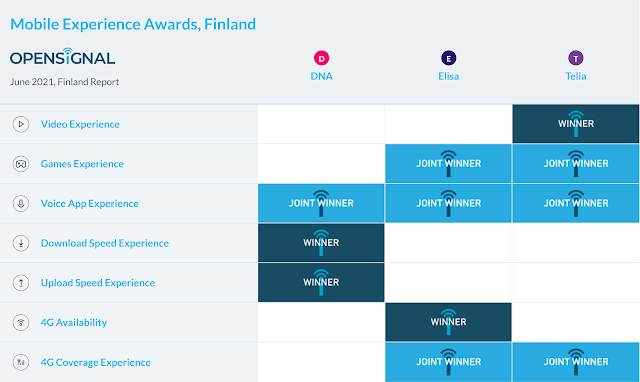
All three operators have a very good coverage and high speed at low prices even in remote and rural areas. Because of the heavy data usage in Finland, 5G becomes very important. According to OpenSignal in 2021, 5G was available to about 11% of Finns and had an average download speed of 200 Mbit/s. In 4G availability all three networks are close at around 93% and download speeds of 37 Mbit/s. DNA featured as the fastest mobile network for both average download and upload speeds, while sharing the victory in Voice App Experience. Elisa solely won 4G Availability, while sharing Games Experience, Voice App Experience and 4G Coverage Experience. Telia solely won Video Experience, while sharing the victory in Games Experience, Voice App Experience and 4G Coverage Experience.
All three national mobile operators in Finland are busy deploying their 5G networks in the country, as they all secured the same amount of spectrum in the recent 700 MHz, 3.5 GHz and 26 GHz 5G spectrum auctions.
Finland consumed 37% of all mobile data in the Nordics & Baltics in 2020 https://t.co/XGxwIDChmu
Telia, rebranded from Sonera in 2017, has the most customers in Finland and its coverage on 3G and 4G is equal to Elisa. In 2018 4G/LTE reached 98% of population. Telia has opened its 5G network to some prepaid plans in 2022.
In November 2021, Telia claimed to have launched the Nordic and Baltic regions’ first commercial Standalone 5G core network in partnership with Nokia.
Nokia noted that the rollout included its cloud packet core and registers, which allow subscriber data to be consolidated into a common repository using a distributed and flexible architecture. Telia Finland is also reportedly using Nokia’s RAN. This network was initially launched in 20 geographical areas across Finland with more rollout in future that will lower latency and include network slicing capabilities.
Elisa Saunalahti is Elisa's consumer sub-brand, which has very good coverage and speed in Finland. For 3G it mostly uses the 900 MHz band (in contrast to 2100 MHz in the rest of Europe), but it is still supported by almost all modern devices. In 2017 B28 on 700 MHz was added for LTE in rural areas. 5G was opened in 2022 for some prepaid plans.
In January 2022 Elisa has confirmed that it has doubled its 5G footprint in the twelve months since January 2021, and now covers four million Finns with its fifth-generation infrastructure. As such, 5G connectivity is now available in a total of 153 locations – equivalent to more than 70% of the population.
In a separate announcement, Elisa has highlighted the level of 5G adoption within its user base. Ville Valkama, Elisa’s Business Director for Consumer Customers, revealed: ‘In 2021 5G phones became commonplace in Finland. The share of 5G models in the phones we sell is already approaching 90%.’
DNA is the 3rd operator in Finland, yet it offers comparable coverage and very high speeds at good rates: coverage map. In 2019 the majority of DNA shares were sold to Telenor from Norway. Unlike Telia and Elisa, 5G is not yet offered by DNA for prepaid, only for subscriptions.
DNA has announced that all of its 5G base transceiver stations (BTS) are now connected to a core network that supports Standalone (SA) 5G architecture. Kimmo Liikonen, DNA’s Director of Core and IP Networks, commented: ‘For our customers, the implementation will take place in stages during 2022, as long as the last quality assurance and design work has been done. We are also looking forward to the sale of terminals that fully support the Standalone 5G network, which are not yet widely available.’
In August 2021, DNA announced that it was planning to shut down 3G by the end of 2023 freeing up spectrum for 4G and 5G network connections. Also, in December 2021, Finnish Transport and Communications Agency Traficom announced an invitation to submit bids for three spectrum licenses for 700 MHz frequency bands which will be technology-neutral. Although 3G shutdown and technology-neutral spectrum auctions are not directly related to 5G, they are certainly positive steps towards releasing valuable spectrum for 5G deployment.
Telecoms tech developers from Japan and Finland are planning to work collaboratively on the development of 6G technologies, an area becoming increasingly influenced by Chinese companies. The Nikkei writes that Nokia will join the effort and that Japan’s ‘Beyond 5G Promotion Consortium’ will sign the agreement soon with Finnish group ‘6G Flagship’. The accord will be formally announced at the Global Digital Summit 2021, an event the paper has organised with Japan’s Ministry of Internal Affairs and Communications (MIC).
Japan’s Beyond 5G Promotion Consortium aims to commercialise sixth-generation communications technology in the 2030s, and includes the University of Tokyo and domestic telcos NTT Corp, NTT DOCOMO, KDDI (au), SoftBank Corp and Rakuten Mobile. 6G Flagship, meanwhile, is led by Finland’s University of Oulu. Talks are also said to be underway to draw in a US counterpart, with the likes of Cisco Systems and Intel touted as possible candidates.
Dr. Kim Larsen, CTIO of T-Mobile Netherlands is very well known as a speaker and on social networks for his honest analysis and insights. We have also used information from him for blog posts for over a decade.
In a recent post on LinkedIn, he nicely summarized the mobile spectrum stars of Europe. In his words:
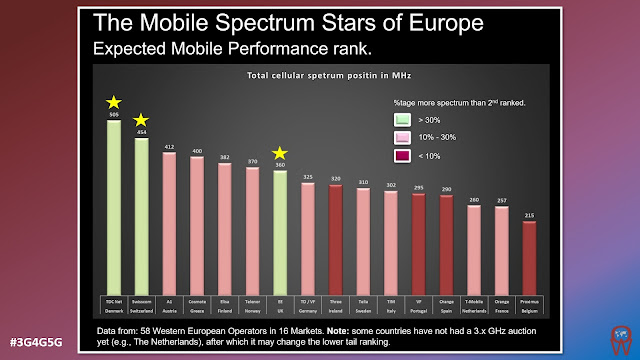
Based on the analysis of 58 Western European MNOs and their spectrum position, the highest expected mobile performance across markets and operators can be shown. Of course, it does require the MNOs to actively use their acquired cellular spectrum and deploy a market- & spectrum-appropriate antenna technology, such as described in my previous blog "RAN Unleased"
How to have the best mobile RAN. An excellent article by the CTIO of @TMobile_NL@KimKLarsen on how to build it. The trade-offs between sites, spectrum and antenna's. In NL very important, bc 8Mbps real world performance is obligation now and in future https://t.co/FlekocddOI
The MNO rank within a country will depend on the relative spectrum position between 1st and 2nd operator. If below 10% (i.e., dark red in chart below), I assess that it will be relative easy for number 2 to match or beat number 1 with improved antenna technology. As the relative strength of the spectrum position of number 1 relative to number 2 is increased, it will become increasingly difficult (assuming number 1 uses an optimal deployment strategy).
The Stars (e.g., #TDCNet / #Nuuday, #Swisscom and #EE) have more than a 30% relative spectrum strength compared to the 2nd ranked MNO in a given market. They will have to severely mess up, not to take (or have!) the best cellular network position in their relevant markets. Moreover, network economically, the Stars should have a substantial better Capex position compared to their competitors (although 1 of the Stars seem a "bit" out-of-whack in their sustainable Capex spend, but may be due to fixed broadband focus as well?). As a "cherry on the pie" both Nuuday/TDCNet and Swisscom have some of the strongest spectral overhead positions (i.e., MHz per pop) in Western Europe, which is obviously should enable superior customer experience.
While this is definitely a good metric to compare, as an analyst and a marketeer, I also think there is also a big role for how operators advertise their services and differentiators to reach the end customers. It may not be too difficult for a second operator (in terms of spectrum holding) to beat the first one with right marketing.
Finnish Transport and Communications Agency Traficom reported that the 26 GHz spectrum auction ended on 8 June 2020 and three frequency bands of 800 megahertz were auctioned. This now means that all three layers (coverage, capacity and high-throughput), ideally required for 5G rollouts has been allocated in Finland as can be seen in the picture below.
The government grants licences on the basis of the outcome of the auction. The frequency range can be used for the construction of 5G networks from 1 July 2020. The licences are valid until 31 December 2033. Finland's position as a top 5G country will be further strengthened by allocating more frequencies for 5G use. Additional frequencies for new technology communications networks provide more capacity and very high speeds for communication links.
Each operator paid 7 million Euros for the spectrum. More details are available here.
5G Observatory reported that, the lowest 850 MHz part of the pioneer band (24.25-25.1 GHz) will be reserved for local and/or regional vertical players and research & development or educational usage.
Big shots from Nokia we quick to announce how operators can provide multi-Gigabit throughput using this newly acquired spectrum.
All three Finnish mobile operators will have 800 MHz of mmWave spectrum available July 1. That is the way towards multi-Gbps 5G data rates and extreme local capacities https://t.co/GQH0J9nuPA
Congrats @teliafinland on securing 800MHz of 26GHz mmWave band! Let’s put some product in the mast. This will deliver 4Gbps speed or cell capacity. And even more with CA over FR1+FR2 or ENDC dual connectivity. #telia#Nokia#5G#Traficomhttps://t.co/ft6REZ8Ht8
Back in October 2018, the operators had received spectrum in C-band as reported here.
Back in November 2016, Finnish operators spent €66m to acquire paired 10MHz bandwidth of the 700 MHz spectrum auction. Capacity media reported:
Finnish operators have paid more than €66 million to acquire new 700MHz spectrum in the country’s latest auction. Telia Company, DNA and Elisa each splashed out €22 million to secure 2x10 MHz of frequencies, with licenses running from February 2017 until the end of 2033. The auction ran until 24 November with licenses payable across five annual instalments. The fee agreed was the reserve price set by the Finnish Communications Regulatory Authority, which offered six pairs of frequency blocks of 5MHz each. To secure the licenses, the operators agreed to provide 4G coverage to at least 99% of Finland’s population by 2020, although both DNA and Elisa said they had already hit the target with their existing networks. Telia, which operates under the Sonera name, said its coverage is 97% at this time. DNA said it will used the spectrum to build up its 4G capacity in sparsely populated areas, while Elisa promised to start construction of 700-MHz-enabled 4G networks next year.
Since then Telia has re branded all their networks to Telia.
5G spectrum auctions went far better than expected in Italy for the government. According to Mobile World Live:
Vodafone Italia and Telecom Italia each spent €2.4 billion to grab the largest share of spectrum on offer in an Italian auction of 5G-suitable frequencies, which raised €4 billion more than the minimum amount targeted by the government. All four of the country’s operators secured spectrum. Newcomer Iliad Italia spent €1.2 billion, while Wind Tre acquired licences to the value of €517 million. In a statement, Italy’s Ministry for Economic Development said the auction generated “lively competition” especially for the lots of 3.7GHz. In that band, Vodafone and Telecom Italia were both awarded 80MHz at a cost of €1.7 billion each, while the other two operators secured allocations of 20MHz for €484 million apiece.
Telecom Italia and Vodafone Italia also bought 200MHz of 26GHz (mmWave) and 20MHz in the 700MHz band. Iliad won 200MHz in the 26GHz band, alongside its 20MHz of 3.7GHz and 10MHz in the 700MHz band. Wind Tre acquired 20MHz of 3.7GHz and 200MHz in the 26GHz band. Licences are valid for 19 years, with the exception of 700MHz allocations, which will not be released until 2022 and cover a term of 15.5 years.
A similar 5G spectrum auction in Finland in 3.4 - 3.8 GHz band raised a mere €77.6 million for the Finnish government. According to Light Reading:
The home of Nokia yesterday wrapped up an auction of spectrum in the 3.4-3.8GHz range that raised just €77.6 million ($89.3 million) for the government, barely enough to refurbish some local saunas. Italy's runaway sale of 3.6-3.8GHz spectrum, by contrast, yesterday passed the €6 billion ($6.9 billion) milestone. Assuming the government doesn't waste it on celebratory Prosecco, the eventual windfall could plug more than a few holes in the public-sector purse. ... Finland's auction has been restrained for a couple of reasons. First, the government decided to auction three very large spectrum blocks of equal size. Second, the Finnish mobile market has effectively consolidated into a three-player affair, a ménage à trois in which everyone is reasonably content. Consequently, Telia Finland, Elisa Corp. and DNA Oy each walked away with a 130MHz license that did not come at eye-watering expense. While Telia Company shelled out the most with a €30.3 million ($34.9 million) payment, no operator spent dramatically more than government base prices of either €23 million ($26.5 million) or €21 million ($24.2 million), depending on the allocation in question. Elisa and DNA paid €26.3 million ($30.3 million) and €21 million ($24.2 million) for their concessions, respectively. In Italy, the government appears to have chopped a 200MHz block of spectrum into four uneven chunks, two of 80MHz and two of 20MHz. A 20MHz channel would not really be enough for most advanced 5G services, though, and operators know it. Four of them are fighting over these airwaves after competition authorities recently opened the door to France's Iliad, one of Europe's most aggressive mobile operators. Their aim was to prevent Italy from consolidating into a dreaded three-player mobile market with the merger of 3 Italia and Wind.
It will be interesting to see how it works out in 5G and if operators are still able to deploy a 5G network that is compared to other European countries.
The Finnish & Estonian mobile operator Elisa staked the claim for "first in world to launch commercial 5G". Their press release states:
Elisa has become the first operator in the world to begin commercial use of a 5G network and starts selling 5G subscriptions. The 5G network was used for the first time to make a video call to Kadri Simson, Minister of Economic Affairs and Infrastructure in Estonia. The video call is yet another historical achievement by Elisa: the first GSM telephone call in the world was also made using Elisa’s network.
The world’s first commercial 5G networks were launched today in Tampere and Tallinn. – We aim to make Finland the leading nation as a developer of 5G mobile services. The Ministry of Communications is ready to allocate the first 5G licences to the 3,400–3,800 megahertz frequency band in autumn, which will make Finland among the first countries in the world to start building 5G networks, says Anne Berner, Minister of Transport and Communications.
5G will offer several new features to users of mobile services. For instance, 5G enables considerably faster data speeds and lower latency, as well as allowing a significantly larger number of devices to connect to the network. This higher speed benefited the video call made over the world’s first commercial 5G network. Elisa, together with Huawei, used the first commercial 5G terminal devices in the world to make the call.
I blogged earlier about Ooredoo, STC and Etisalat staking the claim for world's first 5G networks. At least the press release by Ooredoo and Etisalat did mention the word "Commercial".
Elisa's press release mentions that the licenses are yet to be allocated. Last year, the Finnish regulator FICORA issued 13 radio licences in slices of up to 100 MHz in the 3.5GHz band and up to 1,000 MHz in the 26GHz band. At that time, Elisa was already working with Nokia on 5G showing off peak data speeds were 1.5GBps and the lowest latency was 1.5 milliseconds.
This launch is with Huawei and Elisa was able to show up to 2.2Gbps. There is a picture of base station here for anyone interested.
Elisa said that together with Huawei, it used the first commercial 5G terminal devices in the world to make the call. In an email, Eetu Prieur, Elisa’s head of mobile technology, described the devices as wireless 5G routers. At the moment, the 5G network covers the city center in Tampere and Tallin, according to Prieur. The operator is offering two subscription alternatives: unlimited data with unlimited voice for €49.90/month (about $57 U.S.) and unlimited data (voice not included) for €44.90/month (about $52 U.S.)
So this is more of a Fixed-Wireless Access kind of deployment with wireless routers backhauling on to 5G network. I am assuming the voice calls are more of VoWiFi or app based calling.