Showing posts with label Operator BT / EE. Show all posts

Tuesday, 19 May 2026

BT Turns Sovereign Cloud into a Telco Opportunity

BT’s latest sovereign services announcement is more than another cloud launch. It is a sign that digital sovereignty is becoming a serious operator opportunity, especially as AI adoption, national resilience and enterprise risk management begin to converge.

BT Business has announced what it describes as the UK’s first full suite of sovereign services, covering sovereign connectivity, voice, cloud and AI for public and private sector organisations. The announcement is supported by new research from Assembly Research, which suggests that digital sovereignty could unlock an £18 billion productivity opportunity for the UK by giving organisations greater confidence to scale AI securely.

That headline figure is useful, but the more interesting story is what this means for telecoms operators. For many years, telcos have looked for credible ways to move up the value chain beyond connectivity. Sovereign cloud and sovereign AI may provide one such route, not because operators can out-hyperscale the hyperscalers, but because they can bring together secure networks, domestic infrastructure, operational trust, public sector relationships and resilience at national scale.

This was also the theme behind Colin Bannon’s FutureNet World 2026 presentation, The Sovereign Cloud Opportunity for Telcos. The talk is useful because it adds context to BT’s announcement and explains why sovereignty is no longer just about where data is stored. The discussion has moved from data sovereignty to operational sovereignty, and in some cases towards technology sovereignty.

A few years ago, the sovereignty conversation was largely about data privacy, GDPR, encryption, key management and data residency. Those issues still matter, but many customers have now moved on to a harder question: can they keep their business running if something goes wrong? In the FutureNet talk, this was framed as the point where cyber risk, resilience and sovereignty meet. For boards and risk committees, the concern is no longer only whether someone can read sensitive data. It is also whether a critical platform can be switched off, disrupted, restricted, or made unavailable at the worst possible time.

This is where the taxonomy shown in the first slide becomes helpful. At one end of the spectrum sits data sovereignty, with familiar concepts such as data residency, data encryption and metadata control. In the middle is operational sovereignty, which includes tooling, legal entity, operations, certificates, licensing continuity, code escrow and immunity from foreign jurisdiction. At the far end is technology sovereignty, where the ambition is full isolation and technical autonomy.

That distinction matters because many cloud discussions use the word sovereign too casually. A workload hosted in a local data centre is not automatically sovereign in any meaningful sense. The provider, platform, legal entity, operational staff, support model, software supply chain and foreign jurisdiction exposure all matter. In other words, sovereignty is not a single feature. It is a spectrum of control.

BT’s newly expanded portfolio appears to recognise this. The company says its sovereign services are designed to help customers keep sensitive workloads in the UK, meet data residency and regulatory requirements, and adopt AI while maintaining security and operational control. The portfolio spans connectivity, voice, cloud and AI, which is important because sovereignty does not stop at compute. Critical services also depend on networks, communications platforms, monitoring, support, operations and service continuity.

BT had already signalled this direction in December 2025, when it announced a sovereign platform intended to underpin new sovereign voice, cloud and AI services. That earlier announcement positioned the platform as a foundation for UK digital sovereignty, with BT planning to make sovereign options available across a broader set of existing products during the first half of 2026.

The FutureNet talk also made an important engineering point. Cloud resilience is often described in terms of zones and regions, but recent outages have reminded enterprises that multiple zones do not always remove the risk of a common failure plane. For critical workloads, some organisations may increasingly look at active-active architectures across different environments. If they are already considering a second location or second platform for resilience, placing that workload on a sovereign platform may help address another category of risk at the same time.

That is a powerful argument for telcos. Operators are part of national critical infrastructure. They already run complex, highly available networks. They understand regulated environments, emergency services, enterprise SLAs and national infrastructure dependencies. They also have domestic operational footprints, field engineering capability and long-standing relationships with government and large enterprises. That does not automatically make them cloud providers, but it does give them a credible right to play in sovereign platforms.

The slide above, showing BT’s Sovereign Cloud Framework, helps explain how BT is thinking about this market. The framework distinguishes between public cloud, controlled cloud, trusted cloud, domestic cloud and private data centre models. It also separates characteristics such as provider, host and run model, customer environment, sovereignty controls and objectives. Below that, it maps sovereignty parameters including legal entity, platform, data residency and people.

This is a useful way of cutting through the marketing noise. Public cloud with some additional controls may be enough for many workloads. A trusted cloud instance operated through a domestic partner may be suitable for others. More sensitive workloads may require a domestic provider or even a private data centre owned by the customer. There is no single answer, because sovereignty requirements vary by workload, sector, risk appetite and regulatory exposure.

BT’s own Sovereign Cloud proposition is positioned as a private cloud platform hosted and operated in the UK for organisations with sensitive or regulated workloads. The company’s announcement says it is supported by Rackspace Technology’s UK data centre infrastructure, UK-based security-cleared teams and managed services for migration, operations and compliance.

The AI element adds another layer. BT has also announced plans to work with Nscale to deliver sovereign AI data centres in the UK using NVIDIA full stack AI infrastructure. Under the plans, Nscale will build up to 14 megawatts of AI data centre capacity across three existing BT sites, while BT provides the infrastructure and connectivity needed to support the deployment.

This is where sovereign cloud becomes a growth opportunity rather than just a defensive compliance offer. AI adoption is often slowed by concerns around data protection, intellectual property, regulatory exposure, model governance and operational control. If enterprises and public sector bodies can run AI workloads domestically, with clearer control over where data is stored, who can access it and how services are operated, then more sensitive use cases become easier to justify.

For operators, this is not about pretending that they can build an entire technology stack from scratch. The FutureNet talk was realistic on this point. Full technology sovereignty is extremely difficult, expensive and, in many cases, undesirable. Modern infrastructure depends on global hardware, software and cloud ecosystems. Cutting off major innovation engines would not make economic or technical sense for most telcos.

The more realistic question is whether a telco can design, build and operate a platform domestically while still working with global partners. In BT’s case, the argument is not about rejecting hyperscalers, NVIDIA, Rackspace, Nscale or other partners. It is about creating a sovereign operating model around the parts that matter most to customers: location, control, legal exposure, operations, resilience and trust.

There is still a major challenge. Sovereignty remains poorly defined. The FutureNet presentation referred to the risk of sovereign washing, where products are labelled sovereign without a clear explanation of what that actually means. This creates problems for customers and providers alike. If one provider invests in domestic operations, security-cleared staff and locally controlled platforms, while another simply adds a sovereignty label to an existing service, customers need a way to compare them fairly.

This is where regulation or at least an industry framework may become important. The UK has so far taken a relatively open market approach, which encourages innovation but can also create uncertainty. Without common definitions, it is hard for customers to know what they are buying and hard for providers to justify major investments. A shared framework for levels of sovereignty could reduce confusion, support investment and make procurement more transparent.

The commercial question is also important. Sovereign platforms can cost more to build and operate, especially if staff, support, infrastructure and operational controls are brought onshore. Customers may value sovereignty, but not every workload will justify a premium. The market will therefore need clearer segmentation. Some workloads may only need data residency. Others may require operational sovereignty. A smaller set may require highly isolated environments.

This is why BT’s full-suite approach is interesting. By combining sovereign connectivity, voice, cloud and AI, BT is trying to present sovereignty as an end-to-end service model rather than a single cloud product. That fits the way critical organisations actually operate. They do not just need compute. They need networks, communications, security, continuity, support, compliance and governance.

For the Operator Watch audience, the bigger takeaway is that sovereignty could become one of the more credible routes for telcos to participate in cloud and AI. The opportunity is not to become generic public cloud providers. That battle has already been won by others. The opportunity is to become trusted national infrastructure partners that help enterprises and government bodies run critical workloads with greater assurance.

BT’s announcement is therefore both a product story and a positioning story. It shows how an incumbent operator can connect its network heritage, public sector role, security capabilities, cloud partnerships and AI infrastructure ambitions into a single narrative. Whether customers buy into it at scale will depend on pricing, service clarity, workload suitability and the development of common market definitions.

What is clear is that sovereignty is moving from the margins to the centre of the enterprise technology conversation. As AI becomes more embedded in critical workflows, organisations will increasingly ask not only what the technology can do, but where it runs, who controls it, who can access it and whether it will still be available on a bad day.

That is a conversation where telcos have a stronger role than they have had in many previous cloud debates. BT is now making that case explicitly. The success of this strategy will depend on whether the market sees sovereign services not as a compliance overhead, but as a foundation for trusted AI, resilient operations and national digital capability.

The video of the presentation as follows:

Related Posts: 

Wednesday, 18 May 2022

EE Combines More 4G and 5G Spectrum for Even Higher Data Rates

You may be aware that the most common flavour of 5G in use today is known as 5G Non-Standalone (NSA). This allows the operator to combine 4G and 5G spectrum to achieve higher data rates. EE is one such operator in the UK. 

In a recent announcement, EE said that it has become the first European network to successfully aggregate a 5G signal using seven different spectrum carriers, including its existing 3.4GHz and new 3.6GHz 5G channels. The press release said:

This breakthrough will deliver new benefits for EE customers, with 5G data speeds topping 2.2Gbps in lab testing and expected real-world speeds of over 1.7Gbps on the network. The innovation means a major boost in 5G network capacity, using a total of 170 MHz of Bandwidth, and could deliver the fastest available 5G in some areas of the UK.

Working in collaboration with Qualcomm Technologies at BT’s Borehamwood lab, the EE network can now deliver a 5G signal using seven radio carriers, including some spectrum EE acquired in Ofcom’s spectrum auction last year. Using five 4G (LTE) carriers and two 5G (New Radio), it is the first time any European network has achieved this feat. A mobile test device featuring the Snapdragon® 8 Gen 1 Mobile Platform with Snapdragon X65 5G Modem-RF System was used to achieve the milestone.

While the press release doesn't detail the exact spectrum quantity in each spectrum, it specifies:

5 x LTE carriers = 1.8GHz (2 carriers), 2.1GHz (1 carrier) and 2.6GHz (2 carriers)

2 x NR carriers = 3.4GHz and 3.6GHz

Based on the spectrum holding, it can be assumed that 2x20 MHz was used in 1.8 and 2.6 GHz and 10 MHz in 2.1 GHz band was used. All these 5 carriers were carrier aggregated in LTE. 40 MHz of 3.4 GHz and 3.6 GHz was carrier aggregated in 5G. These were both used with dual connectivity to achieve the data rates specified above.

BT / EE has many firsts in the UK to their name so it's no surprise that their users will be able to enjoy top speeds going further. One final note is to point out that for the consumer segment, BT will use the EE brand as can be seen in the Tweet below.

Related Posts: 

Thursday, 27 January 2022

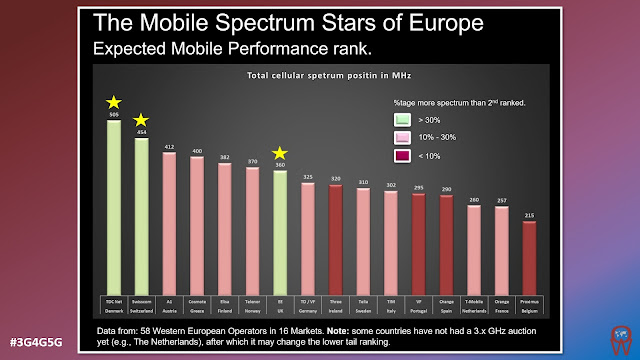
The Mobile Spectrum Stars of Europe

Dr. Kim Larsen, CTIO of T-Mobile Netherlands is very well known as a speaker and on social networks for his honest analysis and insights. We have also used information from him for blog posts for over a decade.

In a recent post on LinkedIn, he nicely summarized the mobile spectrum stars of Europe. In his words:

Based on the analysis of 58 Western European MNOs and their spectrum position, the highest expected mobile performance across markets and operators can be shown. Of course, it does require the MNOs to actively use their acquired cellular spectrum and deploy a market- & spectrum-appropriate antenna technology, such as described in my previous blog "RAN Unleased"

The MNO rank within a country will depend on the relative spectrum position between 1st and 2nd operator. If below 10% (i.e., dark red in chart below), I assess that it will be relative easy for number 2 to match or beat number 1 with improved antenna technology. As the relative strength of the spectrum position of number 1 relative to number 2 is increased, it will become increasingly difficult (assuming number 1 uses an optimal deployment strategy).

The Stars (e.g., #TDCNet / #Nuuday, #Swisscom and #EE) have more than a 30% relative spectrum strength compared to the 2nd ranked MNO in a given market. They will have to severely mess up, not to take (or have!) the best cellular network position in their relevant markets. Moreover, network economically, the Stars should have a substantial better Capex position compared to their competitors (although 1 of the Stars seem a "bit" out-of-whack in their sustainable Capex spend, but may be due to fixed broadband focus as well?). As a "cherry on the pie" both Nuuday/TDCNet and Swisscom have some of the strongest spectral overhead positions (i.e., MHz per pop) in Western Europe, which is obviously should enable superior customer experience.

While this is definitely a good metric to compare, as an analyst and a marketeer, I also think there is also a big role for how operators advertise their services and differentiators to reach the end customers. It may not be too difficult for a second operator (in terms of spectrum holding) to beat the first one with right marketing.

Happy to hear what you have to say.

Related Posts: 

Sunday, 6 June 2021

UK 5G Spectrum Results Summary


It's been couple of months since Ofcom announced 700 MHz and 3.6-3.8 GHz 5G spectrum auctions results here. Part of C-band spectrum was auctioned back in 2018 and the results from Ofcom for the award of 2.3 and 3.4 GHz spectrum auctions is available here.

TMN detailed the spectrum trade between O2 and Vodafone that resulted in Vodafone exchanging their new C-band spectrum with the old one from O2. This allowed O2 to gain 80 MHz of contiguous spectrum but it has its own challenges as highlighted in the Tweet.

It took EE 2 minutes after the results were announced to switch on their 700 MHz site.

More spectrum trades can be expected as TMN reports as it would make sense for the remaining three operators (except Telefonica O2) to obtain contiguous spectrum.

Related Posts: 

Saturday, 18 July 2020

BT UK's Journey to Automation


ETSI's Centre for Testing and Interoperability and the OSM community organized a OSM Hackfest on 1-4 June 2020. The event was run remotely, allowing participants to join the hands-on sessions from home. All videos and slides from the event are available here.

Peter Willis, Senior Manager Software Based Networks Applied Research, BT spoke about BT's Journey to Automation.

BT has deployed an NFV Infrastructure in the UK, using Canonical OpenStack and Juniper Contrail, which will run BT's 5G services intially but grow to support a multitude of BT's network services. This platform will be the foundation for BT's strategic automation initiatives meanwhile BT has many tactical network automation initiatives, many using open source components, plus several Orchestration initiatives, that need to be brought together in concert.

Video is embedded below and slides are available here.


Related Posts:

Saturday, 25 January 2020

2019 UK Mobile Network Developments Roundup


In a presentation/report last year, iDate Digiworld labelled UK as a leader of 5G. So it was good to see a nice roundup from UK, courtesy of Peter Clarke & Jake Mcneill


The video is embedded below and you can find a lot of information on Peter's website here.


Related Posts:

Tuesday, 26 November 2019

BT's Converged Core to Launch in 2023

At last year's Total Telecom Congress, Howard Watson, BT's CTIO laid out his vision (see Tweet) where Fixed, Mobile & Wi-Fi networks work together in a converged network.


While those slides are not publicly available, a similar set of slides are available here on BT's homepage from Barclays CTO Conference earlier this year.

This year, Howard Watson was able to expand further on their vision for converged core of the future.


The slides in the tweet above gives a good idea of BT's vision of convergence where their fixed broadband customers and mobile customers from BT, EE, Plusnet & Wholesale along with Wi-Fi can get the same consistent experience regardless on where and how they access the network.

Total Telecom wrote a nice summary from the congress, part of which is reproduced below:

BT’s Hybrid Network, to be launched in 2023, will be comprised of the company’s mobile, fixed line and WIFI networks, offering customers ever present, gigabit connectivity
Consumers in the UK are increasingly intolerant of complexity, even as they begin to demand ubiquitous, gigabit capable connectivity, according to BT’s CTIO.

Speaking at the Total Telecom Congress in London on Tuesday, Howard Watson said that while consumers were essentially technologically agnostic as to how they received their connectivity, they were becoming increasingly demanding about the speed, quality and reliability of that connection.

At last year’s Congress, Watson announced that BT would be launching a fully converged, hybrid network that would offer seamless connectivity across the company’s mobile, fixed line and WIFI networks, with the aim to have all of its customers signed up to the network by 2023.

This year, Watson stressed the crucial role that WIFI and mobile connectivity would play in this hybrid next generation network.

“Whether you are connecting through fixed, mobile or WIFI, bound by intelligence and software driven common infrastructure, we truly believe we can transform the customer’s experience and deliver that seamless connectivity that they demand. We are in a unique position to do that because we are the only operator in the UK to build this type of network.”

“Making this happen is not east or trivial and we need to push the boundaries of the available technologies in terms of what they can do in terms of coverage, capability and interoperability. We need to rollout new technologies like 5G and WIFI 6 across the whole of the UK.”

BT was the first operator in the UK to launch 5G mobile network services through its mobile subsidiary, EE, which now has a 5G presence in 20 towns and cities cross the country. BT has subsequently launched 5G for its own brand customers and Watson said that EE and BT would try to provide 5G network coverage in an additional 25 towns and cities across the UK by the end of 2019.

Earlier I wrote about how the new 5G Core Architecture promoted Fixed-mobile convergence (FMC) and also another feature called Access Traffic Steering, Switching and Splitting (ATSSS) would play a key role in convergence. It is very likely that BT is moving in that direction for their converged core.

While the slides from Total Telecom Congress is not publicly available, they are present in BT's Technology’s Business Briefing here.


Related Posts:

Monday, 24 June 2019

EE: 5G is going to change everything all over again


EE was the first of the UK operators to launch its 5G network in six UK cities on May 30th 2019. Belfast, Birmingham, Cardiff, Edinburgh, London, and Manchester, were the first cities to get 5G, and later this year will also see additional rollouts in Bristol, Coventry, Glasgow, Hull, Leeds, Leicester, Liverpool, Newcastle, Nottingham, and Sheffield.


EE's device range will include the currently-delayed Samsung Fold, Oppo Reno 5G, Samsung Galaxy S10 5G, LG V50 ThinkQ, and the Huawei CPE Pro and HTC 5G smart hub. It doesn't include any Huawei handsets in its current 5G line-up. EE CEO Marc Allera said EE had put the Huawei 5G devices "on pause" until it has more information and confidence that the handsets would be supported for the lifetime of the devices. But the vendor's equipment is still in EE core network; the UK government is currently deciding whether Huawei kit should be allowed in the nation's 5G networks.


EE has said it has Huawei equipment in the core of its 4G network and has said that in the future it will not be using the vendors kit in the core of its 5G network. But the first phase of its 5G network will run on top of the existing 4G network - using Huawei equipment as part of the radio access network. According to Allera: 

"We have worked for decades with the government and our security services collaborating on our networks both fixed and mobile. We agree and sign off our architecture and how we design and build those networks with their support. At the moment we have no instructions to change our plans but it's important to say that we have also have a multi-vendor policy and architecture. Our core and our radio access network, will be made up of a number of providers Huawei will be part of that but not the only part."
While some people may wonder why they need 5G, Allera said people said the same thing about 4G "and look how much has changed in the way people live their lives". He said that 4G has sparked a huge shift and said "5G is going to change everything all over again."


EE said its 5G strategy has three phases; 2019 to 2022 sees 5G rollout and a ‘non-standalone’ deployment focused on using the combined power of 4G and 5G to give customers the fastest, most reliable mobile broadband experience they’ve ever had and 1,500 5G sites by the end of this year.


Phase 2, from 2022, will introduce the full next generation  5G core network, enhanced device chipset capabilities, and increased availability of 5G-ready spectrum. Higher bandwidth and lower latency featuring network slicing and multi-gigabit-per-second speeds, coupled with expansive and growing 5G coverage, an ultra-reliable and more responsive network, enabling truly immersive mobile augmented reality, real-time health monitoring, mobile cloud gaming and enabling services such as real-time traffic management. Phase 2 is also a vital step on the way to the convergence of network technologies, bringing together fixed, mobile and WiFi into one seamless customer experience.

Phase 3, from 2023, will introduce Ultra-Reliable Low Latency Communications (URLLC), Network Slicing and multi-gigabit-per-second speeds. This phase of 5G will enable critical applications like real-time traffic management of fleets of autonomous vehicles, massive sensor networks with millions of devices measuring air quality across the entire country, and the ‘tactile internet’, where a sense of touch can be added to remote real-time interactions.


EE CEO Marc Allera said that he expects users to hit speeds of 150Mbps on average, and is confident that some customers will even break the fabled 1Gbps milestone on 5G, as some early users of Verizon’s 5G network have managed in parts of the US. 


JComms blog did speed tests on the EE network in both London and Birmingham (two of the launch cities) with the OnePlus 7 Pro 5G  he wasn't able to get results approaching or exceeding 1 gigabit. However, he did get – between 300 and 600Mbps – which are more than required for most needs. Speeds in excess of 300Mbps in city centres, in particular places like Canary Wharf, are particularly impressive.

EE came out of Ofcom’s first 5G spectrum auction with 40Mhz of 3.4GHz spectrum, specifically the 3540MHz – 3580MHz part of the band. They paid £302,592,000 for that.
They won more of the 3.4GHz band – which is ideal for 5G – than Three (which won just 20MHz), but the same amount as O2 and less than Vodafone, which came away with 50Mhz. However, EE also has 255MHz of immediately useable spectrum in other bands less suited to 5G, which means it has more spectrum overall than any other UK network.

It’s also worth noting that there are set to be future 5G auctions for spectrum in the 3.6GHz - 3.8GHz bands and the 700MHz band, as well likely as the 26GHz and 8GHz bands, and potentially others, which Ofcom is set to discuss at WRC-19, so there’s time for EE to collect more spectrum, and it already has more overall than any rival – albeit less that’s ideally suited for 5G than some.
EE will also be transforming Glastonbury 2019 into the UK’s first 5G-connected festival.
The 5G network will mean festival-goers stay connected with superfast phone charging and power bar swapping at the EE Recharge Tent, as well as helping to develop the official Glastonbury 2019 app.

To keep music fans connected throughout the weekend, EE will be installing five temporary masts across the 900-acre Somerset site broadcasting 2G, 3G, 4G and 5G for the first time. Those lucky enough to be at the festival will be able to share their unforgettable moments with friends and family back home via our 5G-powered WiFi – meaning they won’t need a 5G-compatible phone to experience our brand-new 5G network technology.

In 2017, an incredible 54 terabytes of mobile data was used over the festival weekend by Glastonbury-goers sharing photos and videos of their favourite festival moments, streaming content and keeping up to date with events away from the festival.

But EE think Glastonbury 2019 will dwarf that, with up to 40% more data being used over the festival weekend. That’s a staggering 70 terabytes of data – enough to download Stormzy’s hit song ‘Shut Up’ 19 million times or post 784 million times on Instagram.


Related Posts:

Saturday, 19 January 2019

UK MNO Mobile Spectrum Holdings

Picture Source: Keith Dyer

In a recent consultation document on 'Award of the 700 MHz and 3.6-3.8 GHz spectrum bands' that the UK regulator Ofcom has published (link), there is a nice summary picture (pg. 62 or pg. no. 60) of all the current spectrum holding by the big 4 MNOs.

Looking at this, one can conclude that all the UK operators have spectrum to launch basic 5G services whenever they are ready.

Friday, 30 November 2018

5G plans by UK Operators - Nov 2018


Vodafone: 1000 live 5G sites by 2020
  • Back in June, Vodafone announced 7 cities will be part of 5G trials starting in July.
  • In October, Vodafone announced that they have became the first company in the UK to carry full 5G over a commercial network. Live mobile data traffic was being streamed to and from the Internet exclusively over 5G from a site in Salford, Greater Manchester, connected to Vodafone’s nationwide converged fibre network.
  • Vodafone further said as a part of the same announcement that their network engineers were already achieving high-speed Internet connectivity and low latency from the Salford site using Active Antenna (Massive MIMO) technology. This effectively provides multiple-data ‘channels’ from a single antenna, coupled with the 3.4GHz 5G spectrum. Vodafone secured the largest block of this 5G spectrum at this year’s auction.
  • In September, Vodafone made UK’s first holographic call using 5G.
  • Vodafone is planning commercial network and 1,000 5G sites by 2020

The video of the first live holographic call is below:


EE/BT: 1,500 sites, 16 cities with 5G in 2019

  • EE, part of BT Group, has nine live 5G trial sites across East London.
  • Some of the learning as part of this announcement included the fact that rooftop sites often need significant strengthening to carry the new 50 kg 5G antennas – and some sites house three of these (3 sectors)
  • EE launching 5G within 16 UK cities in 2019, roughly 1,500 sites
  • EE is upgrading transmission to 10Gbps links at each 5G site
  • 5G Smartphones to be introduced alongside 5G Home router for 5G broadband
  • EE also building next generation 5G core network, with virtualised network functions on a cloud native infrastructure
  • BT Sport showcased first live trial of remote production broadcast live over EE’s 5G network


‘3’ UK Committed to Invest Over £2bn into 5G

  • According to Three press release: It’s committed spend to date covers the acquisition of the UK’s leading 5G spectrum position, new 5G radio equipment and cell site upgrades, high-capacity dark fibre network, the world’s first end-to-end cloud-based core network, and new digital systems that will enhance user experience
  • The first commercial quantities of 5G smartphone and home broadband devices are expected to be available by H2 2019. 
  • According to CCS Insight, Three now owns about 24 percent of all spectrum suitable for 4G and 5G services. This, it says, places it ahead of BT (21 percent), Vodafone (19 percent) and O2 (15 percent). The remaining 20 percent, which consists of 700 MHz and 3.6 GHz airwaves, is earmarked for sale by Ofcom in late 2019.
  • Customers of Three already use 7.6GB of data per month, more than three times the industry average. Based on projections from Ofcom, Dave Dyson, CEO, sees a scenario in which this usage surges to 90GB per month in 2025. Note that this prediction has increased from 56 GB per month in 2025 as we earlier reported.


O2: Massive MIMO Pilot to prepare for 5G

  • O2 has the least amount of announcements and information on 5G. In a recent press release, it announced that it has launched a pilot to boost London network ahead of 5G.
  • The pilot is effectively saying that O2 is working with Nokia on two Massive MIMO trials in Kings Cross and Marble Arch (in London), aimed at enhancing connectivity for O2 customers and paving the way for the future deployment of 5G across the capital.
  • The pilot is in the newly acquired 2.3 GHz spectrum.
  • The pilot will lay the foundation for the next-generation of mobile connectivity– 5G.
  • On the positive side, Ofcom confirmed that O2 had delivered against its commitment to provide 98% indoor 4G coverage and 90% geographical landmass mass coverage across the UK. 


Wednesday, 30 April 2014

EE, O2, Three & Vodafone 4G: Which is best?

Which network is best value?
4G doesn't quite live up to the 60Mbps advertised speeds as we topped out at 40Mbps. Around congested urban areas like London you can expect speeds to average between 10 - 20Mbps.
Real-world results showed there was little to separate EE, O2 and Vodafone in terms of raw download speeds. Three was slightly slower but you can still expect 10Mbps+ in most areas.
The networks take a different approach to try and attract customers. EE focuses strengths like widespread coverage and consistent high-speeds. 
Three might not be the fastest but it is the cheapest and the only network which provides true all-you-can-eat data, so you don't need to worry about going over data limits. It is also the only network to allow you to use your allowance in the US, so if you're a frequent traveller this will prove invaluable.
O2 and Vodafone offer similar high-speeds and enticing add-ons. O2 offers subscriptions to Evernote and The Sun+, whereas Vodafone throws in access to Sky Sports Mobile or Spotify Premium.
Ultimately, it's going to depend on the reception. For many people in the UK, the only way to currently get 4G will be to sign up to EE as it offers coverage in areas other networks haven't reached.
Make sure you check every operator's coverage checker before signing up to a plan. Also take time to look at the benefits offered:
Recommendations:
EE - This is the network if you need the widest possible 4G coverage and consistent high-speeds and you're not too interested in add-ons.
O2 - Only if you live in or around one of the 13 big cities and you want access to discounts through the Priority Hub and  subscriptions to Evernote and The Sun+
Vodafone - Covers a third of the UK. This one is for sports or music fans as you get the choice between subscriptions Sky Sports Mobile and Spotify Premium. 
Three - Not the fastest, but the network of choice for those who don't want to be constrained by a data limit. Also allow you to use your allowance in the US.


Read more: http://www.itpro.co.uk/mobile/22048/ee-o2-three-vodafone-4g-which-is-best#ixzz31Ugt0IU2

Tuesday, 1 April 2014

Mobile operators in UK


EE

It is the largest mobile network operator in the UK, with around 28 million customers.
Virgin Mobile UK along with ASDA Mobile operates on the EE network under a MVNO agreement.
http://en.wikipedia.org/wiki/EE_(telecommunications_company)

Voda phone

The world's second-largest mobile phone company. As of March 2012, Vodafone UK has 19.2 million subscribers and is the third largest mobile telecommunications network nationally after EE and O2.
http://en.wikipedia.org/wiki/Vodafone_UK

02

It is the second-largest mobile telecommunications provider in the United Kingdom (after EE).
http://en.wikipedia.org/wiki/O2_(United_Kingdom)

Three
http://en.wikipedia.org/wiki/Hutchison_3G#United_Kingdom
http://en.wikipedia.org/wiki/List_of_United_Kingdom_mobile_virtual_network_operators

http://www.independent.co.uk/life-style/gadgets-and-tech/ee-crowned-uks-best-mobile-operator--vodafone-in-last-place-9189018.html
Britain operates on a GSM network.

http://ukmobilecoverage.co.uk/

Britain's largest mobile operator, EE, said on Monday it posted its best quarterly take-up of its 4G network in the first three months of 2014 due to growing demand for fast mobile Internet and forecast customer numbers more than doubling in 2014.
EE, a joint venture between Orange and Deutsche Telekom, said it added another 889,000 customers in the three months to March 31, taking its customer base to 2.9 million with nearly 5,100 corporate clients.
EE, formerly known as Everything Everywhere, said it was on target to exceed 6 million 4G customers by the end of 2014.
Despite the growth, the company said turnover during the quarter dropped 3.6 percent from a year ago to 1.6 billion pounds ($2.7 billion).

Operating revenue was down 1.7 percent on a year ago to 1.5 billion pounds which included the impact of regulatory cuts.
http://uk.reuters.com/article/2014/04/28/ee-results-idUKL6N0NK1RX20140428