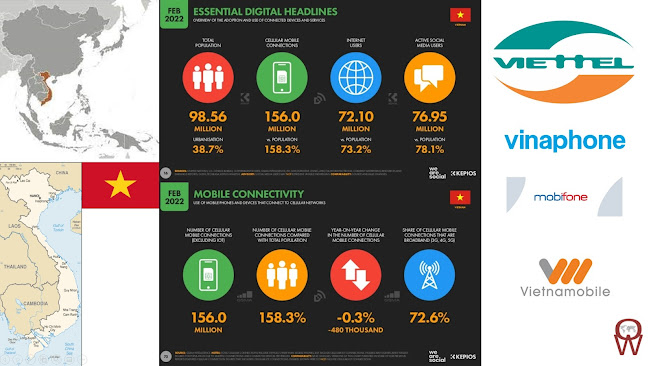
Despite the pandemic-related mobility restrictions, Vietnam’s economy has continued to outperform the rest of the region in 2020 and 2021. Nevertheless, the telecom sector essentially spent most of this period in a holding pattern, focusing on maintaining service throughout the crisis while preparing for some major changes to come in the mobile market in 2022.
Both fixed-line telephony and mobile have experienced small drops in subscriber numbers since the start of the pandemic, but the similarities between the two markets end there. Fixed-line tele-density continued its downwards trajectory towards virtual oblivion, with just 3% penetration (around 3 million subscribers) at the start of 2021. The mobile market has lost about the same number of subscribers since the end of 2019, but has been sitting on much higher penetration levels around 130% for many years. Growth is expected to kick in again in 2022 following the anticipated launch of commercial 5G mobile services along with a range of government-led schemes to move consumers completely off 2G and 3G.
#5G is a key area of focus in #Vietnam, however, #4G and #3G continue to play an important role as customers still spend the majority of their time connected to these networks. Find out how Vietnam's four national operators compare in our latest report! https://t.co/pVj40y6ZXKpic.twitter.com/81kqRkTqDm
One example is the planned redistribution of GSM/3G bandwidth to LTE. In addition to propelling Vietnam into having one of the most advanced mobile markets in the world, this should also spur on the mobile broadband segment. With a penetration level of just over 70%, mobile broadband has considerable room to grow. Increasing economic prosperity coupled with the latest smartphone technology and networks should see mobile broadband underwriting the country’s telecommunications sector for at least the next few years.
Vietnam has a large percentage of broadband Internet subscribers, with rates among the lowest in the world. According to the Department of Telecommunications, under the Ministry of Information and Communications, as of October 2021, Vietnam had more than 18.8 million fixed broadband Internet subscribers. Around the same time, Vietnam had 71 million mobile broadband subscribers, with 89.81% prepaid and 10.19% post paid. In 2021, 4G subscribers accounted for 89.42% of total subscribers, 3G subscribers with 10.05%, and 5G subscribers 0.54%. The Internet infrastructure in the country is set to receive considerable investment in 2022 to meet users’ growing demands. Additionally, the government plans to focus on upgrading bandwidth and modem devices’ capacity, widening domestic and international bandwidth, and amending Internet standards.
There are 4 major GSM network operators in Vietnam: Viettel, Vinaphone, Mobifone and Vietnamobile.
Coverage and speeds are quite good for SE Asian standards: 2G/GSM is on 900 and 1800 MHz, 3G on 2100 MHz. Viettel and Vinaphone introduced DC-HSPA in 2014, 4G/LTE is just being launched on 1800 and 2600 MHz (bands 3 and 7) after Viettel, Vinaphone, Mobifone and Gmobile received licenses in 2016, Vietnamobile in 2017. The three state-owned operators aim to increase 4G/LTE coverage to 95% each in 2019.Vietnam is planning to switch off all its 2G networks by 2022.
Vietnam was expected to launch commercial 5G services by 2020, but due to the pandemic, there were multiple delays, and the rollout time-stretched has stretched till 2022. A thing worth noting here is that the telecom operators in Vietnam have agreed to share 5G infrastructure with each other. This will help the telcos in streamlining their capital investments related to 5G.
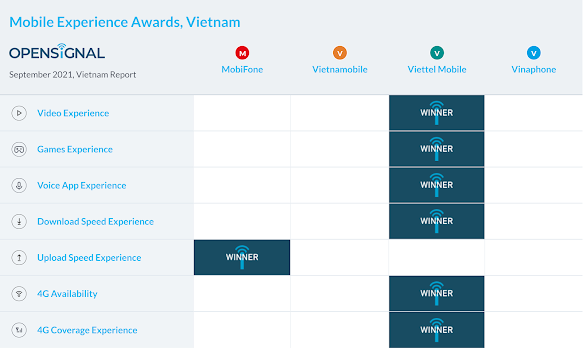
According to OpenSignal report in 2021 Viettel Mobile remains the dominant operator when it comes to Vietnam’s mobile network experience. Viettel Mobile successfully holds on to six outright wins, while MobiFone remains the sole winner of the Upload Speed Experience award.
Viettel is owned by the Ministry of Defense and thus the Vietnamese army. In 2020, Viettel held a market share of approximately 52.5 percent among all terrestrial mobile-cellular service providers in Vietnam, making it the leading provider of this service.
Samsung 5G Traction: @SamsungNetworks gains 5G commercial trial in Da Nang, Vietnam (addition shows how important 5G inflection point is for Samsung's network aspirations as its deep 5G investment pays off, 64T64R M-MIMO a case-in-point) https://t.co/bJlyUHP7qd
Samsung Electronics and Viettel have started 5G commercial trials in Da Nang, the largest city in the Central Vietnam region. In the trial, Viettel is using Samsung’s advanced 5G solutions to power its commercial network and to enable users in Da Nang to experience the full benefits of 5G services.
The main mission of the 5G commercial trials is to build a digitalised society – Viettel has built 4G telecommunications infrastructure covering 97% of the Vietnamese population. The company also pioneers in providing the first 5G service in Vietnam. Up to now, 11 provinces/cities of Vietnam have 5G Viettel coverage (including Hanoi, Bac Ninh, Bac Giang, Vinh Phuc, Dong Nai, Ho Chi Minh City, Ba Ria–Vung Tau, Binh Phuoc, Thua Thien–Hue and Da Nang). People in these areas can experience 5G for free with unlimited capacity, on many 5G support devices. The 5G Viettel network in the above areas has a stable data download speed of 600-700 Mbps, the highest of up to more than 1Gbps.
The Viettel has reached speeds of over 4.7 Gbps over a 5G network it researched, tested, and established. According to the Ministry of Information and Communications (MIC):
"This speed is 40 times higher than the 4G speed and more than two times the existing 5G speed, making Viettel one of the fastest 5G telecom networks in Asia,"
The telecommunications company headquartered in Hanoi used 5G ultra-short wave (mmWave) technology, and, together with Ericsson and Qualcomm, advanced E-Utra New Radio Dual Connectivity (EN-DC) technology to increase speed and extend 5G coverage.
Vinaphone is the second operator in Vietnam. It's owned by the government through the Vietnam Posts and Telecommunications Group. It gives a good coverage and speed throughout the country. 4G/LTE has been started on Phu Quoc island in 2016 and is now rolled out nationwide.
The operator has signed an agreement with Finnish vendor Nokia to improve its digital infrastructure. Under the partnership, the pair agreed to strengthen strategic cooperation to upgrade the capacity of VNPT’s backbone and core networks, develop 4G, 5G and IoT platforms, continue the commercial testing of 5G services, and cooperate in developing and applying new networking technology.
Vinaphone also announced the pilot launch of a mobile money service across the country last year. The operator received one of the nation’s first trial mobile money licences from the State Bank of Vietnam on 18 November, alongside mobile operator MobiFone. The new service will enable customers of VNPT’s mobile unit VNPT-Vinaphone to deposit, withdraw and transfer money, as well as pay for goods and services.
Mobifone is the 3rd provider in the country and has become the first Vietnamese operator to be permitted to provide mobile money services in the country. MobiFone will provide mobile money services via a network of 600 transaction points. It aims to expand the service coverage to more than 10,000 transaction points via its partners and dealers. However, there is definitely demand for such services. There are nearly 125 million mobile phone subscribers in the country, but only 64 percent of adults have bank accounts. MobiFone’s service is expected to make e-payment more widely accessible, especially to people in rural, mountainous and remote areas.
Mobifone completed tests on a pilot 5G network in four cities, making it the second mobile player in the country prepared to launch commercial service.
In a statement the operator said it spent nearly a year deploying and evaluating the performance of 5G base stations in Hanoi, Ho Chi Minh City, Da Nang and Hai Phong. It didn’t give a timeframe for when commercial service would begin. The testing showed the network was capable of delivering download data rates of about 2Gb/s, it said, noting it worked with major 5G equipment providers to assess the responsiveness and service quality of the pilot network.
Vietnamobile is the smallest of the 4 providers and the only one that is privately owned. It gives out the best prices in Vietnam and has a market share of around 10%.
In 2011 they started with 3G services in Ho Chi Minh City, Da Nang and Hanoi, but since then 3G coverage has been expanded to Ba Ria-Vung Tau, An Giang, Khanh Hoa, Binh Thuan, Dong Thap, Long An, Dong Nai, Thai Nguyen and Binh Duong. In 2017 it covers 90% of the population in all 63 cities and provinces by 3G, but coverage is still lower as on the state-owned providers. They have been awarded a 4G/LTE license, but it's still much more restricted than on the state-owned providers.
Vietnam announced that this year, it plans to focus on 6G, the sixth-generation standard currently under development for wireless communications technologies. The government has set up a steering committee on 6G technology. It is responsible for putting forward orientations, mechanisms, and policies to bolster 6G research and development in the country.
The committee will monitor the 6G equipment and service standards, production, and commercialisation from international organisations around the world. It will combine research and forecast development trends from domestic and international telecommunications markets. The committee will also devise a roadmap to study, manufacture, and commercialise 6G equipment as well as a roadmap for testing and commercialising 6G services. It will come up with solutions to support Vietnamese enterprises with the technology. Experts believe that 6G networks will transform the country. While the speed of 5G may reach 20 gigabits (Gbps) per second, a 6G network may achieve terabits-per-second speeds. Nations around the world, including the US, South Korea, China, Japan, and Finland have already joined the race for 6G network development.
Vietnam’s largest telecommunication company, Viettel, will launch commercial 5G mobile services from June this year, the company said on Friday.
Reuters report the military-run company has said in a statement it would use 5G network equipment and software developed itself, adding that it has become the sixth firm in the world to produce 5G network equipment after Ericsson, Nokia, Huawei, Samsung Electronics and ZTE.
The statement came after Viettel conducted its first trial video call on its 5G network the same day. Viettel said it would develop both civilian and military services based on its 5G platform.
It should be pointed out that there are other players like Mavenir, Parallel Wireless, Airspan, Altiostar, NEC, Fujitsu, etc. that have already got 5G in their arsenal so the claim that Viettel is the 6th player is not necessarily true.
According to FT Viettel said it took six months for its research and development arm, Viettel High Technology, to develop the hardware and software needed to make the call.
Viettel has more than 110m customers in 11 countries, including Cambodia, Haiti and Peru.
Vietnam is a fascinating country. Not just because of the stunning sights, sizzling beaches and sumptuous food for which the Rough Guides refer to it as magical, but also because of the mobile users.
Vietnam has a significant amount of young and middle-class consumer, along with high digital media consumption, as well as mobile gaming habit. Any enterprises who wish to tap into Vietnam should develop mobile-friendly websites, videos, pictures, apps, etc.
72% of the Vietnamese people own Smartphone.
68% of the Vietnamese come online via smartphone more often than computer
25% of the Vietnamese are frequent mobile internet users, engage in all online mobile-related activities.
Many Vietnamese people own more than two Internet-connected devices, as the national average is 1.7%.
69% of The Vietnamese watch video and listening to music on their phone every day.
The Vietnamese are willing to try new apps, but at the same time, they have the highest uninstall rate among APAC markets.
The Vietnamese people install five new apps every month on average resulting in a difficult challenge for publishers to retain user.
Three apps are uninstalled every month on average by Vietnamese people.
There are 4 major GSM network operators in Vietnam: Viettel, Vinaphone, Mobifone and Vietnamobile. Coverage and speeds are quite good for SE Asian standards: 2G/GSM is on 900 and 1800 MHz, 3G on 2100 MHz. Viettel and Vinaphone introduced DC-HSPA in 2014, 4G/LTE is just being launched on 1800 and 2600 MHz (bands 3 and 7) after Viettel, Vinaphone, Mobifone and Gmobile received licenses in 2016, Vietnamobile in 2017. The three state-owned operators aim to increase 4G/LTE coverage to 95% each in 2019. These four operators are tipped to receive licences to test 5G in January 2019. According to Nguyen Manh Hung, the country’s minister of Information and Communications:
“Vietnam should be among the first nations to launch 5G services in order to move up in global telecom rankings.”
The country is pursuing a unique model of competition involving different state-owned operators to grow telecommunication networks.
Viettel is owned by the Ministry of Defence and thus the Vietnamese army. It's the market leader in Vietnam with about 40% (66 million subscribers) of all customers on its network. It has the best coverage in remote places even on 3G. 4G/LTE was officially launched in April 2017 on 1800 MHz (B3) over 25,000 base stations in almost 95% of the country giving it the best 4G/LTE coverage in the country for now. As prices don't differ so much between the 3 major operators, Viettel is usually the first choice when venturing into to rural areas. Vittel plans to launch ultrafast 5G networks in 2021, a move expected to promote self-driving car systems and other cutting-edge services that depend on nearly instantaneous data communication. They have been working on 5G plans since 2015, and set up a research group for 5G technology and have mastered the software, core technology for 5G equipment, hardware design for high-frequency transmission and others. They intend to start making investments in infrastructure early next year and introduce the service first in big cities like Hanoi and Ho Chi Minh City.
Viettel already has the biggest telecom infrastructure, so the deployment will be quick.
For 5G, providers are ready with networks. The question is whether users are willing to use 5G and about the readiness of end-user equipment. When the market and end-user equipment are available, 5G deployment is very easy.
Vinaphone is the second operator in Vietnam. It's owned by the government through the Vietnam Posts and Telecommunications Group (VNPT). It has a market share of 30% and is the local partner of Vodafone. It gives a good coverage and speed throughout the country. 4G/LTE has been started on Phu Quoc island in 2016 and is now rolled out nationwide.
Vinaphone has installed more than 21,000 4G base transceiver stations (BTS) nationwide. This number will reach over 30,000 by 2019 to cover 4G VinaPhone service to 95% of Vietnamese population.
According to chairman Tran Manh Hung, Vinaphone are seeking permission from the Ministry of Information and Communications to beta test 5G. He said the test would help them master the technology and prepare to produce 5G equipment, adding Vinaphone is ready to provide 5G services as soon as it gets the ministry green light. Vinaphone has also partnered with Nokia on 5G development.
Mobifone is the 3rd provider in the country with a 18% market share. It's in the process of privatisation. Speeds and coverage may be good in the centers and around the coast, but can be patchy.
Mobifone's 4G started in 2016 in Hanoi, Da Nang and HCMC on 1800 and 2600 MHz (B3,7) and is open for prepaid without surcharge.Earlier this year signed they an agreement with Samsung Electronics for engineering and commercial cooperation on 4G and 5G networks.
Vietnamobile is the smallest of the 4 providers and the only one that is privately owned. It gives out the best prices in Vietnam and has a market share of around 10%. In 2011 they started with 3G services in Ho Chi Minh City, Da Nang and Hanoi, but since then 3G coverage has been expanded to Ba Ria-Vung Tau, An Giang, Khanh Hoa, Binh Thuan, Dong Thap, Long An, Dong Nai, Thai Nguyen and Binh Duong. In 2017 it covers 90% of the population in all 63 cities and provinces by 3G, but overage is still lower as on the state-owned providers. 4G/LTE is going to start and is already advertised in 2018 started as they were awarded a licence to provide 4G/LTE services in 2017. Vietnam’s telecom market was estimated at more than $16 billion in 2016, with the three state-owned providers, Viettel, MobiFone, and Vinaphone, accounting for 95 percent of the market.
While MobiFone and Vinaphone are on the list of state-owned companies slated for privatization by 2020, Viettel will remain in government hands. Vietnam has a unique model of competition; state-owned enterprises have driven a high level of mobile access including in rural areas. The launch of LTE networks and then 5G technology will drive up even more demand for higher-speed broadband.
The following report from Appota makes an interesting reading