Showing posts with label Operator Three Sweden. Show all posts

Friday, 23 October 2026

Sweden's Mobile Market in 2026: Four Operators, Shared Networks and the Shift to 5G Standalone

Sweden remains one of Europe's most advanced telecommunications markets, characterised by high mobile adoption, extensive 5G coverage and continued investment in digital infrastructure. The country's mobile market is dominated by four operators: Telia Sweden, Tele2, Telenor Sweden and Tre Sverige (Three). While the market is mature, competition remains strong, particularly around network performance, coverage, pricing and increasingly enterprise connectivity services.

Sweden benefits from widespread fibre infrastructure, high levels of digital adoption and an established telecommunications industry. With limited opportunities for significant growth in traditional mobile subscriptions, operators are increasingly focusing on improving network quality, expanding 5G capabilities and developing new revenue streams through enterprise services, Fixed Wireless Access (FWA), IoT and advanced connectivity solutions.

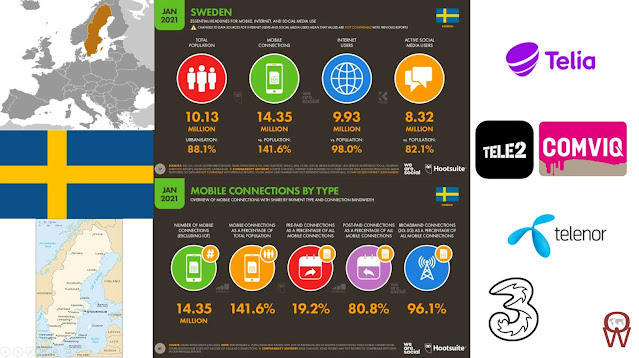
According to GSMA Intelligence figures published by DataReportal, Sweden had approximately 14.8 million cellular mobile connections in late 2025, equivalent to 139% of its population. This reflects widespread use of multiple subscriptions, including separate personal and business connections, rather than the number of individual mobile users.

The number of mobile connections increased by approximately 232,000, or 1.6%, during 2025. The same dataset indicates that 99.1% of connections were classified as broadband-capable, although this does not necessarily mean that every connection was actively used for mobile internet access.

Sweden's national regulator, the Swedish Post and Telecom Authority (PTS), provides additional insights into the market. Its Swedish Telecommunications Market 2025 report, published in May 2026, recorded approximately 15.1 million mobile subscriptions at the end of 2025. This is slightly higher than the GSMA Intelligence estimate, reflecting differences between the datasets and their reporting methodologies.

According to PTS, Telia remained the largest operator with 30.3% of mobile subscriptions, followed by Tele2 with 25.8%, Telenor with 20.5% and Tre (Hi3G) with 19.1%. Other operators collectively accounted for approximately 4.3%. These figures include subscriptions attributed to the respective operator groups.

Telia has traditionally benefited from its extensive coverage, strong brand recognition and significant enterprise customer base. The operator continues to invest in network modernisation, rural connectivity and services for businesses and critical infrastructure. By the end of 2025, Telia reported that its 5G network covered approximately 99% of Sweden's population.

Tele2 is another major player, offering mobile, broadband and television services alongside enterprise connectivity solutions. The operator has invested heavily in network modernisation and has been particularly active in expanding its 5G footprint.

Telenor Sweden also has a substantial presence in both consumer and business markets. In addition to mobile services, it provides fixed broadband, television and enterprise communications solutions. Its priorities include network performance, security and advanced connectivity services for businesses.

Tre Sverige, operated by Hi3G Access, has a more mobile-focused business model and has traditionally competed through pricing, data allowances and mobile broadband services. It has also been active in introducing newer 5G capabilities, including 5G Standalone and millimetre wave deployments.

One particularly interesting aspect of Sweden's mobile market is the extensive use of network sharing. Tele2 and Telenor operate a joint mobile network through Net4Mobility, a company established in 2009 to build and operate shared mobile infrastructure. Although the operators compete commercially, they share substantial radio network infrastructure, allowing them to reduce deployment costs and accelerate coverage expansion.

In September 2025, Tele2 and Telenor announced that their shared 5G network had reached 99.9% of the Swedish population and approximately 90% of the country's land area. The expansion was supported by activating 5G in the 700 MHz band, providing wider geographical coverage and improved indoor penetration. Higher-frequency spectrum around 3.5 GHz is used to provide additional capacity in urban and other high-demand locations.

This illustrates how network sharing can support extensive geographical coverage while allowing operators to maintain separate commercial strategies.

Independent measurements also provide useful insights into competition. The Opensignal Mobile Network Experience Report for December 2025 found that Telenor led in overall download speed experience and Time on 5G, while Tele2 achieved the highest 5G download speeds. Telia led in overall coverage experience and 5G upload speeds, while Tele2 and Telenor shared the lead in 5G coverage experience.

These results highlight an important distinction between geographical network coverage and the experience customers receive in everyday use. An operator may provide extensive 5G coverage without necessarily delivering the highest speeds or the greatest proportion of time connected to 5G.

Sweden's 5G adoption has continued to accelerate. According to PTS, approximately 8.7 million mobile subscriptions had used 5G services by the end of 2025, representing around 60% of mobile subscriptions. This was an increase of approximately 2.2 million compared with the previous year.

Mobile data traffic also increased substantially. Total traffic across Swedish mobile networks reached approximately 5,300 petabytes in 2025, an increase of around 20% year on year. Of this, approximately 1,600 petabytes were carried over 5G networks, more than double the previous year's volume. Nevertheless, 4G continued to carry the majority of mobile data traffic, accounting for approximately 3,600 petabytes.

Fixed Wireless Access is becoming another important part of the mobile market. PTS recorded approximately 420,000 FWA subscriptions at the end of 2025, an increase of more than 20% during the year. Despite representing a relatively small proportion of total mobile subscriptions, FWA accounted for more than one-third of mobile data traffic. This demonstrates the increasing importance of mobile networks as an alternative broadband access technology, particularly where fixed connectivity options are less attractive or more expensive to deploy.

Another important development has been the transition from 5G Non-Standalone (NSA) to 5G Standalone (SA). Unlike NSA, which relies on a 4G core network, SA uses a 5G core and enables capabilities such as network slicing, improved service differentiation and more advanced enterprise connectivity.

In June 2026, Telia launched Telia Critical IoT Connectivity, a commercial service using 5G Standalone technology. The service targets applications requiring secure and predictable connectivity, including emergency services, energy, transport, healthcare and industrial environments. Telia stated that SA capabilities had been deployed throughout its Swedish 5G footprint, although access to the technology also depends on compatible devices and subscriptions.

Tele2 operates one of Sweden's strongest mobile network's and has strengthened its position following years of investment in spectrum and infrastructure. The operator continues focusing on customer experience, converged broadband offerings and business connectivity.

Telenor has also introduced commercial 5G SA services for enterprises. In June 2026, the operator announced its 5G Laptop Connect service, with Ericsson becoming an early customer. The solution enables compatible laptops to connect directly to mobile networks using SIM or eSIM technology, providing an alternative to conventional Wi-Fi connectivity for enterprise users.

Tre Sverige was among the first operators to introduce commercial 5G SA capabilities. In May 2025, it activated a 26 GHz millimetre wave 5G SA deployment at Stockholm's 3Arena, demonstrating the potential for delivering very high capacity in crowded environments. This was followed by a broader commercial 5G SA launch towards the end of 2025, supported by Ericsson technology.

These developments suggest that the next phase of 5G competition in Sweden will increasingly focus on differentiated services and enterprise applications rather than simply improving consumer download speeds.

Sweden has also progressed significantly with the retirement of older mobile technologies. During 2025, all four operators completed the shutdown of their 3G networks. Tele2 and Telenor also retired their shared 2G network, while Telia plans to maintain its 2G network until the end of 2027.

The transition has not been entirely straightforward. PTS reported that some mobile phones capable of normal calls over 4G could not reliably make emergency calls to 112 after older networks were switched off. This required regulatory intervention and highlighted the importance of ensuring device compatibility and emergency service continuity during network technology transitions.

The retirement of legacy networks also has implications for older M2M and IoT equipment used in vehicles, utilities, healthcare and other sectors. Operators and enterprises must ensure that connected devices can continue functioning as older technologies disappear.

Looking ahead, Sweden's mobile market is likely to remain focused on improving network performance, extending 5G Standalone services and developing connectivity solutions beyond conventional consumer mobile broadband. Network automation, energy efficiency, resilience and enterprise connectivity will become increasingly important investment priorities.

Sweden provides an interesting example of how a mature mobile market can continue evolving through network sharing, extensive 5G deployment and the development of advanced services. While subscriber growth may remain modest, the expanding role of mobile connectivity in broadband access, industrial applications and critical infrastructure should create further opportunities for operators over the remainder of the decade.

Related Posts: 

Sunday, 12 December 2021

Sweden is Nordic 5G Laggard

Sweden’s telecom market includes mature mobile and broadband sectors have been greatly stimulated by the progressive investment of the main MNOs in developing new technologies. The country retains one of the best developed LTE infrastructures in the region, while its MNOs have benefited from the January 2021 auction of spectrum in the 3.5GHz band which will enable them to expand services nationally.

Sweden has 4 physical network operators: Telia, Tele2 using brand name Comviq, Telenor (formerly Vodafone Sweden) and 3 (Tre).

However, all the 4 physical networks share 2G, 3G, 4G and 5G with at least one other network:

Telia runs its own 2G and 4G LTE networks. Its 3G network on 2100 MHz is shared with Tele2, while it has an own 3G network on the 900 MHz band.

Tele2 operates all its networks in cooperation with other operators: Tele2's 2G and 4G are shared with Telenor, while its 3G is shared with Telia.

Telenor's 2G and 4G networks are shared with Tele2, 3G is shared with 3 outside Stockholm, Gothenborg, Malmö, Lund and Karlskrona, where they have their own.

3 is the only Swedish network without any 2G. They currently have two different 3G networks, one on the 2100 MHz band, shared with Telenor (except in the cities named above), and one on the 900 MHz band, that they don't share. They have also built their own 4G network.

In 2021 Telia is market leader with the best coverage and 36% of customers, followed by Tele2 with 27% and Telenor with 19% and 3 with 15% in last position.

2G is on 900 and 1800 MHz like everywhere in Europe, 3G is on 900 and 2100 MHz. Tre does not have a 2G network.

All major 4 Swedish operators support 4G/LTE. Tele2 and Telenor have a joint LTE network called Net4Mobility claiming 99.5% coverage. LTE is on all carriers on 2600 MHz (band 7) in the cities. 800 MHz (band 20), 900 MHz (band 8, only on Net4Mobility) and 1800 MHz (band 3) frequencies are used additionally. Tre offers TDD-LTE on 2600 MHz (band 38) and FDD-LTE on 2100 MHz (band 1) in some locations. From 2019 700 MHz (Band 28) will be added by Telia and Net4Mobility.

5G started to be available in Sweden during 2020 on some postpaid subscriptions on the four big operators and since September 2021 on some high-data Comviq postpaid plans, though not on prepaid and MVNO yet. Physically, 3 different 5G networks are being built: Telia and Tre will build their own networks, while Tele2 and Telenor continuing with their joint network Net4Mobility. Frequencies on 700 MHz (n28), 2300 MHz (n40) and 3500 MHz (n78) were auctioned to 4 providers in 2018 and 2021.

Both 2G and 3G are being phased out and are planned to terminated by 2025. Telia has announced that it will shutdown it's 2G network by 2025, but has started with its phase out. Telia has also said that it's own 3G network will shut down at the latest 2025, but it will dismantle individual sites as time goes. Tele2 has said that it's shared 3G network (that has been built with Telia) is being phased out since 2021 and will be completed at the latest 2025. So for data you need to have a device for 4G/LTE on the frequencies mentioned above, while a basic service will be maintained on 2G and 3G up to 2025 for voice and SMS services.

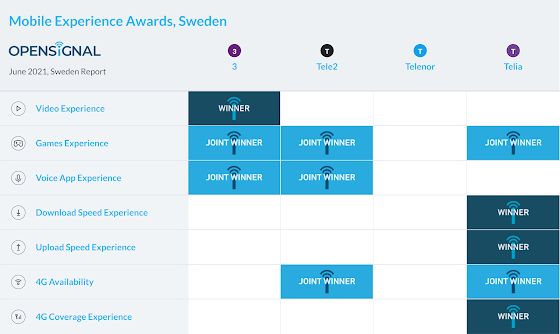
The OpenSignal June 2021 report on Sweden reveals a varied picture with three of the four national operators winning — or sharing the win — in at least three of the seven mobile experience categories. Telia solely wins Download Speed Experience, Upload Speed Experience and 4G Coverage Experience, while sharing the victory in Games Experience and 4G Availability. 3 leads in Video Experience and jointly wins Games Experience and Voice App Experience. Tele2 is a joint winner in Games Experience, Voice App Experience and 4G Availability.


Telia, owned by the Swedish Telia Company is market leader in Sweden with the best coverage nationwide in 2G, 3G, 4G and (on 800, 1800 and 2600 MHz): 4G/LTE is available for all prepaid products with up to 100 Mbit/s speed.

If one is visiting northern Sweden and intending to stay out of cities, then Telia or its subbrand Halebop will probably be the only network that has coverage.

In May 2020, Telia launched Sweden's first large-scale public 5G network in Stockholm. 5G is now being rolled out at a high pace from Skåne to Lappland and is already available in 22 cities. And in doing so, Telia managed to beat the Swedish 5G speed record. Telia collaborating with Ericsson means that 5G will have the same coverage as today's 4G network, in the period leading up to 2025 (covering 90 percent of Sweden’s geography and more than 99 percent of the population). As early as 2023, the 5G network will cover more than 90% of the population. 4G capacity will also double as part of the mobile network modernization. Telia’s 5G network uses higher frequency bands, such as 3.5 GHz, in densely populated areas with a lot of connected people and things using the network. The higher frequency bands are also used to build local, dedicated 5G networks for e.g., industry, ports, and hospitals. The lower frequency bands, such as 700 MHz, are used in rural areas to be able to offer good coverage and connection.

Comviq is a subsidiary of Tele2 in Sweden. That's why it uses the Tele2 and Telenor network on 2G, the Tele2 and Telia networks on 3G and Net4Mobility (= Tele2 and Telenor) on 4G with up to 80 Mbps speed. In September 2021, 5G on Net4Mobility was opened up to some high-data Comviq postpaid plans with up to 100 Mbps speed, but is not open for prepaid yet.

Tele2 doesn't sell own prepaid SIMs anymore, they are geared to contract customers and channel all prepaid products through their Comviq brand. They have a 99+% coverage on 2G, 3G and 4G/LTE.

Tele2 said it had switched on its commercial 5G network on May 24 2020. The operator said that the company’s customers will be able to enjoy the next generation mobile network in Stockholm, Gothenburg and Malmö. 5G services will be offered using 80 megahertz bandwidth on C-Band spectrum.

Telenor has a good 2G, 3G and 4G/LTE network up to 450 Mbps is available on Net4Moblity for prepaid too.

Telenor Sweden activated its 5G network in October 2020 in central Stockholm, marking the launch of nationwide roll-out using the new technology. The operator said the 5G network will provide internet access at 1 Gbps to customers with a compatible handset and a Telenor 5G-ready 30 GB, 75 GB or Unlimited subscription. The Telenor network uses 80 megahertz of spectrum in the 3.7 GHz band, which is shared with Tele2 via their Net4Mobility joint venture.

The next cities to get 5G will be Gothenburg and Malmö, and then the new network technology will reach cities with over 50,000 inhabitants, and finally, smaller towns. Telenor also said that it expects its 5G network to cover 99% of Sweden’s population by 2023.

3 (called "Tre") in Sweden has good speeds in 3G (on 900 and 2100 MHz) and 4G/LTE on (800, 2100 and 2600 MHz, partly as TD-LTE on band 38): Tre 3G and 4G coverage. Have in mind that Tre doesn't operate a 2G network and has no 2G roaming. You'll need to have a 3G or 4G device for using the Tre network. International roaming is blocked for all prepaid lines, you will be able to use their SIMs in Sweden only.

Tre Sweden (3 Sweden) officially launched its 5G network in June 2020 in Malmö, Helsingborg, Lund, Västerås, Uppsala and large parts of Stockholm. In December 2019, the Operator was the first in Sweden to launch a trial 5G network - then in southern Stockholm.

With nearly 400 active 5G masts, half of them in Stockholm, Tre said that it now has Sweden's most developed 5G network. The 5G network is activated using Tres' existing frequency spectrum.

All private customers with a 3Surf subscription from Tre and a 3G mobile from Tre, can access to the new 5G network at no extra cost. The same applies to corporate customers who have subscribed after January 15, 2019.

Related Posts:

Friday, 29 May 2020

Sweden stride into 5G


Sweden took a massive step into the 5G era with three of its mobile operators all launching their 5G networks the weekend of May 24th/25th 2020.
Tele2 issued a press release insisting they were the first operator to launch the next generation mobile network by activating Sweden’s first public 5G network in accordance with global standards.The telco said that the company’s customers will be able to enjoy the next generation mobile network in Stockholm, Gothenburg and Malmö. Their 5G services will be offered using 80 megahertz bandwidth on C-Band spectrum. And from 24 June 2020, all customers with a Tele2 Unlimited subscription and a 5G compatible mobile phone from Samsung’s Galaxy S20 series, will get free access to Tele2’s 5G network.

Meanwhile Telia Sweden inaugurated its first major commercial 5G network in Stockholm. The network has been up and running for a number of weeks already. 15 base stations are already in place, and during June a further 60+ will be built. The 5G network will cover most of central Stockholm by Midsummer. Expansion of the network is underway in a further 12 cities including Gothenburg and Malmö, where it will be launched later this year.

During the spring, 15 base stations were upgraded with 5G in Stockholm, and the network is already up and running. A further 60+ are due to be completed during June in partnership with Ericsson. As a result, a significant part of Stockholm will be covered by 5G by the end of the May, including Norrmalm, Östermalm and Vasastan. Parallel to this, expansion of the network is taking place in a further 12 cities, including Gothenburg and Malmö, where it will be launched later this year.

The new 5G network will contribute to higher data speeds, lower latency and more efficient power consumption. Telia’s 5G network is powered by 100 percent renewable energy which has been certified by the Swedish Society for Nature Conservation. Telia’s 4G network will continue to play an important role in complementing the 5G network.


Finally, Tre Sweden also announced they will be launching 5G services in Malmö, Lund, Helsingborg, Vasteras, Uppsala and western parts of Stockholm in June.This will be an expansion on their already-launched 5G network back in December 2019, when it announced testing.

The announcements have been made despite the fact that Sweden has not yet auctioned the allocation of frequencies in the 3.5 GHz and 2.3 GHz bands, which are key to 5G expansion due to their optimum balance of download speeds and coverage.

The operators have also been forced to be fairly inventive with spectrum for their new 5G networks because of the delay in the allocation of 5G-capable spectrum in the 2.3GHz and 3.5GHz bands. Telia is using its existing 700MHz spectrum assets, Tele2 is currently relying on 80MHz in the C-band and Three Sweden is using frequencies in the 2.6GHz band.

Anders Nilsson, CEO and president of Tele2, explained that Tele2 decided to buy additional frequencies in the C-band to allow it to launch "real 5G" before the summer.

The Swedish Post and Telecom Agency (PTS) has said the auction of frequencies in the 2.3GHz and 3.5GHz bands is due to start on November 10, 2020, with applications invited by June 30. It plans to sell "up to" 15 nationwide licenses in the 3.5GHz band, incorporating a maximum 320MHz of frequencies, and up to 80MHz in the 2.3GHz range.


Related Posts: