Showing posts with label Operator dtac. Show all posts

Thursday, 20 November 2025

5G, Mergers and Momentum in Thailand’s Mobile Sector

Data from GSMA Intelligence shows that Thailand had 99.5 million cellular mobile connections at the beginning of 2025. It is common for people to maintain more than one mobile connection, so the number of connections often exceeds the total population. Someone might have one SIM for personal use while relying on another for work, and the rise of eSIMs has made it easier to manage multiple profiles on a single device.

According to GSMA Intelligence, the number of mobile connections in Thailand was equal to 139 percent of the population in January 2025. Trend data shows that connections grew by 734 thousand, or 0.7 percent, between early 2024 and the start of 2025.

All mobile connections in Thailand now qualify as broadband, meaning they operate on 3G, 4G or 5G networks. This does not necessarily mean they use cellular data, as some subscriptions are limited to voice and SMS. Broadband figures therefore should not be interpreted as a direct indicator of mobile internet usage.

Thailand’s mobile market has undergone rapid change in recent years, driven by consolidation and fast-advancing 5G adoption. AIS, DTAC and True remain the sector’s most recognised names, although the competitive landscape has shifted significantly following the merger of DTAC and True.


AIS is Thailand’s largest mobile operator by revenue. At the end of 2024 it held around 49 percent of the revenue market share, underscoring its dominance in financial performance. By mid-2025 AIS had close to 46 million mobile subscribers, making it a formidable competitor in terms of scale as well.

The company has been at the forefront of 5G deployment. AIS continues to expand coverage while also working on innovative monetisation models. One example is its “5G Mode” offerings, which are tailored for heavy users such as gamers and live streamers who require superior performance. AIS has also been active in acquiring new spectrum, such as the 2100 MHz and 2300 MHz bands, to strengthen its 5G capacity.

Beyond mobile, AIS is reinforcing its presence in fixed broadband through acquisitions such as 3BB, which allows it to bundle services across mobile, internet, and entertainment.

Before merging with True, DTAC was Thailand’s third-largest mobile operator. It served millions of customers and competed on both pricing and service innovation. DTAC’s merger with True in 2023 fundamentally reshaped the market by consolidating customer bases and resources into a much larger entity. 

Although DTAC as a standalone brand has largely been absorbed into True, its legacy remains important for understanding the current market balance. The merger created a powerful player capable of challenging AIS more directly, both in subscriber numbers and infrastructure investment.

True Corporation is now a much larger operator following its merger with DTAC. By mid-2025 the combined company reported around 48.5 million subscribers, making it the largest provider in Thailand by customer base.

True has also taken a strong lead in 5G coverage. By early 2025 it reported 93 percent nationwide 5G coverage, giving it a significant advantage in terms of network reach. To sustain this lead, True continues to acquire spectrum across multiple frequency bands, ensuring both urban and rural areas gain access to next-generation mobile services.

The operator also pursues a convergence strategy, bundling mobile services with broadband, pay-TV, and digital content. This approach helps it to strengthen customer loyalty and increase average revenue per user.

Together, AIS and True (with DTAC now integrated) dominate Thailand’s mobile sector. AIS leads in revenue share, while True edges ahead in subscriber numbers and 5G coverage. The rivalry between these two giants is shaping the pace of 5G rollout, the quality of mobile services, and the innovation in bundled offerings across the country.

Related Posts

Wednesday, 1 December 2021

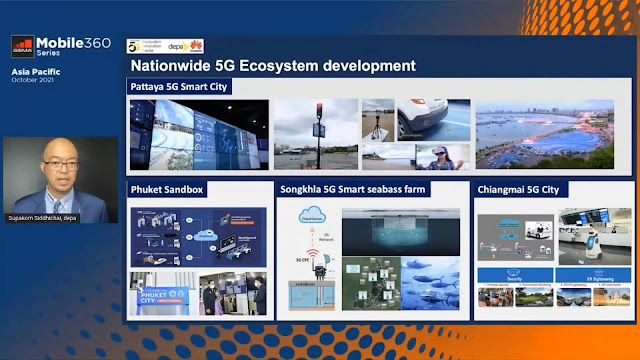
5G lights up Thailand’s digital future

At the GSMA Mobile 360 APAC – 5G Industry Community Summit, October 2021, Dr. Supakorn Siddhichai, Executive VP, Digital Economy Promotion Agency (DEPA) presented a Keynote looking at Thailand’s digital economy development plan, 5G City whitepaper, network and industry standards. His talk is embedded below:

Last week operators True and Dtac announced an $8.6 billion plan to merge. If approved by regulators, the new company would become the largest Thai telco by market share, accounting for about 54 percent of all mobile users. It would also effectively slim Thailand’s three-horse telco race down to a duopoly.

Thailand’s telecom market, with an estimated 91 million mobile customers, has for several years been a three-horse race. The industry leader is AIS, which has 46 percent of the mobile market and posts consistently strong earnings. In 2020 AIS reported 85.6 billion baht in net cash flow from operations and paid investors 20.2 billion baht in dividends. Its two main competitors are True and Dtac, which have about 33.7 percent and 20.8 percent of the mobile market respectively.

Related Posts

Tuesday, 18 February 2020

Thailand gets 5G Spectrum but no demand for 1800 MHz and 3.5 GHz coming in 2021

Over the weekend, Thailand’s 5G Spectrum auction concluded and th telecoms regulator raised over 100 billion baht ($3.2 billion) in 5G spectrum auctions, with operators snapping up 48 licenses ahead of an expected commercial roll out later this year. More information can be found on NBTC website here.

The current spectrum holdings for the operators looks as follows:
Source: Twitter

The above chart includes the spectrum won by the operators on Sunday. The spectrum allocated during the auction is as follows:

No operator bid for the 1800 MHz spectrum due to its inflated price


Today, the Bangkok post reported that:

The National Broadcasting and Telecommunications Commission (NBTC) has signalled the 3500-megahertz range is unlikely to be auctioned for the 5G network this year, a move that could affect Total Access Communication (DTAC), which holds less spectrum bandwidth than bigger rivals.

Referring to talks with Digital Economy and Society (DES) Minister Buddhipongse Punnakanta on Sunday, NBTC secretary-general Takorn Tantasith said the minister believes the planned auction for the 3500MHz range may not have to be sped up.

He said Advanced Info Service (AIS), through its subsidiary Advanced Wireless Network (AWN), won 100MHz of bandwidth on the 2600MHz range on Sunday's 5G licence auction, while True Move H Universal Communication (TUC) won 90MHz of bandwidth on the range and this "could be enough for both of them to develop their 5G adoption".

Mr Takorn said both he and Mr Buddhipongse believe mobile operators have already shouldered a substantial financial burden for 4G and 5G licensing, which has dampened their desire to gain additional spectrum ranges.

He said 5G use cases also need time for real commercial development for vertical industries.

The operators TOT and CAT Telecom are merging to form a new company called National Telecom (NT) that will be 100% owned by the Finance Ministry.

Finally, here are the technical details of the 5G Spectrum that was auctioned.


Related Posts:

Thursday, 10 January 2019

Thailand: Onward to 5G


Thailand has a highly developed mobile market and has experienced strong growth over the last six years driven by increasing numbers of 4G mobile subscribers.However, growth has slowed over the past few years due to the heightened level of maturity. Very slow growth is predicted over the next four years to 2023 with annual growth rates further easing. The market will be constrained from higher growth due to a saturated mobile subscriber market and strong local competition. 

There are 3 main Mobile Network Operators in Thailand, which hold about 97% market share.  In addition to the large 3, there are several smaller MVNO networks.


Source


AIS has the largest 2G/3G network with a 50% customer share. It's part of the SingTel Corp. that also owns e.g. Optus in Australia and SingTel in Singapore. Surprisingly, AIS was the last major provider to start 4G/LTE in 2016 on the 1800 and 2100 MHz band, partly marketed as "4.5G" or LTE Advanced. It now covers 80% of the population in 2017.

The operator has 3G/DC-HSPA on 900 and 2100 MHz (and roaming on TOT 2100 MHz) and started in 2016 with 4G/LTE Advanced called "4.5G" on 1800 and 2100 MHz (bands 1 and 3).

AIS was ranked in second place on which operator has the best 3G and 4G speeds, availability and latency, with 89.22 percent availability by Open Signal.

The market leader has been granted approval by the National Broadcasting and Telecommunications Commission of Thailand to trial 5G on the 26GHz band. They were to conducting testing at the end of 2018. Market leader AIS will conduct the tests in partnership with Nokia. 


dtac is Thailand's 3rd largest network by the number of users. It's partly owned by Telenor group from Norway and is the network that owns the biggest wireless bandwidth in the country

They started 4G/LTE in 2014 on 2100 MHz (B1) in Bangkok only and has been expanded in 2015 to Phuket and Pattaya and another 40 cities nationwide: 4G coverage map. In 2015 4G/LTE was started in the metro Bangkok area mostly on the additional 1800 MHz (B3) frequency which is much more common internationally. In June, 2018 DTAC started offering 4G+ on the 2300 MHz frequency through a deal with Telecommunication of Thailand (ToT). This operator has still to apply to run 5G trials. 


TrueMove is Thailand's 2nd largest network and the most heavily advertised. TrueMove is part of the larger True Corp. conglomerates, owned by CP Group which is the biggest retailer owning all 7-Eleven and Tesco stores in Thailand.

They were the first provider in to bring 4G/LTE on the rare 2100 MHz to Thailand. Its 4G/LTE coverage is the best so far in the country according to Open Signal and comprises 80% rising to 96% by the end of 2016. In 2015 the much more usual 1800 MHz band was added for 4G/LTE as well as 850 and 900 MHz in 2016.

TrueMove will be undertaking 5G tests in partnership with Huawei. 


My is a MVNO operated by CAT Telecom Public Company Ltd., the state-owned company that runs Thailand’s international telecommunications infrastructure, including its international gateways, satellite, and submarine cable network connections. 

It's the 4th largest mobile network operator in Thailand and owns spectrum on the 850 Mhz frequency, rents it out to True Move. In return it can use 20% of the bandwidth for their own My by CAT operation.

My has only 3G/HSPA+ on 850 Mhz (= B5) without fall-back to 2G. As My uses the same 850 MHz network as True Move, their 3G coverage is the same. By 2014 it had a coverage of approximately 97% of population and consisted of around 14,000 BTS. But as there are way less users on CAT's 20% share as they have roughly a market share including MVNOs of 1-2% so far.


4G certainly changed people's lifestyles, but 5G is expected to have a bigger socioeconomic impact, transforming industries ranging from agriculture and manufacturing to healthcare and utilities. Regarding 5G: Thailand has to overcome some major obstacles in order to successfully transition to the next generation technology. For example the financial burden shouldered by telecom operators, including a combined cost of 270 billion baht for the previous 3G and 4G licences; how more spectrum bandwidth has to be allocated; and the telecom regulator's authority, as only an acting board now manages the National Broadcasting and Telecommunications Commission (NBTC). 

The NBTC is encouraging all 5.2 million 2G subscribers to transfer to 3G and 4G systems. The telecom regulator is set to shut down the existing 2G network by October 2019 to give mobile operators more efficient network capacity this will help pave the way to 5G wireless broadband service by 2020. 


Because of 5G's improved speed, latency and connections, mobile operators must hold additional spectrum bandwidth of at least 100MHz (100x2) for upload and download for each service provider. Takorn Tantasith, secretary-general of the NBTC, said he is seriously concerned about "insufficient spectrum holding" by each operator, which would affect 5G ecosystem adoption. 

After the most recent spectrum auction, AIS holds the most spectrum bandwidth, with a combined 60x2MHz, followed by True Move at 55x2MHz and DTAC at 50x2MHz. The NBTC is on the verge of recalling unused or not fully used spectrum ranges from holders to auction them off to serve 5G.


Somkiat Tangkitvanich, president of the Thailand Development Research Institute, states there are three critical factors needed for the domestic telecom industry to ensure real public benefits in 5G adoption. 

The three factors are real liberalisation of the telecom industry, good regulations and a spectrum allocation roadmap. 

Liberalisation, would be allowing foreign stakeholders to hold more than a 50% stake in a company, will create healthier competition and eliminate chronic problems fostered by state-owned enterprises such as corruption and limited procurement transparency. While good policy design and regulations will help eliminate unfair competition among players and reduce high operating costs in some cases, according to Mr Somkiat.

However Mr Somkiat disagreed with the idea of providing assistance for AIS and True Move, the two winners of the 900MHz licence auction. He said they did not deserve state assistance because they bid up the prices by themselves. He also stated AIS and True Move operate mobile services with profit from operations and have the capability to pay the remaining sum of their 900MHz licences due in the next two years.