Qatar is considered one of the regional leaders in terms of its telecoms maturity; having one of the highest fixed and mobile penetrations in the Middle East region. Qatar has also become one of the more progressive countries globally in terms of its progress towards 5G.
Due to its mature telecom sector Qatar has been able to absorb the additional data demands made on it during the pandemic. Mobile services based on LTE are universally available, and this has helped the two operators Ooredoo Qatar and Vodafone Qatar to migrate to 5G. In combination with a strong fibre rollout, the country is aiming to provide gigabit services nationally.
A desire to rapidly transition their customer bases to 5G has boosted 5G Availability in the market, and has helped Qatar climb to second place in Ookla’s Speedtest Global Index™ as of July 2022.
5G services are largely based on 3.5GHz spectrum made available following an auction in early 2019.
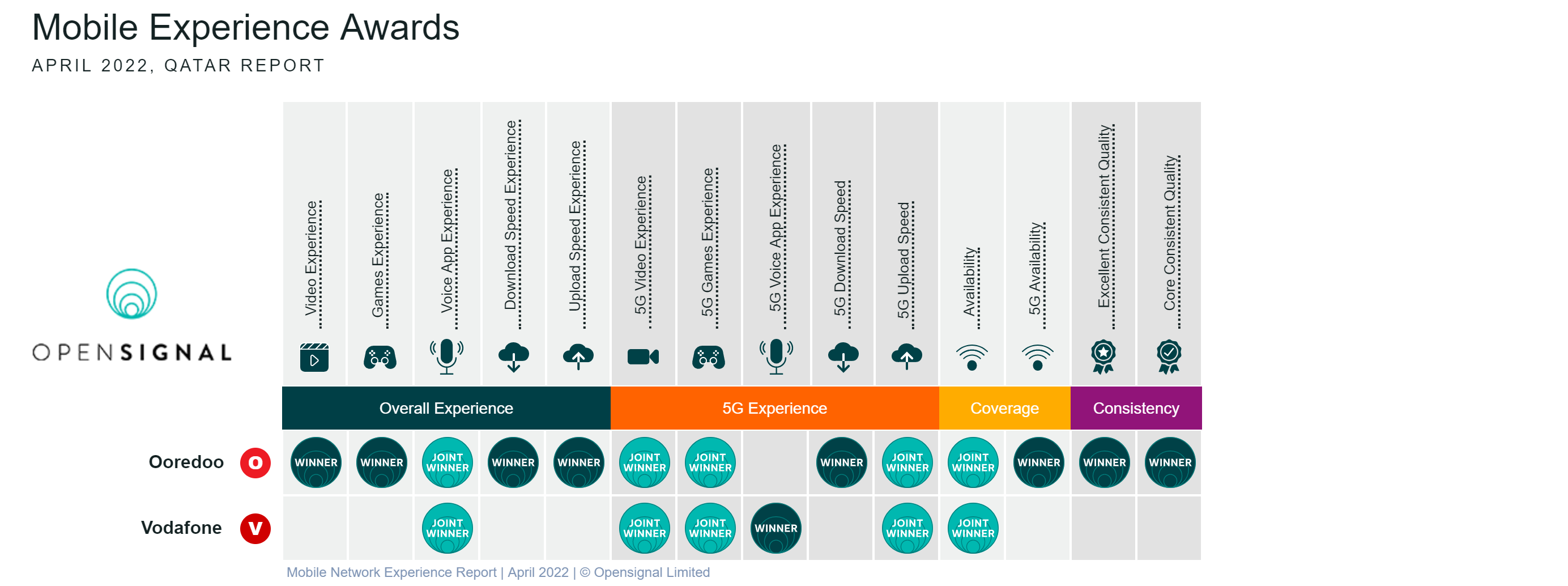
In Opensignal's latest Qatar Mobile Network Experience report both the 5G experience and the overall experience together are analyzed for the first time in one report. Also, two new awards were added that quantify the consistency of the experience on both Qatar's national operators.
Ooredoo leads across most mobile experience categories in Qatar based on Opensignal’s awards table as it wins eight awards outright — four awards in the Overall Experience section, 5G Download Speed, 5G Availability as well as both Consistent Quality awards — compared to Vodafone’s sole outright win in 5G Voice App Experience. The two Qatari operators share the remaining five awards, including 5G Video Experience and 5G Games Experience.
Qatar’s mobile operators continue to explore innovative 5G solutions to improve the mobile experience of their users. In December 2021, Vodafone trialed its mmWave spectrum-based 5G network services with the aim of unlocking new functionality for consumers and businesses, while Ooredoo in March 2022 announced the successful implementation of a ‘world first’ 5G Indoor shareable solution using Ericsson’s kit aimed at enhancing the immersive experiences at stadiums and venues.
Ooredoo (Arabic أريدو), formely Qtel, is the market leader in Qatar with more than 2/3 of all customers in the country. It has the best coverage and speeds in the country.
Ooredoo Qatar and Ericsson have announced the successful implementation of a ‘world first’ 5G Indoor shareable solution, achieving data speeds of 1.5Gbps. The Ericsson Indoor Connect 8855 solution, part of the Ericsson Radio Dot System, has been commercially deployed in stadiums across Qatar ‘to enhance the immersive experiences of international tournaments’. The multi-operator, multi-vendor solution has full band support and 4×4 MIMO capability, enabling several communications service providers to deliver indoor 5G experiences to their subscribers with beyond-gigabit speeds. Ooredoo is an official service provider for the upcoming FIFA men’s football World Cup in Qatar in November-December 2022.
Vodafone is the no.2 in Qatar, but as long as you stay mainly in centers, it's the slightly cheaper alternative. 4G/LTE is available in Doha, Pearl and West Bay. In 2018 Vodafone sold its Qatari branch to its joint venture partner Vodafone & Qatar Foundation. The now Qatari operator has the approval to stick to the Vodafone brand for at least 5 more years.
Ookla reported that Vodafone Qatar’s resurgence as a stronger competitor to market leader Ooredoo Qatar has taken place at a key juncture for the Qatari market — the arrival of 5G. Qatar’s Communications Regulatory Authority (CRA) amended the mobile licenses held by Vodafone Qatar and Ooredoo Qatar in early 2019. The new licenses included harmonized terms and conditions for both companies, authorizing each to utilize 100 MHz of C-band spectrum (3.5 GHz) and committed them to roll out commercial 5G networks before the end of 2020 in all densely populated areas. It also required they provide coverage of all primary roads and highways as well as all venues associated with the up-coming FIFA World Cup. This was updated in May 2022 to plan the allocation to both operators of additional spectrum in the C-band as well as high frequency (26 GHz) spectrum by 2023, while their license obligations require their 5G networks to cover 99% of Qatar with minimum download speeds of 100 Mbps by 2024.
Vodafone Qatar announced in August 2019 that ‘all Vodafone SIM cards are now 5G-ready’. All Vodafone customers, on any of its prepaid or postpaid mobile plans, have the chance to access 5G mobile connectivity with a compatible device. Currently, two compatible smartphones are available in Vodafone stores, namely the Huawei Mate 20 X 5G and Xiaomi Mi 5G. The operator’s 5G network is live in dozens of residential locations across Qatar including Al Waab, Abu Hamour, Al Azizya, Al Mamoura, Al Rayyan, Umm Salal Muhammed, Khartiyat, Al Hilal, Muntazah, Muraykh and Al Sadd.
Vodafone Qatar has claimed the country’s ‘first successful trial of mmWave spectrum-based 5G network services, displaying peak data speed capabilities of 8.1Gbps (downlink)/734Mbps (uplink), with the aim of unlocking new functionality for consumers and businesses, in areas including mobile broadband, fixed wireless and industrial applications such as IoT and Augmented Reality (AR). CEO Hamad Bin Abdulla Al-Thani said:
‘The potential of mmWave technology industries and use cases is huge, and it will pave the way for the future of 5G and connectivity. The results of this trial will enable Vodafone Qatar to continue working to roll out mmWave technology for the benefits of its consumer and business customers alike. Looking ahead, one of the most exciting prospects for mmWave is the facilitation of 360 degree streaming of 8K videos around major sporting or entertainment events … We’re always working to make our GigaNet network bigger, faster and stronger than ever before for the benefit of our customers, and mmWave is an important part of this evolution.'
Despite the harsh impact of the Covid-19 pandemic on the country’s population and economy, Colombia’s telecom sector has been recovering due to positive performances in the fixed-line broadband, mobile broadband, and mobile voice and data markets.
Colombia’s fixed-line penetration remained stable by the end of 2020, though began to increase into 2021 as a result of the particular demands on households resulting from government measures associated with addressing the pandemic. However, at less than 15% it is well below the Latin American average. The mobile market, by contrast, reached a penetration rate of 136% (an increase of over three percentage points on 2019) and managed to keep the same upward growth trajectory that it has sustained over the last ten years. The fixed-line broadband market also expanded, with the number of subscribers increasing 11.4%, and with revenue increasing 9.9% thanks to increased data usage as many customers were forced to work or study from home during the year.
The mobile broadband market was the standout performer in 2020, with a 13% increase in the number of subscribers year-on-year, albeit the penetration rate is relatively low compared to other Latin American countries. Most significant of all was the surge in mobile broadband traffic — a 51% increase over the previous year — which was again a reflection of the strict lockdowns that Colombians had to endure for much of 2020.
Market leader Claro continued to expand its dominance of the mobile broadband market, increasing its share over the last decade by 10% to reach 54% at the start of 2021. Tigo, conversely, has seen its share halved over the same period of time, yet its subscriber base has still managed to grow on the back of a strong overall market. Tigo also suffered the most from Colombia’s imposed lockdowns in 2020, severely impacting its retail sales (a 20% decline in revenue) with nearly half of its stores being forced to close.
There are 4 networks in the country: Claro (formely Comcel), Movistar, Tigo Une (Tigo merged with UNE) and newcomer WOM. The three major operators share almost 90% of the market, led by Claro with about the half and followed by Movistar and Tigo with about 20% each.
2G and 3G is on 850 MHz on Claro and Movistar and 1900 MHz on all three majors. 4G/LTE started 2013/4 on 2600 MHz (B7) on Claro and Tigo and 1700 MHz (AWS/B4) on Movistar and Tigo and reaches already most of the population. WOM started as a 4G/LTE network only on 1700 MHz (B4) and roam on other networks for 2G/3G.
The most recent Open Signal report found Tigo to be the best performing operator in most of their categories.
While Colombia’s Ministry of Information Technologies and Communications (MinTIC) has not yet scheduled an auction of 5G spectrum , in November the regulator announced plans for public consultation on increasing spectrum caps for the frequencies below 3 GHz — up to 50 MHz in the frequency range below 1 GHz and to 95 MHz in the 1710MHz-2690MHz range. The regulator is also considering applying an 80 MHz spectrum cap for the 3300MHz-3700MHz frequencies and intends to make all 400 MHz in this range available for 5G services. Earlier this year, in October, MinTIC renewed Claro and Movistar’s 1900 MHz spectrum licenses, while requiring the operators to update their technology and improve their coverage and quality of services.
In terms of 4G download speeds, Opensignal users on Tigo experienced the fastest average download speeds of 18.7 Mbps. Movistar and Tigo users saw declines in average 4G download speeds, of 0.5 and 2.1 Mbps respectively, while Claro users observed an increase of 1 Mbps. In addition, OpenSignal users on WOM networks enjoyed average 4G download speeds of 14.5 Mbps, which led to a statistical tie with Claro for second place. These changes resulted in Tigo’s lead over second-placed competitors decrease from 6.9 to around four Mbps.
In 2013 Claro merged with Comcel, dropping the name Comcel. They are now the market leaders in Colombia with the best nationwide coverage and a 48% market share. 4G/LTE on 2600 MHz (Band 7) is available for prepaid in about 200 towns and 28 capitals served by its network.
Claro in Colombia has announced modernization of it's network and hence switching off 2G. The press release does not mention 3G but the 3G network will be around for a while. 4G coverage is improving but has a long way to gohttps://t.co/cATwyaC1v4#2G#3G#3G4G5G#2G3Gshutdown
In May 2022, Claro Colombia announced its intention to switch off all 2G services by December 2022 in order to re-farm more spectrum for 4G and for a possible 5G launch.
In 2014 the merger of the two smallest networks in Colombia UNE and Tigo was finalised. The new joined network is marketed mostly under the name of Tigo. They remain the smallest major network in the country with slightly less coverage and 4G/LTE is available for prepaid on 1700 MHz (Band 4).
Tigo wins all but one of the Open Signal awards outright. The only exception is 4G Coverage Experience, which Claro successfully defends and claims outright for the fifth time in a row. Tigo increased its lead over its competitors in Upload Speed Experience and 4G Availability categories, but its lead in Download Speed Experience over Claro declined.
In May 2021 Millicom International Cellular (MIC) announced that its Tigo Colombia subsidiary will become the first operator in Latin America to deploy Open Radio Access Network (O-RAN) architecture. The rollout will be carried out in partnership with Parallel Wireless and deliver 4G service coverage at 362 rural sites.
Telefónica acquired the former state-owned Colombia Telecomunicaciones in 2006 and sells it under its brand name of Movistar. It's now the 2nd operator in the country giving good coverage and speed. 4G/LTE has started in 5 main cities – Bogota, Medellin, Cali, Barranquilla and Bucaramanga on 1700 MHz (Band 4) and 77 municipalities.
WOM announced in August 2021 that it signed up one million subscribers since it launched in April 2021. The operator attracted new customers by offering plans, which undercut its competitors’ prices by 40%. With a new aggressive player in the market, managing subscriber churn will become an even greater challenge for the established mobile operators in Colombia. Maintaining high quality of mobile network experience will remain crucial to retain existing customers and attract new ones.
DirecTV Colombia – a subsidiary of US telecoms giant AT&T – has reportedly switched on a fixed-wireless 5G service in selected parts of Bogota. According to Tecno Movida, the network has gone live in Kenedy and Engativa, and utilises equipment from Ericsson, Qualcomm and Gemtek. The network, which includes a cloud native 5G core and uses Massive MIMO technology, is capable of supporting download speeds of up to 100Mbps.
According to TeleGeography’s GlobalComms Database, satellite pay-TV provider DirecTV Colombia won a 4G concession in June 2013, securing 2×15MHz of FDD-LTE spectrum and a 40MHz block of TD-LTE spectrum in the 2600MHz band. The operator went on to launch its LTE-based 4G wireless broadband service in July 2014 and served 187,322 4G subscribers as of 31 December 2019.
Cambodia’s mobile-dominated telecoms sector spent the last couple of years battling two major challenges: the global pandemic, and the government’s retraction of trial licenses for the rollout of 5G.
Citing concerns about wastage and inefficiency occurring if each operator built a separate 5G infrastructure in order to maximise their own network’s coverage (and, presumably, to capture greater market share), the regulator withdrew the licenses that the operators had been using for their 5G trials. This was despite all of the operators having already announced a successful completion of their trials. More than a year later, the market is still waiting on the government to release its 5G policy and roadmap, along with the allocation of spectrum and approvals to permit commercial operation.
In the meantime, the mobile network operators have maintained their focus and investment strategies on upgrading and expanding their existing LTE networks around the country, and to 5G-enable their base stations. When the 5G market eventually arrives, the underlying infrastructure will at least be ready to support a rapid adoption of the higher-value applications and services.
Overall, the mobile market fell back slightly during 2020 and 2021 (in terms of total subscriber numbers) as the Covid-19 crisis wore on, but it remains in relatively good health as mobile users increased their data usage over the period. Likewise, the mobile broadband market experienced a small but very rare contraction in 2020, although penetration rates were already very high in this area. There is likely to be a quick rebound to previous levels once economic conditions stabilise, followed by a modest rates of growth over the next five years.
Are those solar panels? The entire cell tower runs off solar??? Cool!!
The number of providers in Cambodia has decreased from 9 to 3 in recent years, currently there the main operators are Metfone (by Viettel), Smart (by Axiata) and Cellcard (by Mobitel).
2G/GSM is on 900 and 1800 MHz, 3G on 2100 MHz and 4G/LTE has started on Metfone, Smart and Cellcard so far on 1800 MHz (band 3).
According to the most recent Open Signal report on Cambodia 5G remains some way off, with a representative of the Ministry of Post and Telecommunications saying that both the release of the 5G roadmap and the assignment of 5G spectrum to operators will hopefully occur in 2022. In addition, Cambodia’s mobile networks are struggling under the weight of the nation’s high data consumption. In the Quantifying the Impact of 5G and COVID-19 on Mobile Data Consumption report, it was found that Cambodian users consumed a staggering 15.9 GB of data per month on average in Q1 2021, up from the 13.6 GB/month observed in Q1 2020.
Back in June, Smart Axiata’s CEO Thomas Hundt said that high data consumption had “loaded the 4G network to a level where the operators can’t fully satisfy the expectations from the users in terms of speed anymore”, but he also indicated that this congestion would ease once 5G is deployed.
The market leader Metfone currently has registered up to 9 million subscribers, occupying 50% of the market share.
Metfone, has recently signed a credit package contract with MB Cambodia for the upgrade and expansion of its telecoms network, reports Khmer Times. Under the agreement, MB Cambodia, a branch of Vietnam’s Military Commercial Joint Stock Bank, will provide a credit package with a limit of up to USD100 million.
Metfone has developed the School Information System (SIS) to promote online learning to ensure students were not deprived of education during the health crisis. The SIS platform is equipped with a range of useful features, with documents able to be stored and retrieved quickly, and its digital archiving system enables school information to be stored securely and safely, unlike in physical form where documents can get damaged. Metfone plans to make the system available for all schools across the Kingdom.
Smart, a.k.a. Hello Axiata and Smart Mobile, is the 2nd provider in Cambodia. They were the first network to have started with 4G/LTE in 2014.
Smart Axiata has invested more than $90 million in its wireless network in 2021. The operator aims to expand and improve its network to ensure stable and fast mobile broadband connectivity for its eight million subscribers. The main focus of the upgrade will be on enhancing the 4G LTE network. However, Smart also intends to ensure the network is ready for a major 5G upgrade once the government gives 5G the go-ahead. In fact so strong has been the adoption of 4G by Smart’s subscribers, that it has plans to shut down its 3G network over the course of 2021 and repurpose the residual frequency spectrum used for 3G to 4G. Smart currently operates approximately 3,000 network sites across Cambodia, allowing its subscribers to use a 4G LTE network that covers 91.5 percent of the population. By the end of 2021, Smart Axiata had planned to add 350 sites to meet the growing demand for robust and dependable connectivity. Existing network sites will receive substantial capacity upgrades.
Smart Axiata has conducted a live 5G trial in the capital Phnom Penh using a mobile device from Chinese equipment vendor Huawei. The firm said that when commercial rollout begins in the next few years, 5G coverage will initially be centred on ‘hotspots’ in major cities. According to Smart Axiata’s CEO Thomas Hundt:
‘Our mission is to enrich the lives of millions of Cambodians through world-class networks and exceptional digital experiences, which is why we invest USD70 million to USD80 million yearly, primarily in network infrastructure, to improve mobile broadband connectivity across the Kingdom. Trust that we will continue to improve our existing 4.5G service while preparing for future technologies like 5G in parallel.’
Cellcard (a.k.a. Mobitel) is the 3rd provider in Cambodia. In 2015 they started with 4G/LTE in Phnom Penh, Siem Reap and 5 other towns on 1800 MHz (band 3). They currently have approximately 3 million subscribers.
During the Pandemic they ramped up efforts to keep communities connected during lockdown by installing more than 169 new 4G LTE sites. The Proudly Khmer and only 100% locally owned mobile communications company. In addition to the new sites, Cellcard engineers installed small cell solutions for indoor coverage at hospitals and community venues and invested in three new mobile Cell on Wheels solutions to add coverage and capacity to outdoor locations to support the Ministry of Health’s response to the pandemic at key treatment sites and test & vaccination centers.
The work is part of Cellcard’s continued long term investment in network expansion which will see a total of 500 4G LTE sites added in Phnom Penh.
Uruguay is a nation with few inhabitants, a small territory and a scarcity of mineral resources. However, the country has managed to progress steadily into one of the most stable countries in the area, ranking third in the Human Development Index (right after Chile and Argentina) and number 55 in the world, according to the United Nations Development Program (UNDP).
Uruguay has also one of South America’s highest literacy rates (over 98%), the telecommunications network is 100% digital, and the internet penetration rate is one of the highest in Latin America (90%). 4G/LTE is available in 90% of the country, up from 64% in June 2019. Household broadband internet access is 79%; over 70% of it through fiber-to-the-home (FTTH) systems.
It would be fair to say that Uruguay has an advanced telecom market, with excellent infrastructure and one of the highest broadband penetration rates in Latin America. Fixed-line teledensity is also particularly high for the region, while mobile penetration is the second highest after Panama. In terms of computer penetration, Uruguay tops all other countries in the region by a considerable margin, and this has facilitated growth in fixed-line broadband adoption.
The mobile market is dominated by Antel, with Telefónica’s Movistar in second place and América Móvil’s Claro third. All three operators offer mobile broadband through 3G and LTE networks. Operators have achieved nationwide 3G coverage and the number of mobile broadband subscribers continues to grow. Antel has been at the forefront with LTE services, though the auction of multi-band spectrum in August 2017 has also enabled Movistar and Claro to widen the reach of their LTE offers.
In April 2019 Antel launched a commercial 5G network, though limited in reach. At the end of 2019, spectrum in the 5G-suitable range was auctioned, enabling operators to launch 5G services. The regulator is working on a spectrum and connectivity policy that emphasises 5G.
Antel dominates the mobile market with a 51.5% market share of Uruguay’s 5.33 million mobile lines. Telefónica’s Movistar is second with 30.5% of the market followed by América Móvil’s Claro at 18%.
Coverage and speed are pretty good for Latin American standards. But frequencies are very diverse. While Antel has 2G and 3G on "European bands", Movistar and Claro use "American frequencies".
In the latest Open Signal report on mobile network experience report in Uruguay, every mobile operator wins outright in at least one category. Antel continues to claim both speed awards: Download Speed Experience and Upload Speed Experience along with the 4G Coverage Experience award. Movistar comes first in 4G Availability and Games Experience ending the three-way tie for the latter that existed in the last report and claiming sole victory. Claro wins the Video Experience award, while Claro and Movistar remain joint winners for Voice App Experience.
Antel stands for Administración Nacional de Telecomunicaciones, the state-owned, national provider of telecommunication. It has a monopoly for landlines, but on mobile networks, it competes with Movistar and Claro. Still, it's the market leader with about half of all cellular customers and the best network in the country. 4G LTE covers nearly everywhere, and 4.5G LTE Advanced is available in select cities.
Uruguay made history in April 2019, when Antel claimed to have launched the first 5G network in Latin America, using the 28 GHz band and infrastructure supplied by Nokia. However, Antel’s 5G deployment was pre-commercial, with the limited coverage and targeted at business customers the operator is yet to offer 5G services to individual smartphone users. Antel’s 5G network is still in the testing phase, with trials conducted in inland areas. The operator has invested heavily in its operations $134 million in 2020 and spent a further $145 million in 2021, partly to increase its 4G territorial coverage to 99% between 2021 and 2022, especially in towns with less than 500 inhabitants.
Movistar by Spanish Telefónica is the second provider in the country. It has good coverage on "American" frequencies (see above). 3G coverage is about 50%, 4G/LTE has started in Montevideo and is given out for free when you have a 4G SIM card.
Claro by Mexican América Móvil is the smallest network in the country on "American" frequencies. 4G started in 2014 in Montevideo and has spread to other towns.
Claro Uruguay has begun technical tests of 5G in the 28GHz band after receiving authorization from the Regulatory Unit of Communications Services (Unidad Reguladora de Servicios de Comunicaciones, URSEC). TeleSemana cites a company statement as saying that Claro has adapted it core network and will be using equipment from Finnish vendor Nokia.
Singapore is a small country, roughly the size of Bahrain; 3.5 times the size of Washington DC or half the size of London, UK. That hasn't stopped it from reaching many 5G milestones. In a recent announcement, Singtel, the market leader, said that their 5G network now surpasses 95% nationwide coverage.
The following is an extract from the press release:
This comes more than three years ahead of the regulatory target of end-2025, effectively making Singapore the first country in the world to be fully covered by standalone 5G.
Singtel’s standalone 5G network now covers more than 1,300 outdoor locations and over 400 in-building, as well as underground, creating immense opportunities for the development of ground-breaking applications and immersive experiences for both enterprises and consumers. Singtel was officially awarded the 3.5GHz and the millimetre wave spectrum as part of the 5G licence issued by the IMDA in June 2020, and an additional 2.1GHz spectrum in Nov 2021 which supported the achievement of this critical milestone.
Singtel has achieved many firsts in Singapore’s 5G journey, from launching the first pilot network in July 2018, the first standalone network in May 2021 to providing 5G in the North East Mass Rapid Transit Line that runs entirely underground in May 2022.
Singaporeans will get to experience their first 5G National Day Parade celebration which is being held at the floating platform this year, after a two-year hiatus due to COVID. To mark this nationwide rollout, this year’s Parade will be fully streamed on 5G – showcasing Singtel’s enhanced mobile broadband capability to support ultra-high-definition content. On-site spectators will enjoy high speed connectivity, enabling seamless streaming or uploading of high-resolution content from the Parade.
Singtel has been making steady progress in commercialising 5G. To support the development of a whole host of public sector 5G use cases for the built environment, transport, and tourism industries, Singtel launched the 5G@Sentosa testbed last year, in partnership with multiple government agencies, including the Government Technology Agency and the Sentosa Development Corporation. Around 15 live trials are slated to be running by the end of this year, and at least 30 by the first half of 2023.
Earlier this year, Singtel launched Paragon – the industry’s first all-in-one orchestration platform that consolidates all the necessary resources required across 5G and edge computing into one touchpoint, thus significantly lowering the barriers to 5G adoption and integration for enterprises, from cost to complexity. Recent partnerships include AETOS, Micron and Hyundai who have deployed 5G solutions to improve operational efficiencies, drive innovation and enhance problem-solving and decision-making capabilities.
On the consumer front, Singtel has successfully demonstrated 5G’s benefits and impact through use cases such as Singapore’s first 5G-powered remote racing in Sentosa and The People’s Gallery, an exhibition developed in collaboration with National Gallery that leverages augmented reality to transform more than 25 neighbourhood void decks into art galleries.
Singapore, the island city-state of 728.6 km², which is home to four communications services providers, plus MVNOs, now has blanket 5G coverage via Singtel’s 5G network. The operator, which lost its domestic monopoly in 2000 when the Singaporean government deregulated the telecoms industry, has completed the task more than three years ahead of schedule – and despite the immense disruption caused by the Covid-19 pandemic. Singtel is the country’s biggest mobile provider with some 4.1 million subscribers and now, should any 5G subscriber feel a bit lost in and around the primary and secondary rainforests and lakes that remain untouched in the centre of the island and cover 21.96% of Singapore’s land mass, well, they won’t need to worry because, when their phone is on, Singtel will know where they are and the appropriate app will guide them back to the nearest air-conditioned shopping mall. The 5G network now covers more than 1,300 outdoor locations and provides signal in more than 400 buildings in addition to the Mass Rapid Transit (MRT) underground/overground rail system. Not to be outdone, two of Singtel’s biggest rivals, M1 and Starhub, are also deploying “island-wide” 5G. Talk about an embarrassment of riches.
Mali’s topography includes large tracts of sparsely populated desert, with many settlements being hard to reach and thus rendering it difficult and expensive to provide effective fixed or mobile networks.
Security issues have also been a concern, leading to delays in building the national backbone network. Following a coup in 2012 large areas in the north of the country were taken over by Islamic militants. The coup of September 2020 unsettled politics, and was soon followed by a second coup. The coup leaders put off holding the promised elections, and this in turn contributed to the February 2022 decision by France and other European governments to end their military support against the militants. Many areas of the country have remained generally ungovernable.
Compounding these difficulties is the fact that underinvestment in fixed-line networks has meant that telecom infrastructure is barely adequate to serve consumer needs in most towns and is largely absent in most areas of the country. In addition, a combination of poverty, high illiteracy, and low PC use has led to a very low take-up of fixed-line internet services. In common with many other countries in the region, Mali has taken to mobile networks for voice and data services. Mobile networks account for about 98% of all telecom connections. Despite these challenges, there has been progress in fixed-line connectivity, particularly during 2020 and 2021.
Orange Mali entered the market as the second mobile and fixed-line operator in 2003, and soon became the dominant provider. The duopoly with the national telco, Sotelma, continued until late 2017 when Alpha Telecom (after much delay) launched mobile services. A fourth mobile licence was secured by Mobilis, owned by Algérie Télécom, at the end of 2019.
Mali’s landlocked location makes it dependent on neighbouring countries for international bandwidth, which has kept internet prices high. Improvements in this sector can be expected from the recent arrival of several new international submarine cables in the region, while Orange Group has also been engaged in building a terrestrial network linking the capital cities of eight countries in the region, including Bamako.
Orange Mali owned by French Telecom is the current market leader. The company was extremely successful when it entered the market as the 2nd mobile and fixed-line operator in 2003. They quickly amassed more than 80% market share, offering converged fixed, mobile and broadband internet services.
At the end of 2016, Orange Mali’s network covered about 95% of the population and 46% of the country and had a base of 11 million active mobile subscribers, of which more than 99% were prepaid customers. Their uses mainly cover voice, mobile internet and mobile payment services. Only around 20% of the population have 3G coverage with speeds up to 42 Mbps like in Bamako and other regional capitals. In 2017 Orange Mali renewed its license and received permission to launch 4G/LTE services. It already trials 4G/LTE in Bamako, that is to be expected to be commercially launched by 2018.
Like in most parts of Africa mobile networks double as a payment system. Started in 2010, Orange Money service had 3.5 million customers at the end of 2016.
Orange Mali has claimed the country’s first 5G network tests, presenting its progress at a pilot project launch event on 7 July 2021 attended by government officials including Harouna Mamadou Toureh, the Minister of Communication, Digital Economy & Modernisation of the Administration. Agence Ecofin reports that Orange has begun testing 5G technology in Mali’s capital city Bamako and other regions.
Some months back, Intelsat announced that it has been selected by Orange Mali to bring 3G and 4G connectivity to hard-to-reach areas in the country. The press release highlighted that this agreement ‘marked a first in Francophone West Africa – the successful deployment of 4G networks over satellite, judged to be the optimal solution given the size of the country and the logistics involved’.
Malitel (recently rebranded to Moov Malitel) operated by SOTELMA is the old state telecom provider and first mobile network in the country since 1989. It was privatized in 2009 and now owned: 50% by Maroc Telecom, 20% by local investors, 20% by the Mali government and 10% by staff.
In user numbers and coverage Malitel is in the 2nd position in Mali right now caring for about 41% of the mobile market as well as for a rather limited landline system.
Their 3G coverage is restricted to the towns of Bamako and Kati, Kayes, Koulikoro, Sikasso, Segou, Mopti and Kenieba, the mines of Loulou, Tabakoto, Gounkoto, Sadiola, Siama and Morila as well as Diboli on the border to Senegal. Outside these areas there is only coverage with GPRS at 54 Kbit/s. 4G/LTE has been started at the end of 2018.
In 2012 a 3rd license was issued to Alpha Telecom Mali, but commercial operations have not started until 2017 and the local counterpart has defaulted in the meantime. Finally, in October 2017 the network was launched in Bamako under the brand of Telecel and at year end 3G was added.
In 2018 the first phase of its network deployment was completed. With the cellco having focused its initial efforts on reaching the southern parts of the country, it now covers locations including Kati, Sikasso, Segou, Kayes, Koutiala and Koulikoro. Telecel is now preparing to begin the next phase of its network rollout, covering Mali’s northern and central areas. So far it can't be recommended for travellers because of its restricted coverage, but can be useful locally.
Algerie Telecom subsidiary Mobilis is poised to become the latest player to dip its toe in Mali’s telecommunication market, having been awarded an operating licence to deploy services nationwide. The award – which includes rights to offer 2G, 3G and 4G services – was confirmed by Modibo Arouna Toure, Mali’s Minister of the Digital Economy and Communication, under a provisional agreement with the government. Full terms are yet to be negotiated
Armenia had to battle through 2020 on two fronts: the Covid-19 pandemic that effectively shut down the economy, and a brief but brutal war with neighbouring Azerbaijan over the disputed territory of Nagorno-Karabakh. The country has struggled to build economic momentum and independence since breaking away from the Soviet Union in 1991, and these two events have only served to further delay Armenia’s prospects for economic recovery in the short to medium term.
Despite the woes besetting the country on the larger scale, Armenia’s telecom sector was still able to post modest gains — at least in the mobile and broadband segments. Its fixed-line penetration continues to slide downwards, only buttressed by the rollout of fibre networks which have encouraged the take up of bundled services. Even so, the fixed broadband market remains undeveloped, being somewhat hamstrung by the lack of underlying infrastructure outside the main cities.
In general, Armenia’s small population and low GDP per capita means that the country presents limited opportunities for growth. The one bright spot for the sector is mobile broadband, which is expected reach 130% penetration rate by 2026, at a CAGR of more than 8.6%. However, this is subject to the country managing to avoid conflict.
Armenia has three mobile network operators: Viva-MTS (formerly Viva Cell MTS by MTS Armenia), Team (formerly Beeline, by Telecom Armenia) and Ucom (formerly Orange).
2G/GSM is on 900 and 1800 MHz, 3G/UMTS is on 2100 MHz (and 900 MHz on Ucom) like in the rest of Europe. 4G/LTE started in 2012 on the 2600 MHz (band 7) and Beeline 2016 on unusual 450 MHz (band 31) and UCOM on 800 (B20), 1800 (B3) and 2600 (B7) MHz. 5G hasn't started yet.
Viva-MTS, previously called VivaCell MTS, owned by Russian MTS, is the market leader in the country with more than 60% of mobile customers on its network.
2G and 3G coverage is at 99.8% and 98.8% of the population, respectively; with 99% of Armenia’s populated ares served by its 4G/LTE signal in 2020. It has the best coverage and speeds in the county.
After undergoing a corporate rebrand to mark its strategic shift from ‘a telecommunications operator to a comprehensive digital services company’, its name was changed from VivaCell-MTS to just Viva-MTS. According to General Director Ralph Yirikian, the rebrand is
‘in line with global trends in the sector, as well as the growing needs and expectations of subscribers who want to see the Company being more than a telecommunications operator’.
In dropping the ‘Cell’ part from its brand identity, MTS Armenia said the move reflected its desire to develop and promote digital products and services, and move beyond its traditional mobile offerings. Today, alongside its voice and data services it currently offers gaming, entertainment, and educational applications, e-wallet, mobile TV, cloud services, and business and financial management, amongst others.
‘For many years, the foundation and symbol of our identity has remained unchanged. “Cell”, besides its main meaning, symbolises mobile communication services, that is, what we have always provided. Thus, while continuing to provide telecommunications services, we are growing into a digital company that provides a variety of services,’
Yirikian clarified.
Beeline by Veon Armenia used to be the 2nd operator in the country. In 2020 VEON announced that it has struck an agreement to sell its fixed and mobile business VEON Armenia (trading as Beeline) to Team LLC (Team Telecom Armenia) – the business created by brothers Hayk and Aleksandr Yesayan when they jumped ship from rival operator Ucom in April 2020. In 2022 Telecom Armenia announced that on 1 May it's replacing the Beeline trademark with the new Team Telecom Armenia brand.
Team./Beeline has a good coverage in 2G (2G zone) and 3G (3G zone). In 2016, it started 4G/LTE in Yerevan only so far on the unusual frequency of 450 MHz (on band 31). This was added by B3 (1800 MHz), but remained somewhat lower than its competitors.
According to the General Director Team Telecom Armenia Hayk Yesayan the introduction of a 5G network by any of the telecom operators in Armenia will be an exclusively marketing step. He says:
"I can confidently say that the speed and channels that we have today eliminate the need to switch to 5G. These are additional capital investments that will be unprofitable, because any technology that you buy and do not use becomes obsolete. In fact it turns out that this is a waste of money and labor,"
In this regard, the head of Team Telecom Armenia stressed that in the next year or two, the introduction of such a technology for the Armenian market is inexpedient. At the same time, Yesayan stressed that the same amount of financial resources can be invested in the development of other areas that are more relevant and will bring more benefits to the field of information and telecommunication technologies (ICT).
Yesayan noted that all communication operators in Armenia can now safely work with 4G, which fully meets the requirements of the market. According to him, the advantages of the 5G network are used in large industrial enterprises, and today there is no such need in the country.
Running alongside the rebranding, meanwhile, Telecom Armenia noted that it is continuing the build-out of a Next Generation Network (NGN) with peak 25Gbps speeds, based on 25G-PON technology. The NGN network is already available in the districts of Davtashen and Arabkir in the capital Yerevan, as well as in the towns of Kajaran, Jermuk and Gndevaz. In addition, in recent months, the company has also extended 4G LTE coverage to a further 14 towns and 65 smaller communities, deploying 80 or so base transceiver stations.
Ucom for Universal Communications, officially Յուքոմ, is the smallest operator in the country, but has grown a lot in the last years through a good network at the lowest prices. In 2016 they were acquired by the broadband operator Ucom which has rebranded its network from the former Orange label.
Their 4G/LTE has been launched in 2017 on 800 (B20), 1800 (B3) and 2600 (B7) MHz. 3G is available on 90% and 4G on 99% of population in 2022.