Showing posts with label Organization GSMA. Show all posts

Thursday, 13 August 2026

Singapore's Telecoms Market Enters Its Next Phase

Singapore has one of the world's most advanced and competitive telecommunications markets. Despite its relatively small geographic area and population of around six million, the city-state consistently ranks among global leaders in mobile connectivity, fibre-broadband adoption and digital infrastructure.

DataReportal, citing GSMA Intelligence, reported that Singapore had 9.79 million cellular mobile connections in late 2025. This was equivalent to 166% of the population estimate used in its methodology. The number of connections fell by approximately 99,000, or 1%, between late 2024 and late 2025, while 99.3% were classified as mobile broadband connections.

Mobile-connection figures should not be confused with the number of individual users. Many people maintain separate personal and business subscriptions, while tablets, connected equipment and other devices may also use cellular connections. eSIM has made it easier for users to maintain multiple services.

Singapore has also completed another important transition. The three operators that previously provided 3G services, Singtel, StarHub and M1, retired those networks during 2024, freeing spectrum and resources for newer technologies. Mobile users are now effectively served through 4G and 5G networks.

A mature four-operator market

Singapore's mobile market continues to be served by four mobile network operators: Singtel, StarHub, M1 and SIMBA.

Competition in such a mature market is increasingly about more than geographic coverage. Pricing, network performance, roaming, digital customer experience, bundled services and the ability to turn network capabilities into higher-value consumer and enterprise offerings are becoming more important.

The operators also report subscriber numbers using different definitions and reporting periods. Some report customers, others subscribers, active services or individual lines. Their published totals therefore should not simply be added together to calculate precise market shares.

Singtel remains Singapore's largest telecommunications operator. At 31 March 2026, it reported approximately 4.50 million mobile customers and 686,000 fixed-broadband lines in Singapore.

Its position is supported by extensive infrastructure, a large consumer base and a broad enterprise portfolio, as well as the wider Singtel Group's operations and investments across Asia.

Singtel is now moving beyond basic 5G deployment towards more differentiated network capabilities. In March 2026, it announced an expanded collaboration with Ericsson around 5G-Advanced. Priorities include commercial end-to-end network slicing backed by service-level agreements, programmable network APIs and greater use of AI in the RAN.

StarHub is one of Singapore's three long-established integrated telecommunications operators and describes itself as having the country's number-two mobile revenue market share.

At 31 March 2026, StarHub reported 2.222 million mobile subscribers and 571,000 broadband subscribers. Its mobile subscriber base increased by 17,000 during the first quarter, although consumer mobile revenue declined year-on-year.

StarHub has progressively repositioned itself beyond conventional mobile and broadband services, with activities spanning enterprise connectivity, managed services, cloud and cybersecurity.

It also continues to increase the scale of its consumer business. On 6 August 2026, StarHub and MyRepublic announced that all MyRepublic 4G subscribers would move onto StarHub's network. MyRepublic's 5G customers were already using StarHub through an existing wholesale arrangement. StarHub linked the move to increasing scale and positioning itself for further consolidation in Singapore's telecommunications market.

StarHub also shares part of its 5G infrastructure with M1 through Antina, their network-sharing joint venture.

M1, majority-owned by Keppel, competes across consumer telecommunications, enterprise connectivity and digital services. It serves more than two million customers and has increasingly emphasised enterprise and industry-focused 5G services.

Its activities include private and dedicated 5G, maritime connectivity, industrial applications, network slicing and edge computing. M1 has also introduced commercial 5G RedCap services for enterprises, targeting IoT applications that do not require the capabilities or cost profile of full-featured 5G devices. 

M1's ownership and strategic direction have, however, become one of the most interesting aspects of Singapore's telecom market in 2026.

SIMBA, formerly TPG Telecom Singapore, is the fourth network operator and has been one of the strongest sources of price competition in the market.

At 31 January 2026, SIMBA reported approximately 1.412 million monthly paid active mobile services, up 13% over the preceding half-year. Its broadband business had also expanded to about 46,000 active services.

SIMBA's growth demonstrates that there is still room for subscriber disruption even in a highly penetrated market. Its challenge now is to translate that growth into a sustainable competitive position as Singapore shifts towards standalone 5G and competitors respond through lower-cost brands, MVNO partnerships and consolidation.

The M1-SIMBA deal collapses, but consolidation remains on the agenda

One of the biggest developments in Singapore telecoms over the past year was SIMBA's proposed acquisition of M1's telecommunications business. The transaction would have significantly reshaped the market, but it did not proceed.

In May 2026, IMDA suspended its assessment of the proposed consolidation after saying it had learnt that SIMBA could have been using radio-frequency bands that had not been assigned to it to provide mobile services. The regulator began investigating the matter.

The acquisition agreement subsequently terminated and the regulatory application was withdrawn. The suspension itself should not be interpreted as a final finding of wrongdoing.

Importantly, the collapse of the transaction has not removed consolidation from the industry's agenda. Keppel said in July that it had established a three-year plan to strengthen M1's profitability and competitiveness and maximise its strategic value in any future industry consolidation. The plan targets S$70 million in annual run-rate cost savings by 2028, with S$10 million targeted by the end of 2026. Keppel continues to include M1 Telco in its non-core portfolio for divestment. 

At the same time, StarHub's decision to bring all MyRepublic mobile subscribers onto its network shows consolidation taking place through network, wholesale and brand arrangements even without a merger between two of the four infrastructure operators.

The structure of Singapore's market therefore remains one to watch.

Singapore moves beyond the initial 5G rollout

Perhaps the clearest sign that Singapore's telecom market has entered a new phase is the transition from simply building 5G coverage to making fuller use of standalone 5G.

By mid-2026, Singapore's operators had achieved nationwide 5G Standalone coverage. The migration away from Non-Standalone architecture, where 5G radio still depends partly on 4G infrastructure, has progressed at different speeds by operator.

StarHub switched off its 5G NSA network on 31 May 2026, while M1 said all its 5G sites were operating on standalone architecture. Singtel still retained a small proportion of customers on the older NSA architecture in late July, even though its nationwide SA network was already well established.

This matters because standalone architecture provides the foundation for capabilities such as network slicing, more flexible service assurance, advanced IoT and increasingly programmable networks. The commercial question is now whether operators can convert those capabilities into services that customers are prepared to pay for.

Independent network measurements show that the operators are not delivering identical experiences. In Opensignal's July 2026 Singapore Mobile Network Experience report, Singtel won the 5G Availability category with users connected to an active 5G signal for 79.9% of the time measured. StarHub recorded 70%, M1 67% and SIMBA 31.4%.

These figures are not measures of geographic coverage. Instead, they indicate how often Opensignal's users with suitable devices and subscriptions were actually connected to 5G. The distinction becomes increasingly important now that headline coverage is no longer enough to differentiate operators.

Private 5G and enterprise connectivity

Enterprise connectivity remains one of the most important potential growth areas for Singapore's operators. Government agencies, operators and technology companies have been testing and deploying private or dedicated 5G solutions in sectors including maritime operations, manufacturing, smart estates, transport and other connected infrastructure.

Potential applications include robotics, automated vehicles, industrial monitoring, remote operations, connected equipment, video analytics and real-time data processing.

M1's introduction of commercial RedCap services and Singtel's push towards commercially enforceable network slicing illustrate how the enterprise proposition is evolving from simply providing private coverage towards differentiated connectivity for particular applications.

However, the challenge remains commercial rather than purely technical. Many private 5G and edge-computing projects remain trials, targeted deployments or industry-specific implementations. Singapore's advanced infrastructure provides an excellent environment for such applications, but operators still need to demonstrate repeatable business cases and sustainable recurring revenues.

Fibre is moving towards 10 Gbps

The next phase is not limited to mobile networks. Singapore is also upgrading its Nationwide Broadband Network to support speeds of up to 10 Gbps. IMDA has committed up to S$100 million to the programme, and more than half a million households are expected to sign up for and benefit from higher speeds by 2028.

Commercial competition has already moved in this direction, with 10 Gbps residential broadband services and Wi-Fi 7 increasingly used in premium packages. SIMBA's entry into fixed broadband has also added another aggressive competitor to this part of the market.

As with 5G, the interesting question is not simply how much speed can be delivered, but which services will make practical use of the additional capacity.

Cybersecurity becomes a strategic telecom issue

Singapore's advanced digital infrastructure also makes the resilience and security of its telecommunications networks particularly important.

In February 2026, Singapore's Cyber Security Agency and IMDA disclosed details of Operation CYBER GUARDIAN, the country's largest coordinated cyber incident response operation to date. The authorities said that advanced persistent threat actor UNC3886 had conducted a deliberate campaign targeting all four major Singapore operators: Singtel, StarHub, M1 and SIMBA.

The operation involved more than 100 cyber defenders across government agencies and the operators and lasted for more than eleven months. UNC3886 obtained unauthorised access to parts of telecom networks and exfiltrated a small amount of primarily network-related technical data. However, the authorities said there was no evidence that sensitive or personal customer records had been accessed or exfiltrated, and no evidence that telecommunications services had been disrupted.

The incident is an important reminder that telecom competition increasingly includes resilience, cybersecurity and operational capability alongside speed, coverage and price.

Smart Nation, AI and the wider digital ecosystem

Singapore's Smart Nation strategy and highly coordinated digital infrastructure policies continue to provide favourable conditions for telecommunications innovation.

The country combines extensive fibre infrastructure, nationwide 5G, major data-centre and cloud operations, subsea cable connectivity, a sophisticated cybersecurity ecosystem and close collaboration between government, operators, technology companies and research institutions.

Operators are increasingly applying AI and machine learning to areas such as network optimisation, predictive maintenance, cybersecurity, fraud detection, customer service and capacity management. At the same time, cloud and edge partnerships allow them to combine connectivity with compute, storage, security and data services.

This changes the role of a telecom operator. The long-term opportunity is not simply to sell another mobile subscription, but to become part of the digital infrastructure used by enterprises to run applications, automate operations and manage data securely. Whether operators capture a meaningful share of that value remains an open question.

Market outlook

Singapore's telecom market is therefore entering a different stage of development.

The initial nationwide 5G rollout is largely complete. The three legacy 3G networks are gone. Standalone 5G is becoming the normal architecture rather than an additional feature. Fibre is moving towards 10 Gbps. The focus is shifting towards 5G-Advanced, network slicing, RedCap, enterprise connectivity, AI-enabled operations, cybersecurity and differentiated digital services. 

At the same time, competitive pressure remains intense. SIMBA continues to grow and compete aggressively on value. StarHub is building scale through its brands, wholesale relationships and MyRepublic. Singtel is using its network leadership to push towards more programmable and differentiated 5G services. Keppel is restructuring M1 while openly keeping future industry consolidation in view. 

The failed SIMBA-M1 transaction therefore may not have been the end of Singapore's consolidation story. It may simply have delayed it.

Singapore's compact geography, regulatory environment and highly developed digital infrastructure make it an unusually useful market in which to observe what happens after nationwide 5G coverage has been achieved.

The next competition will not be about which operator can claim to have 5G. It will be about who can make the most effective commercial use of it.

Related Posts: 

Thursday, 7 May 2026

Serbia Enters the 5G Era as Operators Accelerate Nationwide Upgrades

Serbia’s mobile telecommunications market has evolved significantly over the past few years. While the country spent several years preparing for next-generation connectivity through trials and infrastructure upgrades, commercial 5G services only became a reality at the end of 2025.

Data from GSMA Intelligence indicates that Serbia had 8.45 million cellular mobile connections at the end of 2025.

To provide context, it is common for the number of mobile connections to exceed the total population because many individuals use more than one SIM or mobile subscription. For instance, a person may have one connection for personal use and another for work purposes. The growing availability of eSIM technology has made it even easier for users to maintain multiple mobile connections in recent years.

GSMA Intelligence data shows that the total number of mobile connections in Serbia was equivalent to 127 percent of the country’s population in October 2025. Looking at recent trends, the total number of mobile connections in Serbia declined by around 215 thousand, or 2.5 percent, between the end of 2024 and the end of 2025. The data also indicates that 95.4 percent of mobile connections in Serbia can now be classified as broadband connections, meaning that they operate on 3G, 4G, or 5G mobile networks.

However, it is important to note that devices capable of connecting to broadband mobile networks do not necessarily use cellular mobile data. Some subscriptions, for example, may only provide access to voice calls and SMS services. As a result, the share of broadband connections should not be interpreted as a direct measure of mobile internet usage.

Today, the Serbian mobile market is served by three nationwide operators: Telekom Srbija (mts), Yettel Serbia (formerly Telenor Serbia), and A1 Serbia (formerly Vip mobile). Together they cover the entire country and are now transitioning from mature LTE networks toward full 5G deployments.


Based on July 2025 data from Opensignal, Yettel leads the Serbian mobile network market with the best overall experience, securing multiple performance and coverage awards. A1 is a strong competitor, winning several categories, while all operators offer 2G, 3G, and 4G, with 5G deployment expanding in major cities like Belgrade, Niš, and Novi Sad.

Telekom Srbija, operating under the MTS brand, remains the largest telecom operator in the country. It is majority state-owned and offers mobile, fixed broadband, television, and enterprise services.

The operator holds the largest share of the Serbian mobile market, accounting for about 42.7% of the country’s 8.1 million mobile subscribers as of 2024.

Telekom Srbija also leads in network infrastructure. According to regulator reports, it had the highest number of base stations across 2G, 3G, and 4G networks by the end of 2024, reflecting its strong nationwide footprint.

The company had previously conducted 5G trials with vendors such as Ericsson, testing use cases and performance in urban areas. These trials laid the groundwork for commercial deployment once spectrum licences were issued.

The second largest operator is Yettel Serbia, which was previously known as Telenor Serbia before a rebranding in 2022. The company is now part of the e& PPF Telecom Group and provides mobile, broadband, and digital services nationwide.

Yettel holds roughly 33% of Serbia’s mobile market, making it the second-largest operator behind Telekom Srbija.

In preparation for 5G, the operator invested more than €100 million to secure spectrum across key bands such as 700 MHz, 2600 MHz and 3.6 GHz. These frequencies enable a mix of wide-area coverage and high-capacity services required for next-generation networks.

The company has been positioning itself as a strong competitor through network upgrades and digital services, including fixed wireless broadband solutions based on 5G technology.

The third operator is A1 Serbia, part of the A1 Telekom Austria Group. Although smaller than its rivals, it remains a significant player in the Serbian telecom market.

As of 2024, A1 Serbia accounted for around 24.3% of mobile subscribers.

A1 has focused heavily on network modernization and digital infrastructure investments. The company has also announced major investment programmes aimed at expanding fibre infrastructure and strengthening its mobile network in preparation for the 5G era.

Serbia’s long-awaited transition to 5G finally took place in late 2025. The national regulator, RATEL, conducted a multi-band spectrum auction in November 2025 covering frequencies including 700 MHz, 900 MHz, 1800 MHz, 2100 MHz, 2600 MHz and 3.6 GHz.

All three operators: Telekom Srbija, Yettel, and A1, secured licences in the auction, each paying just over €100 million, bringing the total value of the spectrum allocation to around €300 million.

Shortly afterwards, the operators simultaneously activated commercial 5G networks in December 2025, marking the country’s official entry into the 5G era.

Initial coverage focuses on major cities and key tourist areas, with broader nationwide rollout planned through 2026. Users with compatible devices can access the new network where coverage is available.

Serbia’s telecom sector is now entering a new phase of development as operators shift their focus from LTE expansion toward advanced 5G services.

In the short term, operators are expected to concentrate on expanding coverage in urban areas and introducing 5G-based fixed wireless broadband as an alternative to legacy fixed connections.

Over the longer term, the deployment of standalone 5G cores and the expansion of fibre infrastructure will likely play a key role in enabling new digital services, supporting industry modernization, and improving broadband connectivity across both urban and rural regions.

Serbia’s entry into the 5G era represents a significant milestone for the country’s digital economy. With spectrum secured, infrastructure investment under way and competitive pressure among operators increasing, the market is positioned for substantial progress in the years ahead.

Tuesday, 6 January 2026

Cuba’s Mobile Connectivity in 2026

Cuba’s mobile landscape remains one of the most distinctive in the Western Hemisphere. The entire mobile sector revolves around a single state-owned operator, ETECSA, which provides virtually all mobile and internet services on the island through its Cubacel brand. With no competing mobile operators, ETECSA alone determines the pace of technological upgrades, the reach of mobile coverage, and the affordability of data for the Cuban public.

Despite the country’s economic challenges, mobile connectivity has grown steadily. Data from GSMA Intelligence shows that there were 8.14 million cellular mobile connections in Cuba at the end of 2025. For perspective, many people make use of more than one mobile connection, so it’s not unusual for mobile connection figures to significantly exceed figures for total population.

For example, the same person might have one mobile connection for personal use, but also use a separate mobile connection for work activities. The rise of eSIMs has made this even easier over recent years.

However, this practice hasn’t yet pushed mobile connectivity rates in Cuba beyond 100 percent, and GSMA Intelligence’s numbers indicate that mobile connections in Cuba were equivalent to 74.5 percent of the total population in October 2025.

Looking at trends over time, the number of mobile connections in Cuba increased by 280 thousand (+3.6 percent) between the end of 2024 and the end of 2025.

Meanwhile, GSMA Intelligence’s data suggests that 91.4 percent of mobile connections in Cuba can now be considered “broadband”, which means that they connect via 3G, 4G, or 5G mobile networks.

However, devices that connect to “broadband” mobile networks do not necessarily use cellular mobile data, for example, some subscription plans may only include access to voice and SMS services, so this broadband figure should not be considered a proxy for mobile internet use.

The most visible technological improvement in recent years has been the expansion of 4G. ETECSA devoted much of its investment to building out LTE coverage, especially in Havana and major tourism corridors. The company has stated that most active mobile devices are now capable of connecting to 4G networks. Nevertheless, everyday users continue to report congestion, fluctuating speeds, and occasional outages, often tied to power shortages or infrastructure problems. These conditions reflect the broader strain on the country’s electrical grid and telecommunications backbone.

When it comes to 5G, Cuba is not yet on the map for a nationwide commercial rollout. Despite advances elsewhere in Latin America, independent observers and telecom trackers show no evidence of large-scale 5G adoption in Cuba. The government and ETECSA appear focused on strengthening existing infrastructure rather than pushing aggressively toward 5G.

Several factors explain this cautious approach. ETECSA has publicly acknowledged the difficulty of securing the foreign currency required to purchase telecommunications equipment and maintain supplier relationships. This financial pressure slows network upgrades and forces the operator to prioritize repairs and essential improvements over large-scale transitions to new technology. Persistent power instability also affects the feasibility of deploying higher-capacity networks, as mobile towers and backbone links are only as reliable as the grid that supports them. Another constraint is affordability. With average wages low and data plans often benchmarked to hard currency, premium services like 5G would be inaccessible for much of the population under current conditions. Recent controversial changes to mobile data pricing have sparked public frustration as ETECSA seeks to balance affordability with the need to fund network operations.

Tourists visiting Cuba can access the mobile network through Cubacel tourist SIMs or international eSIM services, but all traffic still routes through ETECSA’s infrastructure. Coverage in Havana and major resort areas tends to be more stable than in rural provinces, yet overall performance varies depending on congestion, time of day, and local power conditions.

Looking ahead, the most useful indicators of change will come from official ETECSA communications, regulatory decisions about spectrum, and any announcements involving international equipment suppliers. Improvements in Cuba’s electrical grid and its international bandwidth would also play a major role in making a future 5G rollout economically and technically viable.

In short, Cuba enters 2026 with roughly eight million mobile lines, a steadily improving but still congested 4G network, and no commercial 5G service on the horizon. The country’s mobile future will depend on financial stability, infrastructure resilience, and the ability of its sole operator to navigate both domestic limitations and global technology trends. 

Thursday, 20 November 2025

5G, Mergers and Momentum in Thailand’s Mobile Sector

Data from GSMA Intelligence shows that Thailand had 99.5 million cellular mobile connections at the beginning of 2025. It is common for people to maintain more than one mobile connection, so the number of connections often exceeds the total population. Someone might have one SIM for personal use while relying on another for work, and the rise of eSIMs has made it easier to manage multiple profiles on a single device.

According to GSMA Intelligence, the number of mobile connections in Thailand was equal to 139 percent of the population in January 2025. Trend data shows that connections grew by 734 thousand, or 0.7 percent, between early 2024 and the start of 2025.

All mobile connections in Thailand now qualify as broadband, meaning they operate on 3G, 4G or 5G networks. This does not necessarily mean they use cellular data, as some subscriptions are limited to voice and SMS. Broadband figures therefore should not be interpreted as a direct indicator of mobile internet usage.

Thailand’s mobile market has undergone rapid change in recent years, driven by consolidation and fast-advancing 5G adoption. AIS, DTAC and True remain the sector’s most recognised names, although the competitive landscape has shifted significantly following the merger of DTAC and True.


AIS is Thailand’s largest mobile operator by revenue. At the end of 2024 it held around 49 percent of the revenue market share, underscoring its dominance in financial performance. By mid-2025 AIS had close to 46 million mobile subscribers, making it a formidable competitor in terms of scale as well.

The company has been at the forefront of 5G deployment. AIS continues to expand coverage while also working on innovative monetisation models. One example is its “5G Mode” offerings, which are tailored for heavy users such as gamers and live streamers who require superior performance. AIS has also been active in acquiring new spectrum, such as the 2100 MHz and 2300 MHz bands, to strengthen its 5G capacity.

Beyond mobile, AIS is reinforcing its presence in fixed broadband through acquisitions such as 3BB, which allows it to bundle services across mobile, internet, and entertainment.

Before merging with True, DTAC was Thailand’s third-largest mobile operator. It served millions of customers and competed on both pricing and service innovation. DTAC’s merger with True in 2023 fundamentally reshaped the market by consolidating customer bases and resources into a much larger entity. 

Although DTAC as a standalone brand has largely been absorbed into True, its legacy remains important for understanding the current market balance. The merger created a powerful player capable of challenging AIS more directly, both in subscriber numbers and infrastructure investment.

True Corporation is now a much larger operator following its merger with DTAC. By mid-2025 the combined company reported around 48.5 million subscribers, making it the largest provider in Thailand by customer base.

True has also taken a strong lead in 5G coverage. By early 2025 it reported 93 percent nationwide 5G coverage, giving it a significant advantage in terms of network reach. To sustain this lead, True continues to acquire spectrum across multiple frequency bands, ensuring both urban and rural areas gain access to next-generation mobile services.

The operator also pursues a convergence strategy, bundling mobile services with broadband, pay-TV, and digital content. This approach helps it to strengthen customer loyalty and increase average revenue per user.

Together, AIS and True (with DTAC now integrated) dominate Thailand’s mobile sector. AIS leads in revenue share, while True edges ahead in subscriber numbers and 5G coverage. The rivalry between these two giants is shaping the pace of 5G rollout, the quality of mobile services, and the innovation in bundled offerings across the country.

Related Posts: 

Tuesday, 24 June 2025

Rising Demand and Competition in Algeria’s Mobile Sector

Algeria, the largest country in Africa, has a fast-growing telecommunications sector shaped by strong state involvement, a youthful and increasingly connected population, and rising demand for mobile internet. Despite regulatory complexities and infrastructure challenges, mobile operators are competing to improve coverage, increase speeds and launch innovative digital services.

The mobile market in Algeria is dominated by three major operators: Mobilis (ATM Mobilis), which is state-owned; Djezzy (Optimum Telecom Algeria), a privatised operator with majority state ownership; and Ooredoo Algeria, a subsidiary of the Qatari Ooredoo Group.

According to GSMA Intelligence, there were 54.8 million cellular mobile connections in Algeria at the start of 2025. It is common for individuals to use more than one mobile connection, often splitting usage between personal and professional needs. The growing use of eSIMs has made this even easier. Mobile connections in Algeria were equivalent to 116 percent of the total population in January 2025. This figure had risen by 3.0 million, or 5.8 percent, over the previous year.

Of these connections, 91.4 percent are classified as broadband, meaning they access the internet via 3G, 4G or 5G networks. However, broadband-capable devices do not always translate to mobile internet usage, as some plans may include only voice and SMS services.

Mobilis holds the largest share of Algeria’s mobile market at 43.7 percent. As the state-owned operator, it plays a central role in national connectivity. Mobilis launched GSM services in 2003 and was the first to introduce 4G LTE in 2016. With strong government backing, it focuses on reaching both urban centres and rural areas. The operator offers a full suite of services including prepaid and postpaid voice, SMS and data plans. It has invested heavily in network upgrades and has been preparing for 5G with successful trials and a commercial rollout expected later in 2025.

Recent tests have shown Mobilis achieving speeds of up to 1.2 Gbps with low latency, demonstrating its ability to meet global performance benchmarks. These trials featured use cases such as virtual tourism, cloud gaming and augmented reality experiences. Alongside its mobile efforts, Mobilis is also expanding its fibre-to-the-home (FTTH) offerings through partnerships with local microenterprises, supporting broader national digital inclusion goals.

Djezzy, established in 2001, commands a 30.84 percent market share. Known for its innovation and wide reach, Djezzy has played a major role in expanding Algeria’s 3G and 4G footprint. The operator offers a variety of competitively priced data plans, particularly attractive to value-conscious users. It has also been involved in 5G trials as it looks to modernise its network and stay ahead of evolving consumer demands.

Ooredoo Algeria holds a 25 percent market share but consistently ranks high on digital service quality. The latest Opensignal report highlighted Ooredoo’s strengths in download and upload speeds, network consistency and video experience. Its portfolio includes data-rich plans aimed at younger users as well as solutions for business customers. The company is actively preparing for 5G through partnerships with global technology providers.

Ooredoo is also participating in the Universal Telecommunication Service project, a government-led initiative to extend coverage to remote and underserved regions. As part of this programme, the operator is working to deploy more than 1,200 new sites across rural Algeria, delivering essential voice and data services to communities that were previously unconnected or poorly served.

The mobile landscape in Algeria remains highly competitive, with all three operators striving to enhance service quality and expand their networks. This competition has helped to keep prices attractive while driving continuous improvements in infrastructure and user experience.

Algeria’s mobile ecosystem is evolving rapidly. With growing demand for data, nationwide 4G expansion and the expected arrival of commercial 5G services, the market is set for further transformation. Government initiatives to promote digital inclusion and the operators' sustained investment in technology suggest a strong trajectory for mobile connectivity across the country.

Related Posts: 

Thursday, 22 May 2025

Malaysia Builds Momentum in 5G and Mobile Growth

Malaysia has a robust telecommunications infrastructure and a competitive mobile market. According to GSMA Intelligence, Malaysia had 43.3 million cellular mobile connections at the start of 2025. It is important to note that many individuals use more than one mobile connection, such as one for personal use and another for work, so the total number of mobile connections often exceeds the population. The growing adoption of eSIMs has further simplified the use of multiple connections on a single device.

In fact, GSMA Intelligence data shows that, as of January 2025, mobile connections in Malaysia were equivalent to 121% of the country’s total population.

Looking at recent trends, mobile connections grew by 474,000, an increase of 1.1%, between the start of 2024 and early 2025. Additionally, 99.0% of mobile connections in Malaysia are now classified as broadband, meaning they connect through 3G, 4G, or 5G networks.

However, it is worth noting that not all devices on broadband-capable networks actively use mobile data. Some connections may be limited to voice and SMS services only, so this broadband percentage should not be interpreted as a direct indicator of mobile internet usage.

As part of its broader economic development efforts, Malaysia has actively promoted open competition in the telecommunications sector. This approach has led to high penetration rates in both mobile and mobile broadband services, along with near-universal LTE coverage. Since the launch of 5G in 2022, adoption has grown rapidly, with 5G making up 38 % of all mobile broadband subscriptions by September 2024.

The major mobile operators in Malaysia are CelcomDigi, Maxis, U Mobile, YTL Communications (YES), and Unifi Mobile. These operators have been actively involved in the rollout of Malaysia's national 5G network and are key players in the country's telecommunications landscape. 


To maintain consistent 5G service quality, Malaysia’s mobile operators continue to utilise the state-owned 5G network operated by Digital Nasional Berhad (DNB). In May 2023, Malaysian authorities announced plans to transition to a dual 5G network model once DNB reached 80% population coverage, a milestone that was achieved in December 2023.

This shift marked a significant policy change, including the revocation of a 2021 ministerial directive that had previously appointed DNB as the sole entity responsible for Malaysia’s 5G rollout.

DNB was established by the government in 2021 as a special-purpose vehicle tasked with developing the national 5G infrastructure. Its network, deployed by Ericsson, is currently used by private telcos to deliver 5G services to consumers and businesses.

As of now, the major mobile operators in Malaysia provide 5G services through DNB’s state-run network. These include CelcomDigi, Maxis, YTL Communications (Yes 5G), and U Mobile. Each of these operators, except for Telekom Malaysia which had its equity deal cancelled, holds a 16.3% equity stake in DNB. The Ministry of Finance retains a 34% share.

CelcomDigi holds a 30.1% market share in the Malaysian telecommunications sector. This is a significant increase from 2023, following the merger between Celcom and Digi in November 2022. The merged entity has become the largest telecommunications company in Malaysia, surpassing its closest rival, Maxis.

Currently, it serves over 20 million customers, two-thirds of the Malaysian population, through 6.7 million postpaid and 13.4 million prepaid subscribers. CelcomDigi operates the widest 4G network, covering over 96 % of the population nationwide from approximately 24,000 network sites and has an extensive fibre network of around 15,000 kilometres.

CelcomDigi and Ericsson have signed a Memorandum of Understanding to introduce AI-driven network analytics across CelcomDigi’s infrastructure, aiming to enhance operational efficiency as 5G adoption continues to rise in Malaysia. As part of the agreement, both companies will collaborate on the development of intent-based autonomous networks, integrating AI and automation to improve network performance and efficiency. They also plan to explore the use of AI in building advanced 5G service assurance solutions, with the goal of delivering more reliable and tailored connectivity experiences for both businesses and consumers.

According to Ericsson, Malaysia registered 18.2 million 5G subscriptions as of the end of 2024, which equates to a market penetration rate of 53.4%.

CelcomDigi also signed a Memorandum of Understanding with ZTE to collaborate on integrating AI technologies into its telecommunications infrastructure. The companies plan to explore AI-driven solutions such as new calling, intelligent deep packet inspection for smarter network traffic management, and intelligent operations and maintenance to automate network monitoring and maintenance using AI-powered predictive analytics.

Maxis is the second largest operator in Malaysia. Maxis operates one of the most reliable 4G LTE networks in the country, reaching over 95% of the population. With Malaysia's ongoing 5G rollout under the DNB single wholesale network model, Maxis was initially cautious in adopting the new structure. However, in 2023, Maxis signed an access agreement with DNB, enabling it to begin offering 5G services.

According to Opensignal, Maxis was the first Malaysian operator to win the Reliability Experience award. It also won the Consistent Quality award with 67.3% of tests, closely followed by Digi with 67.1%. Since the last report, Maxis’ Consistent Quality score has improved by 11 percentage points.

U Mobile, despite being a smaller operator, has announced plans to build Malaysia's second 5G network, aiming to rival the first built by DNB. The decision follows government approval for a second 5G network in a move to end the monopoly previously held by DNB. U Mobile has chosen Chinese vendors Huawei and ZTE as technology partners for this project.

The enterprise-grade 5G network will support 5G Advanced and network slicing from day one, enabling tailored services for industries like healthcare, transport, and smart cities. U Mobile’s rollout emphasises improved indoor 5G coverage and prioritises key locations such as transport hubs, medical centres and data centres. U Mobile has stated it will continue working with DNB to ensure quality of service during the transition.

Unifi Mobile is a Malaysian internet mobile network operator and a subsidiary of the national telephone company, Telekom Malaysia. Unifi performed well in the recent Opensignal report, winning the 5G Download Speed Award with speeds of 290.3 Mbps. In the previous report, there had been a three-way tie but Unifi has now emerged as the sole winner. Unifi also won the 5G Video Experience Award with a score of 77.7 on a 100-point scale, more than two points higher than Digi.

Yes Mobile is operated by YTL Communications Sdn. Bhd., a subsidiary of YTL Corporation Berhad, a leading Malaysian infrastructure conglomerate. Launched in November 2010, Yes Mobile was the fifth mobile operator in Malaysia and distinguished itself by deploying an all-IP, all-4G network from the outset.

In December 2021, Yes Mobile became the first operator in Malaysia to launch 5G services, branded as Yes FT5G. This rollout was facilitated through a partnership with DNB. Yes Mobile's 5G services initially covered areas such as Kuala Lumpur, Putrajaya, and Cyberjaya.

The Yes network is built with an all-IP architecture, making it the first and only all-4G and all-IP network provider in Malaysia capable of offering unique services such as user ID-based unified communications and session concurrency for mobile data and telephony services. Yes operates its own network infrastructure in Malaysia, with close to 5,000 base stations and an all-4G network footprint reaching over 85% of the population.

As Malaysia continues to expand its 5G infrastructure, mobile operators are in active competition and are poised to integrate next-generation technologies into their offerings.

Related Posts: 

Tuesday, 29 April 2025

How South Africa’s Mobile Operators Are Shaping the Future of Connectivity

South Africa has one of the most dynamic and competitive mobile telecommunications markets on the African continent. With millions of subscribers and evolving infrastructure, the country's mobile operators play a crucial role in driving connectivity, digital inclusion and economic growth.

Data from GSMA Intelligence shows that there were 124 million cellular mobile connections in South Africa at the beginning of 2025. For perspective, many individuals make use of more than one mobile connection, so it is not unusual for mobile connection figures to significantly exceed the total population. For example, the same person might have one connection for personal use and another for work. The rise of eSIMs has made this even easier in recent years.

GSMA Intelligence’s numbers indicate that mobile connections in South Africa were equivalent to 193 percent of the total population in January 2025. Looking at trends over time, the number of mobile connections increased by 5.2 million (4.4 percent) between the start of 2024 and the beginning of 2025.

Meanwhile, GSMA Intelligence data suggests that 97.5 percent of mobile connections in South Africa can now be considered broadband, which means they connect via 3G, 4G or 5G networks.

However, devices connected to broadband mobile networks do not necessarily use mobile data. For instance, some subscription plans may only include access to voice and SMS services. Therefore, this broadband figure should not be considered a proxy for mobile internet usage.

South Africa's main mobile operators are Vodacom and MTN, the dominant players, with Vodacom holding the largest share, followed by MTN, Telkom and Cell C.

In Opensignal’s latest analysis of the mobile network landscape in South Africa, MTN leads in seven out of 13 metrics, including Download Speed Experience, 5G Availability, and 5G Video and Games Experience. Vodacom achieves top scores in Consistent Quality, 5G Download Speed, 5G Upload Speed, Coverage and 5G Coverage Experience, followed by Cell C and Telkom.

Vodacom South Africa, the country’s largest operator, reported 50.7 million mobile subscribers at the end of December 2024. It has introduced a cloud-based phone to reduce the cost of smartphone access and to accelerate the migration of customers from legacy networks to modern 4G services on what it describes as the country’s most reliable network.

The device, manufactured by South African firm Mobicel, is intended to lower the barrier to smartphone use and to encourage users to move from 2G or 3G to 4G. The Mobicel S4 4G Cloud Phone is a thin-client device with 48MB RAM, 128MB ROM, a 2.8-inch screen and a 1000mAh battery. It relies on the cloud to run applications typically associated with more powerful smartphones, such as YouTube, TikTok and Facebook. Vodacom describes this as a 'smartphone lite' experience. The device is not exclusive to Vodacom and is priced at R249, or approximately US$13.93.

Vodacom was the first operator in South Africa to launch mobile 5G services in May 2020, starting with selected areas in Johannesburg, Pretoria and Cape Town. This early deployment was enabled by temporary emergency spectrum allocated during the COVID-19 pandemic.

Initial performance across the first five 5G clusters in Gauteng showed average download speeds of 154 Mbps, upload speeds of 14 Mbps and latency of around 31 ms, a strong starting point for next-generation connectivity.

Today, Vodacom’s 5G network covers over 50 percent of the South African population, with continued expansion. The company is investing approximately R10 billion annually into its network, focusing on optimising existing infrastructure, deploying new spectrum for improved coverage and capacity, and building new sites to extend its national footprint.

Vodacom has also announced increased investment in the Free State and Northern Cape provinces to enhance network speed and signal quality, particularly in rural areas.

MTN's official quarterly update for the end of September 2024 put its total users in South Africa at 39.2 million.

MTN South Africa launched its commercial 5G network on June 30, 2020, activating 100 sites across major cities including Johannesburg, Cape Town, Bloemfontein, and Port Elizabeth. 

More recently MTN, in partnership with Huawei, successfully completed South Africa’s first 5.5G network trial at MTN’s head office in Johannesburg.

The trial featured Huawei’s SingleRAN ultra-wideband active-antenna units, combining hybrid beam-forming technology with flexible dynamic beam management and inter-FR carrier aggregation to push network performance to the next level. Using spectrum in both the millimetre wave and C-band, made available through a trial license, the test ran on a 5G standalone (SA) setup. MTN reported a peak download speed of 8.6Gbps during the trial, showcasing the future potential of next-gen connectivity.

5.5G, often viewed as a stepping stone between 5G and 6G, promises 10 times the performance of current 5G networks. This includes dramatic improvements in speed, latency, and massive IoT capacity, all while reducing energy consumption per terabyte of data transferred.

MTN has also launched the Icon 5G smartphone with ZTE, priced at just 2,499 rand, or about $138.This move is another strategic effort to bring next-generation mobile technology within reach for more South Africans. The affordably priced Icon 5G smartphone is designed to accelerate the transition from legacy 2G and 3G networks to faster, more efficient 4G and 5G connectivity. As the country pushes forward with its digital transformation goals, MTN’s partnership with ZTE highlights the growing importance of global tech collaborations. By delivering faster internet speeds and lower latency, MTN is addressing the needs of a market that’s hungry for reliable, cost-effective internet, playing a key role in narrowing the digital divide.

In the latest Open Signal Report MTN wins the 5G Availability award, with the 5G users on its network connecting to 5G on average for 11.5% of the time. Having superfast 5G download speeds are only useful when users have a 5G connection. 5G Availability compares the amount of time the 5G users spend with an active 5G connection, the higher the percentage, the more time users on a network spend connected to 5G.

MTN has also announced plans to invest more than $100 million by mid-2024 in generators, batteries, and renewable energy solutions. This effort aims to mitigate the impact of ongoing power outages, ensuring network stability and service continuity despite South Africa’s persistent energy challenges.

Telkom South Africa is seeing significant growth in its mobile subscribers, and is edging closer to the country's two biggest operators, Vodacom and MTN.

Telkom has also announced plans to sell its tower infrastructure, joining rivals MTN South Africa and Cell C in this strategic shift to focus on core business operations. With this move, Vodacom will be the only major mobile operator in South Africa that continues to own its tower infrastructure. This trend reflects a broader industry focus on streamlining business operations by offloading non-core assets.

These plans reflects the company's enhanced operational efficiency and successful monetization of its digital infrastructure asset base. according to Serame Taukobong, Group Chief Executive Officer:

“Our continued investment in our extensive fiber network and mobile infrastructure is now delivering the competitive advantage we anticipated, propelling our data-led strategy to ensure future-readiness,”

 The operator's infrastructure investments continue to deliver significant operational results. Mobile subscribers grew by 24.6% year-on-year, surpassing 22.7 million, while mobile data subscribers increased by 19.6% to 14.6 million, driving a 12.7% rise in data revenues. Openserve’s fiber infrastructure also showed strong performance, with homes passed and connected growing by 11.4% and 18.1%, respectively, maintaining a market-leading home connection rate of 49.7%. Additionally, IT revenues sustained steady growth, highlighting the effectiveness of the company's connect-led strategy.

The smallest of the South Africa operators Cell C has been trying to increase their market share, but only had 7.7 million mobile subscribers at the end of May 2024.

According to the latest Open Signal Report Cell C users have seen the biggest increases across Overall Experience metrics compared to the last report. The quality of experience streaming on-demand video on Cell C has improved by 25%, while the average download and upload speeds have grown by 30% and 53%, respectively. These improvements are particularly significant given that Cell C has not been investing in its own network infrastructure due to severe financial difficulties in recent years. These challenges led to the company's recapitalization and the establishment of new wholesale and roaming agreements with MTN and Vodacom.

As part of this transition, Cell C deactivated its physical tower network and Radio Access Network (RAN). MTN now provides Cell C with a virtual radio access network for its prepaid and mobile virtual network operator subscribers, while Cell C’s contract customers roam on Vodacom’s network. However, Cell C continues to use its own spectrum and retains full control over the customer experience. Additionally, Cell C is currently testing 5G with network partners Vodacom and MTN, with plans to launch it soon.

Cell C has spent the past 18 months deploying a Mocn – multi-operator network core – roaming system, which has allowed it to create a virtual representation of its network on top of either MTN or Vodacom’s infrastructure.

We can clearly see with the ongoing investments from major operators, a great deal of progress is being made and 5G has the potential to bridge the digital divide, drive economic growth, and position South Africa as a leader in next-generation connectivity on the African continent.

Related Posts: 

Wednesday, 1 December 2021

5G lights up Thailand’s digital future

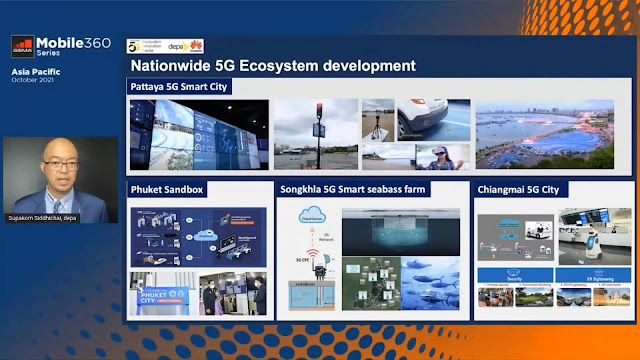
At the GSMA Mobile 360 APAC – 5G Industry Community Summit, October 2021, Dr. Supakorn Siddhichai, Executive VP, Digital Economy Promotion Agency (DEPA) presented a Keynote looking at Thailand’s digital economy development plan, 5G City whitepaper, network and industry standards. His talk is embedded below:

Last week operators True and Dtac announced an $8.6 billion plan to merge. If approved by regulators, the new company would become the largest Thai telco by market share, accounting for about 54 percent of all mobile users. It would also effectively slim Thailand’s three-horse telco race down to a duopoly.

Thailand’s telecom market, with an estimated 91 million mobile customers, has for several years been a three-horse race. The industry leader is AIS, which has 46 percent of the mobile market and posts consistently strong earnings. In 2020 AIS reported 85.6 billion baht in net cash flow from operations and paid investors 20.2 billion baht in dividends. Its two main competitors are True and Dtac, which have about 33.7 percent and 20.8 percent of the mobile market respectively.

Related Posts: 

Sunday, 30 May 2021

‘Health Concerns’ delay 5G pilots in Kyrgyzstan


CIS region countries are not planning to be leaders of 5G rollouts but they have been conducting some or other pilots and trials. Commsupdate reported: 

Kyrgyzstan’s State Communications Agency (SCA) – a subordinate agency of the State Committee for Information Technology & Communications – has disclosed that planned launches of test/pilot 5G networks have been suspended, largely due to COVID-19, although delays were also related to a campaign to address public 5G ‘health concerns’, the regulator told the Tazabek news service, adding that the date for 5G service deployment in the country is ‘not determined’ yet.

TeleGeography’s GlobalComms Database notes that in December 2019 the Kyrgyz regulatory authorities decided to allocate frequencies in test mode for 5G mobile network operations while approving proposed measures for supporting IoT development, in accordance with the 2019-2023 Digital Transformation policy roadmap. The temporary licences permit usage of spectrum within the 3300MHz-5000MHz range.

In July 2020 the regulator underlined that cellcos do not have the right to install and operate 5G network equipment without its specific permission, although adding that if the results of 5G tests ‘are positive’, the authorities would consider the issue of holding an auction of 5G frequencies. However, also that month operators reported multiple criminal attacks on their network facilities related to public fears over 5G, and the SCA began issuing information to address the matter, including global scientific evidence supporting 5G’s safety.

Developing Telecoms added:

Kyrgyzstan’s regulator has issued two 2300MHz spectrum licences to the state-backed operator MegaCom while noting that the country’s 5G network pilots will be delayed.

MegaCom bid KGS116.87 million (US$1.38 million) for two licences in the 2300MHz-2400MHz TDD range in an auction held by the State Communications Agency (SCA), itself a subordinate unit of the State Committee for Information Technology & Communications.

The two licences will allow MegaCom to deliver coverage across Kyrgyzstan, with the notable exception of the capital Bishkek and second largest city Osh. MegaCom spent KGS77.92 million to acquire 40MHz of spectrum in the 2300MHz-2340MHz band, and KGS38.95 million for 20MHz in the 2380MHz-2400MHz band.

TeleGeography reports that MegaCom bid KGS5.56 million more than the combined reserve price for the two licences despite the SCA indicating that it was the only bidder, with a third available licence for 40MHz of spectrum in the 2340MHz-2380MHz band going unsold. The concession covered the Batken, Naryn and Talas regions and had a reserve price of KGS17.72 million.

Related Posts and Links:

Thursday, 11 March 2021

5G will reach parity with 2G in 2025 but 4G will dominate Argentina


Argentina has one of the most dynamic mobile markets in Latin America, being the third largest in the region after Brazil and Mexico. Mobile penetration has fallen in recent years in line with a reduction in the number of subscribers following a long period of steady growth. This is partly due to pricing competition among operators which has reduced the incentive for multiple-SIM card ownership. The regulator has encouraged the market entry of additional MVNOs to increase competition, though collectively the MVNOs only have a very small share of the market. Market changes are anticipated into 2021 as Telefónica Group moves its Latin American businesses (with the exception of Brazil) into a single unit.

Operators have trialled 5G though given the continued capacity of LTE infrastructure it is unlikely that commercial 5G services will be available before 2021.

Argentina has 3 national operators: Claro (by América Móvil), Movistar (by Telefónica Spain) and Personal (by Telecom Argentina). They three all have about the same market share. For being former state-owned company, Personal tends to have a better coverage in rural area but has very llimited prepaid plans compared to Movistar and Claro. In Buenos Aires area, Movistar has best coverage in Subte (subway) networks even in between stations (as of Jan. 2021). Although reliable free WiFi is available inside of each subway station,

2G and 3G is on 850 and 1900 MHz, so users from Europe and Asia need a "US-band" device. 4G/LTE is on AWS (1700/2100) MHz and B28 (700 APT).

According the the most recent Open Signal report  Personal’s lead over second-placed Claro for 4G Availability has risen to 7.6 percentage points, up from the 5.1 percentage points seen in the previous report. However, both Claro and Movistar have edged closer to the 85% mark, with their scores rising by around 1.5 percentage points. However, Personal’s impressive lead over Claro for speed has moderated since the last report, declining from 6.1 Mbps to 5.3 Mbps for Download Speed Experience and from 0.9 Mbps to 0.6 Mbps for Upload Speed Experience. — Claro has consistently placed second for both metrics.

Not everything went Personal’s way, given that Claro won the remaining two awards — Games Experience and Voice App Experience — and the fact that its users enjoyed an experience that was one category higher than that seen by other operators’ users — Fair instead of Poor for Games Experience and Acceptable instead of Poor for Voice App Experience. Claro was also only one point away from a Good rating for Voice App Experience and placed in the same category for Video Experience — Very Good — as Personal. Placing in the Very Good category indicates that users experienced generally fast loading times and only occasional stalling but the experience might have been somewhat inconsistent across users and/or video providers/resolutions.

While Movistar came third in five of the seven measures of the mobile experience, it succeeded in beating Personal to second-place for Games Experience and Voice App Experience. It is not Personal that has to watch out for Movistar — the latter was only 0.8 percentage points behind Claro on 4G Availability and 1.1 Mbps behind it on Download Speed Experience.


Claro (formerly called CTI Movil) owned by Mexican América Móvil is still market leader by a small margin amd has good coverage. For 4G/LTE mainly band 4 on 1700 MHz is used.


Movistar is owned by Spanish Telefónica and still the No.2 in the country what customers are concerned. It has the widest 4G/LTE coverage in the country covering 68% of population in 2016 on bands 4 and 28. 4G service is available in more than 380 locations, including all 23 provincial capitals and the national capital.


Although being only no.3 in the country OpenSignal gives Personal the best nationwide performance. Note that their customer service is not available in English. About 90% of the Buenos Aires metro system (called Subte) is covered by Personal's 4G/LTE. At the end of 2017 it had 71% coverage of population in over 1000 towns and cities.

Telecom Argentina which owns Personal has announced that its mobile unit Personal has activated the first 5G network in Argentina, launching a total of ten mobile antennas in the cities of Buenos Aires and Rosario. The five mobile sites in Buenos Aires were deployed by Huawei, while the Rosario infrastructure utilises Nokia technology. The network re-farms existing 4G frequencies, via a Dynamic Spectrum Sharing (DSS) configuration. The 5G cell sites can be accessed by any Personal subscribers with compatible handsets.


Argentina’s National Communications Agency (Ente Nacional de Comunicaciones, ENACOM) has confirmed that it will stage a week-long 5G trial at its headquarters in Buenos Aires this month. The tests will run from 15 March to 19 March and explore how fifth-generation technology will benefit the country’s industrial, educational and entertainment sectors. While the spectrum intended for use has not been divulged, TeleGeography notes that the watchdog has previously sanctioned both Movistar and Personal to utilise 28GHz millimetre wave (mmWave) frequencies for 5G trials.

According to GSMA Intelligence Mobile Economy Latin America 2020 Report, smartphone adoption in Argentina will continue to increase along with the subscriber penetration but most of the growth will be in 4G subscriptions. 5G will reach a parity with 2G/GSM while 3G will continue to be used as well.