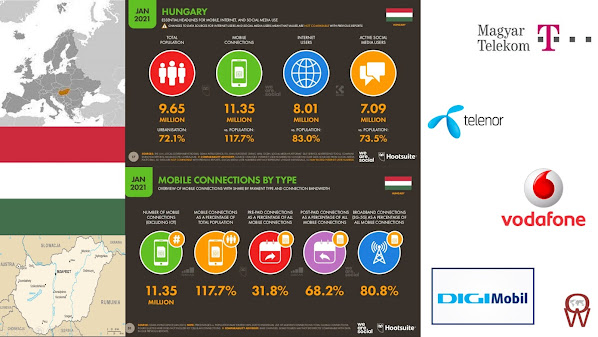
Hungary has the advantage of a developed telecom infrastructure, with a focus among operators to develop the 5G sector and upgrade fixed networks to provide a 1Gb/s service. Services based on 5G have been supported by the January 2021 multi-spectrum auction for spectrum in the 900MHz and 1800MHz bands. Digi Mobile failed to secure spectrum, which prompted the operator’s parent company to sell the unit to 4iG.
As in many other markets in the region, the number of fixed-lines continues to fall as subscribers migrate to the mobile platform for voice and data services. Operators have thus looked to bundled packages to boost revenue and retain subscribers. This strategy encouraged Vodafone Group to acquire UPC Hungary in mid-2019.
The dynamic mobile market is served by four MNOs and a small number of MVNOs. Mobile penetration is relatively high for the region, and there remains considerable growth in mobile broadband services delivered via upgraded networks. Revenue growth is focused on mobile data as operators struggle with competition and regulated tariff reductions.
Maygar Telekom is at the forefront of 5G developments, supported by the government, universities, other telcos and vendors forming the Hungarian 5G Coalition. By March 2021, Vodafone Hungary managed about 300 5G base stations in Budapest and its surrounds, as well as in a number of other cities.
The four mobile operators in Hungary are: Magyar Telekom (a.k.a Telekom, formerly T-Mobile/Westel), Telenor Hungary (formerly Pannon, partly state-owned), Vodafone Hungary and DIGIMobil (limited coverage, postpaid only)]
For the three major providers Telekom, Telenor and Vodafone 2G is on 900 and 1800 MHz, 3G is on 900 and 2100 MHz, while Digi works only on 1800 MHz with 2G/4G. The big three carriers are offering 4G/LTE services since 2015 on 800, 1800 and partly 2100, 2600 MHz (bands 1, 3, 7 and 20). LTE-A is available by big three providers in bigger cities in up to 300 Mbit/s. Telekom and Telenor have network sharing agreement for 4G on 800 MHz (B20) outside of Budapest and have therefore almost the same coverage on 4G/LTE. Generally Hungary has a quite good coverage with 4G/LTE networks and high speeds in most areas except Digi.
According to the recent Opensignal report on operators in Hungary, it was found that Telekom is the dominant operator when it comes to national mobile network experience. The operator won five out of the seven awards outright — Video Experience, Games Experience, Voice App Experience, Upload Speed Experience, and 4G Coverage Experience — and further jointly won the Download Speed Experience award with Telenor. It was noteworthy that Telekom users saw strong results for the experiential metrics — Excellent rating in Video Experience, Good ratings on Games Experience, and Voice App Experience. Telekom also had a considerable lead in Upload Speed Experience, with the users on its network observing 18.9% to 306.5% faster speeds compared to their peers. However, this was not the case for other metrics, as Telenor came close to challenge Telekom on most of them.
Hungary has held a strong position globally when it comes to mobile network experience and is striving to establish the same level of global success in the 5G era. The country opened its doors to 5G earlier last year with the auction of 5G capable bands in which three national operators — Telekom, Telenor, and Vodafone — acquired three bands of which the 2.1 GHz and 3.6 GHz bands were ready to be used immediately, while the 700 MHz band was available for use from September 2020 onwards. Since then, 5G deployments have been evolving in the country.
In terms of commercial 5G service, Vodafone claimed to be the first to launch services covering downtown Budapest in late 2019, using its existing 3500 MHz band frequencies. Telekom has claimed to have expanded 5G mobile services using the 2100 MHz band, via Dynamic Spectrum Sharing (DSS) technology and launched its commercial 5G network in April 2020 using the 3600 MHz band in selected areas of downtown Budapest and central Zalaegerszeg. In contrast, Telenor is yet to launch commercial 5G services, while the newest mobile operator — DIGIMobil — did not acquire any spectrum from the 5G auctions. The measurements from 5G users contribute to the overall scores included in this report.
In the future, as Hungary’s operators continue to make strides for a nationwide rollout it will be interesting to see how the mobile network experience in the country shapes up.
In this report, Opensignal used real-world data to compare the experience of our users on the country’s four key national operators — DIGIMobil, Telekom, Telenor and Vodafone — for a period of 90 days starting October 1, 2020.
Magyar Telekom Nyrt., often simply called Telekom, is the largest Hungarian telecommunications company. The former monopolist is now a subsidiary of (German) Deutsche Telekom.
It has the best and fastest network according to Opensignal. 4G/LTE is available on 800, 1800 and 2600 MHz and covers 98% of the population coverage map in up to 150 Mbit/s.
Telekom launched its commercial 5G network in April 2020 with spectrum in the spectrum from the 3.5GHz band, connecting areas in downtown Budapest and county capital Zalaegerszeg, it also switched on 5G base stations in the Lake Balaton region in July 2020.
Magyar Telekom stated 5G services are live in four other county capitals Debrecen, Szeged, Kecskemet and Szombathely. There is also 5G connectivity in the town of Budaors and 21 settlements around Lake Balaton.
DSS technology enables spectrum to be shared between 4G and 5G to a millisecond, allowing operators to rely on spectrum they already possess.
Telenor in Hungary was sold by Telenor to the Czech PPF Group in 2018, and since 2019 25% of it is owned by the state. It has pretty good coverage throughout the country. Their 3G is on 900 and 2100 MHz up to 42 Mbit/s and their 4G/LTE is available on 800, 1800 and 2600 MHz covering 99% of the population up to 150 Mbit/s.
Vodafone is the smallest provider in Hungary what the number of customers is concerned. It covers about 98% of the population on 2G and 3G and about 95% on 4G.
For 3G your device should be capable of the 900 MHz frequency, because most of its 3G antennas are based on it up to 21 Mbit/s. 4G/LTE network started in 2015 on 800 MHz and now available on 1800 and additionally on 2100 and 2600 MHz available for prepaid users in up to 75 Mbit/s.
Vodafone has signed a cooperation agreement Huawei along with Hungary's East-West Intermodal Logistics and British telecommunications operator, in a joint effort to build Europe's first smart railway hub managed by a 5G private network to be empowered by Huawei.
Vodafone Hungary and Huawei's Hungary subsidiary will provide a 5G private network for the project. 5G technology will be used to remotely control fully automatic gantry cranes for intelligent loading and unloading operations. It will be able to handle 1 million standard containers per year after project completion in the first quarter of next year.
A 4th LTE license to Romanian-backed RCS & RDS company (brand name: 'DIGI') was given out in 2014. They started their own 2G and 4G network on 1800 MHz (band 3) in May 2019.
Their coverage is very limited and there is no domestic roaming on other networks. They sell only postpaid packets.
The Hungarian regulator NMHH has announced the result of a tender for 5G licences in the country. In a statement, it says that the licences, valid for 15 years in three frequency bands, have been awarded to Magyar Telekom, Telenor Hungary and Vodafone Hungary. It adds that in total the three companies will pay HUF128 billion (€360.4 million) for the rights. NMHH notes that the bids received by March 11 for the 700 MHz, 2100 MHz and 3600 MHz bands revealed that there was more demand than supply. It therefore held auctions for the blocks offered, subject to strict precautions. The three service providers were able to bid for a number of frequency blocks within each frequency band, starting with the initial bid value specified in the documentation for that band. The auction was preceded by a trial auction on March 24. Karas Monika, chairman of NMHH, said: “5G frequency services will play a key role in economic development and, in the short term, can effectively support our healthcare network, domestic telework and distance education, even in times of coronavirus restrictions. And in the post-epidemic period, they can accelerate the recovery of the Hungarian economy.” To this end, NMHH will encourage service providers to install 5G at locations that are not only important to them from a market point of view but are also socially important, such as the internet. hospitals, campuses or major transport routes. The usage rights of the acquired frequencies will expire uniformly in 2035. The 700 MHz frequency band will only be available once this band has definitively moved out, ie not earlier than September 6, 2020. The term of the rights may be extended once for a further period of five years, subject to unchanged conditions and without a single additional fee being charged for the right of use of the frequency.
The March 11 bidding process for the sale of usage rights for the fifth generation (5G) mobile technology and wireless broadband in the 700 MHz, 2100 MHz and 3600 MHz bands revealed that there was more demand than supply, Thus, on March 26, NMHH held auctions of the blocks offered, subject to strict precautions. This is of paramount importance for the Hungarian economy, as it will give Hungary a competitive advantage over those countries where the most important spectrum parts for 5G services have not yet been sold. After the auction, Hungary will be among the first to take advantage of 5G innovations in, for example, industry, health, agriculture, transport or even logistics. The bidding service providers pay the Hungarian public a significant amount, about HUF 128.5 billion, for the frequency usage rights acquired at the auction, thus ultimately for the Hungarian citizens. The three service providers involved in the NMHH process were able to bid for the number of frequency blocks within each frequency band , starting with the initial bid value specified in the documentation for that band . The auction was preceded by a trial auction on March 24, where representatives of the service providers, in addition to the sales documentation, were introduced to the auction site and the auction methodology at the auction site. Due to the well-known epidemic situation, the auction took place under special circumstances. The NMHH provided general health monitoring of the event on site, and the necessary protective equipment for each auction participant. At the event, both the service providers and the authority representatives displayed responsible, disciplined behavior, abiding by the health rules that can be expected in such a situation. Detailed results At the auction on March 26, Magyar Telekom acquired 10 MHz twice in the 700 MHz band, 10 MHz twice in the 2100 MHz band and 120 MHz in the 3600 MHz band. Telenor acquired 5MHz twice in the 700 MHz band, with no success in the 2100MHz band, and 140MHz in the 3600MHz band. Vodafone acquired 10 MHz twice in the 700 MHz band, 5 MHz twice in the 2100 MHz band and 50 MHz in the 3600 MHz band. There was intense competition between service providers in the 700 MHz band, while none of the bidders in the 2600 MHz band. Monika Karas, president of the NMIAH According to "The developing are your 5G-and frequency-sales as a result of services plays a key role will be economic development , even in the short term have been the time constraints associated with the coronavirus can effectively support the operation of the health network, domestic telework and distance learning. In the post-epidemic period, they can accelerate the recovery of the Hungarian economy. " To this end, NMHH will encourage service providers to install 5G at locations that are not only important to them from a market point of view, but are also socially important - such as the Internet. hospitals, campuses or major transport routes. The usage rights of the acquired frequencies will expire uniformly in 2035. The 700 MHz frequency band will only be available once this band has definitively moved out, ie not earlier than 6 September 2020. The term of the rights may be extended once for a further period of five years, subject to unchanged conditions and without any additional one-off payment being made for the right to use the frequency.