Showing posts with label Technology FWA. Show all posts

Tuesday, 17 March 2026

Norway’s Mobile Market Balances Competition and Performance

Data from GSMA Intelligence indicates that there were 6.07 million cellular mobile connections in Norway at the end of 2025. For context, many individuals use more than one mobile connection, so it is common for the total number of connections to exceed the total population. For instance, a person may have one mobile connection for personal use and another for work. The growing availability of eSIM technology has made it even easier to manage multiple connections in recent years.

GSMA Intelligence’s figures show that mobile connections in Norway were equal to 108 percent of the total population in October 2025. Looking at changes over time, the number of mobile connections in Norway declined by 35 thousand, or 0.6 percent, between the end of 2024 and the end of 2025.

At the same time, GSMA Intelligence reports that 99.1 percent of mobile connections in Norway can now be classified as broadband, meaning they connect through 3G, 4G, or 5G mobile networks. However, devices that are capable of connecting to broadband mobile networks do not always use cellular data. Some subscription plans may only provide access to voice and SMS services, so this broadband figure should not be interpreted as a direct measure of mobile internet usage.

Norway’s mobile market is characterised by a relatively concentrated structure, with three mobile network operators and a range of mobile virtual network operators that rely on wholesale access to the main networks. The three companies that operate mobile network infrastructure in Norway are Telenor, Telia Norway, and Ice. These operators account for the vast majority of mobile subscriptions in the country and provide the underlying infrastructure that supports a number of smaller service providers.

Historically, Norway’s mobile market has been dominated by two large operators. Telenor has long been the market leader, while Telia has served as the primary challenger since entering the market through its predecessor NetCom. Over the past decade, Ice has emerged as a third infrastructure operator following significant investment in network deployment.

The presence of three network operators has strengthened competition in the Norwegian mobile sector, although the market remains relatively concentrated compared with larger European markets.


Telenor continues to hold the largest share of mobile subscriptions in Norway. The company operates extensive nationwide infrastructure and has historically maintained strong coverage across both urban and rural areas.

Telenor Norway reports 111k FWA subs in Dec 2025, a number that is the same as in the beginning of 2022 (or 15k down from peak). The total number of fixed broadband subs (incl. FWA) is in decline as a growth in fibre subs can't compensate for losses in cable and FWA. FWA now 16% of total base.

[image or embed]

— Tefficient🚥 (@tefficient.bsky.social) 6 February 2026 at 08:14

Telenor also emerges as the dominant force in Norway’s mobile landscape, retaining its Best Network title and standing out as the most-awarded operator in Opensignal’s November 2025 report. From the awards grid, Telenor secures six outright wins and five joint wins, leading in 11 out of 15 measured categories. Telia follows with two outright and six joint wins, while ice collects five joint wins, according to real-world experience data recorded by users.

Telia Norway represents the second largest operator and competes directly with Telenor across most segments of the market. The operator has invested heavily in network upgrades in recent years and has expanded its 5G footprint across the country.

Following on several trials, Telia is first to launch 5G SA commercially in Norway. Telia now offers 5G SA as 'Avansert 5G' to B2B customers across its 5G network nationwide. kommunikasjon.ntb.no/pressemeldin...

[image or embed]

— Tefficient🚥 (@tefficient.bsky.social) 13 February 2026 at 06:18

Ice, the third network operator, has focused on building its own infrastructure while also relying on national roaming agreements to extend coverage beyond its network footprint. The company has positioned itself as a challenger operator with a focus on competitive pricing and data centric mobile plans.

Breaking: Lyse Tele (ice Norge) and Telia Norway to share mobile network across Norway, a first for the country. news.cision.com/telia-compan...

[image or embed]

— Tefficient🚥 (@tefficient.bsky.social) 2 February 2026 at 18:06

Norway has consistently ranked among the leading European markets in terms of mobile network performance and coverage. Independent benchmarking conducted by Rohde & Schwarz has placed Norwegian operators among the strongest performers globally, reflecting sustained investment in network infrastructure despite the country’s challenging geography and dispersed population. In recent testing covering more than 7,000 kilometres and over half of the population.

Which country - Norway, Denmark, Finland, Sweden - has the highest mobile and fixed broadband ARPU? What value for money do customers get? The Norwegian government's @dfd.regjeringen.no made this Tefficient analysis public. www.regjeringen.no/no/dokumente...

[image or embed]

— Tefficient🚥 (@tefficient.bsky.social) 8 March 2026 at 09:19

The country’s operators have invested heavily in 4G and more recently 5G infrastructure. For example, Telia reported that its 5G network now reaches close to 99 percent of Norway’s population following several years of nationwide deployment, highlighting the rapid pace of next generation network rollout in the market.

Recent industry developments include plans by Telia and Lyse, the parent company of Ice, to combine parts of their mobile radio access networks in Norway through a jointly owned entity. The companies expect the arrangement to reduce infrastructure costs and improve coverage while continuing to operate as separate retail competitors with independent core networks.

Norway’s mobile market is likely to remain relatively stable in terms of structure. The presence of three infrastructure operators, combined with a range of virtual operators, provides a balance between network investment and retail competition.

Future developments in the sector will likely be shaped by continued 5G deployment, infrastructure sharing arrangements, and the evolving role of wholesale access in supporting smaller mobile brands.

Related Posts: 

Friday, 16 August 2024

World's Largest Mobile Networks by Data Traffic - Q1 2024

Last year, India became the most populous country in the world. India's population stood at slightly over 1.428 billion, edging past China's population of 1.425 billion people. India and China's combined population is one third that of the whole world. As a result it won't come as a surprise that the operators with most data consumption in their networks are the ones from India and China.

At the end of Q1 2024, Reliance Jio was the operator with largest mobile data traffic flow through its network. China Mobile was just behind. 

As Tefficient reported, Jio says that 5G's share of traffic is 28%, the rest being 4G as it doesn't have 2G/3G network. Another interesting stat was that the monthly usage per AirFibre (FWA) subscription was 390 GB, 30% higher than for a JioFiber subscription.

You can do a comparison with Q4 2022 numbers available here.

Tuesday, 14 November 2023

Jio 5G - Enabling India to go Digital

Jio, the incumbent Indian MNO, was in news recently for having rolled out 1 million 5G cells across India. An RCR Wireless article nicely summarised their announcement from the earning statement as follows:

Reliance Jio Infocomm has already deployed over 1 million 5G cells across India, the telco said in its earning statement.

Jio’s 5G network is currently providing coverage in nearly 8,000 towns and cities across India.

Jio also highlighted that it has contributed to 85% of the overall 5G capacity in the country. This has been powered by a 100% in-house 5G stack, designed, developed and manufactured in India, the telco added.

Reliance Jio Infocomm has been rapidly expanding its 5G network using Standalone (SA) architecture since October 2022. Reliance Jio had previously secured a mix of wireless spectrum for 5G across the 700 MHz, 3.5 GHz and 26 GHz bands. Jio is the only Indian operator with the 700 MHz low-band spectrum.

Earlier this month, Reliance Jio Infocomm Limited demonstrated what it claims to be India’s first satellite-based giga-fiber service, dubbed JioSpaceFiber, at India Mobile Congress 2023.

The telco said the new offering aims to provide high-speed broadband services to hard-to-reach geographies across the country.

At the recent Brooklyn 6G Summit, Shyam Mardikar gave a keynote on how Jio 5G is enabling India to go Digital. His bio states: "Shyam Prabhakar Mardikar is responsible for Reliance Jio’s mobile network and leads the network strategy, design, and transformation towards making Jio’s mobile network fully converged, programable and future ready. Over past one year, he has successfully led world’s fastest 5G network creation with nearly 1 Mn 5G cells live." 

His talk is embedded below:

Related Posts: 

Thursday, 24 November 2022

UScellular 5G Progress and 6G Plans

At the Annual Brooklyn 6G Summit (B6GS) last month, Robert Jakubek, Vice President of Engineering and Network Operations for U.S. Cellular, presented deployment strategies for the next generation of wireless communications.

Sue Marek details the talk in Fierce Wireless as follows:

Speaking at the 2022 Brooklyn 6G Summit, which is jointly hosted by Nokia and NYU Wireless, Robert Jakubek, VP of engineering at US Cellular called for the industry to figure out how to get more functionality out of mmWave. “CPEs [customer premises equipment] need to get more sophisticated,” Jakubek said. “Help us solve some of the challenges of mmWave fixed wireless and make it more effective.”

The request is notable because Nokia, which is a sponsor of the event, is a key supplier to UScellular and provides 5G radio gear for the company’s low-band and mmWave networks. Nokia also is working with UScellular on its deployment of standalone 5G (SA).  Jakubek said that UScellular is moving “full speed ahead” with its SA core. Nokia has said previously that it should be deployed by year-end.

Jakubek added that UScellular has had success with a couple of extended range trials where its FWA signal used mmWave spectrum. In 2020 the operator and its partners Ericsson and Qualcomm completed an extended range 5G mmWave data call over a distance of more than 5 kilometers (around 3.1 miles) at speeds over 100 Mbps. And in 2021 the company set a record of 10 km (about 6.2 miles) in tests with Nokia and Qualcomm.

UScellular has deployed a Home Internet+ product that uses 5G and mmWave spectrum to deliver FWA to customers in more than 10 cities. It launched that product last April. In addition,  the operator offers a FWA product over the company’s LTE network to its entire footprint. At the end of 2Q, UScellular said it had 57,000 FWA customers, but it doesn’t break out those on mmWave vs. those on the LTE network.

Besides FWA, Jakubek said that the company is looking ahead to deployment 5G voice over new radio (VoNR) but that isn’t likely to happen until 2024 or later.

And of course as it is a 6G summit, you couldn't do a presentation without talking about what is needed from 6G. The talk is embedded below, courtesy of IEEE TV.

Related Posts:

Wednesday, 29 September 2021

Telenor Norway says 5G is the Key Enabler for Modernization going forward

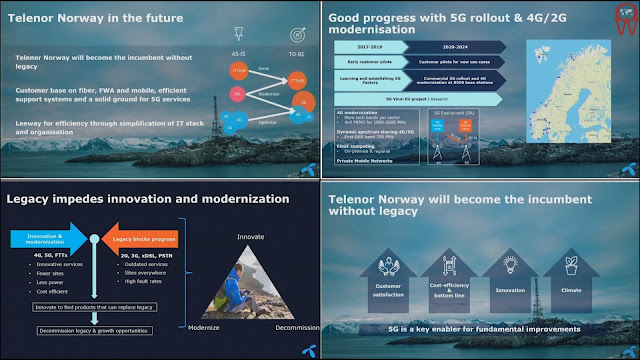
In the recently concluded 5G World Summit 2021, Ingeborg Øfsthus, CTO of Telenor Norway provided a Holographic Service Provider Keynote on "Innovate, modernize and decommission, - moving Norway from legacy technology to high speed broadband with 5G, FWA and fiber"

Her talk was full of interesting facts about Norway and Norwegians. As a matter of comparison, UK for example is 3/4th the size of Norway while the population is roughly 12 times. This does not mean that the people out there expect anything less than the best from their operators. 

This is a reason that Telenor has embarked on a journey to modernize their network (fixed and mobile) and phase out the legacy. There is an ongoing program to get rid of the copper network that has served the country well for over 160 years.

Users in urban and sub-urban areas can get fiber to their premises, be it home or business. The mobile network is being upgraded to 5G with 3G being shut down end of 2021. A small chunk of 2G will remain for fallback, roaming and IoT purpose. This whole modernization should be completed by 2024.

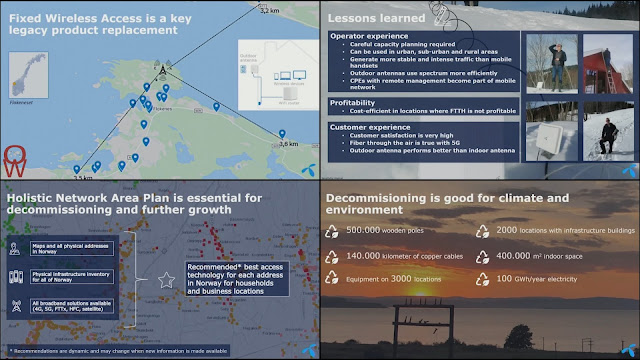
While Fiber will be available for most of the users, some rural and hard to reach areas may have to rely on Fixed Wireless Access. To ensure that good speeds are available to FWA as well as mobile users, granular planning is done to decide what kind of internet service would be offered in each area. In case of some very remote locations, Satellite broadband is provided as well.

As can be see in the picture above, Telenor has managed to stretch the C-band FWA as far as 3.6 kilometers. This of course requires line of sight outdoor antennas that have to be planned and installed by professional RF engineers. 

Telenor considers all of these equipment to be part of the network so as to ensure a fantastic quality of experience to the end users. FWA is treated as fiber through the air by the end users. 

As the old copper network is decommissioned, it is allowing a lot of power to be saved and indoor space to be reclaimed. Some of these old infrastructure is also a threat to wildlife as it's old and can fall down. 

The main challenge is also to retain the customers while doing this transition from legacy to modern infrastructure. Telenor aims to retain at least 60% of the existing customers and 70% of the revenue. The approach using fiber and FWA is profitable and the best approach going forward. 

Related Posts: 

Friday, 8 November 2019

Orange Romania Finally Launches 5G


Orange has entered the 5G fray with the launch of its first commercial network within its footprint, deploying the technology in three major Romanian cities. The operator launched 5G services in capital Bucharest, Cluj-Napoca and Iasi, with other Romanian cities to follow from 2020 onwards. At a launch event Ramon Fernandez, deputy CEO for Finance, Performance and Europe, explained the country was a natural choice to lead the operator’s 5G charge, having been a key part of its footprint since 1997. He also said the operator had invested “more than €3.5 billion” in its Romanian operations over the past 22 years.


Fernandez explained the operator deployed 115MHz of spectrum in the 3.4GHz to 3.6GHz bands, “more than double” the amount available to competitors. Orange stated the network offers peak download rates of 1.2Gb/s, with average rates of 600Mb/s.


Orange is the largest operator in Romania with 10.3 million connections according to GSMA Intelligence, just ahead of rival Vodafone’s 10 million.Vodafone and number four player Digi launched 5G earlier this year.

This launch and this network is the result of an attractive exclusive partnership with Samsung. An interesting partnership which works both ways. Samsung devices can only be sold by Orange, and Orange 5G tariffs can only be run through Samsung devices. It might sound unusual that two companies would want to limit this potential in this manner, but considering Orange is the market share leader for 4G (roughly 40%) while Samsung is the devices market share leader (estimates range between 50-55%), there are attractive gains for both parties.


The second interesting element of this announcement is the focus on Fixed Wireless Access (FWA). Orange has never been shy about its convergence ambitions, the success of bundling is evident in numerous markets but with no fixed assets in Romania it becomes difficult. There is a wholesale agreement in place with Telecom Romania, however this is far from an ideal position.

With 5G, FWA becomes a much more apparent opportunity to compete with the fibre services which are being offered by competitors. It certainly isn’t perfect by any means, but if Orange can deliver the promised gigabit speeds over the air, there will certainly be demand from increasingly speed obsessed consumers.

The final interesting aspect of this story could count against the Orange. After performing a number of speed tests across Bucharest, it became very apparent, very quickly, that the 4G network is excellent (60-96 Mbps), providing speeds which even the most demanding consumer could not make use of. In delivering such eye-watering speeds over 4G, one should ask whether this weakens the selling point of 5G. As attractive as 1.2 Gbps download speeds are, who actually needs that much power right now?

Despite the number of features and wild promises here, the success of Orange Romania in the 4G era might undermine the pursuit of early adopters for 5G. This is a difficulty which only remains while the operators discuss little more than speed upgrades, though as the ecosystems develop new services will be pushed at the consumer.


Further Reading:

Sunday, 18 November 2018

Optus launching commercial 5G Fixed Wireless Access services in January 2019


Optus is the second largest telecommunications company in Australia. It is a wholly owned subsidiary of SingTel (a company headquartered in Singapore) since 2001.

As of 31 October 2018, Optus’ 4G network population coverage was 97.2% in Australia, with 7,011 sites upgraded to 4G of which over 5,990 have been upgraded to 700 MHz spectrum. The total 4G customer base reached 6.39 million (Including Enterprise customers, Optus’ total number of 4G customers reached 6.48 million) as of 30 September 2018. They believe that all Australians deserve high quality mobile coverage are committed to relentless improvement, especially to the roll-out of 5G.

During this quarter, Optus launched the 50th Federal Government Blackspot. In addition, Optus successfully concluded “live” 5G network trial in Sydney, paving the way for the commercial launch of Fixed Wireless Access services in Canberra and Brisbane in January 2019, and other capital cities by March 2019. 


Optus' road to 5G saw it begin switching on its 4.5G network in February last year, followed by the addition of Massive Multiple-Input Multiple-Output (Massive MIMO) and three-cell carrier aggregation to 4G at the end of last year.


According to chief executive officer Allen Lew, Optus has now finished trials at its HQ in Macquarie Park; its 5G Live centre in the Gold Coast is stage two of its 5G plan, as it will allow the telco to gather data on how consumers interact with and react to the low-latency, high-bandwidth capabilities of 5G and the technologies it enables.
Optus is also inviting "young entrepreneurs" to visit the showcase -- which utilises both indoor and outdoor 5G base stations -- and commercialise any ideas they come up with, which will also help Optus to decide who to partner with.
While according to Optus head of Networks Dennis Wong  5G is the final piece of the "industrialisation puzzle" -- due to its characteristics of low latency, high bandwidth, network slicing architecture, and massive machine type communications -- Wong said Optus is well positioned to deliver a 5G network thanks to its holdings in the 3.5GHz spectrum band.

***
To learn more about Fixed Wireless Access, see 3G4G Blog post here.

See also:

Monday, 8 October 2018

USA gets two faux 5G networks

From Android Headlines, back in July:

Regional wireless carrier C-Spire claims it already launched 5G service in the United States, having announced it’s now offering a next-generation fixed wireless access solution in select locations across Mississippi earlier this week. While the company is referring to its solution as 5G, it’s not basing it on the 3GPP’s Release 15 or any other standard released by the wireless consortium. Instead, it’s using proprietary hardware and a set of close-sourced IEEE 802.11 specifications, so while the service offers faster speeds compared to 4G LTE, it likely wouldn’t be considered as “true” 5G by anyone outside of C-Spire.


Another one from Android Headlines regarding Verizon's 5G Fixed Wireless:

A number of officials from the stateside wireless segment dismissed Verizon’s claim of having the world’s first commercial 5G network and customers. Speaking with AndroidHeadlines under the condition of anonymity, several industry veterans pointed to the examples of Qatari carrier Ooredoo and Mississippi operator C-Spire as clear evidence that Verizon’s claims about the uniqueness of its 5G Home service are entirely false. Much like Verizon, C-Spire and several other telecom companies abroad already launched fixed wireless access solutions reliant on a proprietary specification that’s in no way associated with the 3GPP, the organization responsible for standardizing the next generation of cellular connectivity.

Here is what John Legere, CEO of T-Mobile USA had to say about Verizon's 5G launch

Related Posts:

Friday, 28 September 2018

Turkcell Group in 5 slides

I came across couple of presentations from Turkcell recently, one from ITU by İzzet Sağlam, 5G R&D Engineer and the other by Gulay Yardim, Head of Radio Network and 5G R&D at Istanbul 5G briefing. There was a lot of commonality in the slides. Here is summary of Turkcell in 5 slides.


Turkcell Group is present in 9 countries and has 50.2 million subscribers, including 2.1 million fixed subscribers. Its largest presence is in Turkey, followed by Ukraine & Belarus.


Turkcell has its own apps which has been downloaded 86 million times. Based on the figures available, the apps have gained popularity in the last year.


The picture above shows their 5G Architecture. Turkcell thinks that 5G can have major impact in Education, Healthcare, Smart Cities and Automation. In addition Turkcell is using LTE-Advanced Pro (a.k.a. 4.5G) for drones to provide coverage in case of emergencies and is also using 4.5G for providing fixed wireless access.  The following is a video from their Dronecell testing


Turkcell has been a leader in testing 5G, working with both Ericsson & Huawei. Turkcell 5G R&D team has been focusing on SON, AI, Network Slicing, MEC, Physical Layer, Connected Car, Healthcare, etc. Along with being active in standard bodies, its been active in NGMN as well.


Finally, Turkcell thinks that 5G FWA will be a great opportunity as its already present in this area. Its 4.5G Superbox has packages from 50GB to 200GB data allowance. 4.5G also offers impressive speeds to most users.

One interesting fact worth highlighting is that Turkcell is probably the only mobile operator with 50% women employed in its workforce and 42% of women in the leadership positions. Hence it is very common to see woman speakers from Turkcell in many conferences and events.

Here is Turkcell's Aysem Ertopuz, Executive VP, Digital Services and Solutions, speaking on 5G and Digital Transformation at 5G MENA

Thursday, 20 September 2018

Dialog Axiata: On its way to 5G after successful roll-out of commercial 4.5G

In our post back in May, we looked at the Sri Lankan mobile market. Dialog Axiata is the mobile operator with largest market share. In its 2017 annual report, it mentions that there are 3,000 2G/3G sites and over 1,500 4G sites. The 4G LTE coverage has a lot of scope for improvement.

It has also launched 4.5G, LTE-Advanced Pro features that allow download speeds in excess of 1 Gigabits per Second (Gbps).

In addition, as per the report, "Dialog Broadband Networks (DBN) serves over 700,000 individuals and corporates, providing multiple services including fixed telephony, hosted PABX offerings, broadband, internet leased lines, data communication, Internet Data Centre (IDC), converged ICT solutions, telecommunication infrastructure, transmission and backbone services. DBN commercially launched 4.5G technology in June 2017, establishing yet another milestone in the region’s broadband technology landscape featuring download speeds in excess of 100 Mbps. The fixed LTE demonstrated accelerated growth, where the customer base grew by 59% in 2017, surpassing 300,000 subscribers. DBN launched Prepaid LTE in July 2017, the only Prepaid option for Home Broadband (HBB) to cater to the mass market. Additionally, VoLTE services were launched on HBB routers by end of 2017, providing crystal clear voice solutions."


Indika Walpitage, Vice President, Network Operations & Service Assurance, Dialog Axiata shared his perspective on technical requirements on path to 5G at 5G Asia yesterday. The following are couple of pictures/slides shared by Neil Shah from Counterpoint Research on Twitter.


As mentioned above, they have already launched 4.5G which includes Massive MIMO as well.


On 5G, they are trialing with Ericsson and Huawei. In an interview with telecoms.com last month, Indika Walpitage mentioned the following:

Acquisition of larger spectrum blocks such as 100 MHz will be a challenge in Sri Lanka in the 3.5GHz band as there are occupants already using legacy wireless technologies like Wimax and other proprietary solutions. Regulations related to the use of E band and other high bands are not yet finalised in Sri Lanka. This will cause some delays in introducing commercial 5G networks locally.

Since 2G, 3G and 4G are still widely used, having to co-locate a fourth technology on existing base station infrastructure will be a challenge. There will be challenges in installing heavier antenna integrated radios into existing infrastructure.

Operators need to densify the network, especially when we deploy 5G at higher frequencies. This needs a sound business case to justify the investments and is going to be a logistically challenging task.

Deployment of fibre to all sites is essential to support the higher fronthaul and backhaul bandwidths which are needed in 5G systems. This also creates a significant challenge for operators like us.

We have been actively lobbying with the regulator to release the spectrum required to rollout 5G. In terms of infrastructure readiness we have been working proactively since the introduction of SDR based radio products by major network equipment suppliers. All new procurements are in line with 5G architecture to support upgrading to 5G. The core and transport network roadmap is being developed with 5G and its applications in mind and we are already progressing towards building cloud-based NFV and SDN infra.

We have already deployed a considerable number of massive MIMO radios in the access network. More importantly, building people skills on digitization and automation within the organization is key to success in our 5G journey. We have focused attention on this aspect.

We have realized the importance of introducing commercial 5G networks to our market as soon as the technology is ready. Currently the use case is enhanced broadband with low cost per bit, yet in the future we will see multiple use cases, mainly targeting industry automation. It’s important to work with business and technology partners to identify the needs and correct solutions while working with regulators to secure the spectrum assets. We also need to integrate with the complete 5G ecosystem to get maximum gains. Digitization and automation should be key ingredients in the 5G success formula.

Related Post:

Wednesday, 12 September 2018

Lesotho: First 5G launch in Africa


Lesotho is a small kingdom of approx. 2 million people landlocked by South Africa. According to ITU's Measuring the Information Society Report 2017, this small landlocked country was one of the first African countries to implement sector reform that included establishing a regulator, privatizing the incumbent and introducing competition. This has resulted in some of the highest levels of mobile-broadband coverage in Africa.

There are two mobile providers: Vodacom Lesotho (VCL), a subsidiary of the South African mobile group, which launched in 1996; and Econet Telecom Lesotho (ETL), the country’s incumbent telecommunications operator, which launched in 2002. Penetration is relatively high for the region, with the State of ICT in Lesotho survey reporting that 79 per cent of individuals owned a mobile phone in 2016, including 87 per cent in urban areas and 72 per cent in rural areas. One factor is relatively high 2G coverage that reaches 98 per cent of the population, one of the highest levels in sub-Saharan Africa. The universal service fund has played a role in extending mobile coverage to underserved areas. Mobile-broadband was introduced relatively early in Lesotho, when Vodacom launched its 3G network in 2008. This early start has also resulted in one of the highest 3G coverage rates in Africa, at 100 per cent of the population. LTE was introduced in 2014 and population coverage is high by regional standards, at 69 per cent of the population.


The market share of  VCL and ETL is as shown in the table below:


In 2008, there were 599,500 mobile subscribers in Lesotho, but by 2016 this number had increased to almost 1.9 million – achieving a growth rate of around 216% in eight years. However, while the industry has experienced an exponential growth in subscriptions, there is substantial dominance in the market. As of 2008, Vodacom Lesotho (VCL) controlled around 82% of the market, while ETL controlled the remaining 18%. 


However, ETL seems to be regaining ground as it increased its market share to 23.6% in 2016 (LCA 2016). This has led to a reduction in VCL’s market share to 76.4%. Pricing data from RIA shows that VCL was the most expensive over the period 2013–2015. Then VCL reduced its prices in Q1 2016 to become the cheapest operator.


More recently Vodacom Group has launched Africa’s first commercial 5G fixed wireless access (FWA) network, in Lesotho, while announcing the technology was ready for deployment in South Africa when spectrum is assigned. This service will use 3.5GHz wireless spectrum, previously assigned by regulators to deliver “fibre-like speeds"— a radio frequency with greater ability to penetrate buildings, but lower expected speeds. This is a fixed 5G intended to replace slower, cable-tethered broadband modems, rather than mobile phones.


Initially, Vodacom’s service is delivering roughly 700Mbps download speeds with 10-millisecond latency, slower than the 1-5Gbps download speeds and sub-2-millisecond latency other 5G carriers have been promising. While Vodacom says that it is using standards-based 5G, it claims that its download speeds will improve to over 1Gbps after future software updates and devices.

In a statement, CEO Shameel Joosub talked-up the achievement, but warned Vodacom’s home market of South Africa could not afford to be left behind as 5G rolls out elsewhere.
“What we’ve accomplished in Lesotho is an example of what can be achieved in Africa, should the requisite spectrum also be made available,” Joosub said. “Vodacom will be able to make 5G services available to its customers in South Africa once requisite spectrum is assigned. Global technological advancements are evolving at a rapid pace and South Africa can’t afford to be left behind, particularly when we look at some of the potential use cases for 5G to support critical sectors of our society such as healthcare and education.”

The Independent Communications Authority of South Africa is yet to confirm a date for its 5G auction. South Africa has granted Vodacom a temporary license for 5G testing, but the carrier is not allowed to sell its services there yet, and 5G spectrum approvals elsewhere in Africa aren’t expected for some time.


Further Reading:

Tuesday, 4 September 2018

Orange Romania: 1st European 5G multi-vendor Fixed Wireless Access (FWA) test


According to The Mobile Network Magazine:

Orange has been trialling 5G Fixed Wireless Access (FWA), using the 5GTF specifications, with live customers in Romania. It is the first such trial in Europe, although other trials of the same radio access technology are much more advanced in the USA with Verizon, Sprint and AT&T.

Orange sees FWA as a likely use case for 5G in markets where fibre and fixed broadband availability is constrained. It said that in Romania it could see potential for up to 10% of the overall broadband customer base to have a FWA connection

In Floresti, Orange has two Samsung Fixed Wireless Access points operating over 500MHz of experimental 26GHz spectrum. The access points have 128 element MIMO antennas. Orange has one access point on a tower on top of a hill and one on a lower, 20m, tower. The trial runs from the start of June to mid July.

About 30km away in an Orange data centre the operator has sited vBBU capacity from Samsung on COTS server hardware, and a dedicated Virtual Core from Cisco. Arnaud Vamparys,  Orange Senior VP Radio Networks, said the operator would not necessarily deploy vRAN to support FWA deployments, but that it was important to do so in this instance to explore the potential flexibility and efficiency benefits that such an architecture could support. “We are not saying that FWA will be on virtual radio, but we are doing it in the beginning because it is important to understand the choice.” The operator had deployed a high layer split between the access point and vBBU, he added.

More details are available in TMN mag. Below is the official video about the FWA testing.


Further Reading:

Saturday, 14 July 2018

Verizon's 5G Progress & Plans


Verizon plans to launch 5G in at least 4 cities this year, two that have already been announced being Sacramento and Los Angeles. This information is based on Lowell McAdam, Verizon chairman and CEO, speaking to CNBC's David Faber back in May.

Their intention is still to use millimeter wave bands (mmWave) in 28GHz and do a Fixed-wireless access (FWA). Lowell McAdam referred to this as ultra-wideband 5G as he says there will be different flavors of 5G.

The videos (playlist) below shows some of the trials and applications and the first video is particularly interesting as it tries to dispel the myths associated with mmWave bands.


Verizon have publicly announced that they are doing trials with Samsung, Ericsson and Nokia. According to Light Reading, Samsung is supplying the gear for Verizon's fixed 5G network in Sacramento, Calif., while Ericsson's equipment will be used in Los Angeles, the only two markets announced so far.

We will see Nokia equipment being deployed in another city soon as its being heavily promoted by their marketing department and rightly so.

Verizon is also working with innovative universities, start-ups and other companies to develop the use cases that will run on tomorrow’s 5G networks. At Alley, site of Verizon’s 5G incubator, five of these innovators are getting to use real 5G technology to develop, refine and demonstrate ways 5G networks will change the ways we live, learn, work and play.

We are looking forward to seeing real world results after the services are launched on Q4 2018.

Further Reading:

Friday, 29 June 2018

Elisa claims "first in world to launch commercial 5G" - technical details and controversy

The Finnish & Estonian mobile operator Elisa staked the claim for "first in world to launch commercial 5G". Their press release states: 

Elisa has become the first operator in the world to begin commercial use of a 5G network and starts selling 5G subscriptions. The 5G network was used for the first time to make a video call to Kadri Simson, Minister of Economic Affairs and Infrastructure in Estonia. The video call is yet another historical achievement by Elisa: the first GSM telephone call in the world was also made using Elisa’s network. 


The world’s first commercial 5G networks were launched today in Tampere and Tallinn.

–  We aim to make Finland the leading nation as a developer of 5G mobile services. The Ministry of Communications is ready to allocate the first 5G licences to the 3,400–3,800 megahertz frequency band in autumn, which will make Finland among the first countries in the world to start building 5G networks, says Anne Berner, Minister of Transport and Communications.


5G will offer several new features to users of mobile services. For instance, 5G enables considerably faster data speeds and lower latency, as well as allowing a significantly larger number of devices to connect to the network.  This higher speed benefited the video call made over the world’s first commercial 5G network. Elisa, together with Huawei, used the first commercial 5G terminal devices in the world to make the call.

I blogged earlier about Ooredoo, STC and Etisalat staking the claim for world's first 5G networks. At least the press release by Ooredoo and Etisalat did mention the word "Commercial".
Elisa's press release mentions that the licenses are yet to be allocated. Last year, the Finnish regulator FICORA issued 13 radio licences in slices of up to 100 MHz in the 3.5GHz band and up to 1,000 MHz in the 26GHz band. At that time, Elisa was already working with Nokia on 5G showing off peak data speeds were 1.5GBps and the lowest latency was 1.5 milliseconds.

This launch is with Huawei and Elisa was able to show up to 2.2Gbps. There is a picture of base station here for anyone interested.

According to this FierceWireless News:

Elisa said that together with Huawei, it used the first commercial 5G terminal devices in the world to make the call. In an email, Eetu Prieur, Elisa’s head of mobile technology, described the devices as wireless 5G routers.

At the moment, the 5G network covers the city center in Tampere and Tallin, according to Prieur. The operator is offering two subscription alternatives: unlimited data with unlimited voice for €49.90/month (about $57 U.S.) and unlimited data (voice not included) for €44.90/month (about $52 U.S.)

So this is more of a Fixed-Wireless Access kind of deployment with wireless routers backhauling on to 5G network. I am assuming the voice calls are more of VoWiFi or app based calling.

See Also:

Sunday, 20 May 2018

Three Middle East Operators launch 'World's First' 5G Networks

I am sure you have heard of the saying, "Good news comes in threes". Well, what better than to have three Middle East operators claim World's First 5G Networks.

1. Ooredoo, Qatar:

Picture Source: IloveQatar

In a press release on 14 May, Ooredoo announced:

Ooredoo has today announced that the company is the first operator in the world to launch a live 5G network on the 3.5GHz spectrum band.

The breakthrough announcement was made in an event attended by Ooredoo senior management at the Ooredoo Tower in West Bay. Attendees were also briefed on the first Ooredoo 5G site which was accomplished just days after Ooredoo’s new 5G Commercial Core Network was activated.

Ooredoo’s 5G network is the first commercially available 5G network in the world and is an important technological breakthrough for the telecommunications industry worldwide.

Speaking at the event, Waleed Al Sayed, Chief Executive Officer, Ooredoo Qatar, said: “Today, Ooredoo and Qatar make history. We are the first company in the world to offer access to 5G technology and services, and the people of Qatar are the first to have access to the incredible benefits this technological upgrade will bring. We dedicate this important milestone to the people of Qatar and to our beloved leaders, who have encouraged this step in building the knowledge-based economy of Qatar.”

The first stage of Ooredoo’s 5G Supernet deployment will cover an area from The Pearl Qatar to Hamad International Airport, with Lagoona, Katara Cultural Village, West Bay, the Corniche and Souq Waqif also included in the initial commercial launch coverage area.

The Ooredoo 5G service offers the latest network technology (5G NR) meaning much higher speeds, capacity, and better latency, than existing cellular systems. The new network will bring advantages over the previous generations of cellular technology and will enable business and consumer customers to unlock more of their potential and explore opportunities that were simply not possible before 5G.

“Ooredoo has been a leader in 5G service deployment since 2016. We have invested in the testing and installation of our 5G network so that we can confidently open its benefits fully to our people and the world. The 5G Supernet will be the infrastructural backbone of Qatar as our nation pushes to offer the latest smart applications in-line with Qatar National Vision 2030. This network will provide the necessary foundation to introduce a wave of new innovations, including driverless cars and smart roads, virtual and augmented reality, a national fleet of service drones, and much more,” added Waleed Al Sayed.

In becoming the first company in the world to deploy commercial 5G, Ooredoo has built upon an impressive number of earlier milestones, including the first-in-the-region trials of 5G on Qatar National Day in 2016, the completion of 10 5G-ready base stations in May 2017, and the launch of the 5G Business services trial in partnership with Qatar Airways in November 2017.

Access to the Ooredoo 5G Supernet will require a 5G compatible device from Ooredoo. The company has announced that this is just the beginning of the Ooredoo 5G network, which will continue to be expanded over the coming months to cover even more areas of Qatar.

A video from the launch event as follows:


2. Saudi Telecom Company (STC), Saudi Arabia

Picture Source: TelecomDrive

In a very short press release on 15th May, STC announced:

STC announced the first live 5G network in MENA. This launching is the initial phase for operating the service once 5G special devices are available in the global markets. 

In January 2017, STC succeeded in advanced technical experiments and trials on 5G technology as part of the company's strategy of leading technological development and leading modern and advanced services. 

The widespread use of 5G will facilitate the dissemination of information, promote prosperity of the common digital economy and accelerate changes in productivity methods and lifestyles.

Back in March STC had announced a collaboration with Nokia for 5G launch.

TelecomDrive notes:

Eng. Nasser Al Nasser, STC Group CEO, expressed his proudness of this initial launching that confirms STC`s pioneering position in providing innovative services for the customers around the Kingdom and the region. He added:’ we have confidence, knowledge, and innovation, which will enable us to lead the 5G era”. He said:” the launching of 5G started with operating a number of towers, initially, in the eastern region”. Al Nasser added:”the company will continue working on building the network construction gradually in the cities of the Kingdom until the devices are available during of 2019”


3. Etisalat, UAE

'Khaleej Times' and 'The National' and many others ran an article on the 14th May about Etisalat 5G launch. There were no photos or videos and the press release noted:

In the first phase of the launch, 5G fixed wireless services (fixed and internet services) will be provided in selected locations in UAE, which will gradually expand to other parts of the country depending on consumer demand and requirements. The commercial fixed devices and services will be available for consumers starting from September this year.

Saleh Al Abdooli, CEO, Etisalat Group applauded the efforts of the entire team, he said: "Today's announcement is a historic moment for the company as the commercial launch of the 5G network will set a milestone for the UAE. Etisalat today is the first telecom operator in the world to provide this ultra-high 5G C-band data speed as a commercial service over the wireless network.

The press release on Etisalat's own website says:

“The launch of the 5G network and associated applications will also bring in an immense potential for all stakeholders providing them a platform to innovate, launch futuristic applications and empower the next generation with digital capabilities. As a company our vision ‘Driving the Digital Future to Empower Societies’ is also focused on making this digital future a reality by facilitating innovation, creativity and bringing technologies of the future to all our audiences across our markets.” 

Keeping in line with its vision of bringing in digital innovation, Etisalat was on track as the first operator in the MENA region to launch the first commercial 5G wireless network achieving a technology milestone and set an industry benchmark. Etisalat is the first operator to have a fully developed commercial 5G network available to provide gigabit internet services to its customers.

Now that the first 5G networks have been rolled out, we can move on and focus on important topics like how to make money and what new use cases will be served by 5G, etc.


Other news on this topic: