Showing posts with label Operator Vodafone. Show all posts

Thursday, 30 April 2026

Vodafone Approach to AI Driven Networks Built on APIs

At FutureNet World 2026 in London, one of the more thought-provoking sessions came from Víctor Fernández of Vodafone Group, who explored what it really means to enable AI to act at scale through APIs. While much of the industry conversation around AI still focuses on models and data, this talk shifted attention to a more practical layer. If AI agents are to move beyond insights and into action, they need structured, reliable and well-designed interfaces into the network and its capabilities.

The central idea was straightforward but important. AI agents cannot deliver value in isolation. They need access to systems, data and control points, and APIs are the mechanism that makes this possible. However, simply exposing APIs is not enough. If they are not designed with AI consumption in mind, they risk becoming bottlenecks rather than enablers.

A key theme was the need to rethink API design principles for an AI-driven environment. Traditional APIs have largely been built for human developers who understand documentation, constraints and context. AI agents operate differently. They require APIs that are easy to discover, clearly defined and consistent in structure. Standardisation becomes critical here, not just for interoperability across systems, but also to allow agents to reliably interpret and use them without ambiguity.

Closely linked to this is composability. AI agents are most powerful when they can orchestrate multiple services to achieve a goal rather than executing a single isolated task. This means APIs should not be designed as standalone endpoints, but as building blocks that can be combined into workflows. In a telecoms context, this could involve stitching together network data, policy controls and service exposure capabilities to enable more advanced automation scenarios.

Another important aspect discussed was scale. As AI agents begin to interact with APIs at a much higher frequency than human users, the load on systems will increase significantly. This introduces new challenges around monitoring, management and optimisation. It is no longer just about whether an API works, but how it behaves under continuous, automated usage. Observability, rate control and intelligent traffic management become essential to ensure reliability.

There is also a governance dimension. Allowing AI agents to take actions through APIs introduces risks if not properly controlled. Mechanisms are needed to define what actions are permitted, under what conditions, and with what level of oversight. This is particularly relevant in telecom networks where certain actions can have wide-ranging operational impacts. Ensuring that AI-driven interactions remain safe and predictable is as important as enabling them in the first place.

The session also highlighted the importance of a developer-friendly ecosystem. Even in an AI-centric world, developers remain central to creating and maintaining the underlying capabilities. Clear documentation, sandbox environments and consistent tooling are all necessary to support both human developers and the AI systems they build. In many ways, the goal is to create an environment where APIs are equally usable by humans and machines.

What stood out from this talk was how it grounded the AI discussion in something tangible. There is a growing recognition that the real challenge is not just building smarter models, but integrating them into operational systems in a way that delivers measurable outcomes. APIs sit right at that intersection.

For operators, this represents both an opportunity and a responsibility. By exposing network capabilities through well-designed APIs, they can enable a new class of applications and services driven by AI. At the same time, they need to ensure that these interfaces are robust, scalable and secure enough to handle the demands of automated consumption.

As the industry continues to explore the role of AI in telecoms, conversations like this help move the narrative forward. They shift the focus from what AI could do in theory to what it needs in practice to operate effectively at scale.

The video of the talk is embedded below:

Related Posts: 

Wednesday, 1 June 2022

Vodafone UK Bares Its Vision and European Strategy

At Telco to Techco 2022, Andrea Dona, Vodafone UK’s Chief Network Officer gave a keynote presentation on 'Transforming Vodafone's network and operations to support the journey to Techco'.

He started his talk by referencing the Vodafone Technology’s Tech 2025 strategy that was launched last year. A video of this strategy is as follows:

Vodafone has formed a pan-European R&D unit called Vodafone Technology that, as part of the operator’s plans to “transform from a traditional telecommunications company to a new generation connectivity and digital services provider of scale across Europe and Africa,” will add 7,000 software engineers to its roster by 2025. 

But not all of those 7,000 will be new recruits – more than half will be existing Vodafone staff who will be retrained, while the rest will be either insourced (bringing in-house some tasks that have been done by external partners) or join as new recruits. 

Those 7,000 roles will be added to the existing 9,000 software engineers Vodafone already employs and, by 2025, at least half of the Vodafone Technology R&D team will be software engineers, up from about 30% currently.

The operator believes the move makes business sense as it will be able to develop more of its own unique, differentiating applications (for which it will own the IPR) and at a lower cost than outsourcing the development (Vodafone estimates that ‘insourcing’ is about 20% cheaper on average).

During the talk, Andrea referred to having access to the skills anywhere on their footprint in Europe and other parts of the world, which is central to their vision. 

Here is the video of his talk:

In case you were wondering how big is Vodafone's footprint, here is the latest stats from FY22 presentation.

Recently, the UAE state-controlled Emirates Telecommunications Group, which recently rebranded from Etisalat to e&, is now Vodafone’s biggest shareholder after confirming a £3.3bn investment on the UK group:

E& said it had made the investment “to gain significant exposure to a world leader in connectivity and digital services” and did not intend to launch a takeover bid, a statement which blocks the company from making such a move for at least six months.

Related Posts: 

Sunday, 20 March 2022

Vodafone to keep pushing for Open RAN

At Mobile World Congress 2022, Johan Wibergh, Chief Technology Officer of Vodafone presented their vision and plan going forward in the 'Evolving the Network for the Future' session. On his LinkedIn post, he said:

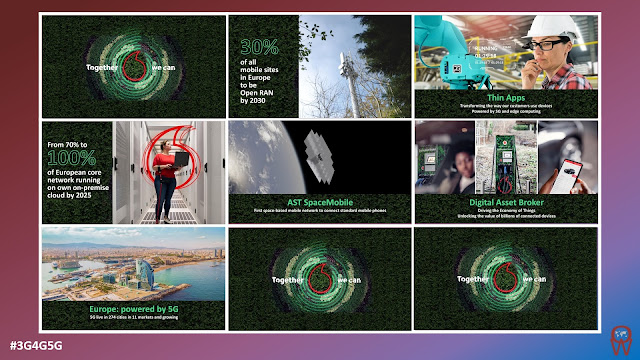
I have just presented at Mobile World Congress #MWC22 and was delighted to announce that around 30% of our European network will run on #OpenRAN by 2030, following the first site going live in the UK last month. This will give us more flexibility and speed in how we operate.

It is also an example of how innovation is coming back to the network.

Disruptive technologies such as Open RAN, Network as a Platform and Multi-Access Edge Computing are perfect illustrations of how we are meeting demand for fast connectivity, as well as driving supply chain diversity, creating digital eco-systems, and inventing new industrial-strength applications.

Also, through our scaled platforms – M-PESA, IoT and now Digital Asset Broker (DAB) – combined with our geographical scale, we aim to help support the digital needs and ambitions of our customers and societies across Europe and Africa.

Around 30,000 sites across Europe will eventually use OpenRAN, with rural areas the first to benefit from the new 4G and 5G masts. When the roll-out reaches cities, the equipment from any existing 5G masts being replaced will then be reused elsewhere to reduce unnecessary wastage.

A press release release from Vodafone has details here. 

Their MWC22 page has more related news on this and other topics they discussed in Barcelona.

In another news Vodafone announced that seven UK communities is set to receive 4G based on Open RAN. Last year we wrote about their first Open RAN site with Samsung here. At that time it was assumed that Samsung is bring 2G (GSM) but Light Reading recently mentioned that Samsung hasn't got 2G. 

Parallel Wireless has been in Vodafone Turkey network for the last few years doing 2G and 4G as we detailed before. In a press release, Juniper Networks announced that it is working with Vodafone and Parallel Wireless conducting a multivendor RAN Intelligent Controller (RIC) trial for tenant-aware admission control use cases. It says:

The trial, initially running in Vodafone’s test labs in Turkey and with plans to move into its test infrastructure, supports O-RAN interfaces and addresses the key business challenges faced by mobile operators around personalized user experience, viable revenue generation and reduction in both CAPEX and OPEX for 4G and 5G services.

The trial is based on an open, software-driven architecture that leverages virtualization to deliver more programmable, automated granular-by-user traffic management. The initial focus is on delivering tenant-aware admission control capability, enabling operators to personalize services and provide superior user experiences. Real-time tracking and enforcement of radio resources across the RAN enables mission-critical users – for example, hospitals and schools – to receive prioritized mobile data services delivery. This capability is enabled by Juniper’s rApp/xApp cloud-based software tools that manage network functions in near real-time, along with Parallel Wireless cloud-native Open RAN functions.

The trial’s design philosophy is focused on demonstrating the potential of enabling open, agile resource management and mobile data delivery in any software-driven RAN environment. This approach enables services and applications to be managed, optimized and mitigated automatically by the RAN, built on real-time data insights from its own performance.

All three organizations are active operators/contributors of the O-RAN ALLIANCE and the Telecom Infra Project (TIP), underlining their shared commitment to industry innovation and standards.

Juniper’s RIC solution is architected as an open platform supporting open interfaces on the north bound and south bound side, enabling easier integration with Open RAN partners in the ecosystem. Juniper’s RIC platform will also enable easy integration of third-party rApps/xApps, using UI-based onboarding and deployment tools coupled with flexibility to select between either network-based or SDK-based APIs (Application Programming Interfaces).

Parallel Wireless brings cloud-native Open RAN solutions - which are now integrated with the leading-edge RAN Intelligent Controller (RIC) based on O-RAN ALLIANCE specifications from Juniper Networks, giving operators more choices to build the best-of-breed RAN.

Juniper has a short RIC explainer video which is embedded below: 

Telecom TV reminds:

It’s no coincidence that Juniper is involved in Open RAN tests and trials in Turkey: It engineered its way into the RIC R&D scene by striking a deal in January 2021 to take the early RIC work undertaken by Netsia, the tech R&D unit at Türk Telekom, and develop it further, all the while ensuring that the resulting platform would not only conform to Open RAN specifications but also be suitable for deployment by Türk Telekom. As part of that deal, Juniper gained all the IPR and rights, and so has bene able to take it into tests with other operators at will.

Related Posts:

Tuesday, 29 June 2021

Vodafone UK Selects Commercial Open RAN Network Partners

Vodafone has been a huge supporter of the Open RAN movement. Not only have they supported it with projects, expertise, etc., they have also contributed their IPR to TIP to drive it further. Last year, I wrote about how they have been evangelizing the benefits to other operators. Now, Vodafone has unveiled its strategic vendors – Dell, NEC, Samsung Electronics, Wind River, Capgemini Engineering and Keysight Technologies – to jointly deliver the first commercial deployment of Open Radio Access Network (RAN) in Europe. A press release said:

The company believes the move will spark other large-scale Open RAN launches and spearhead the next wave of digital transformation across Europe.

Pioneered by Vodafone and its partners, Open RAN will drive greater innovation through a diverse and open vendor ecosystem. It will lead to a more cost-effective, secure, energy efficient and customer-focused network of the future.

Vodafone’s initial focus will be on the 2,500 sites in the UK that it committed to Open RAN in October 2020. It is one of the largest deployments in the world and will be built jointly with Dell, NEC, Samsung and Wind River. Vodafone also expects to use new radio equipment defined under the Evenstar programme, a joint initiative it contributes to. Capgemini Engineering and Keysight Technologies are providing support to ensure interoperability between all the components.

Starting this year, the vendors will work with Vodafone to extend 4G and 5G coverage to more rural places across the South West of England and most of Wales, moving into urban areas in a later phase. Vodafone is also working to launch Open RAN in other countries within both Europe and Africa, enabling the digital society to be accessible to all, with no one left behind. 

Under this initiative to deliver an open and disaggregated network in the UK, Samsung will be a reference RAN software provider. Samsung and NEC will supply Massive MIMO – a method to boost capacity of a mobile antenna – along with Samsung and Evenstar radio units, which establish a signal between users’ smartphones or devices and the mobile mast.

Evenstar radios are part of a joint effort between Facebook and Vodafone to create ‘white-box’ radio units within the Telecom Infra Project (TIP) and are a key component for Open RAN success. These will provide vendors with detailed specifications needed to develop compatible radio units much more cheaply, and are designed to encourage new players to the market to boost the ecosystem and stimulate innovation.

The initial deployments will be implemented using COTS (common off the shelf) Dell EMC PowerEdge servers to support the combined DU/CU function running Containers as a Service (CaaS) software from Wind River Studio, which will provide a distributed cloud-native platform hosting the Open RAN applications and virtualised RAN from Samsung. This gives Vodafone the benefit of being able to mix and match and install new software releases and upgrades more easily. 

Keysight Technologies will deliver its comprehensive Open RAN test solution portfolio designed to support conformance, interoperability and E2E system testing. Capgemini Engineering will be the key partner within our lab testing to ensure interworking of the Open RAN multi-vendor ecosystem.

The O-RAN Alliance 7-2x split, that defines the interface between the radio antenna and the baseband unit, will be used in the deployments, following successful test and simulations that make it the option of choice. The resulting Open RAN network is expected to improve energy efficiency compared to the existing solution from traditional widely deployed RAN products.

In addition, Vodafone is working with several chipset suppliers, including an important research & development (R&D) collaboration with Intel, whose role in developing Open RAN is widely recognized in the industry. Vodafone’s Open RAN Test and Integration lab in Newbury, UK, has been devised to be an innovation centre to foster collaboration and implement new ideas. In this space, Vodafone’s newly announced partnership with Qualcomm will provide solutions that will be added to the project in the future.

The new Open RAN lab will be complemented by two newly created European digital skills hubs in Málaga and Dresden, employing 600 and 200 people respectively. Opening later this year, the skill hubs will be used to develop a number of new solutions for businesses, including cyber security, mobile private networks and Open RAN.

Vodafone is working with other operators to lower the entry barriers for smaller vendors and startups. Recently published Open RAN technical requirements by Vodafone and other telecommunications companies will provide a blueprint to help expedite the development of new products and services based on industry specifications from the O-RAN Alliance (of which Vodafone is a member) and eventually ETSI standards (from the European Telecommunications Standards Institute), always compatible with 3GPP.

There was a considerable amount of confusion regarding different G's and Core, etc. It was all clarified in a Tweet from VF UK Communications Manager as can be seen above. It seems that Samsung went off and dusted their 2G stack to support a legacy technology along with 4G and 5G.

Related Posts:

Thursday, 27 May 2021

Ethiopia to get a new Mobile Network Operator that will provide 4G & 5G


Ethiopia has been talking for a long time about getting a new MNO. Finally, they may have one.

Bloomberg reported:

Ethiopia awarded a new telecommunication license to a consortium including the U.K.’s Vodafone Group Plc, paving the way for a long-awaited opening of the sector to outside investors.

The government of the Horn of Africa country had received two offers. The consortium led by Safaricom submitted a bid of $850 million, according to the prime minister. The other from MTN Group Ltd., Vodacom’s Johannesburg rival, and partners including the Silk Road Fund, a Chinese state investment group, was for $600 million.

The winners -- Vodafone, Vodacom Group Ltd., in which the British carrier has a majority stake, and Nairobi-based Safaricom Ltd. -- will invest $8.5 billion in their network during the coming 10 years, including the license fee. Others include CDC Group Plc and Sumitomo Corp.

The government of the Horn of Africa country had received two offers. The consortium led by Safaricom submitted a bid of $850 million, according to the prime minister. The other from MTN Group Ltd., Vodacom’s Johannesburg rival, and partners including the Silk Road Fund, a Chinese state investment group, was for $600 million.

Al Jazeera added:

The Safaricom-led consortium will provide 4G and 5G internet services, and by 2023 a low-orbit satellite will be put in place to provide nationwide 4G coverage, Brook said.

“A momentous day for Ethiopia!” he wrote on Twitter.

“Imagine the quality service and efficiency it will engender, the new opportunities, millions of jobs and the transformative effect to our economy!”

Ethiopia’s telecoms reforms also include a plan to sell a stake in Ethio Telecom, a move officials hope will make the firm more efficient.

It should be noted that last year, Vodafone group invested in AST & Science's SpaceMobile to Beam 4G / 5G Directly to Devices. Nick Read, CEO, Vodafone Group, said: “At Vodafone we want to ensure everyone benefits from a digital society – that no-one is left behind. We believe SpaceMobile is uniquely placed to provide universal mobile coverage, further enhancing our leading network across Europe and Africa - especially in rural areas and during a natural or humanitarian disaster - for customers on their existing smartphones.”

There is very little information on Global Partnership for Ethiopia available at the moment. This Wikipedia article has some details that will hopefully be expanded later on.

Related Posts:

Wednesday, 25 November 2020

Turkey Plans 5G Rollouts in 2021 with Demand Expected from 2022 Onwards


It's been 3 years since we last wrote about Turkey. Turkey’s telecoms sector continues to make great strides with its 5G implementation. The operators have conducted significant trials, largely supported by Ericsson and Huawei. LTE networks are already well established across the country, providing population coverage of over 93%. Many base stations have been upgraded to LTE-A.

Deployment of fibre-based broadband networks are also well underway in Turkey and while DSL services are still the leading fixed broadband access method - it will eventually lose its dominance due to the rapid growth in fibre subscriptions.

Turkey’s fixed and mobile infrastructure will help to underpin its Smart City initiatives, which have become a key area of focus for the future. Turkey recently released its National Smart Cities Strategy and Action Plan which will run for 3 years, between 2020-2023

BuddeComm notes that the outbreak of the Coronavirus in 2020 is having a significant impact on production and supply chains globally. During the coming year the telecoms sector to various degrees is likely to experience a downturn in mobile device production, while it may also be difficult for network operators to manage workflows when maintaining and upgrading existing infrastructure. Overall progress towards 5G may be postponed or slowed down in some countries.

On the consumer side, spending on telecoms services and devices is under pressure from the financial effect of large-scale job losses and the consequent restriction on disposable incomes. However, the crucial nature of telecom services, both for general communication as well as a tool for home-working, will offset such pressures. In many markets the net effect should be a steady though reduced increased in subscriber growth.

There are three network operators in Turkey: Turkcell, Vodafone and. Türk Telekom (formerly called Avea).

Like in Europe, 2G GSM is on 900 and 1800 MHz, 3G on 2100 MHz. Nationwide Turkcell has the best coverage, followed by Vodafone and Avea. If you stick mainly to the cities, it does not make any difference which of the three providers to choose.

In 2015 the regulator auctioned off licenses on 800, 900, 1800, 2100 and 2600 MHz bands for 4G/LTE (Bands 3, 8, 1 and 20) . All three providers launched 4G/LTE in 2016. It has been marketed from the start as "4.5G", otherwise known as LTE+ or LTE Advanced, accelerated by carrier aggregation where available in major cities in all 81 provinces from the start. Coverage is generally quite good: Turkcell has the best, followed by Vodafone and Türk Telecom with the least.

According to the recent report by Open Signal, Turkcell was to be the dominant operator across the majority of their network experience metrics. Turkcell managed to win in four out of their seven award categories — 4G Coverage Experience, Video Experience, Download and Upload Speed Experience — and each one of them by a large margin. The operator also came close to challenging its peers in the remaining three, but failed to beat Türk Telekom on Voice App and Games Experience, as well as Vodafone on 4G Availability.


Turkcell is the biggest operator in the country with 34 million mobile subscribers and 46.8 percent of the market share. 2G is on 900 MHz, 3G on 2100 MHz. In 2015 Turkcell’s population coverage was at 99.8% in 2G and 95% in 3G. Turkcell launched their "4.5G" LTE in 2016 using tri-band aggregation of 800, 1800 and 2600 MHz frequency bands. 4G/LTE is free to prepaid. Turkcell is known to have the best coverage in the countryside.

Turkcell has transformed its LTE and 5G voice network into 100% virtual infrastructures using Mavenir’s cloud-native, NFV-based IMS solution. Mavenir’s Virtualized IMS (vIMS) solution is designed to support LTE use cases and evolve into a fully web-scale platform that can meet growing requirements.

Vodafone is the 2nd operator in terms of coverage. 2G on 900 MHz, 3G on 2100 MHz, 4G/LTE was launched in 2016. It has a good coverage in the country, slightly worse than Turkcell, but better than Türk Telekom.

Vodafone has conducted extensive trials on Open RAN technology with the OpenRAN leader Parallel Wireless. These trials resulted in the creation of a Playbook with the help of Telecom Infra Project (TIP) OpenRAN group.

This playbook is developed by teams from Vodafone and Parallel Wireless to capture the learnings from this trial deployment where brownfield sites in Turkey were swapped with OpenRAN solutions for 2G/3G/4G, evaluating the technical and operational KPIs in the process. The playbook helps the OpenRAN community members, RAN solution providers, network operators, and system integrators take an informed approach to the selection of technology and the planning of OpenRAN deployments. It's available here.

In 2016 Türk Telekom rebranded its mobile network from Avea, but you see their old sign still sometimes. It's the smallest provider in Turkey in terms of coverage, but they have still good speeds in the cities and a fair coverage in the countryside. 2G is on 900 and 1800 MHz, 3G on 2100 MHz, 4G/LTE was launched in 2016. It still has the lowest coverage in the countryside, but is strong in cities.

A recent GSMA report, Roadmaps for awarding 5G spectrum in the MENA region, October 2020, mentioned that BTK, the Turkish regulator, has outlined its 2019-2023 strategic objectives under nine main themes in a 105-page long document. These objectives include detailed discussions on support for research and development activities to establish ‘5G and beyond’ national technologies; expanding fibre optic infrastructure to support fixed, mobile and cable broadband technologies; support for emerging technologies, e.g. IoT/M2M; and development of national cyber security capabilities.

The New Generation Mobile Communications Technologies Turkey Forum (5GTR Forum) was established in 2016 to coordinate activities of industry and academia relating to the development of 5G technology in Turkey. The forum produced a 338-page long ‘white book’ titled ‘5G and Beyond’. The report provides a set of recommendations for the development of physical layer, core network and terminals as well as how individual verticals could benefit from the use of 5G technology.

In terms of spectrum allocations, the report notes that the bands 470-694 MHz, 694-790 MHz, 1427-1518 MHz, 2300-2400 MHz, 2500-2690 MHz140, 3400-3800 MHz, 24.25-27.5 GHz, 40-43.5 GHz and 66-71 GHz are planned for mobile broadband systems in the short (before 2023), medium (2023-2028) and long (beyond 2028) term.

5G trials are being conducted, including:

  • Turk Telekom live trials for 3.5 GHz band; and
  • Turkcell field trials for 26/28 GHz and 3.5 GHz.
  • Vodafone has planned its 5G trials but is yet to operationalise them.

Related Blog Posts:

Sunday, 22 November 2020

Vodafone Accelerates Open RAN Innovation, Evangelizes Benefits to Other Operators

Vodafone has taken a lead in Open RAN trials and deployments. It has been very active in the Telecom Infra Project for the last 3 years but it has become more vocal and active recently. In addition to all the announcements, it has also released an eBook available here. 


Back in August, Vodafone become the first UK mobile operator to switch on a live Open Radio Access Network (OpenRAN) 4G site enabling the introduction of more suppliers for mobile networks. The first site is connecting Vodafone customers around the Royal Welsh Showground in Powys, Wales. This was using the kit from Mavenir. Mavenir Open RAN Demo from TIP Summit 2019 is available here. 

Earlier this month, Vodafone reiterated again that it will deploy the open interface, disaggregated radio access network technology at a minimum of 2,600 sites in the UK by 2027, the year by which UK operators must have rid themselves of Huawei gear. A Vodafone spokesperson fleshed out the strategy in a call with TelecomTV. 

The 2,600 sites is a minimum commitment: That number of sites, which have already been identified and which are in rural areas of the UK (in the south-west), will be built out with Open RAN technology. Vodafone has started its vendor evaluation process, expects to select its suppliers in 2021, and will begin deployments in 2022. 

It is not sharing any details about the capex it has set aside for Open RAN or which companies are at the front of the queue to be selected, though the likes of US vendor Mavenir and UK startup Lime Micro, which have been working with Vodafone UK on Open RAN trials in Wales, will clearly be hoping to be involved. But there will be plenty of competition from other specialists, such as Altiostar, Parallel Wireless and Comba Telecom, as well as bigger names such as Fujitsu and NEC (which, with Altiostar, is working on Open RAN trials with Vodafone Netherlands).

This week, Vodafone Ireland announced partnership with Parallel Wireless on Ireland’s first Open Radio Access Network (OpenRAN), bringing 4G coverage to 30 new locations. The sites are being built on an O-RAN architecture with a Remote Radio Unit (RRU) provided by Comba Telecom, Parallel Wireless Distributed Unit (DU) and Central Unit (CU) software running on a vBBU (virtual Baseband Unit) provided by Supermicro and deployed on site. The DU/CU software connects to Parallel Wireless' Near Real-time Intelligent Controller (RIC), located in a Dublin data center on HP hardware using VMWare ESXi v6.7 virtualized environment. Parallel Wireless Open RAN Demo from TIP Summit 2019 is available here.

Johan Wibergh, Group Chief Technology Officer at Vodafone said in a LinkedIn post, "OpenRAN continues to gain traction. Vodafone will be the first company in Ireland to use this exciting new technology to deliver 4G coverage more quickly to 30 locations in remote parts of the country. This is a major boost to rural communities in need of a digital lifeline. Well done to the team. The news follows hot on the heels of the OpenRAN UK plans unveiled recently and underlines our commitment to helping new, smaller suppliers enter the market. With the OpenRAN ecosystem still in its infancy, it needs continued industry and government support across Europe."

At the Open RAN summit 2020, Yago Tenorio, the current Chairman of the Telecom Infra Project (TIP) and Head of Group Network Architecture at Vodafone, outlined the international operator’s Open RAN developments and plans, highlighted the importance of open networking for the future of communications service providers, and identified the key areas of development that need to be addressed if Open RAN technology is to play a major role in carrier networks of the future and help deliver 5G’s potential. Thanks to Telecom TV for making all the talks available here. His talk is embedded below.


Related Posts:

Saturday, 14 September 2019

Vodafone: Creating Europe's Largest Tower Company

Earlier this year Vodafone unveiled plans to spin off or float its telecom tower business, a company that would be valued at up to £18 billion and rocket into the FTSE 100.

The new standalone business, called TowerCo, will own Europe’s largest tower portfolio, comprising approximately 61,700 towers across 10 countries, with 75% of these sites in the major markets of Germany, Italy, Spain and the UK. Total towers comprise 19,300 in Germany, 11,000 in Italy, 9,700 in Spain (adjusted for the sharing deal with Orange), 6,600 in the UK (representing 50% of total UK towers, consistent with Vodafone’s ownership of Cornerstone, the 50:50 joint venture company that owns and manages its passive infrastructure) and 15,100 in Other Europe (excluding VodafoneZiggo). The masts provide mobile coverage across each country allowing phone owners to make and receive calls and use data to access apps and websites. Income comes from leasing space on each mast to rivals offering their own mobile phone networks.


The business is estimated to generate about €1.7bn in revenues and €900m profits, leading analysts to value the business at between €15bn and €20bn, based on valuations of other mast businesses.


The deal would also allow Vodafone to focus on selling broadband and developing 5G services. TowerCo would allow rival telecom companies to share infrastructure, a move that will please City planners and environmentalists worried about the growth of the masts. The new company should be operational by May 2020. 

According to Nick Read, Vodafone’s chief executive:

“We are now creating Europe’s largest tower company. Given the scale and quality of our infrastructure we believe there is a substantial opportunity to unlock value for shareholders.”
Shares in the world’s second largest mobile operator climbed almost 10% as investors relished the prospect of a windfall from a sale or initial public offering of Europe’s largest towers company.

Vodafone intends to use the proceeds from the sale programme to reduce its levels of debt, 
which reached €48bn when the company completed its €18.4bn deal to buy Liberty Global’s German and eastern European cable assets. 

Vodafone has also spent €4bn on 5G spectrum as prices ballooned in auctions in Germany and Italy during the past year. According to George Salmon, equity analyst at Hargreaves Lansdown.

“Yes, Vodafone will lose the profits associated with running the towers, but it will also remove the €200m of annual spending tied up maintaining and expanding the network. So it’s easy to see the logic for the deal, especially since the group’s debts are fairly pressing.”
Vodafone has launched 5G roaming in 55 towns and cities across Italy, Spain, Germany and the UK. However, coverage remains limited, as the company only switched on 5G in Britain in July 2019.

Towers have become a key trading asset for cash-strapped European telecoms companies in Europe, with businesses including Telefónica, Iliad, Altice, Sunrise and BT selling masts.


US and African carriers were quicker to sell their towers than their European peers but the rising value of infrastructure assets has led many networks to consider deals to generate cash for 5G investments. That has given rise to specialist tower businesses including Spain’s Cellnex, which has built a base of 45,000 masts largely via acquisition. 

Tuesday, 3 September 2019

Africa: The Race For No. 2 Operator

MTN is the largest mobile operator group in Africa with roughly 168 million subscribers, but who is number 2?

Airtel just crossed 100 millions subscribers in Africa and many news sites have started calling them the second largest operator group in the region. Livemint for example reported:

Bharti Airtel’s Africa arm has crossed the 100-million customer mark across its operations in the continent, the company said in a statement on Wednesday.

This is significant for the company, which entered the continent in 2010. Airtel Africa is currently the second-largest mobile operator in Africa by the number of active subscribers; South Africa’s MTN is the largest.

Airtel Africa is the holding firm for Bharti Airtel’s operations in 14 countries in the continent across three regions — Nigeria; East Africa, comprising Kenya, Uganda, Rwanda, Tanzania, Malawi and Zambia; and the rest of Africa, including Niger, Gabon, Chad, Congo Brazzaville, the Democratic Republic of the Congo, Madagascar and Seychelles. Nigeria alone accounts for almost half of its earnings before interest, taxes, depreciation and amortisation (Ebitda).


According to this Bloomberg article, back in July 2019, Airtel was the 4th largest by subs numbers.

  • MTN 167.7 million 
  • Orange 120 mil 
  • Vodacom 110 mil 
  • Airtel 98.9 mil

There is a small caveat though. While MTN does not include Middle East, Orange does. Again, Vodacom includes Safaricom in which it has around 35% stake. Vodafone, Vodacom’s parent (64.5% stake), had an additional 49.3 million customers in its operations in Egypt and Ghana at the end of June. If we include Vodafone, Vodacom and Safaricom, it would be going head-to-head with MTN for the top place.

The Guardian, Nigeria has a good summary of the top 4 mobile operators in Africa here.


Related Posts:

Thursday, 11 April 2019

Angola's Emerging Telecom Sectors


Angola is Africa’s second largest oil producer after Nigeria, with a population of approximately 30 million. Its telecom sector has shown consistent recovery following the end of a decades-long civil war in 2002. ICT growth has largely been driven by economic growth from the country’s large oil reserves. 


Political stability has encouraged foreign investment while the government and regulator have started the process of opening up the telecom sector to new competitors. 


The market is a duopoly between UNITEL and MOVICEL.  

Unitel, has 70% of the subscription market share. It is the most preferred provider and oldest GSM mobile network in Angola. Their network covers every major population area and with about 11 million subscribers (including pre-paid), it has a market share of 80%. The network has nationwide 2G coverage in 900 and 1800 MHz bands, UMTS in 2100 MHz and 4G LTE coverage on 1800 MHz (band 3) in Luanda Province.


The remaining 30% is held by Movicel with roughly 3 million subscribers. The company was set up by state-owned Angola Telecom initially using the CDMA technology, but was for 80% privatized later and moved to using GSM based technology. The network utilizes 900 Mhz and 1800 MHz bands for 2G and 2100 MHz for 3G with 4G/LTE coverage on 1800 MHz (band 3) in the provinces of Luanda, Cabinda and Benguela allowing speeds up to 75 Mbps. Movicel has phased out CDMA in March 2016 to make way for digital terrestrial television.


Both operators introduced LTE in 2012, one of the earliest launches of this mobile broadband technology in sub-Saharan Africa. With Long Term Evolution (LTE) rapid expansion and slowdown in 2G and 3G services, the Angola telecom market is evolving rapidly.

Movicel have recently signed a strategic consultancy agreement with Vodafone Group,  to collaborate in a number of business areas. Under the terms of the non-equity agreement, Vodafone will provide “strategic and operational support” in areas including consumer marketing, technology and business operations. It will also see the pair “collaborate on further potential opportunities to benefit their customers”, the companies said in a statement.

Sunday, 27 January 2019

World's largest mobile networks by subscriber numbers - Jan 2019

Here is a list of top 10 mobile networks by subscribers. The list is very dynamic as some operators grow while others shrink. The best example of operator that has been growing rapidly, overtaking others is Reliance Jio.


1. China Mobile, China, 925 million [1]

2. Vodafone Group, UK, 536 million [6]
Note: Vodafone Idea, India has 422 million subscribers [2]

3. Bharti Airtel Group, India, 413 million [4]
Note: Airtel India has 329 million subscribers [3]

4. China Unicom, Hong Kong, 315 million [1]

5. China Telecom, China, 303 million [1]

6. Reliance Jio, India, 280 million [6]

7. América Móvil Group, Mexico, 279 million [5]

8. Telefónica Group, Spain, 272 million [7]

9. MTN Group, South Africa, 221 million [9]

10. Veon Group, Netherlands, 211 million [8]
10. Orange Group, France, 211 million [10]*

* = added later

[1] https://www.mobileworldlive.com/asia/asia-news/china-telecom-narrows-subs-gap-to-unicom/
[2] https://discover.vodafone.in/about-us/home?section=consumer
[3] https://www.airtel.in/about-bharti/equity
[4] https://www.airtel.in/about-bharti/about-bharti-airtel?icid=footer
[5] http://q4live.s22.clientfiles.s3-website-us-east-1.amazonaws.com/604986553/files/doc_financials/quarterly/2018/3Q18.pdf
[6] https://www.mobileworldlive.com/asia/asia-news/jio-profit-surges-on-continued-subs-gains/
[7] https://www.telefonica.com/en/web/shareholders-investors/financial_reports
[8] https://veon.com/Global/Files/Reports/3Q18/Q3%202018-Full%20announcement.pdf
[9] https://www.mtn.com/MTN%20Service%20Detail%20Quarterly%20Quarterly%20Trading%20Upd/MTN_Q12018_Results.pdf
[10] https://rai2017.orange.com/orange2017-content/uploads/2018/05/orag_1802135_ra_150x210_gb_mel.pdf

Sunday, 2 September 2018

Global Top 20 Telcos by Revenue


Source: Global 100 Total Telecom via Elena Neira

AT&T, Verizon, China Mobile and NTT have maintained their top four positions in 2017 while Softbank has slipped one place to let Deutsche Telekom become the fifth largest operator by revenue. Other top 20 players by revenue include Telefónica, Vodafone, China Telecom, América Móvil, Orange, Comcast, China Unicom, KDDI, British Telecom (BT), Charter, Altice, Telecom Italia, Telsta and KT

Related posts:

Friday, 19 September 2014

Chinese carriers dominate global operator ranking as M&A deals shake up US market

All three Chinese mobile operators feature in the top ten in GSMA Intelligence’s latest ranking of mobile operator groups, underlying China’s status as the world’s largest mobile market.
The study ranks global operators using a model based on reported mobile connections and mobile revenue (see methodology below). China Mobile was comfortably the largest group by both measures, reaching 790.6 million mobile connections and recording annualised revenue of £66.4 billion for the period to Q2 2014. China Mobile’s two domestic rivals, China Unicom and China Telecom, are ranked third and tenth, respectively.
The remaining positions in the top ten were filled predominantly by operator groups with substantial global footprints across multiple markets, including Vodafone, Telefónica, América Móvil, Deutsche Telekom, Orange and VimpelCom.
Notes on methodology
Subsidiaries are included within a parent group as per reported consolidation. Minority holdings (less than 50 percent plus one share) are included where a group does so within its audited financial statements.
Data for connections is shown as the period-ending value, excluding customers from any subsidiaries that have been divested over the course of the year. Revenue data is annualised, such that revenue attributed to any qualifying subsidiary is included on a quarterly basis over the four quarters provided the subsidiary meets the rules for consolidation in the respective quarter.
The ranking gives equal weighting to period-ending connections and annualised mobile revenue in determining final positions. The ranking by connections and revenue is combined to give an overall ‘score’, with a lower combined score ranking higher. For example, Vodafone is ranked second by connections and fifth by revenue, giving it a combined score of 7 (2+5). This ranks the group second behind China Mobile, which scores 2 (1+1), as it the largest group by both connections and revenue. Where scores are tied, the rank by connections is used as the deciding factor.


Wednesday, 30 April 2014

EE, O2, Three & Vodafone 4G: Which is best?

Which network is best value?
4G doesn't quite live up to the 60Mbps advertised speeds as we topped out at 40Mbps. Around congested urban areas like London you can expect speeds to average between 10 - 20Mbps.
Real-world results showed there was little to separate EE, O2 and Vodafone in terms of raw download speeds. Three was slightly slower but you can still expect 10Mbps+ in most areas.
The networks take a different approach to try and attract customers. EE focuses strengths like widespread coverage and consistent high-speeds. 
Three might not be the fastest but it is the cheapest and the only network which provides true all-you-can-eat data, so you don't need to worry about going over data limits. It is also the only network to allow you to use your allowance in the US, so if you're a frequent traveller this will prove invaluable.
O2 and Vodafone offer similar high-speeds and enticing add-ons. O2 offers subscriptions to Evernote and The Sun+, whereas Vodafone throws in access to Sky Sports Mobile or Spotify Premium.
Ultimately, it's going to depend on the reception. For many people in the UK, the only way to currently get 4G will be to sign up to EE as it offers coverage in areas other networks haven't reached.
Make sure you check every operator's coverage checker before signing up to a plan. Also take time to look at the benefits offered:
Recommendations:
EE - This is the network if you need the widest possible 4G coverage and consistent high-speeds and you're not too interested in add-ons.
O2 - Only if you live in or around one of the 13 big cities and you want access to discounts through the Priority Hub and  subscriptions to Evernote and The Sun+
Vodafone - Covers a third of the UK. This one is for sports or music fans as you get the choice between subscriptions Sky Sports Mobile and Spotify Premium. 
Three - Not the fastest, but the network of choice for those who don't want to be constrained by a data limit. Also allow you to use your allowance in the US.


Read more: http://www.itpro.co.uk/mobile/22048/ee-o2-three-vodafone-4g-which-is-best#ixzz31Ugt0IU2

Tuesday, 1 April 2014

Mobile operators in UK


EE

It is the largest mobile network operator in the UK, with around 28 million customers.
Virgin Mobile UK along with ASDA Mobile operates on the EE network under a MVNO agreement.
http://en.wikipedia.org/wiki/EE_(telecommunications_company)

Voda phone

The world's second-largest mobile phone company. As of March 2012, Vodafone UK has 19.2 million subscribers and is the third largest mobile telecommunications network nationally after EE and O2.
http://en.wikipedia.org/wiki/Vodafone_UK

02

It is the second-largest mobile telecommunications provider in the United Kingdom (after EE).
http://en.wikipedia.org/wiki/O2_(United_Kingdom)

Three
http://en.wikipedia.org/wiki/Hutchison_3G#United_Kingdom
http://en.wikipedia.org/wiki/List_of_United_Kingdom_mobile_virtual_network_operators

http://www.independent.co.uk/life-style/gadgets-and-tech/ee-crowned-uks-best-mobile-operator--vodafone-in-last-place-9189018.html
Britain operates on a GSM network.

http://ukmobilecoverage.co.uk/

Britain's largest mobile operator, EE, said on Monday it posted its best quarterly take-up of its 4G network in the first three months of 2014 due to growing demand for fast mobile Internet and forecast customer numbers more than doubling in 2014.
EE, a joint venture between Orange and Deutsche Telekom, said it added another 889,000 customers in the three months to March 31, taking its customer base to 2.9 million with nearly 5,100 corporate clients.
EE, formerly known as Everything Everywhere, said it was on target to exceed 6 million 4G customers by the end of 2014.
Despite the growth, the company said turnover during the quarter dropped 3.6 percent from a year ago to 1.6 billion pounds ($2.7 billion).

Operating revenue was down 1.7 percent on a year ago to 1.5 billion pounds which included the impact of regulatory cuts.
http://uk.reuters.com/article/2014/04/28/ee-results-idUKL6N0NK1RX20140428