Showing posts with label Operator m:tel. Show all posts

Sunday, 23 January 2022

Montenegro is Ripe for 5G!


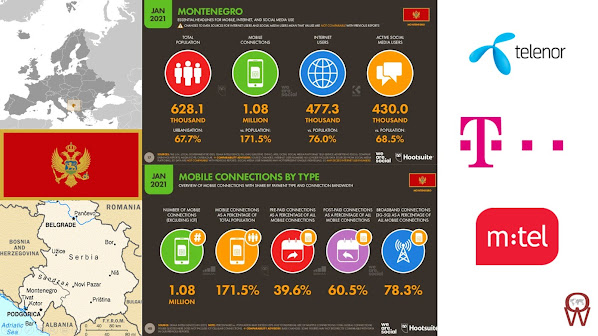
Montenegro has a small telecom market supported by a population of only 623,000. Fixed broadband services are available via a variety of technology platforms, though fibre is the dominant platform, accounting for almost 40% of connections. The growth of fibre has largely been at the expense of DSL as customers are migrated to fibre networks as these are built out progressively.

Mobile penetration is particularly high, though this is partly due to the significant number of tourists visiting the country seasonally, as also to the popularity of subscribers having multiple prepaid cards. In the wake of the pandemic and associated restrictions on travel, the number of mobile subscribers fell in 2020, as also in the first quarter of 2021, year-on-year. Networks support a vibrant mobile broadband services sector, largely based on LTE. 

Two of the MNOs began trialling 5G in May 2021. Montenegrin regulator EKIP (Agency for Electronic Communications and Postal Services) confirmed that the country’s latest round of spectrum auctions saw 220MHz of frequencies sold. The auctions were conducted in late December, with spectrum in the 900MHz, 1800MHz, 2GHz and 2.6GHz bands available for bidding. Licences obtained during the auctions are valid between 21st April 2022 and 1st September 2031.

Montenegro has three network operators: Telenor, Crnogorski Telekom and M:tel. M:tel had a 34.61% share of the overall number of subscribers at the end of May 2021, followed by Crnogorski Telekom with 34.27% and Telenor with 31.12%.

All operators have good coverage in 2G on 900 and 1800 MHz, and on 3G on 2100 MHz. Also, all of them offer 4G/LTE on 800 (B20), 1800 (B3) and 2600 (B7) MHz. The tax of €1 per month for users of mobile telephony that was in place 2012-14, has been abolished again. 5G hasn't started yet, but is in testing phase.

Telenor (formerly Promonte) was owned by the Norwegian provider and sold in 2018 to the Czech PPF Group. It covers already 98% of the population with 3G and 4G/LTE and has recently surpassed T-Mobile in customer numbers. From 2016 4G/LTE was made available for prepaid.

For the second time in a row, Telenor received the "Best in Test" award at the independent measurement of the quality of mobile networks in Montenegro, conducted by Umlaut from November 2020 to April 2021.

PPF Telecom Group has entered into a final agreement to sell a 100% stake in mobile network operator (MNO) Telenor Montenegro to Hungarian technology company 4iG for an undisclosed price. The transaction, which is subject to customary regulatory clearances, is expected to be completed before the end of 2021.

Telenor Montenegro claims 475,580 mobile subscriptions and a leading 37% share of the market at 30 September 2021. Private investment company PPF Group acquired Telenor’s assets in Montenegro, Hungary, Bulgaria and Serbia in 2018 in a deal valued at USD3.3 billion.

Crnogorski Telekom (a.k.a. T-Mobile, formerly Monet) owned by Croatian Telekom (indirectly by Deutsche Telekom) has a good coverage on 2G, 3G and 4G rivalling with Telenor. In 2016 they finally opened 4G/LTE for prepaid too. They cover 70% by the end of 2016 with 4G/LTE using 800, 1800 and 2600 MHz.

Crnogorski Telekom (CT) has begun 5G network testing in Bijelo Polje and Berane, making it the first telecoms operator in Montenegro to successfully test a 5G network at several locations in real world conditions using existing 2100MHz frequency spectrum. The operator received support from the Deutsche Telekom group and hardware partner Ericsson for the tests, which were performed in coordination with the Agency for Electronic Communications and Postal Services (EKIP) and the Faculty of Electrical Engineering of Montenegro.

m:tel is the newest operator in the country, but battles hard for its position. It's a joint venture between Telekom Srbija and Telekom Srpske. Coverage is in 2G, 3G and 4G/LTE.

Back in November, Montenegro’s telecoms watchdog, EKIP, launched a public tender to award technology neutral licences for wireless frequencies in the 900MHz, 1800MHz, 2GHz and 2.6GHz bands for mobile telephony services. The bidding is scheduled to take place between 1 and 24 December 2021 and the concessions will be valid until 1 September 2031.

The auction was conducted using a combined format of a multi-round clock phase and a single round of sealed bids. Participation is open to companies and consortia with at least five years of experience in public mobile electronic communications network operation and service provision.

Mtel was the biggest spender, shelling out EUR5.911 million to acquire permits in the 900MHz, 1800MHz, 2GHz and 2.6GHz bands. Meanwhile, Telenor and Crnogorski Telekom each acquired 2.6GHz licences with respective bids of EUR825,011 and EUR350,000. CommsUpdate notes that the auctions generated a total of EUR7.086 million (US$8.027 million), with four 5MHz blocks in the 2.6GHz band – worth around EUR192,000 – going unsold.

Thursday, 22 October 2020

Bosnia and Herzegovina - the last European Country with 4G is Not Ready for 5G

The Bosnian telecom market has been liberalised and a regulatory framework created based on the EU’s regulatory framework for communications. Although Bosnia-Herzegovina remains an EU candidate country, in July 2017 it applied amended mobile roaming charges to fit in with changes introduced across the Union. Further roaming agreements were made in 2019 with other western Balkan countries

The market is characterised by three zones, each with an incumbent operator. The largest operator BH Telecom is the dominant provider, while Telekom Srpske (m:tel) operates in Republika Srpska and HT Eronet (HT Mostar) is active in Herzegovina. Together, these three incumbent operators control 99% of the market. All three are subject to specific obligations designed to improve competition.

The fixed-line broadband network is comparatively underdeveloped, with the result that investments made in mobile upgrades by BH Mobile and Telekom Srpske are facilitating broadband connectivity in the country to a greater extent than is common elsewhere in Europe. Internet services are available through the incumbents and a number of alternative operators. DSL and cable are the main platforms for fixed-line connectivity, while fibre broadband as yet has only a small market presence.

The three mobile network operators, each affiliated with one of the incumbent fixed-line operators, provide national coverage. Their upgraded networks are helping to support broadband in rural areas where fixed-line infrastructure is insufficient. In addition, mobile data and mobile broadband offers will provide future revenue growth given the limited potential of mobile voice services.

Bosnia and Herzegovina’s telecom’s regulator Regulatorna agencija za komunikacije (RAK) has issued 4G licences to the nation’s trio of mobile network operators in April 2019. The concessions are valid for 15 years and oblige the licence holders to begin offering commercial 4G services within one month of the award. The operators are also required to ensure the networks covers 90% of the country’s territory within five years of the award.

The RAK did not stipulate which spectrum band the allocated frequencies were in. Previously, RAK had identified the 1800 MHz band (B3) for LTE use, alongside the 900 MHz (B8) and 2100 MHz (B1) ranges, which are currently used for 2G and 3G networks, respectively. In 2019/20 4G/LTE started as one of the last countries in Europe on all three networks.

In April 2019 Albania, Bosnia and Herzegovina, Kosovo, North Macedonia, Montenegro and Serbia agreed to reduce roaming charges between their Balkan countries. The agreement will come into effect from July 2019 when roaming costs will be lowered and mobile calls will cost 0.19 € per minute, an SMS will cost 6 cents and internet will be 2.5 cents per MB roaming between these countries. It's intended to end all roaming surcharges by summer 2021 which is a prerequisite to eventually join the EU/EEA common roaming zone.

BH Telecom is the leading provider in the country with a 45% share in 2015. 2G is on 900 and 1800 MHz, 3G on 2100 and 900 MHz. First trials with 4G/LTE started in 2014 and the commercial launch was in April 2019. The operator is planning to expand 4G coverage to 60% of the territory by the end of 2019.

BH Telecom has successfully tested 5G technology, achieving downlink speeds of 1.4Gbps. The operator announced the development in a press release, noting that the test had taken place in a multi-vendor environment. BH Telecom stopped short of setting out a timetable for a commercial deployment of 5G, however, saying only that such a development would arrive when demand for the speeds offered by the next generation of mobile broadband warranted it, and the appropriate regulations were in place. Meanwhile, the operator did state its intention to utilise 5G to provide a fixed wireless access (FWA) service in rural areas, when it does eventually commercialise the technology.

m:tel owned by Serbian Telekom Srpske is BH Telecom's biggest rival in the country and the number 2 provider with a 41% share. 2G is on 900 and 1800 MHz, 3G on 2100 and 900 MHz. First trials with 4G/LTE started in 2013, and the commercial launch was in April 2019.

HT Eronet by HT Mostar is the smallest provider with only 14% market share. In 2016 national roaming has ended, leaving HT Eronet clients to rely on their own limited infrastructure; 2G is on 900 MHz, 3G on 2100 MHz, 4G/LTE started in May 2019. 

Global mobile Suppliers Association (GSA) had reported back in 2019 that LTE Networks were deployed in every European country after the last major not-spot, Bosnia and Herzegovina, gained an LTE network in April 2019, less than a month after Telekom Srpske (m:tel) was awarded its licence. As you can see above, we do not know when will 5G arrive in Bosnia and Herzegovina. There is an uphill task for the operators to educate the end users in the country.