Showing posts with label Infrastructure Sharing. Show all posts

Sunday, 12 December 2021

Sweden is Nordic 5G Laggard

Sweden’s telecom market includes mature mobile and broadband sectors have been greatly stimulated by the progressive investment of the main MNOs in developing new technologies. The country retains one of the best developed LTE infrastructures in the region, while its MNOs have benefited from the January 2021 auction of spectrum in the 3.5GHz band which will enable them to expand services nationally.

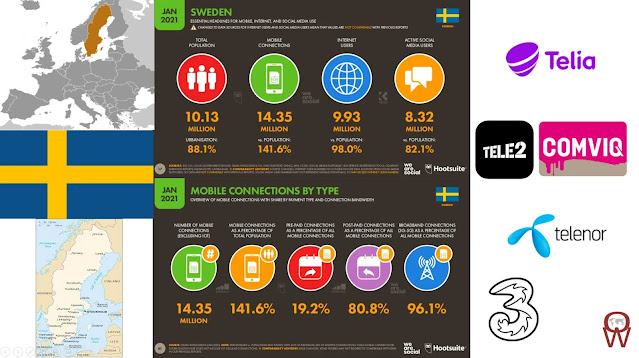
Sweden has 4 physical network operators: Telia, Tele2 using brand name Comviq, Telenor (formerly Vodafone Sweden) and 3 (Tre).

However, all the 4 physical networks share 2G, 3G, 4G and 5G with at least one other network:

Telia runs its own 2G and 4G LTE networks. Its 3G network on 2100 MHz is shared with Tele2, while it has an own 3G network on the 900 MHz band.

Tele2 operates all its networks in cooperation with other operators: Tele2's 2G and 4G are shared with Telenor, while its 3G is shared with Telia.

Telenor's 2G and 4G networks are shared with Tele2, 3G is shared with 3 outside Stockholm, Gothenborg, Malmö, Lund and Karlskrona, where they have their own.

3 is the only Swedish network without any 2G. They currently have two different 3G networks, one on the 2100 MHz band, shared with Telenor (except in the cities named above), and one on the 900 MHz band, that they don't share. They have also built their own 4G network.

In 2021 Telia is market leader with the best coverage and 36% of customers, followed by Tele2 with 27% and Telenor with 19% and 3 with 15% in last position.

2G is on 900 and 1800 MHz like everywhere in Europe, 3G is on 900 and 2100 MHz. Tre does not have a 2G network.

All major 4 Swedish operators support 4G/LTE. Tele2 and Telenor have a joint LTE network called Net4Mobility claiming 99.5% coverage. LTE is on all carriers on 2600 MHz (band 7) in the cities. 800 MHz (band 20), 900 MHz (band 8, only on Net4Mobility) and 1800 MHz (band 3) frequencies are used additionally. Tre offers TDD-LTE on 2600 MHz (band 38) and FDD-LTE on 2100 MHz (band 1) in some locations. From 2019 700 MHz (Band 28) will be added by Telia and Net4Mobility.

5G started to be available in Sweden during 2020 on some postpaid subscriptions on the four big operators and since September 2021 on some high-data Comviq postpaid plans, though not on prepaid and MVNO yet. Physically, 3 different 5G networks are being built: Telia and Tre will build their own networks, while Tele2 and Telenor continuing with their joint network Net4Mobility. Frequencies on 700 MHz (n28), 2300 MHz (n40) and 3500 MHz (n78) were auctioned to 4 providers in 2018 and 2021.

Both 2G and 3G are being phased out and are planned to terminated by 2025. Telia has announced that it will shutdown it's 2G network by 2025, but has started with its phase out. Telia has also said that it's own 3G network will shut down at the latest 2025, but it will dismantle individual sites as time goes. Tele2 has said that it's shared 3G network (that has been built with Telia) is being phased out since 2021 and will be completed at the latest 2025. So for data you need to have a device for 4G/LTE on the frequencies mentioned above, while a basic service will be maintained on 2G and 3G up to 2025 for voice and SMS services.

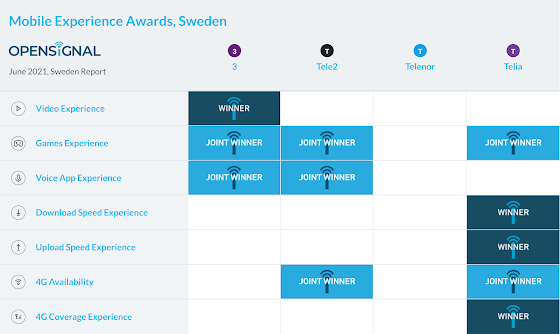
The OpenSignal June 2021 report on Sweden reveals a varied picture with three of the four national operators winning — or sharing the win — in at least three of the seven mobile experience categories. Telia solely wins Download Speed Experience, Upload Speed Experience and 4G Coverage Experience, while sharing the victory in Games Experience and 4G Availability. 3 leads in Video Experience and jointly wins Games Experience and Voice App Experience. Tele2 is a joint winner in Games Experience, Voice App Experience and 4G Availability.


Telia, owned by the Swedish Telia Company is market leader in Sweden with the best coverage nationwide in 2G, 3G, 4G and (on 800, 1800 and 2600 MHz): 4G/LTE is available for all prepaid products with up to 100 Mbit/s speed.

If one is visiting northern Sweden and intending to stay out of cities, then Telia or its subbrand Halebop will probably be the only network that has coverage.

In May 2020, Telia launched Sweden's first large-scale public 5G network in Stockholm. 5G is now being rolled out at a high pace from SkĂ„ne to Lappland and is already available in 22 cities. And in doing so, Telia managed to beat the Swedish 5G speed record. Telia collaborating with Ericsson means that 5G will have the same coverage as today's 4G network, in the period leading up to 2025 (covering 90 percent of Sweden’s geography and more than 99 percent of the population). As early as 2023, the 5G network will cover more than 90% of the population. 4G capacity will also double as part of the mobile network modernization. Telia’s 5G network uses higher frequency bands, such as 3.5 GHz, in densely populated areas with a lot of connected people and things using the network. The higher frequency bands are also used to build local, dedicated 5G networks for e.g., industry, ports, and hospitals. The lower frequency bands, such as 700 MHz, are used in rural areas to be able to offer good coverage and connection.

Comviq is a subsidiary of Tele2 in Sweden. That's why it uses the Tele2 and Telenor network on 2G, the Tele2 and Telia networks on 3G and Net4Mobility (= Tele2 and Telenor) on 4G with up to 80 Mbps speed. In September 2021, 5G on Net4Mobility was opened up to some high-data Comviq postpaid plans with up to 100 Mbps speed, but is not open for prepaid yet.

Tele2 doesn't sell own prepaid SIMs anymore, they are geared to contract customers and channel all prepaid products through their Comviq brand. They have a 99+% coverage on 2G, 3G and 4G/LTE.

Tele2 said it had switched on its commercial 5G network on May 24 2020. The operator said that the company’s customers will be able to enjoy the next generation mobile network in Stockholm, Gothenburg and Malmö. 5G services will be offered using 80 megahertz bandwidth on C-Band spectrum.

Telenor has a good 2G, 3G and 4G/LTE network up to 450 Mbps is available on Net4Moblity for prepaid too.

Telenor Sweden activated its 5G network in October 2020 in central Stockholm, marking the launch of nationwide roll-out using the new technology. The operator said the 5G network will provide internet access at 1 Gbps to customers with a compatible handset and a Telenor 5G-ready 30 GB, 75 GB or Unlimited subscription. The Telenor network uses 80 megahertz of spectrum in the 3.7 GHz band, which is shared with Tele2 via their Net4Mobility joint venture.

The next cities to get 5G will be Gothenburg and Malmö, and then the new network technology will reach cities with over 50,000 inhabitants, and finally, smaller towns. Telenor also said that it expects its 5G network to cover 99% of Sweden’s population by 2023.

3 (called "Tre") in Sweden has good speeds in 3G (on 900 and 2100 MHz) and 4G/LTE on (800, 2100 and 2600 MHz, partly as TD-LTE on band 38): Tre 3G and 4G coverage. Have in mind that Tre doesn't operate a 2G network and has no 2G roaming. You'll need to have a 3G or 4G device for using the Tre network. International roaming is blocked for all prepaid lines, you will be able to use their SIMs in Sweden only.

Tre Sweden (3 Sweden) officially launched its 5G network in June 2020 in Malmö, Helsingborg, Lund, VÀsterÄs, Uppsala and large parts of Stockholm. In December 2019, the Operator was the first in Sweden to launch a trial 5G network - then in southern Stockholm.

With nearly 400 active 5G masts, half of them in Stockholm, Tre said that it now has Sweden's most developed 5G network. The 5G network is activated using Tres' existing frequency spectrum.

All private customers with a 3Surf subscription from Tre and a 3G mobile from Tre, can access to the new 5G network at no extra cost. The same applies to corporate customers who have subscribed after January 15, 2019.

Related Posts:

Wednesday, 27 October 2021

South African MNO, Cell C, is Transitioning from Telco to Techco

If you can't beat them, join them says the old proverb. The South African MNO Cell C has taken this seriously. A news article back in September said:

In a bid to give its customers access to world-class network quality, excellent service and innovative value offers, Cell C has over the last eight months deactivated 39% of its physical radio access network (RAN) towers with 100% migration in the Eastern Cape, Free State, Northern Cape and Limpopo. 

Over the next four months, Cell C plans to decommission a further 5% of its towers, with a focus on parts of Kwa-Zulu Natal and Mpumalanga. 

Rather than spending billions building network infrastructure to compete with its fellow mobile giants, the company concluded roaming agreements with network partners like MTN and Vodacom to use the spare capacity that they have on their networks. 

Prepaid customers will roam on the MTN network, whilst post-paid customers will be on the Vodacom network. 

We see a dual approach by Cell C here. Rather than putting all their eggs in a single basket, they have spread their risk portfolio.

In our blog post last year, we saw that both MTN and Vodacom has similar coverage and capabilities. This would mean that Cell C subscribers will win regardless of whichever network they are on.

With Vodacom, it looks like Cell C is using a roaming agreement and will act like a Thick MVNO. We have explained the different types of MVNOs here but if you prefer to watch a video then see here.


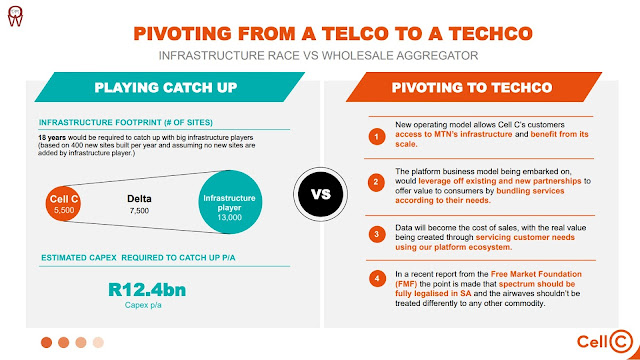
The approach with MTN, based on the above slide shared by them seems to be a combination of MVNO and MORAN. To understand what MORAN is, read here or watch the video here. Cell C explained it as follows back in June:

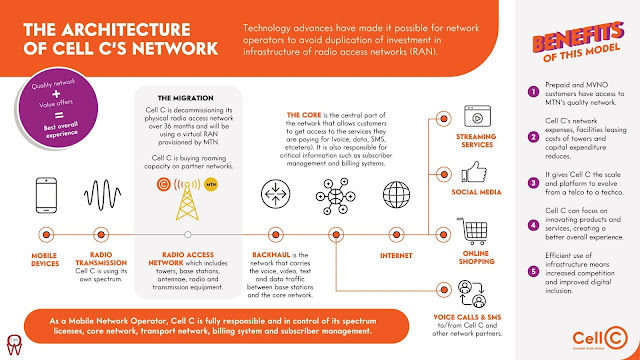
Cell C has successfully decommissioned 34 percent of its physical Radio Access Network (RAN) sites, while seamlessly migrating prepaid and Mobile Virtual Network Operator (MVNO) customers to roam solely on its partner network, MTN, via a virtual RAN.

The initial Cell C and MTN roaming agreement from 2018 provided coverage in areas outside of the main metros. The decommissioning of sites in these provinces means that where Cell C customers previously moved between Cell C and MTN towers, they will now only roam on MTN’s network through the virtual radio network provisioned for Cell C, which has wide network coverage. 

Based on technology advances it is possible for network operators to avoid duplication of investment in RAN infrastructure. In this model, Cell C will decommission its physical RAN, which includes towers, base stations, antennae, radio and transmission equipment, while MTN will provision a virtual RAN.  Cell C will use its own spectrum on this virtual RAN and manage the customer experience.  As a mobile network operator Cell C is still responsible for its spectrum licenses, core network, transport network, billing system and subscriber management.

While Cell C continues to refer to the arrangement as 'virtual RAN', it shouldn't be confused with vRAN / Open RAN. It would be interesting to see how this arrangement works and if this will continue for 5G going forward.

Cell C's FY 2020 annual results presentation slides and video may be worth a watch. 

Related Posts: 

Saturday, 14 September 2019

Vodafone: Creating Europe's Largest Tower Company

Earlier this year Vodafone unveiled plans to spin off or float its telecom tower business, a company that would be valued at up to £18 billion and rocket into the FTSE 100.

The new standalone business, called TowerCo, will own Europe’s largest tower portfolio, comprising approximately 61,700 towers across 10 countries, with 75% of these sites in the major markets of Germany, Italy, Spain and the UK. Total towers comprise 19,300 in Germany, 11,000 in Italy, 9,700 in Spain (adjusted for the sharing deal with Orange), 6,600 in the UK (representing 50% of total UK towers, consistent with Vodafone’s ownership of Cornerstone, the 50:50 joint venture company that owns and manages its passive infrastructure) and 15,100 in Other Europe (excluding VodafoneZiggo). The masts provide mobile coverage across each country allowing phone owners to make and receive calls and use data to access apps and websites. Income comes from leasing space on each mast to rivals offering their own mobile phone networks.


The business is estimated to generate about €1.7bn in revenues and €900m profits, leading analysts to value the business at between €15bn and €20bn, based on valuations of other mast businesses.


The deal would also allow Vodafone to focus on selling broadband and developing 5G services. TowerCo would allow rival telecom companies to share infrastructure, a move that will please City planners and environmentalists worried about the growth of the masts. The new company should be operational by May 2020. 

According to Nick Read, Vodafone’s chief executive:

“We are now creating Europe’s largest tower company. Given the scale and quality of our infrastructure we believe there is a substantial opportunity to unlock value for shareholders.”
Shares in the world’s second largest mobile operator climbed almost 10% as investors relished the prospect of a windfall from a sale or initial public offering of Europe’s largest towers company.

Vodafone intends to use the proceeds from the sale programme to reduce its levels of debt, 
which reached €48bn when the company completed its €18.4bn deal to buy Liberty Global’s German and eastern European cable assets. 

Vodafone has also spent €4bn on 5G spectrum as prices ballooned in auctions in Germany and Italy during the past year. According to George Salmon, equity analyst at Hargreaves Lansdown.

“Yes, Vodafone will lose the profits associated with running the towers, but it will also remove the €200m of annual spending tied up maintaining and expanding the network. So it’s easy to see the logic for the deal, especially since the group’s debts are fairly pressing.”
Vodafone has launched 5G roaming in 55 towns and cities across Italy, Spain, Germany and the UK. However, coverage remains limited, as the company only switched on 5G in Britain in July 2019.

Towers have become a key trading asset for cash-strapped European telecoms companies in Europe, with businesses including TelefĂłnica, Iliad, Altice, Sunrise and BT selling masts.


US and African carriers were quicker to sell their towers than their European peers but the rising value of infrastructure assets has led many networks to consider deals to generate cash for 5G investments. That has given rise to specialist tower businesses including Spain’s Cellnex, which has built a base of 45,000 masts largely via acquisition. 

Saturday, 6 July 2019

Japan on Infrastructure Sharing Mission, Driven by 5G


Japan has started exploring different approaches for Infrastructure Sharing. Earlier I wrote about Infrastructure Sharing over Electric Power Infrastructure. TEPCO (Tokyo Electric Power COmpany) Power Grid, Incorporated, KDDI CORPORATION, SoftBank Corp. and Rakuten Mobile Network, Inc. announced that the four companies have reached an agreement to collaborate on trials of base station site and equipment sharing utilizing TEPCO PG’s utility poles and other electric power infrastructure, ahead of the introduction of 5th generation mobile communications systems (5G) in Japan. The trials are due to be begin in the first half of FY2019. 

We have written earlier about the Japanese Market, the new entrant Rakuten that is transitioning from MVNO to MNO and 5G Spectrum Allocation. After the 5G Spectrum allocations were over, last month, Japanese Cabinet approved a project to install 5G wireless relay devices, to support the provision of 5G services, on traffic signals across the country. The government is allowing 208,000 traffic signals to be used to deploy the new 5G equipment, expecting to the network installation to be complete by the end of March 2026. In addition, the government also plans to upgrade the traffic lights with communication functions that allow them to collect and share more traffic data.
Regarding the relays, I am assuming something similar to Type 1a/1b, see here. NTT Docomo has been trying our a lot of innovation including small cells (probably relay) on traffic lights, reflectors and even mobile relay node. I am sure some of these will make it into practice.

This week, KDDI and SoftBank announced they have reached an agreement on the mutual use of their base station assets to jointly promote the rapid build-out of 5G networks in Japan's rural areas. According to the press release:

Many issues lie ahead for Japanese society, including an aging population, a shrinking workforce, depopulation in rural areas, deteriorating infrastructure and natural disasters of increased intensity. To address these issues, the Japanese government is advocating Society 5.0 and promoting initiatives to achieve it. With the spread of a super-smart society under Society 5.0, large volumes of data will need to be shared to utilize IoT, big data and AI, and a rapid build-out of 5G networks is expected to help facilitate this. In particular, 5G networks are expected to help resolve Japan's regional issues by enabling remote monitoring and operation through the transmission of high-definition images. Furthermore, 5G networks can help increase productivity by facilitating data gathering and analysis, which could contribute to the revitalization of regional industries, including local companies and startups.

Since 5G networks use the 28GHz and 3.7GHz high-frequency bands, many base stations need to be installed nationwide, and this requires long-term construction and large investment commitments. Accordingly, to quickly provide services that meet Japan's regional revitalization needs, more than ever before, carriers need to promote mutual infrastructure sharing to efficiently construct a network of 5G base stations. To accelerate the build-out of 5G networks in rural areas, KDDI and SoftBank will explore options with a view to establishing a joint construction management company that would facilitate construction designs and manage construction work to efficiently utilize the base station assets of both companies.

As a first step, both companies will establish a preparatory office, and starting this fall, conduct joint trials in Asahikawa City in Hokkaido, Narita City in Chiba Prefecture and Fukuyama City in Hiroshima Prefecture. In addition to streamlining processes from design to construction management stages, the trials will be used to verify the effects of 5G network quality improvements and shortened construction periods in rural areas.

KDDI has also be testing relay nodes (small cells) in rural areas, camouflaging it to not spoil the natural beauty of the area. They can very well be sharing this with Softbank.

Many countries are looking towards Japan to learn from the outcome of these infrastructure sharing schemes. Hopefully we will learn more about them in the coming years, if not months.


Related Posts:

Monday, 16 April 2018

South Korea MNOs to build Shared 5G infrastructure


According to Yonhap News Agency:
South Korea's mobile carriers and an Internet service provider will share the burden of building the costly infrastructure for a high-end fifth-generation network, which they will then share in using, officials said Tuesday.  
The move could save about 1 trillion won (US$938 million) over the next 10 next years, as it would keep SK Telecom Co., KT Corp., LG Uplus Inc. and SK Broadband Inc. from making redundant investments, according to the Ministry of Science and ICT.  
The four companies will together build the nationwide infrastructure, such as base stations for the 5G network, though details on how much each firm will pay are set to be finalized during the first half of this year, it said.  
The ministry did not elaborate on its estimation of the cost of building the 5G network. 
We recently blogged about KT's ambition to roll out 5G in 2019 here.

One of the reasons the shared infrastructure makes sense is because while most of the world will be rolling out initial 5G network in sub-6GHz band (mainly between 3.4 - 3.8 GHz), South Korea is looking at 28 GHz band. While technically millimeter waves start at 30 GHz (or they are known as centimeter waves or cmWaves below that), anything above 20GHz is often referred to as mmWave. 

Very few networks have commited to mmWave 5G rollout initially. Main commitments are from US operators (AT&T and Verizon), South Korea and Japan.