Showing posts with label Operator Vodafone Turkey. Show all posts

Thursday, 18 January 2024

Türkiye is Still Waiting for 5G but 4.5G (LTE-Advanced) is Working Great

Couple of years back, Turkey officially changed its name to Türkiye and as such we will refer to them by their new name. 

Türkiye continues to develop its capabilities within its telecom sector, becoming one of the relatively few countries able to build and develop its own communications satellites. With the successful launch of the Turksat 5A and 5B satellites in 2021, the country has vastly increased its bandwidth capacity. These satellites will be joined by the Turksat 6A in early 2023.

In addition to these technological breakthroughs, the country’s operators have invested in fibre infrastructure, with Vodafone Türkiye having trialled a 1Tb/s service in late 2021 to support its 5G network backhaul and improve the quality of its fixed infrastructure.

Deployment of fibre-based broadband networks are well established, with fibre accounting for 26.7% of all fixed broadband connections as of early 2022. The DSL sector still dominates, accounting for about 63% of connections, but its share is steadily declining, year-on-year, while the number of fibre connections has grown strongly.

Improved fixed and mobile infrastructure is underpinning the country’s initiatives relating to Smart City concepts, which have become a key area of focus for the emerging digital economy and the transformation to a knowledge-based economy. Türkiye's National Smart Cities Strategy and Action Plan runs through to 2023.

There are three network operators in Türkiye : Turkcell, Vodafone and Türk Telekom (formerly called Avea).  

In 2015 the Turkish regulator auctioned off licenses on 800, 900, 1800, 2100 and 2600 MHz bands for 4G/LTE (Bands 3, 8, 1 and 20) . All three providers launched 4G/LTE in 2016. It has been marketed from the start as "4.5G", otherwise known as LTE+ or LTE Advanced, accelerated by carrier aggregation where available in major cities in all 81 provinces from the start. Coverage is generally quite good: Turkcell has the best, followed by Vodafone and Türk Telecom with the least.

The Turkish Government sought to be an early adopter of 5G, but plans have stalled and 5G spectrum has not even been auctioned at the time of writing this blog. European Commission's Türkiye 2023 Report notes that there was no progress reported in the procurement of 5G. Türkiye still needs to allocate additional frequencies for the development and predictability of the sector. In 2022, 94.1% of households had access to the internet, increasing from 92% the previous year.

In Opensignal's latest Türkiye Mobile Network Experience report, Turkcell wins five awards outright out of eight recognitions available, it retains both speed awards and Video Experience, while it also claims two newly introduced awards Live Video Experience and Coverage Experience. Türk Telekom turns two joint wins for Games Experience and Availability into outright victories, as Turkcell slips off the podium for both of these metrics. On top of these two wins, Türk Telekom is the sole recipient of Consistent Quality. For the third time in a row, Vodafone wins no awards, either outright or jointly.


Turkcell is the biggest operator in the country with the best coverage nationwide. 2G is on 900 MHz, 3G on 2100 MHz. In 2015 Turkcell’s population coverage was at 99.8% in 2G and 95% in 3G.

Turkcell launched their "4.5G" LTE in 2016 using tri-band aggregation of 800, 1800 and 2600 MHz frequency bands. 4G/LTE is free to prepaid. Turkcell is known to have the best coverage in the countryside.  

According to Statista, as of the second quarter of 2022, Turkcell’s mobile business had a market share of 41.3%, ahead of Vodafone at 30.4 %, and Turk Telecom at 28.3%. According to the company’s own figures, it had 42 million subscribers across fixed and mobile in Q2 2023; the mobile subscriber base reached 37.6 million in the same quarter.

In 2016 Türk Telekom rebranded its mobile network from Avea, but you see their old sign still sometimes. It's the smallest provider in Turkey in terms of coverage, but they have still good speeds in the cities and a fair coverage in the countryside.

2G is on 900 and 1800 MHz, 3G on 2100 MHz, 4G/LTE was launched in 2016. It still has the lowest coverage in the countryside, but is strong in cities.  

Türk Telekom serves more than 15 million broadband and 25.6 million mobile subscribers. As the company plays a critical role in leading Turkey's digital transformation, they sought to modernize their infrastructure supporting business-critical systems, including core billing and charging applications and databases.

Vodafone is the 2nd operator in terms of coverage. 2G on 900 MHz, 3G on 2100 MHz, 4G/LTE was launched in 2016. It has a good coverage in the country, slightly worse than Turkcell, but better than Türk Telekom.

The number of Vodafone Turkiye's mobile subscribers reached 25.4 million, by November 2023, the total number of mobile subscribers including M2M (Machine Inter-Machine Communication) reached 29.3 million . The company increased the number of postpaid subscribers to 19.1 million. While having 1.4 million fixed broadband subscribers.

Related Posts: 

Sunday, 20 March 2022

Vodafone to keep pushing for Open RAN

At Mobile World Congress 2022, Johan Wibergh, Chief Technology Officer of Vodafone presented their vision and plan going forward in the 'Evolving the Network for the Future' session. On his LinkedIn post, he said:

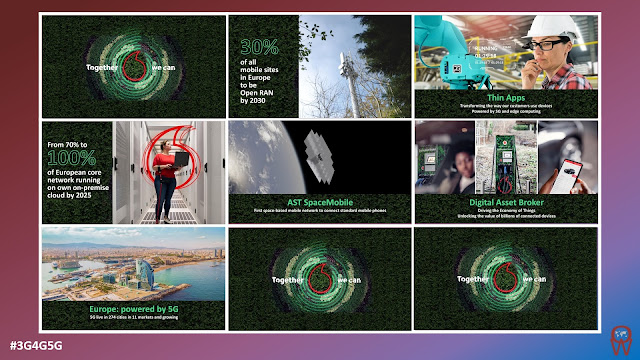
I have just presented at Mobile World Congress #MWC22 and was delighted to announce that around 30% of our European network will run on #OpenRAN by 2030, following the first site going live in the UK last month. This will give us more flexibility and speed in how we operate.

It is also an example of how innovation is coming back to the network.

Disruptive technologies such as Open RAN, Network as a Platform and Multi-Access Edge Computing are perfect illustrations of how we are meeting demand for fast connectivity, as well as driving supply chain diversity, creating digital eco-systems, and inventing new industrial-strength applications.

Also, through our scaled platforms – M-PESA, IoT and now Digital Asset Broker (DAB) – combined with our geographical scale, we aim to help support the digital needs and ambitions of our customers and societies across Europe and Africa.

Around 30,000 sites across Europe will eventually use OpenRAN, with rural areas the first to benefit from the new 4G and 5G masts. When the roll-out reaches cities, the equipment from any existing 5G masts being replaced will then be reused elsewhere to reduce unnecessary wastage.

A press release release from Vodafone has details here. 

Their MWC22 page has more related news on this and other topics they discussed in Barcelona.

In another news Vodafone announced that seven UK communities is set to receive 4G based on Open RAN. Last year we wrote about their first Open RAN site with Samsung here. At that time it was assumed that Samsung is bring 2G (GSM) but Light Reading recently mentioned that Samsung hasn't got 2G. 

Parallel Wireless has been in Vodafone Turkey network for the last few years doing 2G and 4G as we detailed before. In a press release, Juniper Networks announced that it is working with Vodafone and Parallel Wireless conducting a multivendor RAN Intelligent Controller (RIC) trial for tenant-aware admission control use cases. It says:

The trial, initially running in Vodafone’s test labs in Turkey and with plans to move into its test infrastructure, supports O-RAN interfaces and addresses the key business challenges faced by mobile operators around personalized user experience, viable revenue generation and reduction in both CAPEX and OPEX for 4G and 5G services.

The trial is based on an open, software-driven architecture that leverages virtualization to deliver more programmable, automated granular-by-user traffic management. The initial focus is on delivering tenant-aware admission control capability, enabling operators to personalize services and provide superior user experiences. Real-time tracking and enforcement of radio resources across the RAN enables mission-critical users – for example, hospitals and schools – to receive prioritized mobile data services delivery. This capability is enabled by Juniper’s rApp/xApp cloud-based software tools that manage network functions in near real-time, along with Parallel Wireless cloud-native Open RAN functions.

The trial’s design philosophy is focused on demonstrating the potential of enabling open, agile resource management and mobile data delivery in any software-driven RAN environment. This approach enables services and applications to be managed, optimized and mitigated automatically by the RAN, built on real-time data insights from its own performance.

All three organizations are active operators/contributors of the O-RAN ALLIANCE and the Telecom Infra Project (TIP), underlining their shared commitment to industry innovation and standards.

Juniper’s RIC solution is architected as an open platform supporting open interfaces on the north bound and south bound side, enabling easier integration with Open RAN partners in the ecosystem. Juniper’s RIC platform will also enable easy integration of third-party rApps/xApps, using UI-based onboarding and deployment tools coupled with flexibility to select between either network-based or SDK-based APIs (Application Programming Interfaces).

Parallel Wireless brings cloud-native Open RAN solutions - which are now integrated with the leading-edge RAN Intelligent Controller (RIC) based on O-RAN ALLIANCE specifications from Juniper Networks, giving operators more choices to build the best-of-breed RAN.

Juniper has a short RIC explainer video which is embedded below: 

Telecom TV reminds:

It’s no coincidence that Juniper is involved in Open RAN tests and trials in Turkey: It engineered its way into the RIC R&D scene by striking a deal in January 2021 to take the early RIC work undertaken by Netsia, the tech R&D unit at Türk Telekom, and develop it further, all the while ensuring that the resulting platform would not only conform to Open RAN specifications but also be suitable for deployment by Türk Telekom. As part of that deal, Juniper gained all the IPR and rights, and so has bene able to take it into tests with other operators at will.

Related Posts:

Friday, 8 December 2017

Turkey: 4G Trials and Tribulations

Image result for mobile network operators Turkey


Turkey has had its fair share of drama regarding mobile networks and technology. For example fourth-generation (4G) mobile data network didn't arrive in Turkey until April 2016 thats nearly eight years after arriving in Scandinavia and South Korea.Turkish mobile phone users had to wait for bureaucratic issues and uncertain market conditions to clear up before they could use faster data connections. Moreover in 2015 Turkish President Recep Tayyip Erdogan claimed that his country does not need to upgrade to the 4G system. Instead, Erdogan said, Turkey should leap forward to the more advanced 5G network in two years. This was a rather bizarre statement considering 5G technology does not exist and will not for a few more years. 

One expert, a senior engineer and product manager at Turkey’s leading mobile phone company, Turkcell, talked to Al-Monitor on condition of anonymity. He said that the most optimistic estimate for 5G’s first use around the world would be 2020. “The hope is to use 5G at the Tokyo Olympics,” the expert said, adding that Erdogan’s estimate of two years “does not appear to be technically possible.” The lack of a 4G network would slow down every facet of the Turkish economy — business, industry, transportation, communication and government — and undermine Erdogan’s ambition to turn his country into one of the top 10 global economies by the next decade.

So why this delay in bulding 4G? According to Fusun Sarp Nebil, one of Turkey’s leading telecommunications experts, Turkey's adoption of 4G is not the first time that Turkey has been late to adopt an innovation in telecommunications.

“Turkey always follows technology belatedly. It took [four years] before ADSL Internet came to Turkey,” while “3G [mobile networks] arrived nine years after it did in the rest of the world.”

Central and local governments’ delays and inadequacy explain why the development of wireless and landline Internet is moving at a snail’s pace in Turkey. For Nebil, a major problem is the extremely high tax burden on consumers. The Finance Ministry recently admitted that an exorbitant 60% of what Turkish consumers pay on their mobile phone bills goes to taxes. That is, for every 40 Turkish liras ($15) of minutes and data that customers pay their mobile service providers, they pay 60 Turkish liras ($23) to the Turkish government. (By comparison, US customers pay about 17% in federal, state and local taxes.)

However Turkey has now launched its self-declared '4.5G' network. Turkish mobile operators have engaged in even more impressive marketing stunts to sell new phones and data plans. The market leader Turkcell appeals to popular and patriotic sentiments with its “bagliyiz biz” (we are tied / connected / loyal to each other) campaign. Vodafone, with its “4 bucak g” (4 corners g) campaign, showcases folk dancers from the four corners of Turkey performing their own regional dances as well as those of other areas. Former telecom monopoly Turk Telekom (previously Avea) takes a different route and uses Portuguese soccer star Cristiano Ronaldo to emphasize its 4G network’s speed.

Currently Turkcell is the leading mobile phone operator of Turkey,based in Istanbul. In February 1994, Turkcell started Turkey’s first GSM network. In Q3 2012, it had a market share of 52,4%. Its competitors were Vodafone with a market share of 27,9% and Avea with a market share of 19,7%. The introduction of this '4.5G' infrastructure and an increased smartphone ownership, mobile-based internet and data services in Turkey have grown, this, in turn, has boosted revenues for the country's mobile operators. 

As of June 2017, Turkey had some 76.6 million mobile subscribers, including machine-to-machine communication (M2M) subscribers, which corresponded to 96 percent a penetration rate.

Since April 2016, there was a quick transition from 3G to 4.5G subscriptions and at the end of June 2017, the number of 3G subscribers dropped to 13.2 million, while the number of 4.5G subscribers reached 59.8 million. So much so, internet and data accounted for 71.1 percent of Turkcell's, 61.2 percent of Vodafone's and 51.4 Türk Telekom's total revenues in the second quarter of this year.Online music and video streaming services, internet TV, and social media applications have mainly driven the growth in mobile data usage.

However Subscription plans also do not come cheap. Modest plans with 2 gigabytes (GB) of data, 1,000 text messages and 1,000 minutes of phone calls vary between 35-50 Turkish lira ($12 to $17). But some plans with 15 GB of data can reach as high as 159 Turkish lira ($55), including taxes and other fees. For a country where the net minimum wage is 1,300 Turkish lira ($457), even the cheapest data plan seems like a luxury. To boost consumer demand and usage, Turkey must create a mature 4G network and, more importantly, a robust Internet infrastructure.

As a result Kozan Demircan, one of the country’s leading technology experts, calls the new '4.5G' an “April Fool’s joke” because Turkey simply does not have the fiber optic network to support the promised connection speeds. High levels of fiber optic penetration (an area in which Turkey comes up short) enable high-quality connections between personal computers, mobile devices and cell towers. 

As another expert told Al-Monitor a few months ago, Portugal — with a total area of 100,000 square kilometers (38,600 square miles) — boasts a fiber optic network of 545,000 kilometers (338,000 miles). But Turkey, with nearly eight times the area of Portugal, only has 250,000 kilometers of fiber optic cable (a figure that was already 150,000 kilometers in 2005), when it should have over 4.5 million kilometers of fiber optic cable to catch up with Portugal.

These shortcomings slow connection speeds. Demircan points out that “whereas the targeted speed with 4.5G is around 330 to 400 megabits per second [Mbps], average connection speeds are 30-40 Mbps.” Although those figures are a respectable improvement over actual speeds of 14 Mbps on the 3G network, even those limited speeds are not available to Turks who live in major cities such as Istanbul and Ankara. (According to Akamai Technologies, a global content delivery company, Turkey’s average Internet connection speed was 6.2 Mbps in the third quarter of 2015.) As Demircan warns, there is a positive relationship between high broadband Internet penetration and its contribution to high levels of national income.

So why does Turkey not dedicate itself to a truly viable and progressive 4G that would help to grow its economy?

One major problem is the Turkish state’s inability to open up the market to competition. In particular, Turk Telekom, which owns most of the fiber optic network thanks to its former status as Turkey’s telecom monopoly, does not want to share its property with service providers. Also Turkish municipalities continue to charge exorbitant fees whenever service providers attempt to lay new fiber optic cables.

A bigger challenge is the allegation that the Turkish state and the ruling Justice and Development Party (AKP) view high-speed Internet with suspicion. One Turkish Internet expert and former government employee told Al-Monitor alleges that Gezi protests of 2013 and the Gulen-AKP fallout in early 2014, the state — especially the national security apparatus — has become wary of very high Internet connections. “You cannot upload high-quality videos or extended audio files on the 3G,” said the expert. So there is not much enthusiasm to improve conditions through the 4G network.

Due to the delays and problems in 4G there is unfortunately a real possibility that Turkey will also be late in adopting 5G and that means falling further behind in economic development. Hopefully this can still be remedied.