Showing posts with label Operator Swisscom. Show all posts

Thursday, 30 July 2026

What Europe’s Five Greenest Telecom Groups Are Doing Differently

Energy efficiency and sustainability have moved from being specialist environmental topics to strategic priorities for telecom operators. Energy typically represents around 3% to 5% of operators’ operating expenditure, and sometimes considerably more. Electricity prices can also change rapidly because of geopolitical conflict, extreme weather, grid constraints and competition for renewable energy from data centres.

The scale of the challenge is significant. According to the Telecom Energy & Sustainability (TES) research from MTN Consulting and Téral Research, telecom operators consumed 340.6 TWh of energy in 2024. Only around 23% came from renewable sources, although this was an improvement from 10% in 2019. When Scope 3 emissions from equipment, suppliers and the wider value chain are included, the sector generated approximately 342 million metric tonnes of CO₂-equivalent emissions.

The TES study analyses 66 telecom operators representing approximately 85% of the global market. One of its rankings compares market-based Scope 1, Scope 2 and Scope 3 emissions against company revenue. This is important because it measures the total reported carbon footprint relative to the size of the business, rather than simply rewarding the largest purchaser of renewable electricity.

On this measure, the five leading European telecom groups in 2024 were: 

A note on acquisitions and reporting boundaries: The ranking is based on 2024 reported data and therefore reflects each group’s reporting perimeter during that period. Acquisitions, disposals and infrastructure spin-outs can materially change subsequent energy and emissions profiles. Swisscom’s figures, for example, reflect the reporting perimeter before Vodafone Italia is incorporated into the TES analysis on a fully consolidated basis.

For comparison, the average across European operators was approximately 105 MT CO₂e per $1 million of revenue, while the global average was around 192. Seven of the worldwide top ten were European groups, with Deutsche Telekom and Tele2 also making the list.

These figures should not be treated as a perfect comparison. Group structure, geography, network ownership, leased infrastructure and the quality of Scope 3 reporting can all affect the results. Nevertheless, the leading companies provide some useful lessons about how sustainability can be embedded into telecom strategy.

Swisscom leads today, but Vodafone Italia changes the future picture

Swisscom has the strongest overall TES position among the operators assessed, receiving a five-star Leader rating. Its 2024 energy intensity was 43.2 MWh per $1 million of revenue, while its market-based Scope 1 and Scope 2 emissions intensity was only 0.87 tonnes of CO₂-equivalent per $1 million. Renewables accounted for 90.4% of reported energy use.

What distinguishes Swisscom is not only its energy performance. The company has integrated financial and environmental reporting, placing sustainability alongside revenue, investment and other measures used to evaluate the business.

However, there is an important qualification. Swisscom completed its acquisition of Vodafone Italia in December 2024, and the current TES figures largely reflect the earlier reporting perimeter of Swisscom and Fastweb. The enlarged group will have a different energy and emissions profile.

Vodafone Italia’s energy sourcing includes a greater contribution from conventional and nuclear generation. Although nuclear electricity is low-carbon, it is not classified as renewable under the TES methodology. When the TES analysis is updated to reflect the fully consolidated group, Swisscom’s reported renewable share is therefore expected to decline and its emissions intensity could increase unless the acquired operations are brought into alignment with the group’s existing renewable-energy strategy.

The Italian operation may consequently become the biggest test of Swisscom’s sustainability leadership. Extending Fastweb’s renewable procurement programmes across the combined Fastweb and Vodafone Italia footprint could help the group defend its position.

This illustrates a wider lesson about sustainability rankings. A company can improve through network modernisation and renewable procurement, but its reported profile can also change abruptly following an acquisition. The same effect can happen in reverse when operators sell energy-intensive assets such as tower portfolios.

Telefónica connects sustainability with financing and network investment

Telefónica’s approach demonstrates how environmental commitments can be incorporated into corporate financing. In early 2026, the group raised €1.75 billion through a green hybrid bond. The funds were intended to support network transformation, energy-efficient modernisation, renewable-energy projects and digital services that help customers lower their energy consumption.

This matters because telecom networks require continuous investment. Attaching environmental criteria to financing can influence which programmes receive funding and how their outcomes are measured.

Telefónica is also incorporating energy efficiency into major technology procurement. Telefónica Germany highlighted energy efficiency when announcing a five-year agreement to deploy Nokia’s AirScale radio platform. Its operations outside Europe are following a similar direction. Movistar Chile entered a long-term renewable-energy agreement, while Telefónica Mexico arranged to obtain part of its electricity from a solar project.

Approximately 86% of Telefónica’s energy was classified as renewable in the TES data. More importantly, the group is applying its sustainability priorities across multiple operating companies rather than limiting them to its European headquarters.

Proximus is turning energy management into a software capability

Proximus shows that sustainability is not only about buying renewable electricity. It is also about understanding where, when and why energy is being consumed.

The Belgian group has developed an application called Energy Box, which combines data analytics, real-time energy-market information and artificial intelligence. The platform is intended to improve energy planning across buildings and mobile sites while making better use of intermittent renewable sources such as solar and wind.

This is an increasingly important capability. Networks cannot simply switch everything off when electricity becomes expensive or renewable generation falls. Operators must understand traffic patterns, service requirements, battery capacity, equipment performance and local energy conditions before making changes.

AI and automation could eventually allow sites, data centres and other facilities to adjust energy use dynamically. The same capabilities could help operators participate in electricity demand-response programmes or use network batteries as part of virtual power plants.

Proximus also illustrates the green-enablement opportunity. The skills and platforms developed to manage its own facilities can potentially be offered to enterprise customers facing similar energy-management challenges.

Liberty Global is investing directly in energy generation

Most operators purchase electricity from utilities, sign power purchase agreements or buy renewable-energy certificates. Liberty Global is going further by investing directly in renewable-energy development.

Its clean-energy business, egg Power, raised £400 million in debt financing in January 2026 to support large-scale renewable projects across Europe. At the time, around 250 MW of solar and wind capacity was under construction or development, with plans to expand the portfolio.

This approach can provide more than environmental benefits. Direct investment in generation can offer greater certainty over long-term energy supply and cost, particularly as data centres and other large electricity users compete for renewable capacity.

Liberty Global obtained approximately 81.5% of its energy from renewable sources in 2024. It was also among the most energy-efficient operators in the wider TES analysis.

Some of this performance may reflect Liberty Global’s corporate and asset structure, so it should not be compared directly with a traditional integrated operator without qualification. Even so, its willingness to act as an energy investor rather than only an energy customer is significant.

Telia combines renewable electricity with transparency about Scope 3

Telia had the highest renewable-energy ratio among these five groups, at approximately 94.6%. It procures fossil-free electricity across its operating markets and has also emphasised the use of energy-efficient network equipment.

The company has given sustainability unusual prominence in its financial communications. Its results presentations and annual reporting discuss environmental performance alongside traditional financial and operational metrics.

Perhaps more importantly, Telia has been willing to acknowledge where it is falling short. It disclosed that it had not achieved one of its targets relating to the proportion of suppliers with emissions targets validated by the Science Based Targets initiative.

That is an important admission because renewable electricity mainly reduces Scope 1 and Scope 2 emissions. For many leading European operators, the majority of the remaining footprint is now in Scope 3. This includes network equipment, handsets, construction, logistics, leased infrastructure and other supply-chain activities.

Telia’s recent network decisions also highlight the connection between sustainability and modernisation. When announcing the deployment of a cloud-native 5G Standalone core and additional RAN capacity across its Nordic and Baltic operations, the company identified energy efficiency as one of the drivers.

Corporate restructuring can change the numbers

Energy and emissions rankings are influenced not only by operational improvements but also by changes in corporate structure.

An acquisition can bring a large network with a different electricity mix, equipment base and emissions profile into the group. Conversely, selling towers, data centres or other energy-intensive infrastructure can make an operator’s direct Scope 1 and Scope 2 figures appear significantly better.

The environmental impact does not necessarily disappear. When an operator sells towers and leases them back, some or much of the associated footprint may shift from its direct emissions into Scope 3, depending on the reporting boundary and lease arrangements. In principle, the operator remains connected to those emissions even though it no longer owns the infrastructure.

This makes Scope 3 reporting especially important. A ranking focused only on direct emissions may reward asset disposal rather than genuine decarbonisation. Investors and customers therefore need to examine reporting boundaries, acquisitions, disposals and leased infrastructure alongside headline emissions reductions.

Concluding Lessons

The five groups are not following exactly the same strategy, but several common themes emerge.

First, they are treating sustainability as a senior-management and financial issue. It appears in annual reports, earnings presentations, financing decisions and investment priorities.

Second, they are moving beyond the simplest form of renewable-energy purchasing. Long-term power purchase agreements, direct generation, batteries and investment in new renewable projects can provide greater additionality and more predictable energy costs than certificates alone.

Third, network modernisation remains essential. More efficient radio equipment, fibre replacing copper, cloud-native platforms, intelligent sleep modes and the retirement of legacy networks can all reduce energy consumption. Buying green electricity does not remove the need to lower the amount of electricity consumed.

Fourth, procurement is becoming one of the most important sustainability tools. Scope 3 accounts for most of the telecom sector’s carbon footprint, and a large part of it comes from purchased equipment and services. Operators therefore need credible environmental information from vendors and must make emissions performance part of supplier selection.

Finally, some operators are looking beyond their own footprint. Green-enablement services can help customers manage buildings, transport, energy systems and industrial processes more efficiently. This could turn sustainability from a cost and compliance requirement into a source of new revenue.

Europe benefits from mature renewable-energy markets, stronger disclosure requirements and growing pressure from investors and regulators. Those advantages cannot always be reproduced in other regions. Operators with large numbers of off-grid sites, unreliable electricity supplies or limited access to renewable generation face very different challenges.

However, most operators participate in the same global equipment and technology supply chains. They can select more efficient infrastructure, demand credible emissions data, use energy performance in procurement, modernise legacy networks and give sustainability greater management attention.

The key lesson from Europe’s five leading groups is that environmental performance is not being delivered through one flagship project. It comes from combining reporting, financing, procurement, network design, energy sourcing, automation and supplier engagement.

Sustainability is becoming part of how these companies operate, rather than simply something they report once a year.

The data and examples in this post are based on the Telecom Energy & Sustainability research service, a collaboration between MTN Consulting and Téral Research. The ranking uses 2024 market-based Scope 1, Scope 2 and Scope 3 emissions divided by company revenue. Figures apply to operator groups and should not be interpreted as rankings of individual national networks.

For more details, get in touch at TES(at)3g4g.co.uk 

Thursday, 22 January 2026

Automation and Data Driven Network Optimization in Swisscom’s Mobile Strategy

At Ericsson’s rApp DevCon 2025, Swisscom provided a clear view of how automation and data driven network optimisation are becoming core elements of mobile strategy rather than isolated technical initiatives. In a keynote delivered by Francesco Pellegrini, Product Owner for Radio Network Optimisation at Swisscom, the emphasis was on how long term investment in automation, analytics and innovation supports not only network performance, but also the sustained delivery of a high quality mobile customer experience.

For Swisscom, automation is closely tied to its ambition to offer the best possible mobile experience across Switzerland. This ambition has guided network decisions for more than a decade and is reflected in the operator’s consistent top rankings in independent benchmarks. Rather than treating these results as an endpoint, Swisscom views them as a baseline that must be continuously defended as network complexity increases. Data driven insights and automated decision making now play a central role in translating customer experience expectations into concrete network actions.

Advanced analytics allow Swisscom to better understand how customers experience the network in real conditions and to prioritise optimisation accordingly. Automation then becomes the mechanism that allows these insights to be acted upon at scale and with consistency. As mobile networks evolve, with new spectrum layers, denser deployments and growing 5G usage, traditional manual optimisation approaches are no longer sufficient to maintain efficiency or performance.

Swisscom’s journey towards automated radio network optimisation started several years ago with early self organising network capabilities such as antenna tilt optimisation in LTE. Over time, this expanded into a broader portfolio of automation use cases, including open loop optimisation driven by customer experience data and AI supported solutions for performance analysis. Centralised optimisation algorithms for 5G mobility and the introduction of closed loop automation further strengthened this approach. Today, much of the 4G network is optimised through automation, while 5G tuning is already at an advanced stage.

Pellegrini highlighted that achieving this level of automation required more than deploying new tools. One of the main challenges was introducing innovation while continuing to operate one of the highest performing networks in the market. This demanded changes in processes and mindset, particularly within radio optimisation teams. Engineers increasingly moved away from manual, vendor specific tools towards programmable, data centric workflows that support repeatability and scale.

The next phase of Swisscom’s mobile strategy builds on this foundation through its expanded partnership with Ericsson. A key component is the integration of the Ericsson Intelligent Automation Platform into Swisscom’s existing automation framework. This enables coordination between existing use cases while providing access to a standardised rApp environment and to the wider ecosystem. Just as importantly, it allows Swisscom to leverage data already available within its internal data lake to support more advanced optimisation and automation scenarios.

In radio network optimisation, Swisscom is already working with several AI enabled rApps, including anomaly detection, root cause analysis and antenna optimisation capabilities. At the same time, the operator is exploring the development of its own rApps, with radio optimisation as the starting point. The ambition, however, extends beyond optimisation alone. Network deployment and network healing are also seen as key areas where automation can deliver measurable benefits, particularly through zero touch approaches that accelerate cell acceptance and improve network health monitoring.

A central enabler of this strategy is the evolution of skills within Swisscom’s engineering teams. Radio engineers are increasingly expected to combine deep domain expertise with capabilities in coding, data handling and AI. While radio knowledge remains the foundation, closer collaboration with internal data science teams is becoming essential. This balance allows Swisscom to develop more sophisticated automation use cases without diluting its core engineering strengths.

The keynote also underlined the importance of open ecosystems in sustaining differentiation. Swisscom sees value in combining vendor developed rApps with innovations from a broader community, enabled by a standardised automation platform. This approach supports experimentation, accelerates innovation and reduces dependency on bespoke integrations, all while maintaining control over network performance and quality.

Swisscom’s experience illustrates that automation and data driven network optimisation are not short term initiatives, but long term strategic capabilities. As network complexity continues to grow, the ability to combine customer experience insights with intelligent, coordinated automation will be critical to maintaining leadership. Swisscom’s mobile strategy shows how these elements can be embedded into daily operations, positioning the operator to continue delivering a high quality mobile experience in an increasingly demanding environment.

The embedded keynote video provides additional depth and context, offering valuable insight into how Swisscom is translating automation concepts into real world operational practice.

Related Posts:

Thursday, 12 December 2024

Harnessing AI in Telcos: Data, Opportunities, and the Future

At the Telecoms Europe virtual event, How AI is Transforming Telecoms (27 Nov 2024), Daniel Dobos, Research Director at Swisscom, presented an engaging talk titled "Have telcos got the right data in the right places to harness AI?" As Research Director, Daniel manages Swisscom’s collaborations with universities, applied sciences institutions, and research organizations. Alongside employees from various Swisscom business units, his team develops solutions leveraging cutting-edge research and technology for the benefit of customers. His prior experience includes leading AI research projects at CERN and the United Nations.

In his presentation, Daniel addressed a critical question: Do telcos have the right data infrastructure to harness AI effectively? This topic is especially pertinent as AI—especially generative AI—rapidly reshapes the telecommunications industry. He explored this question through the lenses of academic research, public sector regulation, and private sector application.

The Tsunami of AI: Opportunities and Risks

Daniel began by comparing the AI revolution to The Great Wave off Kanagawa, the iconic Japanese woodblock print. He emphasized AI's transformative potential, particularly large language models (LLMs), and urged telcos to adapt swiftly to this evolving landscape. He posed a thought-provoking question: "Are we the last generation to ask whether telcos have the right data to harness AI?" Daniel warned that telcos failing to adapt risk irrelevance or obsolescence.

Swisscom's AI Journey: From Research to Application

Daniel recounted Swisscom’s AI journey, beginning in 2016 with a partnership with EPFL to establish a digital lab focused on applied AI research for telcos. This collaboration leverages Swisscom’s extensive data resources and partnerships with leading institutions like EPFL and EDAP. Key AI techniques—natural language processing, automated speech recognition, and distributed machine learning—are deployed to enhance customer experience, network operations, and workforce management.

Real-World Applications: Optimizing Networks and Customer Care

Daniel shared three practical examples of Swisscom's AI implementation:

  1. Network Optimization: AI-driven analysis of network data to optimize mobile antenna deployment, improving both coverage and energy efficiency.
  2. Event Sequence Detection: Identifying patterns in massive data streams to predict network issues, optimize maintenance, and bolster cybersecurity.
  3. Generative AI for Customer Care: Deploying LLM-based chatbots to automate customer interactions, enhancing self-service capabilities and boosting customer satisfaction.

Knowledge Graphs: Decoding Complex Infrastructures

Daniel highlighted the role of knowledge graphs in visualizing Swisscom’s intricate infrastructure. These graphs map out infrastructure components and their relationships, enabling better human comprehension of network structures and anomalies. This approach enhances maintenance efficiency and risk detection.

Current Research: Pushing AI Boundaries

He also shared insights into Swisscom’s ongoing research in areas like infrastructure optimization, energy savings, and secure data analytics. A key innovation is the use of synthetic data, which enables collaboration between researchers and telcos without compromising privacy. Other projects include graph anomaly detection and advanced energy-saving strategies.

Key Takeaways: Data is the Key to AI Success

Daniel concluded by emphasizing that while Swisscom is well-positioned to leverage AI, many telcos are not. He underscored the importance of making data accessible and ready for AI algorithms. He urged telcos to prepare their data now, as the window of opportunity is narrowing. Comparing the current AI landscape to "teenage love," he advised experimenting with different AI models without committing prematurely. By ensuring data readiness, telcos can fully capitalize on AI’s transformative potential.

The video of his talk is embedded below:

Note: This blog post was created with assistance from ScreenApp for generating the video summary.

Related Posts: 

Thursday, 21 March 2024

5G in Liechtenstein Gains Ground

The Principality of Liechtenstein (Fürstentum Liechtenstein) is one of Europe’s smaller countries nestled between Switzerland and Austria. It’s a German-speaking, 25km-long principality, known for its medieval castles, alpine landscapes and villages linked by a network of trails. It only measures 160 square kilometres. But it’s in a very special position. It's part of the EEA, so EU laws apply, but it's attached to networks of Switzerland too, where they don't.

Liechtenstein has 3 network operators: Telecom Liechtenstein (FL1, formerly Mobilkom Liechtenstein), Swisscom and 7acht (by Salt Mobile SA of Switzerland, formerly Orange CH).

It has an excellent coverage on 2G and 4G. Telecom Liechtenstein TLI) is the market leader in this country, but has no prepaid product so far. 4G/LTE has started with all three operators. Frequency bands 800, 900, 1800, 2100 und 2600 MHz (Bands 1, 3, 7, 8 and 20) were allocated. 3G on 7acht (Salt), Swisscom and Telecom Liechtenstein have been shut down by 31 Dec 2023, so for data service, you will need a 4G/LTE or 5G/NR capable device. For prepaid offers you need to turn to Swiss providers or roam with another EEA SIM card.

The Liechtenstein mobile phone system is attached to Switzerland. This means that customers of all three providers can roam in Switzerland on Swiss networks without additional fees. This applies to data too.

Telecom Liechtenstein (FL1) uses its partner network Salt for free roaming in Switzerland, while 7acht (Salt) and Swisscom are linked to their respective Swiss home networks.

Telecom Liechtenstein received approval to expand its 5G network the Principality of Liechtenstein in January 2023 by acquiring the rights to use frequencies through reallocation. TLI will expand its 4G/LTE network capacity and introduce 5G, the most powerful mobile communications standard currently available, to FL1 customers by mid-2023. The expansion will require FL1 customers to have an FL1 LIFE subscription and a 5G-capable smartphone. After the successful roll-out of the fiber optic core network in Liechtenstein, Telecom Liechtenstein and Nokia have also signed the contract to expand their 5G network.

Swisscom “Liechtenstein” is the largest mobile operator in Switzerland and also in Liechtenstein.
Hence, it is also the largest mobile operator in Liechtenstein. It is a mostly state-owned company (51%) with the best overall performance in Switzerland and Liechtenstein.

Salt Mobile “Liechtenstein”, just Salt Mobile or 7acht, is the smallest mobile operator in Switzerland. Hence, it is also the smallest mobile operator in Liechtenstein.

Monday, 2 May 2022

Swisscom Outlines Challenges and Plan to Transition to a Software Company

In a recent keynote at Mobile Europe's Telco to Techco, Christoph Aeschlimann, CTO & CIO, Swisscom gave a presentation on 'Redefining telco for the digital age'. During the presentation he highlighted the challenges of being a 170 year old operator, from infrastructure to processes and mindset.

To overcome these challenges, Christoph believes that a three pronged approach will be needed as highlighted in the image below:

  1. Disaggregation of Hardware and Software
  2. Telcos need to be become software companies
  3. AI and automation to create new opportunities

The current CEO of Swisscom, Urs Schaeppi, is stepping down from his role as a CEO and the Board of Directors has elected Christoph Aeschlimann as the new CEO of Swisscom. This will allow him to implement his vision of transitioning to a software company where many of the tools will be developed in house.

The presentation below is definitely worth listening to, along with the interesting Q&A at the end. Kudos to him for tackling all difficult questions on how they plan to transition to a software company going forward and how they will operate.

Interested in knowing your thoughts.

Related Posts: 

Thursday, 27 January 2022

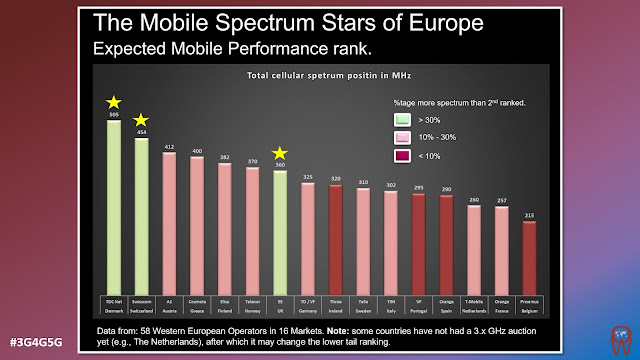
The Mobile Spectrum Stars of Europe

Dr. Kim Larsen, CTIO of T-Mobile Netherlands is very well known as a speaker and on social networks for his honest analysis and insights. We have also used information from him for blog posts for over a decade.

In a recent post on LinkedIn, he nicely summarized the mobile spectrum stars of Europe. In his words:

Based on the analysis of 58 Western European MNOs and their spectrum position, the highest expected mobile performance across markets and operators can be shown. Of course, it does require the MNOs to actively use their acquired cellular spectrum and deploy a market- & spectrum-appropriate antenna technology, such as described in my previous blog "RAN Unleased"

The MNO rank within a country will depend on the relative spectrum position between 1st and 2nd operator. If below 10% (i.e., dark red in chart below), I assess that it will be relative easy for number 2 to match or beat number 1 with improved antenna technology. As the relative strength of the spectrum position of number 1 relative to number 2 is increased, it will become increasingly difficult (assuming number 1 uses an optimal deployment strategy).

The Stars (e.g., #TDCNet / #Nuuday, #Swisscom and #EE) have more than a 30% relative spectrum strength compared to the 2nd ranked MNO in a given market. They will have to severely mess up, not to take (or have!) the best cellular network position in their relevant markets. Moreover, network economically, the Stars should have a substantial better Capex position compared to their competitors (although 1 of the Stars seem a "bit" out-of-whack in their sustainable Capex spend, but may be due to fixed broadband focus as well?). As a "cherry on the pie" both Nuuday/TDCNet and Swisscom have some of the strongest spectral overhead positions (i.e., MHz per pop) in Western Europe, which is obviously should enable superior customer experience.

While this is definitely a good metric to compare, as an analyst and a marketeer, I also think there is also a big role for how operators advertise their services and differentiators to reach the end customers. It may not be too difficult for a second operator (in terms of spectrum holding) to beat the first one with right marketing.

Happy to hear what you have to say.

Related Posts: 

Thursday, 21 November 2019

Swisscom Plans to Deploy 5G Standalone (SA) in 2020

We wrote about Swisscom's 5G Fast and 5G Wide when they launched their 5G network earlier this year. In a recent presentation at Total Telecom Congress, Christoph Aeschlimann, CTO & CIO of Swisscom AG provided a bit more detail of what it is. This can be seen from the picture below


While 5G Fast aggregates the C-band spectrum Swisscom owns, 5G Wide relies on Dynamic spectrum sharing using 4G spectrum only.

In addition, he presented Swisscom's the next phase of 5G deployment, Standalone 5G with 5G Core. This can be seen below:


As can be seen the 5G SA trial is planned for H1-2020 and first deployments are expected in H2-2020. If you are unsure of what the difference between SA and NSA 5G is, please refer to our 3G4G tutorial here. While it does not say what 5G Network Architecture Option Swisscom will be deploying, it is assumed to be Option 2. Nearly all operators are thinking of that option when moving to 5G core, except a few like NTT Docomo that believe that Option 7 will be needed in the interim, followed by Option 4 and then Option 2.


Finally, a slide that lists Swisscom's latest facts and figures. Just in case you were wondering, Mio, is an abbreviation for "millions" as a unit indicator in some financial markets, such as the German, Swiss and Dutch markets.

Christoph Aeschlimann, CTO & CIO of Swisscom wrote a LinkedIn post titled "90% 5G coverage in 2019. How to turn the impossible into reality" back in August. It's worth a read.

Related Posts:

Monday, 16 September 2019

Fastweb and the Shared 5G Network in Italy

                                                                                                                                                Source
Fastweb, an Italian subsidiary of Swisscom since 2007, was already a mobile virtual network operator (MVNO), but now the company will run its own infrastructure-based network and following approval from the Ministry of Economic Development become the fifth mobile operator in Italy, building and marketing their own 5G services. The operator has 2.6 million broadband customers but only 1.6 million subscribers to its mobile services.

Having acquired Tiscali SpA 's fixed-wireless business and full ownership of its 5G-friendly 3.5GHz spectrum and 835 of their towers in a deal worth around €150 million (US$176 million).  Since December 2016 Fastweb has had the right to use 3.5GHz spectrum in the main Italian cities and allows them to provide fixed-wireless connectivity to all market segments in Italy.

In July 2019 Fastweb announced a network-sharing deal with CK Hutchison’s Wind Tre “to accelerate the roll-out of a nationwide, state-of-the art 5G network”. Fastweb said then that “the shared 5G network will include Wind Tre and Fastweb macro and small cells, connected through dark fibre from Fastweb, to be deployed nationwide, with a targeted coverage of 90% of the population by 2026”.

As a result Fastweb will be able to compete with TIM and Vodafone as well as with Wind Tre, and with French-owned Iliad, which started up in the market when Wind – then owned by Veon – merged with Hutch’s Tre.

Due to the astronomical prices of spectrum licenses and fighting competition on all sides, Italy's telecom operators are increasingly engaging in network-sharing partnerships as they roll out their new 5G services. Network sharing is hardly a new thing in Europe, of course, and has already taken off in Italy. Under competitive and regulatory pressure, Telecom Italia and Vodafone are sharing mobile towers and will even use the same 5G basestations outside the big cities. Across the entire European region, market dynamics are spurring interest in similar arrangements.But Fastweb and Wind Tre are going much further.


The two operators are pooling spectrum resources and site equipment to build a single 5G network that each will use to provide retail services to its customers. If the scheme works, it may validate network slicing, an advanced technique that allows operators to run different "virtualized" network services over the same physical infrastructure. It could even become the preferred model for other European operators struggling to fund the deployment of 5G networks. It will also allow Fastweb to deploy 40MHz of 3.5GHz spectrum acquired in a private transaction last year. Adding this to Wind Tre's 20MHz they hope this will give the operators the means to challenge Telecom Italia and Vodafone.

The details of their approach, confirmed by a Fastweb spokesperson, mean each company will effectively become a virtual operator of a shared 5G platform. While some of the commercial arrangements are still unclear, the companies will use the same mobile sites and network equipment across the entire country. The first 5G services are scheduled to arrive next year. By 2024, Fastweb and Wind Tre expect to have nationwide coverage.
                                                                                                                             Source
Fastweb believe network slicing can overcome much of the concern about control and efficiency. This untried technology, which is due to be standardized in future 5G releases, usually attracts attention as a means of guaranteeing service levels for different enterprise customers. To Fastweb, it is above all a way to guarantee service independence from Wind Tre on a shared 5G network. "Thanks to the slicing capabilities of 5G, both Fastweb and Wind Tre will have complete end-to-end control on our virtual networks," said Fastweb's spokesperson. "This agreement allows us to achieve the utmost level of synergies and efficiency in the deployment, without compromising on independence and control."

Realizing this vision would mean proving that network slicing can facilitate the most extreme form of network sharing. To give itself the best chance of success, Fastweb is also developing software tools for the full automation of 5G network management. "5G is more than just a new mobile technology. It is a new way to think and develop services, processes, IT systems and networks," they say. If it can persuade the industry that a single 5G network used by multiple operators holds no major drawbacks, it could usher in a new 5G paradigm.

Related Posts:

Thursday, 27 June 2019

Swisscom brings Industry 4.0 to Ypsomed

Swisscom, Ericsson and the École Polytechnique Fédérale de Lausanne (EPFL) initiated the “5G for Switzerland” programme in the summer of 2016 in order to carry out joint research in this new mobile telephony standard. Swisscom seeks to offer its customers the best infrastructure. Swisscom is working intensively on the development of 5G in order to make this latest technology available to its customers as early as possible. 5G will enable greater speed, greater capacities and shorter reaction times. The economy, science, industry as well as residential customers will benefit from it in equal measure.  Digitisation is also being worked on in the direction of Industry 4.0. In addition, Swisscom is promoting the further development of 4G and now provides 4G+ with speeds of up to 300 Mbit/s to 40% of the population; at the end of the year, it will be 67%. Swisscom already covers 15% of the population with speeds of up to 450 Mbit/s.

Ypsomed is the leading developer and manufacturer of injection and infusion systems for selfmedication and a renowned diabetes specialist with 30 years experience. As an innovation and technology leader, the company is the preferred partner of pharmaceutical and biotech companies for pens, auto-injectors and pump systems for administrating liquid medication. Ypsomed presents and distributes its product portfolios under the umbrella brand mylife Diabetescare directly to patients or via pharmacies and clinics, as well as under YDS Ypsomed Delivery Systems in business-to-business operations to pharmaceutical companies. The company is based in Burgdorf, Switzerland, and has a global network of production sites, subsidiaries and sales partners employing around 1300 staff worldwide
“It is of great value to us that we can attract Ypsomed as our first industrial partner for our "5G for Switzerland" programme. This will enable us to gain key insights into the digitisation of industry processes.” says Heinz Herren, CTO and CIO of Swisscom. 5G-specific features, such as extremely high bandwidths and long latency periods, are being tested. But they are also investigating aspects of wirelessly-networked production and its integrated data processing. Here, technology such as edge computing is being used for the first time. The cloud will become an integral component of a base station and control IT production processes both locally and directly. Ypsomed aims to gain experience of 5G technology early on in order to prepare for the new age of mobile-networked production. Ypsomed also aims to be able to benefit quickly from the economies of scale in production IT. “At Ypsomed, we are investing a lot in the digitisation of the injection systems and we see some great opportunities for growth. We want to fully exploit the potential for digitisation and apply it to all processes,” explains Ypsomed CEO Simon Michel about their collaboration with Swisscom.

Press Release
Swisscom 5G


Related Posts:

Wednesday, 8 May 2019

Swisscom launched 5G Fast and 5G Wide

We wrote a detailed post about 5G Spectrum auctions in Switzerland earlier this year. Now Swisscom has recently announced the launch of its 5G network this month (May 2019):

Long-awaited and available from May: Swisscom presents the first commercially available 5G smartphone in Switzerland. The Oppo Reno 5G is set to make the 5G mobile telephony standard a reality for residential customers. The range of 5G-capable devices will continue to be expanded.

Following the first prototypes at the end of 2018, Swisscom can now announce four end devices for sale. The very first 5G device in the Swisscom shop comes from the manufacturer Oppo, followed by other brands such as LG (from May), Samsung (from July) and Huawei (third quarter).

As can be seen in the picture on the top and the one above, Swisscom has a variety of spectrum available but is also refarming 2G & 3G to use 4G. This way Non-Standalone (NSA) 5G could be used with 4G. So what is happening with Swisscom 2G & 3G:

  • 2G will be switched off at the end of 2020 and the 2G frequencies will be used for 5G. 
  • As of October 2019, the 2100 MHZ frequency will be used for 5G instead of 3G. 3G technology itself, however, will continue to be available on the Swisscom network for some time to come: Standard 3G coverage will be offered at least until the end of 2024.
  • Swisscom has 2x15 MHz of 900 MHz spectrum available. Right now it uses the frequency for 2G & 3G. 3G will continue to run in 900 MHz but 2G will be switched off. Not sure if this means that the 900 MHz 2G will be refarmed for 3G or 5G mMTC kind of usage.

Swisscom PR defined 5G-Fast and 5G-Wide as follows:

As soon as the Federal Office of Communications grants the licence, Swisscom will activate the 5G network which it has established with technology partner Ericsson. The first 5G devices run on a proven frequency in the 3.5 gigahertz band, which was previously used for outdoor TV reports and has now been approved by the federal government for mobile communications. This frequency is designed to achieve speeds of up to 2 Gbit/s (5G-fast). During the media event, Swisscom demonstrated a peak speed of 1.86 Gbit/s. "As number one, we are responsible for our country and must think ahead," says Urs Schaeppi. "We invented prepaid in 1996, introduced Mobile Unlimited as a world first in 2004 and were the first to build a 4G network in 2012. We intend to ensure Switzerland remains an innovation location. We have therefore been shaping the development of 5G in international committees since 2016 and are working on a modernisation of NIRO." By the end of the year, Switzerland will be supplied with 5G; this includes cities, the countryside and the mountain regions. Known as 5G-wide, this stage of the expansion uses frequencies that permit extensive coverage. Customers everywhere will benefit from faster response times, greater bandwidths and, thanks to technology sharing with 4G, higher speeds.


It should be noted that Swisscom also won 700 MHz spectrum in the auctions earlier, so it's a matter of time before we see 5G Ultra-wide or something similar later on.

Further Reading:

Wednesday, 13 February 2019

Switzerland 5G Spectrum Auctions Results

According to Mobile World Live:

Switzerland’s Federal Communications Commission (ComCom) awarded 5G radio frequencies to all three mobile operators – Swisscom, Sunrise and Salt – raising CHF380 million ($379 million).

The frequencies will be assigned for 15 years, which the regulator said provides the “operators long-term planning security to develop their networks.”

...

Dense Air, a small cell player which launched in 2018, pulled out of the Swiss auction. Reuters noted this “removes a potential rival for the three companies in the already crowded Swiss mobile market”.

Swisscom, which paid CHF196 million, said by the end of 2019 it expects to roll-out 5G to 60 towns and communities.

Sunrise and Salt did not have such concrete plans. The former said the frequencies gained will help it to “deliver a world-class 5G network in the future” and the latter that it will “improve its high-quality mobile network” with “next-generation speed, latency and capacity”.

According to a media release by Sunrise:

At the 5G frequency auction, Sunrise has acquired the strategically most important frequencies in the 3.5 GHz band, which perfectly fit its "5G for People" strategy.

With its existing and new frequencies, Sunrise will be able to secure its existing 96% 4G area coverage and deliver a world-class 5G network in the future. This will provide outstanding area coverage and, notably, give suburban and rural areas "optical fiber speed over the air".

Thanks to a clever bidding strategy, Sunrise was able to acquire the most important bands at a favorable price of 0.077 CHF per MHz/Pop. With the frequencies acquired in the middle frequency range and combined with the existing frequencies, Sunrise will be able to provide the area coverage and capacities needed in the long term. 


According to the chart on top (from Sunrise media release), you can see that all the three operators are well placed with a reasonable amount of coverage and capacity layer 5G spectrum. The 5G future looks good for Swiss.