Showing posts with label Operator Cosmote. Show all posts

Thursday, 27 January 2022

The Mobile Spectrum Stars of Europe

Dr. Kim Larsen, CTIO of T-Mobile Netherlands is very well known as a speaker and on social networks for his honest analysis and insights. We have also used information from him for blog posts for over a decade.

In a recent post on LinkedIn, he nicely summarized the mobile spectrum stars of Europe. In his words:

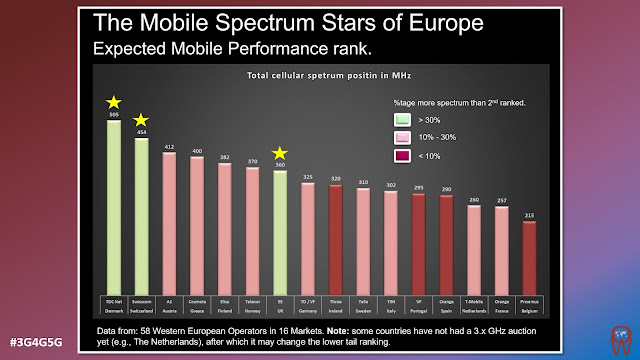
Based on the analysis of 58 Western European MNOs and their spectrum position, the highest expected mobile performance across markets and operators can be shown. Of course, it does require the MNOs to actively use their acquired cellular spectrum and deploy a market- & spectrum-appropriate antenna technology, such as described in my previous blog "RAN Unleased"

The MNO rank within a country will depend on the relative spectrum position between 1st and 2nd operator. If below 10% (i.e., dark red in chart below), I assess that it will be relative easy for number 2 to match or beat number 1 with improved antenna technology. As the relative strength of the spectrum position of number 1 relative to number 2 is increased, it will become increasingly difficult (assuming number 1 uses an optimal deployment strategy).

The Stars (e.g., #TDCNet / #Nuuday, #Swisscom and #EE) have more than a 30% relative spectrum strength compared to the 2nd ranked MNO in a given market. They will have to severely mess up, not to take (or have!) the best cellular network position in their relevant markets. Moreover, network economically, the Stars should have a substantial better Capex position compared to their competitors (although 1 of the Stars seem a "bit" out-of-whack in their sustainable Capex spend, but may be due to fixed broadband focus as well?). As a "cherry on the pie" both Nuuday/TDCNet and Swisscom have some of the strongest spectral overhead positions (i.e., MHz per pop) in Western Europe, which is obviously should enable superior customer experience.

While this is definitely a good metric to compare, as an analyst and a marketeer, I also think there is also a big role for how operators advertise their services and differentiators to reach the end customers. It may not be too difficult for a second operator (in terms of spectrum holding) to beat the first one with right marketing.

Happy to hear what you have to say.

Related Posts: 

Wednesday, 13 January 2021

Greece - 5G on the move...

Greece’s telecom market continues to suffer from tough economic conditions, with long-term financial strain on the public still affecting revenue and investment. However, there are signs of recovery and renewed confidence. 

Greece’s well-developed mobile market is dominated by the three mobile network operators Wind Hellas, Vodafone Greece and Cosmote. Operators continue to invest in LTE infrastructure and technologies to provide networks capable of meeting customer demand for data services. Although the MNOs have trialled 5G since 2019, commercial services await the auction of suitable spectrum: the regulator expects to auction spectrum in the 3.4-3.8GHz range later in 2020, followed by 700MHz spectrum in 2021.

All three MNOs have closely attached subsidiaries that resell their offers: Frog Mobile on Cosmote, Tazamobile on Vodafone and Q on Wind. There are hardly independent MVNOs on the market.

Their frequencies: 

Cosmote is the national provider with the most subscribers and the best coverage in 2G, 3G and 4G/LTE. 4G is given out without surcharge to all customers including prepaid plans. 4G/LTE covers at least 95% of population in 2018. 4G+ can be found in many areas and 3CA (3+7+20) is very common in big cities achieving great speeds (up to 300 Mbps). Even if your phone does not support 4G+, the speeds that you will achieve are great. It is currently the fastest (overall) network.

Cosmote has announced the commercial launch of its 5G network in Athens, Thessaloniki and other Greek cities, with speeds exceeding 1Gbps in certain areas. The company is aiming to increase coverage to over 50% of the population by the end of 2021, with 100% 5G coverage of 2,000km of highways by the end of 2023. The 5G network is accessible to all Cosmote subscribers with compatible devices, at no additional charge and regardless of their mobile plan.

Vodafone Greece is the 2nd network in Greece. Their 4G speeds are ok-ish but don#t expect anything crazy-fast especially in remote areas or villages. 4G+ or 2CA (3+20 or 3+7) can be found in very big cities/busy areas. They claim to have 4G speeds faster than anyone else, but that is not the case.

In last years 5G spectrum auction Vodafone reportedly spent €130 million on 14 blocks in the 3.4GHz to 3.8GHz range; two blocks of 700MHz; four blocks of 2GHz; and two blocks of 26GHz.

They have now launched their Giga Network 5G, the new state-of-the-art network, with high speeds and the immediate response. With first stations in areas of Athens and Thessaloniki, the Vodafone Giga Network 5G is already operational and by the end of this financial year a population coverage of 40% will have been achieved. At the same time, through the parallel modernization of the 4G network, Vodafone 4G customers will also benefit from an improved connection experience and higher speeds - up to 50% - from day one. In addition, Vodafone already has the first 5G devices, while within two months the available devices will be more than twenty.

Wind is the smallest network provider in Greece. Their 4G speeds are usually slow and thus they are the slowest (overall) network in Greece. In many tourist attractions, Wind has done a great job and their 4G speeds are acceptable. 4G+ or 2CA is not common in Wind but when it is found, it usually is B3+B20 or B7+B20.

They have selected Ericsson to deploy their core network for standalone (SA) and non-standalone (NSA) 5G. The Swedish vendor will also supply a suite of business support system (BSS) solutions to help the telco improve customer experience and launch 5G-enabled services for both private and business users.

Wind Hellas also announced that they switched on their 5G mobile network on 18 December – a matter of days after winning frequencies in the country’s multi-band 5G spectrum auction. The network will initially serve Athens and Thessaloniki, while coverage of other major cities will follow in due course. 5G population coverage is expected to exceed 60% within three years. Certified 5G handsets include the Xiaomi Mi 10T, the Xiaomi Mi 10T Pro, the Xiaomi Mi 10T Lite, the Huawei P40 DS and the Huawei P40 Pro DS. Users can expect to receive download speeds of up to 1Gbps. 

Monday, 29 July 2019

Cosmote 5G Ready as Greece Prepares for Spectrum Auctions

Along with being the largest of the Greek mobile operators, Cosmote provides an impressive coverage of all different generations of the networks; 2G, 3G, 4G (LTE), 4G+ (LTE-Advanced) and 4G++ (LTE-A Pro).

While up to date numbers of different mobile operators in Greece is not easily available, it is estimated to have roughly over 8 million subscribers.

Back in December 2018, Cosmote did some 5G demos with Ericsson. A summary of the demo is available in this presentation and embedded in the video below.


Some more information on what 5G would mean for Comote subscribers is available on their website here.

According to Telegeography:

Greece’s telecoms regulator, the Hellenic Telecommunications & Post Commission (Ethniki Epitropi Tilepikoinonion kai Tachydromeion, EETT), has taken a significant step towards its planned auction of 5G mobile spectrum. It has called for applications for a tender to find a contractor to help manage the award process, with bids for the EUR160,000 (USD181,000) contract invited until 12 July.

The watchdog is looking to award 2×30MHz in the 700MHz band, 65MHz in the 1500MHz range, 2×15 plus 2×45MHz in the 2100MHz band, 280MHz at 3.6GHz and 2,500MHz in the 24GHz-28GHz range. While some frequencies will be sold via auction, others will be offered for free.