Showing posts with label Vendor Parallel Wireless. Show all posts

Monday, 15 August 2022

Colombians Pin Their Hopes on 5G Due to Lacklustre 4G Experience

Despite the harsh impact of the Covid-19 pandemic on the country’s population and economy, Colombia’s telecom sector has been recovering due to positive performances in the fixed-line broadband, mobile broadband, and mobile voice and data markets.

Colombia’s fixed-line penetration remained stable by the end of 2020, though began to increase into 2021 as a result of the particular demands on households resulting from government measures associated with addressing the pandemic. However, at less than 15% it is well below the Latin American average. The mobile market, by contrast, reached a penetration rate of 136% (an increase of over three percentage points on 2019) and managed to keep the same upward growth trajectory that it has sustained over the last ten years. The fixed-line broadband market also expanded, with the number of subscribers increasing 11.4%, and with revenue increasing 9.9% thanks to increased data usage as many customers were forced to work or study from home during the year.

The mobile broadband market was the standout performer in 2020, with a 13% increase in the number of subscribers year-on-year, albeit the penetration rate is relatively low compared to other Latin American countries. Most significant of all was the surge in mobile broadband traffic — a 51% increase over the previous year — which was again a reflection of the strict lockdowns that Colombians had to endure for much of 2020.

Market leader Claro continued to expand its dominance of the mobile broadband market, increasing its share over the last decade by 10% to reach 54% at the start of 2021. Tigo, conversely, has seen its share halved over the same period of time, yet its subscriber base has still managed to grow on the back of a strong overall market. Tigo also suffered the most from Colombia’s imposed lockdowns in 2020, severely impacting its retail sales (a 20% decline in revenue) with nearly half of its stores being forced to close.

There are 4 networks in the country: Claro (formely Comcel), Movistar, Tigo Une (Tigo merged with UNE) and newcomer WOM. The three major operators share almost 90% of the market, led by Claro with about the half and followed by Movistar and Tigo with about 20% each.

2G and 3G is on 850 MHz on Claro and Movistar and 1900 MHz on all three majors. 4G/LTE started 2013/4 on 2600 MHz (B7) on Claro and Tigo and 1700 MHz (AWS/B4) on Movistar and Tigo and reaches already most of the population. WOM started as a 4G/LTE network only on 1700 MHz (B4) and roam on other networks for 2G/3G.

The most recent Open Signal report found Tigo to be the best performing operator in most of their categories. 

While Colombia’s Ministry of Information Technologies and Communications (MinTIC) has not yet scheduled an auction of 5G spectrum , in November the regulator announced plans for public consultation on increasing spectrum caps for the frequencies below 3 GHz — up to 50 MHz in the frequency range below 1 GHz and to 95 MHz in the 1710MHz-2690MHz range. The regulator is also considering applying an 80 MHz spectrum cap for the 3300MHz-3700MHz frequencies and intends to make all 400 MHz in this range available for 5G services. Earlier this year, in October, MinTIC renewed Claro and Movistar’s 1900 MHz spectrum licenses, while requiring the operators to update their technology and improve their coverage and quality of services.

In terms of 4G download speeds, Opensignal users on Tigo experienced the fastest average download speeds of 18.7 Mbps. Movistar and Tigo users saw declines in average 4G download speeds, of 0.5 and 2.1 Mbps respectively, while Claro users observed an increase of 1 Mbps. In addition, OpenSignal users on WOM networks enjoyed average 4G download speeds of 14.5 Mbps, which led to a statistical tie with Claro for second place. These changes resulted in Tigo’s lead over second-placed competitors decrease from 6.9 to around four Mbps.

In 2013 Claro merged with Comcel, dropping the name Comcel. They are now the market leaders in Colombia with the best nationwide coverage and a 48% market share. 4G/LTE on 2600 MHz (Band 7) is available for prepaid in about 200 towns and 28 capitals served by its network.

In May 2022, Claro Colombia announced its intention to switch off all 2G services by December 2022 in order to re-farm more spectrum for 4G and for a possible 5G launch.

In 2014 the merger of the two smallest networks in Colombia UNE and Tigo was finalised. The new joined network is marketed mostly under the name of Tigo. They remain the smallest major network in the country with slightly less coverage and 4G/LTE is available for prepaid on 1700 MHz (Band 4).

Tigo wins all but one of the Open Signal awards outright. The only exception is 4G Coverage Experience, which Claro successfully defends and claims outright for the fifth time in a row. Tigo increased its lead over its competitors in Upload Speed Experience and 4G Availability categories, but its lead in Download Speed Experience over Claro declined. 

In May 2021 Millicom International Cellular (MIC) announced that its Tigo Colombia subsidiary will become the first operator in Latin America to deploy Open Radio Access Network (O-RAN) architecture. The rollout will be carried out in partnership with Parallel Wireless and deliver 4G service coverage at 362 rural sites. 

Telefónica acquired the former state-owned Colombia Telecomunicaciones in 2006 and sells it under its brand name of Movistar. It's now the 2nd operator in the country giving good coverage and speed. 4G/LTE has started in 5 main cities – Bogota, Medellin, Cali, Barranquilla and Bucaramanga on 1700 MHz (Band 4) and 77 municipalities. 

WOM announced in August 2021 that it signed up one million subscribers since it launched in April 2021. The operator attracted new customers by offering plans, which undercut its competitors’ prices by 40%. With a new aggressive player in the market, managing subscriber churn will become an even greater challenge for the established mobile operators in Colombia. Maintaining high quality of mobile network experience will remain crucial to retain existing customers and attract new ones. 

DirecTV Colombia – a subsidiary of US telecoms giant AT&T – has reportedly switched on a fixed-wireless 5G service in selected parts of Bogota. According to Tecno Movida, the network has gone live in Kenedy and Engativa, and utilises equipment from Ericsson, Qualcomm and Gemtek. The network, which includes a cloud native 5G core and uses Massive MIMO technology, is capable of supporting download speeds of up to 100Mbps.

According to TeleGeography’s GlobalComms Database, satellite pay-TV provider DirecTV Colombia won a 4G concession in June 2013, securing 2×15MHz of FDD-LTE spectrum and a 40MHz block of TD-LTE spectrum in the 2600MHz band. The operator went on to launch its LTE-based 4G wireless broadband service in July 2014 and served 187,322 4G subscribers as of 31 December 2019.

Sunday, 20 March 2022

Vodafone to keep pushing for Open RAN

At Mobile World Congress 2022, Johan Wibergh, Chief Technology Officer of Vodafone presented their vision and plan going forward in the 'Evolving the Network for the Future' session. On his LinkedIn post, he said:

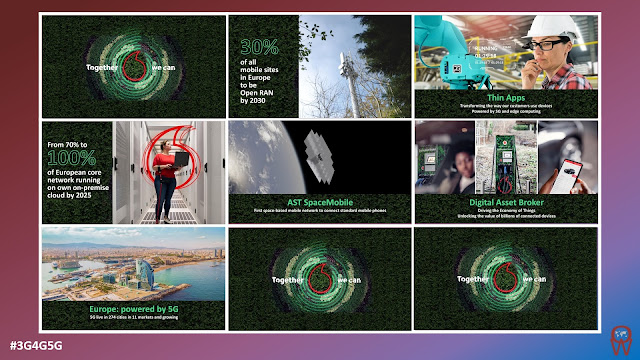
I have just presented at Mobile World Congress #MWC22 and was delighted to announce that around 30% of our European network will run on #OpenRAN by 2030, following the first site going live in the UK last month. This will give us more flexibility and speed in how we operate.

It is also an example of how innovation is coming back to the network.

Disruptive technologies such as Open RAN, Network as a Platform and Multi-Access Edge Computing are perfect illustrations of how we are meeting demand for fast connectivity, as well as driving supply chain diversity, creating digital eco-systems, and inventing new industrial-strength applications.

Also, through our scaled platforms – M-PESA, IoT and now Digital Asset Broker (DAB) – combined with our geographical scale, we aim to help support the digital needs and ambitions of our customers and societies across Europe and Africa.

Around 30,000 sites across Europe will eventually use OpenRAN, with rural areas the first to benefit from the new 4G and 5G masts. When the roll-out reaches cities, the equipment from any existing 5G masts being replaced will then be reused elsewhere to reduce unnecessary wastage.

A press release release from Vodafone has details here. 

Their MWC22 page has more related news on this and other topics they discussed in Barcelona.

In another news Vodafone announced that seven UK communities is set to receive 4G based on Open RAN. Last year we wrote about their first Open RAN site with Samsung here. At that time it was assumed that Samsung is bring 2G (GSM) but Light Reading recently mentioned that Samsung hasn't got 2G. 

Parallel Wireless has been in Vodafone Turkey network for the last few years doing 2G and 4G as we detailed before. In a press release, Juniper Networks announced that it is working with Vodafone and Parallel Wireless conducting a multivendor RAN Intelligent Controller (RIC) trial for tenant-aware admission control use cases. It says:

The trial, initially running in Vodafone’s test labs in Turkey and with plans to move into its test infrastructure, supports O-RAN interfaces and addresses the key business challenges faced by mobile operators around personalized user experience, viable revenue generation and reduction in both CAPEX and OPEX for 4G and 5G services.

The trial is based on an open, software-driven architecture that leverages virtualization to deliver more programmable, automated granular-by-user traffic management. The initial focus is on delivering tenant-aware admission control capability, enabling operators to personalize services and provide superior user experiences. Real-time tracking and enforcement of radio resources across the RAN enables mission-critical users – for example, hospitals and schools – to receive prioritized mobile data services delivery. This capability is enabled by Juniper’s rApp/xApp cloud-based software tools that manage network functions in near real-time, along with Parallel Wireless cloud-native Open RAN functions.

The trial’s design philosophy is focused on demonstrating the potential of enabling open, agile resource management and mobile data delivery in any software-driven RAN environment. This approach enables services and applications to be managed, optimized and mitigated automatically by the RAN, built on real-time data insights from its own performance.

All three organizations are active operators/contributors of the O-RAN ALLIANCE and the Telecom Infra Project (TIP), underlining their shared commitment to industry innovation and standards.

Juniper’s RIC solution is architected as an open platform supporting open interfaces on the north bound and south bound side, enabling easier integration with Open RAN partners in the ecosystem. Juniper’s RIC platform will also enable easy integration of third-party rApps/xApps, using UI-based onboarding and deployment tools coupled with flexibility to select between either network-based or SDK-based APIs (Application Programming Interfaces).

Parallel Wireless brings cloud-native Open RAN solutions - which are now integrated with the leading-edge RAN Intelligent Controller (RIC) based on O-RAN ALLIANCE specifications from Juniper Networks, giving operators more choices to build the best-of-breed RAN.

Juniper has a short RIC explainer video which is embedded below: 

Telecom TV reminds:

It’s no coincidence that Juniper is involved in Open RAN tests and trials in Turkey: It engineered its way into the RIC R&D scene by striking a deal in January 2021 to take the early RIC work undertaken by Netsia, the tech R&D unit at Türk Telekom, and develop it further, all the while ensuring that the resulting platform would not only conform to Open RAN specifications but also be suitable for deployment by Türk Telekom. As part of that deal, Juniper gained all the IPR and rights, and so has bene able to take it into tests with other operators at will.

Related Posts:

Tuesday, 22 June 2021

Peru wants more 4G and Open RAN

Peru is the third largest country in South America, after Brazil and Argentina. It's roughly over three times the size of Japan or Germany or five times as large as UK. Having said that, its population is just over 33 million. It is made up of a variety of landscapes, from mountains and beaches to deserts and rain forests. Most people live along the coast of the Pacific Ocean, where the capital, Lima, is located.

Peru’s fixed-line teledensity remains among the lowest in South America, with obstacles to fixed-line growth including widespread poverty, fixed-to-mobile substitution, expensive telephone services, and geographical inaccessibility in the rugged Andean mountains and lowland Amazon jungles. The government is addressing these shortcomings via ambitious investment plans to deploy telecom infrastructure and services in underserved areas. Most of the work was complete by the end of 2017, when eight regional fibre-based networks were connected to the National Fibre-Optic Backbone.

Broadband penetration in Peru is considerably lower than the Latin American average, despite government efforts to encourage the development of the sector.

Mobile penetration is on a par with the regional average, though high penetration is attributed to the popular use (especially among urban dwellers) of multiple mobile subscriptions. This phenomenon is becoming less pronounced as network operators respond to market competition by providing generous data and voice bundles (so obviating the need for SIM cards from different networks) and as the regulator endeavours to remove illegal devices and unregistered SIM cards from the market.

Telefónica Perú (trading as Movistar Perú) is the leading player in the mobile market, followed by Claro Perú, Entel Perú and Viettel (trading as Bitel). The market still has considerable potential to expand, especially given the country’s low fixed broadband penetration which has encouraged the uptake of mobile data services. By late 2020, the mobile broadband penetration rate reached 69% of the population.

2G/GSM and 3G/UMTS are on 850 and 1900 MHz on the three major operators Movistar, Claro and Entel. 4G/LTE has started in 2014 in major cities on AWS frequency 1700/2100 MHz on Movistar and Entel and 1900 MHz on Claro and is already open for prepaid. Soon on all three operators the 700 MHz frequency (Band 28) will be added. Bitel has a limited 3G network so far on 900 and 1900 MHz and launched 4G/LTE on 900 MHz (Band 8).

In the most recent OpenSignal report Entel was the dominant operator as far as the awards table was concerned, winning three out of seven awards outright and jointly winning another three. This time round, both it and Movistar each hold two awards outright and two jointly. However, Entel remains the operator with the best scores for our two speed metrics — Download Speed Experience and Upload Speed Experience. Neither operator has been able to challenge Claro’s grip on the 4G Coverage Experience award.

Also, Bitel users’ mobile experience has improved very significantly since the previous report, with impressive gains seen across Video Experience, Download Speed Experience, Upload Speed Experience and 4G Availability. With the exception of 4G Availability, much of the improvement made up for the lost ground seen back in the August 2020 report, when many scores dropped significantly due to the headwinds created by the COVID-19 pandemic. However, Bitel’s scores in this report for Video Experience, Download Speed Experience and Upload Speed Experience have risen more strongly than other operators and are up by 6 points (15.1%), 1 Mbps (23.8%) and 0.6 Mbps (30.5%) respectively from the scores in Opensignal’s February 2020 report.

Although operators are yet to launch commercial 5G services for smartphone users and the auctioning of spectrum in the 3.5 GHz and 26 GHz bands will not take place until 3Q 2021, there have still been a number of interesting developments in the Peruvian mobile market since the last report. These include the news that the country’s Ministry of Transport and Communications (MTC) is seeking to invest around $413 million to bring 4G connectivity to more than 2,600 communities. In addition, MTC has also published draft network sharing regulations that it believes will cut the cost of network rollout and make it easier to serve rural areas.

Movistar in Peru, owned by Spanish Telefónica, is the biggest provider and market leader in the country. It has more than 1/2 of all mobile customers and the best coverage (coverage map). But this comes at the highest prices. Also, you should keep in mind when you are travelling overland between major cities many hours without any signal are common.

4G/LTE has started in 2014 on the AWS frequency of 1700/2100 MHz (band 4) and added 700 MHz (band 28) which is open to all prepaid tariffs. Movistar guarantees speeds of 5-130 kbps on 2G, 0.4-1 Mbps on 3G and 2-5 Mbps on 4G/LTE. They use carrier aggregation of both LTE bands in the capital for the highest speeds.

Claro is the big rival of Movistar in Peru. It has more than 1/3 of all mobile customers and only a slightly lower coverage at lower prices.

4G/LTE has started in major cities and is available on all prepaid plans. Unlike its competitors, Claro uses the 1900 MHz (band 2) frequency for it, which is more accessible to many devices from out of the US. In 2016/7 it added the 700 MHz (band 28) in Lima and 38 more towns for LTE. In and around Lima they have added support for 2600 MHz (band 7) 4G+ is available using both bands.

Their LTE coverage is on par and partly surpasses that of Movistar, if you don't have a device that carries band 4. However, you should keep in mind when you are travelling overland between major cities many hours without any signal are common.

As in many other countries, the incumbent operator Movistar offers the best coverage, but at higher rates. Claro as challenger has a heavy marketing footprint all over the country, while Movistar is less visible. Despite that, where there is Claro, there is always Movistar too. Either next door (literally) or in the same Claro-colored small shop/street vendor.

This operator has launched commercial fixed-wireless broadband services via 5G technology, having received authorisation from the telecom ministry to use its existing 3.5GHz spectrum for the service earlier this year.

The Chilean market leader Entel bought Peruvian network Nextel in 2013 and changed its name to Entel in 2014. It's still building up its network and lacks the coverage of the big two providers, but can be reasonable if you stick to the cities. Please note however coverage is very limited in the Loreto Department (Amazonas region). There is no (zero) siginal when travelling by boat between Yurimaguas and Iquitos.

4G/LTE has started in 2014 in Lima on the 1700 MHz AWS (B4) frequency and spread out to more places. According to OpenSignal's country report compiled in 2019, it's the best 4G/LTE network in the country what speed is concerned and matches Movistar's coverage of 85% covered by 4G networks.

This operator as also launched a fixed-wireless broadband service utilising 5G technology on the 3.5GHz band. Both Entel and  Claro, were granted permission by the Ministry of Transport and Communications (Ministerio de Transportes y Comunicaciones, MTC) to utilise its existing frequencies in the band to offer a fixed-wireless internet service using 5G New Radio (NR) technology. Entel’s 5G plan provides downlink speeds of up to 50Mbps for PEN150 (USD40.13) per month, plus an up-front fee of PEN1,499 for the modem and installation.


Bitel is the latest arrival in Peru. They are the Latin American branch of Vietnamese army-owned Viettel and started in 2014 with an own network in the country. It's in a rather limited area (see coverage map) on 900 MHz and 1900 MHz. The rather unusal 900 MHz spectrum is used for 3G, added by 1900 MHz. In 2016 Bitel launched its 4G/LTE network through 1,750 4G base stations, covering 500 population centres on the rather unusual band 8 (900 MHz). It has a wide 4G coverage in Peru now, but focuses on rural areas which are not covered by other operators. So it's only recommended if you go to these places. In an OpenSignal test in 2019 speeds were much lower than on the other three networks.

Back in 2018, Telefónica announced “Internet para todos” (“Internet for all”), a collaborative project to connect the unconnected in Latin America. The Initiative is aimed at connecting the more than 100 million people in Latin America with no internet access. Telefónica agreed collaboration with Facebook on key technological and commercial innovations and collaboration with multiple stakeholders: rural operators, technology firms and regulators.

Parallel Wireless have been deploying OpenRAN sites with them and even did a press release last year to say hundreds of sites have been deployed.

Last month Telefónica announced that 'Internet Para Todos' is two years old and has contributed to connecting more than 2 million Peruvians in rural areas with 4G internet. Internet para Todos expects to close 2021 with 13,000 communities with high-speed mobile internet access.

Related Posts: 

Wednesday, 25 November 2020

Turkey Plans 5G Rollouts in 2021 with Demand Expected from 2022 Onwards


It's been 3 years since we last wrote about Turkey. Turkey’s telecoms sector continues to make great strides with its 5G implementation. The operators have conducted significant trials, largely supported by Ericsson and Huawei. LTE networks are already well established across the country, providing population coverage of over 93%. Many base stations have been upgraded to LTE-A.

Deployment of fibre-based broadband networks are also well underway in Turkey and while DSL services are still the leading fixed broadband access method - it will eventually lose its dominance due to the rapid growth in fibre subscriptions.

Turkey’s fixed and mobile infrastructure will help to underpin its Smart City initiatives, which have become a key area of focus for the future. Turkey recently released its National Smart Cities Strategy and Action Plan which will run for 3 years, between 2020-2023

BuddeComm notes that the outbreak of the Coronavirus in 2020 is having a significant impact on production and supply chains globally. During the coming year the telecoms sector to various degrees is likely to experience a downturn in mobile device production, while it may also be difficult for network operators to manage workflows when maintaining and upgrading existing infrastructure. Overall progress towards 5G may be postponed or slowed down in some countries.

On the consumer side, spending on telecoms services and devices is under pressure from the financial effect of large-scale job losses and the consequent restriction on disposable incomes. However, the crucial nature of telecom services, both for general communication as well as a tool for home-working, will offset such pressures. In many markets the net effect should be a steady though reduced increased in subscriber growth.

There are three network operators in Turkey: Turkcell, Vodafone and. Türk Telekom (formerly called Avea).

Like in Europe, 2G GSM is on 900 and 1800 MHz, 3G on 2100 MHz. Nationwide Turkcell has the best coverage, followed by Vodafone and Avea. If you stick mainly to the cities, it does not make any difference which of the three providers to choose.

In 2015 the regulator auctioned off licenses on 800, 900, 1800, 2100 and 2600 MHz bands for 4G/LTE (Bands 3, 8, 1 and 20) . All three providers launched 4G/LTE in 2016. It has been marketed from the start as "4.5G", otherwise known as LTE+ or LTE Advanced, accelerated by carrier aggregation where available in major cities in all 81 provinces from the start. Coverage is generally quite good: Turkcell has the best, followed by Vodafone and Türk Telecom with the least.

According to the recent report by Open Signal, Turkcell was to be the dominant operator across the majority of their network experience metrics. Turkcell managed to win in four out of their seven award categories — 4G Coverage Experience, Video Experience, Download and Upload Speed Experience — and each one of them by a large margin. The operator also came close to challenging its peers in the remaining three, but failed to beat Türk Telekom on Voice App and Games Experience, as well as Vodafone on 4G Availability.


Turkcell is the biggest operator in the country with 34 million mobile subscribers and 46.8 percent of the market share. 2G is on 900 MHz, 3G on 2100 MHz. In 2015 Turkcell’s population coverage was at 99.8% in 2G and 95% in 3G. Turkcell launched their "4.5G" LTE in 2016 using tri-band aggregation of 800, 1800 and 2600 MHz frequency bands. 4G/LTE is free to prepaid. Turkcell is known to have the best coverage in the countryside.

Turkcell has transformed its LTE and 5G voice network into 100% virtual infrastructures using Mavenir’s cloud-native, NFV-based IMS solution. Mavenir’s Virtualized IMS (vIMS) solution is designed to support LTE use cases and evolve into a fully web-scale platform that can meet growing requirements.

Vodafone is the 2nd operator in terms of coverage. 2G on 900 MHz, 3G on 2100 MHz, 4G/LTE was launched in 2016. It has a good coverage in the country, slightly worse than Turkcell, but better than Türk Telekom.

Vodafone has conducted extensive trials on Open RAN technology with the OpenRAN leader Parallel Wireless. These trials resulted in the creation of a Playbook with the help of Telecom Infra Project (TIP) OpenRAN group.

This playbook is developed by teams from Vodafone and Parallel Wireless to capture the learnings from this trial deployment where brownfield sites in Turkey were swapped with OpenRAN solutions for 2G/3G/4G, evaluating the technical and operational KPIs in the process. The playbook helps the OpenRAN community members, RAN solution providers, network operators, and system integrators take an informed approach to the selection of technology and the planning of OpenRAN deployments. It's available here.

In 2016 Türk Telekom rebranded its mobile network from Avea, but you see their old sign still sometimes. It's the smallest provider in Turkey in terms of coverage, but they have still good speeds in the cities and a fair coverage in the countryside. 2G is on 900 and 1800 MHz, 3G on 2100 MHz, 4G/LTE was launched in 2016. It still has the lowest coverage in the countryside, but is strong in cities.

A recent GSMA report, Roadmaps for awarding 5G spectrum in the MENA region, October 2020, mentioned that BTK, the Turkish regulator, has outlined its 2019-2023 strategic objectives under nine main themes in a 105-page long document. These objectives include detailed discussions on support for research and development activities to establish ‘5G and beyond’ national technologies; expanding fibre optic infrastructure to support fixed, mobile and cable broadband technologies; support for emerging technologies, e.g. IoT/M2M; and development of national cyber security capabilities.

The New Generation Mobile Communications Technologies Turkey Forum (5GTR Forum) was established in 2016 to coordinate activities of industry and academia relating to the development of 5G technology in Turkey. The forum produced a 338-page long ‘white book’ titled ‘5G and Beyond’. The report provides a set of recommendations for the development of physical layer, core network and terminals as well as how individual verticals could benefit from the use of 5G technology.

In terms of spectrum allocations, the report notes that the bands 470-694 MHz, 694-790 MHz, 1427-1518 MHz, 2300-2400 MHz, 2500-2690 MHz140, 3400-3800 MHz, 24.25-27.5 GHz, 40-43.5 GHz and 66-71 GHz are planned for mobile broadband systems in the short (before 2023), medium (2023-2028) and long (beyond 2028) term.

5G trials are being conducted, including:

  • Turk Telekom live trials for 3.5 GHz band; and
  • Turkcell field trials for 26/28 GHz and 3.5 GHz.
  • Vodafone has planned its 5G trials but is yet to operationalise them.

Related Blog Posts:

Wednesday, 11 November 2020

Ghana gets 4G, 4G+, Open RAN but no 5G

 
The mobile market of Ghana is one of the most vibrant in Africa, with competing operators including the regional heavyweights MTN Ghana, Vodafone Ghana and AirtelTigo, formed from the merger of Airtel Ghana and Tigo Ghana. Although subscriber growth has remained strong in recent years, with the exception of a dip in 2017 resulting from a redefinition of active subscribers from one of the operators, competition has resulted in lower Average Revenue Per User (ARPU) and pressure on revenue. The country ranks high in BuddeComm’s Telecom Maturity Index, a testament to ongoing developments in network upgrades among operators as well as efforts by the government and regulator to expand services to underserved rural areas.

There remains enormous potential in mobile broadband services, both in terms of subscriber additions and in mobile data ARPU. Mobile internet connections already account for the vast majority of all internet accesses in the country. The launch of LTE services by MTN Ghana in mid-2016 and by Vodafone Ghana in March 2019 has added to the vibrancy of this sector. The regulator has encouraged other operators to refarm 2G spectrum for 3G use in a bid to improve internet access in rural and remote areas.

Overall there are four national operators competing for customers in Ghana: MTN Ghana, Vodafone Ghana, AirtelTigo (merged Airtel and Tigo) and Glo Ghana.

National networks are on 2G/GSM 900 MHz and 1800 MHz and 3G/UMTS 2100 MHz plus 900 MHz from 2017. Coverage and speeds are fairly good compared with regional standards and Ookla speedtests show an average of 9 Mbps for the country. 4G/LTE has been started by MTN and Vodafone on 800 MHz (Band 20).


MTN Ghana from South Africa is the market leader in Ghana with a 48% share and the best coverage and speeds since it took over Arreeba Ghana (Scancom) in 2007.

It's the only major network so far that has rolled out 4G/LTE from mid-2016, now available in every regional capital and some larger towns. For LTE they use spectrum on 800 MHz (B20). In March 2019 they activated its ‘4G+’ service based on LTE-A carrier aggregation technology, disclosing that it currently operated 1,226 4G LTE sites of which 625 were LTE-A enabled.

With 23.9 million voice subscriptions, MTN Ghana controls 57% of the subscriber market share in Ghana, far ahead of Vodafone, AirtelTigo, and Glo at 21.97%, 20.3%, and 1.75% respectively.

Despite the presence of 52 Internet service providers and 3 other operators, MTN enjoys 67% of the country’s data market and currently leads the country’s fast-growing mobile money sector.


Vodafone Ghana used to be the second placed rival, but will be overtaken by the merger of Tigo and Airtel. It was formerly called Ghana Telecom and was the national telecommunications company of Ghana. In 2008 Vodafone agreed to acquire 70% of Ghana Telecom from the Ghanaian government while the Ghanaian government retained a 30% stake.

Vodafone has started with 4G/LTE in a partnership with Surfline Communications to offer 4G services to its own customers in the cities of Accra, Tema and Takoradi. In 2019 Vodafone received spectrum on the 800 MHz (band 20) for LTE services, that have been launched in the springtime.


In 2017 Bharti Airtel has merged with Millicom’s Tigo in Ghana to become the country’s 2nd largest mobile operator called AirtelTigo with a 26% market share.

The regulator granted conditional approval for the merger in 2017. In the following months the two networks were integrated. In December 2018 AirtelTigo has announced that it has completed the network integration it has been carrying out for the past year. The new network is shown as Tigo on most phones.

Bharti Airtel has announced that it plans to end its Ghana operations by selling all of its 100% stake in its Ghana division, AirtelTigo. Airtel owns a 49.95% non-controlling stake.

The government of Ghana is reportedly set to acquire 100% shares of AirtelTigo, its customers and agreed liabilities. The government is expected to temporarily operate the assets and help protect the jobs of employees and the Interests of customers and stakeholders.


GLO for Globacom from Nigeria entered the Ghanaian market some years ago. It's the new 4th ranked operator with a meagre 4% share. Due to its lower coverage, it can't be recommended for travelling through the country.

Glo’s entry into Ghana in 2011, and the merger between Airtel and Tigo in 2017, could not provide sufficient competition for MTN in the telecom market.

Consequently, Ghana’s telecom market is gradually edging fully towards consolidation instead of a competitive one.

The Ghanaian government is working with Huawei Technologies to deploy more than 2,000 Rural Star sites in rural areas of the country. The network project, which is scheduled for completion by September 2021, is expected to provide voice and data services to over 3.4 million people in underserved and unserved communities, thereby extending national mobile coverage from 83% to 95%.

Back in April, the All G Open RAN vendor Parallel Wireless had announced that they have been selected by Ghana Investment Fund for Electronic Communications (GIFEC) to provide mobile telephony connectivity to underserved and unserved communities in Ghana. GIFEC is a special Fund set up by the Government of Ghana under the Electronic Communications Act 2008 (Act 775), designed to provide telecommunications and ICT services to unserved, underserved and deprived groups and communities in the country.

Tuesday, 21 July 2020

Central African Republic (CAR) to get more 3G, Open RAN and possibly some 4G


Persistent conflict has hampered telecommunication and media development in the Central African Republic. Potential  for growth is significant as the penetration rate remains low, (lowest penetration rate in Central Africa with 22%), and still affected by the country’s challenges such strong inflation and infrastructure deficiency due to the conflict.

Due to the fact that it is a landlocked country there is no scope investment in broadband networks and access to cross-border submarine cables. Mobile, however, is more optimistic with a reasonable level of competition, given the challenges.

There are four mobile operators in the country; MOOV, which launched in 2005 and is a subsidiary of Morocco Telecom; TELECEL, the oldest operator in the market, having launched in 1996, a subsidiary of South Africa-headquartered Econet:Wireless, AZUR, which launched in 2004 and is owned by a private Congolese group;and Orange, the latest market entrant, launched in 2007, a subsidiary of Orange France.

According to data collected directly from mobile operators and the Telecommunications Regulatory Authority, as of April 2019, the total number of active mobile telephone subscribers in the Central African Republic is 1,228,554 for an estimated population of 4.5 million. This represents a penetration rate of about 27 percent. According to this data, Telecel, which covers about 60 cities (the 50 percent of the market share), is the largest mobile network provider with 618,391 active subscribers, followed by Orange with 501,181 (in about 50 cities), Moov with 65,588 and Azur with 43,394.

Moov operates 2G GSM services over the 900 MHz band. Currently no 3G UMTS or 4G LTE services are available. The company began operations in 2005 then owned by Atlantic Telecom, only to be acquired by Etisalat shortly after. In 2014 Maroc Telecom took over Etisalat's West African operations comprising of its subsidiaries in Benin, Ivory Coast, Gabon, Niger, the Central African Republic and Togo.

Telecel Centrafrique is operating since 1996 and operates 2G GSM services over the 900 MHz band and 3G UMTS over B1 (2100 MHz). The company is the first and oldest mobile carrier in the country. Then owner Orascom (controlled by GTH/Vimpelcom), initiated a sale of Telecel to Niel Telecom in 2013 only for the deal to fall through due to inadequate financing. Orascom finalised the sale in October 2014 to Econet Wireless.

Azur RCA is a mobile carrier owned by Congolese businessman Jean Bruno Obambi (previously Bintel), operating in the Central African Republic (Centrafrique). Azur also present in Gabon, Congo, and Somaliland (under the NationLink brand). The company began operations in June 2004 operating under the NationLink Telecom name, and today has about 85,000 subscribers across 18 cities of the CAR. The company's Centrafrique headquarters is located in Bangui. The company operates 2G GSM services over the 900 MHz band, and 3G UMTS (HSPA+) over the B1 (2100 MHz) band. Due to the ongoing humanitarian crisis in the CAR, groups such as Emergency Telecommunications Cluster (ETC) have been assisting local carriers with maintenance and repair.

Orange Centrafrique is the second largest mobile carrier and the most recent company to join the market. The company operates 2G GSM services over the 900 and 1800 MHz bands, and launched 3G UMTS over the B1 (2100 MHz) band in 2013, with coverage mainly limited to urban areas. It has provided the four main cities of the country with mobile data services through its positioning in offers to companies, organizations and international military forces. In addition, Orange is the only operator to provide mobile payment services since it launched its Orange Money offer in 2016. Orange also provides WiMAX services in some regions.


According to Mobile World Live, Orange Centrafrique became the latest operator to throw weight behind Open RAN technology, inking a deal with vendor Parallel Wireless and infrastructure company i engineering group to deploy software-based networking equipment for its unit in the Central African Republic.

The agreement is part of Orange’s Include Digital in Every African Life (IDEAL) scheme, which aims to provide access to digital services to unconnected users across its African footprint.

A statement from Parallel Wireless suggested the small country of Central African Republic (its population is less than 5 million) will be the first of a number of open RAN deployments for Orange in Africa.

Orange MEA CTIO Herve Suquet said the use of virtualisation, open RAN and automation would help the company in its ambition to lead the Central African Republic market.

It plans to provide voice, data and mobile money services already available in urban parts of the country to rural areas.

A software-based approach to the network is partly intended to ease expansion and introduction of new services.

“Being able to run 2G and 3G on the same system today and, as our customers upgrade their devices to 4G in the future, seamlessly upgrade to 4G will help us not only extend our initial investment, but also bring new services much faster,” Suquet said.