Showing posts with label Use Cases. Show all posts

Thursday, 20 January 2022

China Telecom explains Implications of Innovative Fixed 5G (F5G) Applications

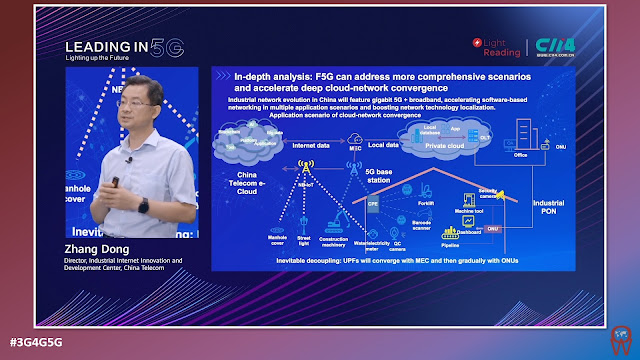
Last year, Zhang Dong, Director, Industrial Internet Innovation and Development Center, China Telecom, spoke at at Light Reading’s Leading in 5G webinar series.

He said China Telecom began trials three years ago with half a dozen early adopter clients.

The base station cost was mostly paid for by the enterprises, while China Telecom sold O&M services and applications on top including big data, AI, and so on, he said.

While we see challenges like how to ensure lower latency and higher network assurance, and deal with problems like jittering, or how to simultaneously deliver 8K HD video from eight cameras, China Telecom is still making important milestones on its 5G journey.

Zhang said that after deploying more than 1000 5G use cases, China Telecom experts have identified four key categories.

The first is using 5G to enable high-speed mobility, with applications such as autonomous driving, remote control of vehicles or remote management of ports and warehouses.

The second type is those leveraging the faster 5G uplinks and downlinks. This is mostly related to video and in the future will also include various other integrated media, like AR and VR, Zhang said.

The third type of 5G use case focuses on scenarios where people and things gather, such as transportation hubs, and places with large number of people or large objects moving around.

The fourth type is deployment of 5G in hazardous environments. For example, some working environments might expose personnel to toxic gas, loud noise or other safety hazards. 5G can play an important role in ensuring safety.

Zhang cited some of China Telecom’s collaborations in the resource and utility sectors.

One was with oil and gas giant Sinopec, which was one of the first to trial 5G because it was willing to pay for the base station rollouts and services.

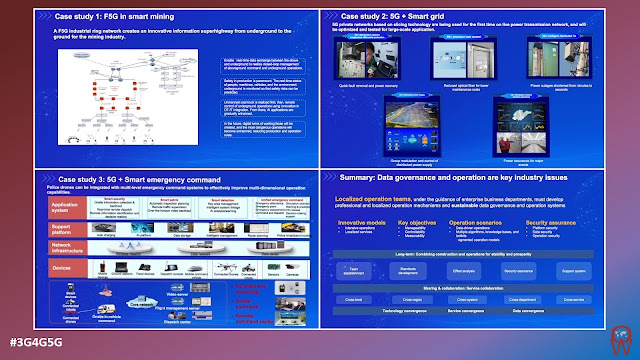
Another was the Shendong Coal Group in the mining sector, which had worked with China Telecom to roll out private networks under the wells, requiring investment of over 100 million yuan ($15.6 million).

China Telecom had also partnered with Qingdao Power Grid in a project where network slicing ensured the connectivity and lower latency to support precision power distribution.
We have looked at Fixed 5G (F5G) in our blog posts here and here. During the talk, Zhang also discussed F5G. 

He highlighted that in F5G,  there's a F before 5G where this F stands for fiber connection. Fiber connections and 5G joining hands will usher in another wave of technological innovations with 5G.  Base stations already need fiber for data transmission, etc. These connections can be extended to OT industry, which would mean that the fiber connection can be used to control robots, etc. If fiber connections are deployed together with 5G, mining and other use cases in verticals will emerge in addition we know do today.

The video of his talk is embedded below:

Related Posts:

Thursday, 23 December 2021

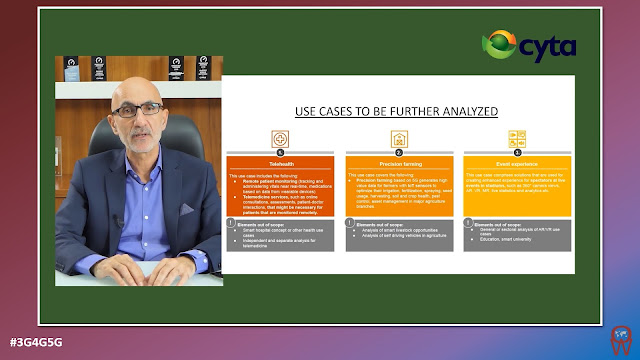
CYTA in Cyprus is betting on 5G Use Cases for 5G Success

Cyta for CYprus Telecommunication Authority is jointly owned by the Government of the Republic of Cyprus and Vodafone and is still the largest operator in the country giving a reasonable coverage at the highest rates around.

Cyta launched the first 5G network in Cyprus in January 2021.The Cytamobile-Vodafone 5G network has a population coverage of 70 per cent and is expected to reach 98 per cent in around 12 months, the company said. All Cytamobile-Vodafone subscribers, individuals and companies have access to the 5G network at no extra charge. All a subscriber needs is to be to have a 5G device certified on the Cyta network and to be in an area with 5G coverage.

At the 5G Techritory Conference 2021, Chrysis Phiniotis, CTIO of CYTA presented a talk on 'CYTA 5G Journey to the Top'. His talk is embedded below:

Back in October, Ookla®, the Speedtest® company, announced that Cyta had the fastest mobile network in Europe.

Related Posts:

Thursday, 9 December 2021

Vodafone Deutschland (Germany) Continues 5G Use Cases Innovation

Since the launch of the first European 5G Standalone Network, Vodafone Germany has continued innovating, to find the killer use case. Here are some of them that they have been working on this year.

First 5G Hospital: In the first 5G clinic in Europe, the network of the future will make innovative applications possible in the future that will significantly improve the medical treatment and care of patients. Whether in surgery, in the emergency room or even when calling the emergency services: "Digitization can save lives", says Vodafone Germany boss Hannes Ametsreiter. In order to expand the digital possibilities in hospitals, the Düsseldorf network pioneer is now equipping the Düsseldorf University Hospital (UKD) with 5G power. "We bring our real-time network directly to the hospital to support patients and doctors with new technologies."

5G Telemedicine: State-of-the-art technology, sensors and a direct line to a doctor await you when you visit the doctor in the telemedicine station. The US company Onmed has now launched one of the first treatment rooms for remote treatment on the market. Go in, get treatment, get medication, go out again. A visit to the doctor in the telemedicine station could be so easy. The first Onmed stations are to be set up in the USA and worldwide this year. And now let's take a look. This is what you can expect when you visit the doctor in the telemedicine station

Research on the 5G train: Vodafone builds campus network for test track in the Ore Mountains - Imagine you take the train from Hamburg to Berlin - and that completely without a train driver: in. How this can work is researched and tested by Vodafone in cooperation with the Technical University of Chemnitz. With 5G and the Internet of Things, the two partners want to digitalize rail traffic sustainably in order to make it safer and more efficient.

Sky 5G Multiview App: Anyone watching football matches in the stadium wants to see top sporting performance on the pitch and experience pure emotions. But fans in the stands do not always get every detail of the game and miss some crucial scenes. 5G technology from Vodafone and the Sky 5G Multiview app could soon change that. The Sky 5G Multiview app combines the advantages of a live sports broadcast on home TV with real emotions in the stadium. Because the new app provides fans in the audience with exclusive content and makes it possible to experience the top game directly on the smartphone from five camera perspectives.

Football live with DAZN: GIGA 5G from Vodafone kicks off the real-time broadcast - Vodafone and the sports platform DAZN want to make live sports broadcasting with 5G technology more environmentally friendly, more efficient and more flexible. The two partners are working on a sustainable football live stream that brings the impressions and emotions from the pitch to your home in real time. Live broadcasts at sports events usually work like this: Several cameras are connected to an OB van via cables. From there, the recordings are forwarded to a broadcasting center via satellite and played out from there. All of this requires a lot of technical and human resources. The data exchange via the 5G network from Vodafone can simplify these processes considerably. With the innovative solution from Vodafone and DAZN, the camera is simply connected to a 5G-capable router and the recordings are transmitted directly to the broadcast center. No annoying cables, no OB vans and almost no delay.

Please note: All news item from German has been translated to English automatically using Google translate.

Related Posts:

Wednesday, 8 September 2021

stc Saudi Arabia's Robotic Hajj 2021

The Hajj pilgrimage despite being greatly impacted and reduced in term of pilgrims due to the pandemic these last two years is being transformed by innovative technologies and advances in mobile networks especially with the rollout of 4G and 5G. 

For example stc Group have launched a series of smart robot technologies aimed at increasing the efficiency of the Hajj pilgrimage and developing a reference experience for the coming Hajj Seasons through shortening the effort and time and providing safety for the pilgrims. 

stc envisage two types of robots to be used in Mecca. The first robot is featured as a personal robot, while the other is a security robot. The personal robot works using 3D technology and is equipped with a screen, camera and microphone, as it can move among and talk to pilgrims, answer their inquiries and provide guidance and advice. It further enhances communication among individuals under the circumstances of remote work and social distancing imposed by Covid-19 pandemic.

The security robot is dedicated to follow up and monitor the compliance with the precautionary and preventive measures that the pilgrims must follow as per the applicable health protocols. It can measure the human temperature and monitor the mask wearing through its AI technologies. Further, it undertakes site sanitization on a continuous basis, where it can be controlled and operated remotely through the Monitoring and Control Platform.

Furthermore, stc enhanced “Augmented Reality” technology (AR) together with its efforts to expand and deploy (5G) technology across Holy Sites. Such AR technology is an interactive experience based on the latest technologies where the user can deal with the information and objects that reside in the virtual world and see the surrounding world through mobile devices such as smartphone or through wearable devices such glasses and contact. Such technology contributes to the enhancement of Hajj and Umrah experience and provides virtual guide for circumambulation (“Tawaf”), information about the directions to the main sites and first-hand information about the Holy Mosque.

Moreover stc Group has significantly raised its network operational plan, and its network availability rate with the latest technology in 5G and 4G in recent times. Regarding the Hajj pilgrimage 5G coverage in Mecca and the Holy Sites has increased by 48% comparing to last year. Data Traffic on stc network has increased 40% compared with the last year. With the number of international voice channels increased by 33% distributed over 8 international exchanges, the company. Concerning the internal coverage solutions, sites in the Grand Mosque and the Prophet’s Mosque have been allocated and upgraded to 5G technology, in parallel with the company’s goal to create an innovative Hajj experience for pilgrims during this season.

The Digital Operations Control Center, which was recently launched at stc complex in Riyadh as the largest control and monitoring center in the region, has monitored the difference in the movement of services in parallel with the strategy of delivering more services through the latest networks. In fact, the voice traffic recorded more than 737% growth compared to last year, with more than 65% delivered through the 4G network to enhance customer experience in voice services, while the 4G and 5G networks have carried more than 96% of the internet traffic in Mina.

While data traffic increased on The Day of Arafat by 220% compared to last year, while the volume of voice traffic increased by 350%. Around 97% of this increase was transmitted through 5G and 4G networks. The data also showed a 330% increase in the number of stc customers on the Holy Mount Arafat.

This quantitative and qualitative increase in state-of-the-art voice traffic delivery and data traffic technologies comes in conjunction with the development of the 5G and 4G networks this year in order to increase the qualitative efficiency of customer experience across all stc services.

On the other hand, the critical communication network solutions provided by “specialized by stc” to government and private entities involved in the Hajj season recorded an availability rate of 99%, thus ensuring continuity of communication with field teams and immediate communication of critical and emergency situations. 

Another interesting innovation is the deployment of the 'smart card' this is linked with all services being provided to the pilgrims; such as their entry to hotels in Makkah and tents in the holy sites as well as their using of means of transportation.

Indeed King Salman of Saudi Arabia has affirmed that the digital Hajj system aims to reduce human cadres in managing crowds and organizing Hajj to ensure the safety of pilgrims and those serving them.

Deputy Minister Hajj Amr Al-Maddah said that the launch of the card establishes a digital phase ahead in which all transactions will be managed in a smart and contactless manner. He pointed out that it will also serve as an electronic financial wallet in the future; thus eliminating the need for pilgrims to carry cash.

The smart card can be used in payments through points of sale as well as to guide lost pilgrims on to their camps; governing access to camps and timing of grouping and transportation. It aims to facilitate the movement of pilgrims to and from Makkah and markedly reduce the waiting time for buses that transport them between Makkah and the Holy Sites. The card also enabled pilgrims to bring down the human contact to the minimum.

Also this year, instead of communal water dispensers, an army of robots was deployed to distribute sacred water to the faithful.

“Bottled zamzam water is much better. There are fewer people and there's no need to queue,” Pakistani-American Aneela, 37, told AFP.

Egyptian pilgrim Siam said the new technologies meant the Haj was “keeping up with the times”.


Related Posts:

Sunday, 7 February 2021

China Mobile on The Next Phase of 5G: Progress, Challenges, and Opportunities


China always makes the news when it comes to the number of base stations and the vastness of the mobile network deployment. According to Tefficient, China will soon have 10 million mobile base stations. Of these, 718K are 5G equipped.

According to a recently posted lecture from IEEE 5G World Forum back in September, Dr. Chih-Lin I of China Mobile showed that there were 480k+ 5G capable base and the number of users that have a 5G capable phone or subscription exceeded 130 million. 

Back in April 2020, we looked at China Mobile's 5G+ network in detail here. There has been a lot of progress as over 200 5G devices were available back in October and over 400 5G application trials were conducted.

Remote surgery is one of the applications I take an exception with and have detailed it here and here. It looks like China Mobile is using 5G for a lot of medical use cases. Some of these are detailed in the pictures above and more details is available in the video below.

Finally, it is good to see that China Mobile sees 6G as Open & Smart. They are one of the founding operators of O-RAN Alliance so they definitely have a vision for open. AI is expected to play a big role in 6G networks and hence Smart.

At the IEEE 5G World Forum 2020 Virtual event, Dr. Chih-Lin I delivered her presentation embedded below. Chih-Lin I is one of the authorities driving the transformation. As China Mobile’s chief scientist, she is one of the experts helping to create a faster, greener, and healthier 5G world. You can find her complete bio here.

Her talk is embedded below.

While slides from this talk were not shared, Dr. Chih-Lin I delivered a very similar presentation to the Open Networking Foundation (ONF). The slides from that are available here and the video from that is here.

Related Posts: