Showing posts with label Operator LG Uplus. Show all posts

Friday, 11 November 2022

Is South Korea Losing its 5G Crown?


South Korea is second only to Hong Kong in the world rankings of telecom market maturity. It enjoys a highly competitive but stable market, with strong central government support that helps drive the rollout of advanced infrastructure in both the fixed and mobile arenas. South Korea is also on the leading edge of the latest telecom technology developments, including around 6G. And it is host to two of the world’s top equipment manufacturers in the form of Samsung and LG.

With its highly urbanised, tech-savvy population, South Korea also enjoys very high penetration levels across all segments – fixed-line telephony (44% at the start of 2022), fixed broadband (46%), mobile voice and data (144%), and mobile broadband (120%). The performance of the mobile sector is on a par with other developed markets around the region, but it’s the wireline segment that allows South Korea to stand out from the crowd. This is partly a reflection of the large proportion of its population who live in apartment buildings (around 60%), making fibre and apartment LAN connections relatively easy and cost-effective to deploy. The government’s Ultra Broadband convergence Network (UBcN) had aimed to reach 50% adoption by the end of 2022, but that target may be a few more years away. Still, the country already has one of the world’s highest fixed broadband rates.

Fixed-line teledensity is also at a very high level compared to most of the rest of the world, but it has been on a sharp decline from a penetration rate of 60% ten years ago. That fall has forced the incumbent telco KT Corp to diversify into other telecom segments (including investments in 5G and the development of 6G) as well as non-telecom sectors (such as autonomous vehicles) in an effort to transform itself into a digital platform company. However, a major network outage in October 2021 drew the ire of the government and the police (in addition to the consumers and businesses directly affected by the shutdown), suggesting that the company may need to refocus its attention back on its core business.

On the mobile front, users have enthusiastically migrated from one generation of mobile platform to the next as each iteration becomes available. There also doesn’t appear to be any great concern about there being a lack of demand for 5G in South Korea (when the country is already well supported by 4G networks), with 30% of all subscribers having already made the switch. Part of the reason behind the rapid transition may be the subsidised handsets on offer from each of the MNOs and the MVNOs – a practice that has become so widespread and cutthroat that the regulators has regularly stepped in and fined the operators billions of won for breaching the subsidy level and risking a price war that will ultimately damage the entire industry.

There were over 22 million 5G subscribers in South Korea at the end of March 2022 which represented a penetration rate of 45%, served by 215,000 5G base stations. South Korea is one of the most advanced 5G markets in the world, and the scores of South Korea's operators in this report highlight the extent of 5G success.

The total number of 5G subscribers in South Korea reached nearly 24 million in May 2022, according to the latest available data from the Ministry of Science and ICT.

South Korea was the first country to launch commercial 5G networks in April 2019 and currently has 5G coverage across its 85 cities. Korean mobile operators have deployed a total of 202,903 5G base stations as of the end of February, according to previous reports. This figure is equivalent to 23% of total 4G LTE base stations installed in South Korea.

Not everyone is impressed by 5G in South Korea though as you can see in the Tweets above.

KT (Korea Telecom) is the public provider and 2nd network in the country with a good coverage. It's a formerly public enterprise, is relatively cheaper than SK Telecom with the largest WiFi coverage in Korea and a well-organized prepaid plan available. Remember, there is no 2G anymore, just 3G, 4G/LTE and now 5G NR.

KT has also unveiled plans to build a specialized 5G testbed running on the 4.7 GHz band with the aim of enabling multiple customers to access its core network equipment from the public cloud and test private or “specialized” networks.

“When KT’s 5G specialized network testbed is established, it will be possible to perform a one-stop service for testing equipment for 5G specialized network, interworking with terminals, and conducting network trial operation and inspection. It is expected to greatly reduce the cost and technical burden of companies considering the introduction of a 5G specialized network.”

The Korean operator added the testbed is expected to reduce the cost and technical requirements for companies considering introducing private networks.

KT is deploying private 5G networks at Seoul National University and Samsung Seoul Hospital.

SK Telecom is the biggest mobile provider in South Korea. SK operates 3G on the usual 2100 MHz, but 4G/LTE on the rather unusual 850 MHz (band 5) as primary frequency that is rarely covered by devices from overseas (except those capable of AT&T's LTE in the US). The more usual 1800 MHz (band 3) is only employed for back-up. But the coverage is reported to be better than that of KT, by press every year. 2G has been switched off in 2020.

In November of 2021, Swedish vendor Ericsson announced a partnership with SK Telecom, with the aim of supporting 5G Standalone networks through the deployment of a cloud-native dual-mode 5G Core.

Ericsson and SK Telecom had initially unveiled next-generation cloud-native 5G Core networks technology, architecture, implementation and operations plans in March 2019. The vendor said that this latest cooperation builds on the existing partnership. According to Ericsson, the dual-mode 5G core is deployed on its bare metal solution, known as Ericsson Cloud Native Infrastructure.

Ericsson had previously provided SK Telecom with 5G radio access network (RAN) equipment and network management system for their commercial 5G network rollout.

LG Uplus is working to further expand its 5G coverage across the country. In July this year, the operator secured an additional 20 megahertz of spectrum to use for 5G.

The Ministry of Science and ICT confirmed the allocation of the 3.4-3.42 GHz frequency band to LG Uplus, in addition to the 3.42 to 3.5 GHz spectrum that the telecom company bought in 2018.

LG Uplus had previously asked the Korean government for an additional 20 megahertz of spectrum to boost its 5G offerings. In a government spectrum auction in June 2018, rival operators SK Telecom and KT had secured 100 megahertz of spectrum, while LG Uplus had only acquired 80 megahertz.

During a keynote speech at Huawei’s 2022 Mobile Broadband Forum, held this week in Bangkok, Thailand, Yoon Ho Choi, president of XR business department at LG Uplus noted that the company’s 5G coverage had reached 85% of the population in large cities and central rural areas across Korea. The executive also highlighted that the level of 5G availability at a national level was 90.9% and 95.2% in capital Seoul. He also noted that the average download speed of the telco’s 5G service was 640.7 Mbps.

While the mobile operators have been very enthusiastic about 5G, people aren't as excited. While the data rates have increased and latencies reduced, there are still many technical issues that regularly plague the users. One of the lessons Japanese operators learned after being the first to launch 3G was to not roll out a technology until it was thoroughly tested. The Korean operators maybe learning this as well.

South Korea is seeing a rapid adoption of 5G private networks, chiefly due to the widespread coverage of 5G technology in the country and the allocation of specific spectrum by the government to enable private network deployments.

In August, South Korean tech firm Samsung announced a tranche of new private 5G deployments in its home country, including with three public sector agencies and two private sector hospitals. The vendor noted that this project is part of the government initiative to advance the country’s private 5G ecosystem, allowing non-telecom operators to build and operate 5G networks using 4.7GHz and 28GHz — which are dedicated frequency bands for private 5G networks in Korea.

Samsung said it was selected in each case – by three state-owned utilities and two privately-owned hospitals – “as part of the government’s” drive to release spectrum for industrial change. Its three public sector contracts – with Korea Electric Power Corporation, Korea Industrial Complex Corporation, and Korea Water Resources Corporation – are geared around “workplace safety and efficiency”, it said.

The vendor also said that this new project follows Samsung’s previous deployment of what it claimed to be Korea’s first private 5G network at Naver’s new headquarters.

Related Posts:

Tuesday, 29 March 2022

3G and 4G form the Backbone for Oman's 5G and Mobile Internet Growth

For many years Oman’s mobile market was a duopoly between the incumbent telco Omantel and its challenger Ooredoo Oman. In February 2021, Vodafone Group and Oman Future Telecommunications consortium secured a license to operate the Sultanate’s third network, with services being under the Vodafone Oman brand. 

Oman has a modern mobile sector which comprises substantial coverage of both 3G and LTE networks. In February 2021 Omantel launched commercial 5G services, while Ooredoo Group has a five-year framework agreement with Ericsson to develop its 5G platform across the Group’s ten markets, including Oman. The Covid-19 pandemic has caused a spike in mobile data traffic, which prompted Omantel to upgrade a number of sites from 3G to LTE, as well as build a number of additional 5G sites.

While Oman’s fixed broadband infrastructure penetration is considered low, it is being improved with the building of fibre-based networks as part of Oman’s Vision 2040 program.

Oman has also established itself as an important communications hub in the Middle East, with access to numerous submarine cables including the 2Africa submarine cable, which should become available during 2023-2024. The 9,800km Oman Australia Cable running from Muscat to Perth, with the potential for a branch line to Djibouti, is making progress and is expected to be completed in December 2021. This additional infrastructure will provide considerable additional bandwidth.

Regarding bands: 2G/GSM is on 900 MHz, 3G/UMTS on 900 and 2100 MHz. 4G/LTE started in 2013 on 1800 MHz (B3) on Omantel and Ooredoo and is available on prepaid. Ooredoo added 800 MHz for FD-LTE (B20) and Omantel started TD-LTE on 2300 MHz (B40) too.

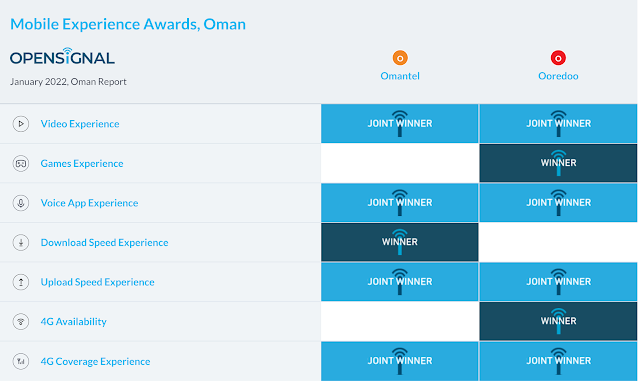
According to the recent Open Signal report (which only surveyed Ooredoo and Omantel), these two operators were joint winners in four out of seven categories due to statistical ties. Of the two, Ooredoo has the most outright wins, being the sole winner of both the Games Experience and 4G Availability awards, while Omantel is the outright winner of the Download Speed Experience award.


Omantel is the Sultanate’s incumbent telecoms operator and primary provider of internet in the country on landline and ADSL. It's mostly state-owned and market leader in mobile networks too. In 2018 it reached 56% of the market. It has the best coverage and speeds and most customers. It's mobile branch is also known as Oman Mobile. Its 4G/LTE reaches most populated areas.

In June 2021 Omantel and Ericsson announced the completion of a 5G millimetre wave (mmWave) proof of concept (PoC) trial that will enable the Omani operator to meet the increasing demand for high-quality connectivity as well as facilitate new use cases. When rolled out, 5G mmWave will greatly enhance the user experience at mobile broadband hotspots and home broadband (fixed wireless access [FWA]), as well as enable low-latency industry applications like Augmented Reality (AR). The trial delivered multi-gigabit speeds with eight cell carrier aggregation functionalities using Ericsson’s Streetmacro 6701 mmWave solution and advanced 5G software features. The trial used a carrier bandwidth of 800MHz at 26GHz, with 5G in Non-Standalone (NSA) mode of operation.

Omantel has also formed a memorandum of understanding (MoU) with the South Korean operator LG Uplus to expand its 5G offerings using edge technology. Included within the scope of the MoU is Augmented reality (AR), Virtual Reality (VR), Multiview, Timeslice solution and any potential business cooperation opportunities on XR platforms.

Ooredeoo is the 2nd provider in the country still giving good coverage in 3G and 4G: 3G 4G coverage maps. 3G covers 90% of the population and has reached 96% coverage of the Sultanate’s population with its ‘SuperNet’ 4G/LTE mobile network in 2019.

Ooredoo from Qatar has acquired the majority of the operator which was called Nawras before and renamed it to Ooredoo in 2014. It's the no.2 slightly behind Omantel at 46% share of the market in 2018. Generally Ooredoo has lower prices than Omantel at a slightly lower coverage.

In June 2021 Nokia and Ooredoo announced the introduction of super-fast and reliable 4G and 5G fixed wireless (FWA) access throughout Oman. Work to deploy the Nokia FastMile 4G FWA solution throughout the country commenced in February 2021. The scope of work initially saw 15,000 homes and businesses connected. In addition, 3,000 homes in city centers will soon get Nokia FastMile 5G FWA.

Vodafone has become the third operator in the sultanate. Vodafone Oman launched in January 2022. Their plans include bringing a next-generation 5G network and cloud services to Oman and then, its spokesperson said, moving into ecosystems that reach far beyond telecommunications.

Local reports suggest that the government initiated the bid for a new mobile operator to improve communication services, generate fresh job opportunities for Omanis, and enhance the country’s GDP. It’s not too surprising therefore that Vodafone Oman is highlighting a focus on employing Omanis and a local partnership ecosystem across key sectors. Vodafone will provide services through 3,500 authorized distributors and a comprehensive network. 

The entry of a new player could also usher in some price competition, potentially benefiting consumers in a market where, according to some reports, internet access is seen as being high compared to other countries in the region. The country, whose population is around five million, is said to have nearly 1.2 million postpaid and 4.7 million prepaid mobile subscribers.

Vodafone received the licence to operate in Oman in 2019. Formal approval of Vodafone as the third operator was given a year ago.

Vodafone Oman also recently signed an agreement with Ericsson to deploy, operate and maintain a new 4G and 5G core and radio access (RAN) greenfield network.

Ericsson will supply a complete core network solution based on Ericsson Cloud Core, NFVI and Cloud VoLTE as well as an end-to-end transport network solution. The greenfield network includes other Ericsson Radio System products and solutions such as the antenna-integrated radio and Ericsson Spectrum Sharing. The end-to-end solution range will deliver a cost-efficient, energy-efficient, and flexible layered architecture design to support 5G from network launch. Vodafone customers will also benefit from Ericsson Voice over LTE (VoLTE) services.

Related Posts:

Wednesday, 17 November 2021

5G Network Sharing using MOCN for Rural South Korea

South Korea may have been the first country where all the networks switched on their 5G but that does not mean they have been having an easy ride. 

Back in April, the ICT ministry announced that the three major mobile carriers will share their 5G networks in remote coastal and farm towns in a move to accelerate the rollout of the latest generation networks. The Korea Herald reported: 

The carriers -- SK Telecom Co., KT Corp. and LG Uplus Corp. -- signed an agreement so that 5G users can have access to the high-speed network regardless of the carrier they are subscribed to in 131 remote locations across the country, according to the Ministry of Science and ICT.

Under the plan, a 5G user would be able to use other carrier networks in such regions that are not serviced by his or her carrier.

The ministry said telecom operators will test the network sharing system before the end of this year and aim for complete commercialization in phases by 2024.

The ministry said the selected remote regions are sparsely populated, with a population density of 92 people per square kilometer, compared with those without network sharing at 3,490 people per square kilometer.

The move comes as the country races to establish nationwide 5G coverage, with network equipment currently installed in major cities.

In another article back in September, The Korea Herald reported:

The number of 5G network base stations in South Korea accounted for just 11 percent of the total in the second quarter, data showed Monday, amid continued user complaints against the latest generation networks.

As of the April-June period, there were 162,099 5G base stations in the country, compared with a total of 1.47 million mobile network base stations, according to data from the Korea Communications Agency.

The number of 5G base stations was far outnumbered by around 1 million 4G base stations and over 300,000 3G base stations.

In comparison, the number of 5G users accounted for 23.8 percent of the total in July at just over 17 million, while there were 50.5 million 4G users and 20.2 million 3G users.

The latest data comes as local mobile carriers have faced complaints from 5G users over spotty connection and slower-than-expected speeds since the networks' launch in April 2019.

At a recent GSMA conference, Daehun Lim, Head of Global Strategic Partnerships, LG Uplus shared the 5G Rural Network Sharing plans in more details. The picture on the top shows the timelines and the areas that are planned to be covered by each operator.

The network sharing will be based on MOCN which we have explained in our tutorial here.

Since the 5G spectrum allocation for all the operators is very similar, we don't expect any issues with the network sharing plan going forward. We will have to wait a couple of years before is becomes commercially available though.

Related Posts:

Monday, 22 March 2021

Wi-Fi and 5G Status in South Korea


Last year we reported on this blog that South Korean Ministry of Science and Technology Information and Communication is heavily promoting Wi-Fi 6, in 6GHz (a.k.a. Wi-Fi 6E). 

Back in February, South Korea's ICT ministry said that it has made over 15,000 new public Wi-Fi service zones available across the country and in buses last year, bringing the total locations with free public Wi-Fi to over 57,000. Yonhap News Agency revealed:

The Ministry of Science and ICT said the public can access free Wi-Fi in 28,132 public locations, such as bus stations, public facilities and parks, and also in 29,100 buses.

By region, there are 2,529 public Wi-Fi locations in Seoul, with 4,358 locations in the surrounding Gyeonggi Province, according to the ICT ministry.

South Korea has recently boosted efforts to expand public Wi-Fi zones that had previously been limited to indoor facilities, such as community centers and traditional markets.

The ICT ministry said it has focused on outdoor locations, installing free Wi-Fi at 7,949 bus stations, 1,286 parks and 320 major streets across the country from 2019 to 2020.

The ministry has also replaced 18,000 aging routers with the latest Wi-Fi 6 equipment, resulting in speeds that are three times faster on average.

The ministry said it plans to establish 15,000 additional public Wi-Fi zones this year.

You can see a video of one such Free WiFi on Bus event here.

Hackaday reported that the government has released the details of the 220,000 WiFi access points to the public. This includes the location, IP address, and RSSI data for use by people and companies wanting to develop location-based services.

Aju Business Daily said Geographical locations, internet protocol addresses and received signal strength indicators (RSSIs) have been collected for emergency response purposes and to pinpoint the location of an AP or to calculate the floating population. RSSI is an estimate of the strength of WiFi signal between an AP and recipient device.

In the mobile news,  Tefficient reported that 4G/LTE traffic has been going down as 5G traffic grows.  February 2019 was the last time monthly 4G traffic was so low (380 PB) in South Korea as it was in January 2021. 4G visibly in decline the past months while 5G traffic grew to 45% of total.

Also as you can see in the other tweet, South Korea's operators net added over 1 million 5G subscribers in January 2021 - the first month over 1 million since the 5G launch. 18% of total mobile subscriber base now 5G.

But not everyone is happy with 5G. The Korea Bizwire reported:

Hundreds of 5G smartphone users in South Korea are banding together to take legal action against the country’s three major telecom operators — SK Telecom Co., KT Corp. and LG Uplus Corp. — for spotty connection and the poor quality of the latest generation network, industry sources said Thursday.

As of Thursday, around 1,000 5G smartphone users have expressed intent to take part in the collective lawsuit to seek at least 1 million won (US$890) in compensation per user from the three mobile carriers over their 5G network quality that fall short of expectations, despite their costlier pay plans, according to Kim Jin-wook, a lawyer at law firm Joowon, which is spearheading the legal action.

Kim argues that 5G network quality is not a discernible improvement from previous 4G LTE networks and has drawbacks, such as limited availability.

The three telecom operators had deployed 166,250 5G base stations as of November last year, which is just 19 percent of the number of 4G base stations, according to industry tracker Opensignal.

South Korea’s 5G coverage centers around major urban areas, such as Seoul, with carriers aiming for nationwide coverage by next year.

Carriers also initially advertised 5G download speeds as being 20 times faster than 4G LTE, but a government report last year found that average 5G download speeds were around four times faster than those of 4G.

“Considering that monthly 5G plans are around 50,000 won more expensive than 4G LTE plans, we expect around 1 million won in compensation for users subscribed to two-year plans,” said Kim.

He added that the lawsuit will be filed in May after gathering more participants.

This may be the catalyst the Korean operators need to massively improve the 5G user experience for the end users.

Related Posts:

Sunday, 29 September 2019

LG Uplus Tests 5G in 28GHz band using 800MHz Bandwidth. Sees AR as 5G Killer App


In a recent press release (no shareable link but press releases are here - see 27 Sep), LGU+ announced that they have tested 5G commercial environment in the 28 GHz band using 800 MHz bandwidth. I am assuming this means Carrier Aggregation. With this they have successfully verified 4.2 Gbps DL and 1 Gbps UL speeds.

The press release (using Google translate from Korean) states:

This test is based on the 3GPP standard based on the 28GHz frequency bandwidth 800MHz allocated by LG Uplus, and tested by applying the terminal specifications expected to be released next year.

Download 4.2Gbps is more than three times the current 3.5GHz 5G download speed of 1.33Gbps, enabling HD-quality 2GB movies to be downloaded in four seconds. Upload 1Gbp is now more than 10 times the 3.5GHz 5G upload maximum speed of 85Mbps.

Testing was done using two antennas and 64QAM technology. LG Uplus plans to increase speeds by two to three times with four additional multi-antenna MIMO technologies and advanced modulation (256QAM).

At the end of 2017, LG Uplus conducted a speed verification of 20Gbps maximum speed by combining 28GHz and 3.5GHz as non-standard equipment.

28GHz is installed in hot spot areas such as Hongdae and Gangnam, shopping malls and stadiums, and has a large amount of data and a large number of floating populations to provide stable high-speed services. do.

In particular, the maximum upload speed is 10 times higher than the existing LTE and 3.5GHz 5G speed 75 ~ 85Mbps, smart factories that require a lot of upload capacity. It is expected to provide a new service environment in the enterprise and industry areas such as 200 cars can be accommodated) and personal service areas such as real time live broadcasting and customer video transmission.

As 28GHz uses high frequency, it has high straightness and is affected by obstacles and has a small coverage, so it needs more careful base station location design and more time and effort for quality stabilization.

LG Uplus Sang-Heon Lee, NW Development Officer, said, “This test was conducted to prepare for commercialization, and to improve cell design and mobile / boundary quality advancement at the optimal location.” 28 GHz is one of the core values ​​of 5G. It is an important technology that provides ultra high speed, but it is difficult to handle, so we will thoroughly prepare to satisfy both speed and quality from the customer's point of view. ”


Average data usage by 5G users is as high as 18.3GB, and average 4G users use 9GB in the same period, according to MSIT in May 2019. 5G data is about 2 times than that of 4G. This remarkable traffic growth is driven by UHD and AR/VR contents. According to LG Uplus, new services featuring AR and VR functions are proving popular and already account for 20% of 5G traffic, compared with 5% for 4G. The company said it aims to double the number of AR content to 1,500 by the end of this year, including K-pop dance, home training and sports videos, to cater to varied consumer needs.


The above video is one of the adverts for the LG Uplus AR K-Pop (Korean popular music) app. K-Pop is a musical genre consisting of pop, dance, electropop, hiphop, rock, R&B, and electronic music originating in South Korea. In addition to music, K-Pop has grown into a popular subculture, resulting in widespread interest in the fashion and style of Korean idol groups and singers.

While it looks like 5G is making an impact for the operators and the users in South Korea at the moment, the real challenge is to see if this trend continues. Also, it may be a bit difficult to replicate this success in other countries. We will have to wait and see.

Sunday, 1 September 2019

5G+ Strategy of the Republic of Korea


    Back in April this year, the South Korean Ministry of Science and ICT provided details not just about 5G commercialization but also about the future 5G+ strategy. This post combines that announcement with a recent presentation by the Ministry at UN ESCAP:

    The Korean government celebrated world’s first 5G commercialization in Olympic Park on April 8 2019 and shared the national vision for realizing an innovative growth in the 5G era. On that day, the Korean government announced the ‘5G+ Strategy’ as a way to create new industries and services based on 5G and pledged to establish the world’s best 5G ecosystem moving on from being world’s first. In particular, the Korean government proposed the goal to reach 180 trillion won in productivity, 73 billion dollars in export and create 600,000 quality jobs by 2026, through promoting 5G+strategic industries (major 10 industries and 5 services).

    As an effort to nurture 5G-based new industries and markets and improve the quality of people’s lives, 52 specific tasks under the following major five strategic areas will be implemented.
    1. secure early market and improve people’s quality of life through taking initiative in investing in public sector
    2. create testbed for expanding investment in private sector and develop industries
    3. support 5G service facilitation and user protection through system maintenance
    4. nurture globally recognized innovative enterprises and talents through establishment of industrial foundation
    5. globalize Korea’s 5G technologies and services through providing support to overseas expansion
    Demonstration and spread of 5G+ core services
    provide support in identifying and demonstrating profit models in 5 core areas in the private sector (2018~2021) ⇨ carry out 5G+ innovation project for deployment and spread of services (2021~2025)
    1. immersive content: real time hologram performance for remote areas
    2. smart factory: solution development for each industry and spread of industrial complex
    3. autonomous vehicle: develop and distribute 5G self-driving shuttle buses
    4. smart city: emergency rescue service in fire sites
    5. digital healthcare: emergency medical service between ambulances and hospitals
    Support demand creation in public sector
    • (SOC) support safe and efficient management of infrastructure and deteriorated facility
      • (infrastructure) carry out ‘5G+ smart SOC project’(2020~) for establishing real time monitoring system (utilization of 5G robots and CCTVs etc.) on road, port and airport etc.
      • (life support facility) support real time 5G-based safety monitoring in educational and cultural facility (2020~)
      • (deteriorated nuclear power plant) develop and adopt safe, 5G-based nuclear power plant decommissioning technologies such as real time monitoring of high risk work sites and identifying biometrics of workers (2020~2023)
    • (utilize cutting-edge device) create 5G device market based on public demand
      • (robot) carry out 5G public service robot (guide robot on public facility etc.) pilot project (2020~)
      • (drone) support R&D and demonstration of 5G drone service such as public safety, environment and measurement (2020~) and develop 5G drones for mail delivery (2019~2021) and connect this to public procurement
      • (CCTV) implement 5G intelligent CCTV R&D and demonstration as well as disaster safety pilot service (2021~)

    improve people’s quality of life through 5G public service deployment
    • (5G+ life sustaining project) distribute 5G solutions* based on public demand for improving people’s livelihood in areas such as education, agriculture and environment and resolving regional social issues (2021~)
      • * e.g. (immersive education) provide 5G-based, VR and AR remote education and training for local and vocational schools, (smart agriculture) deploy 5G unmanned tractors and drones, (environmental monitoring) 5G-based, real time fine dust monitoring etc.  
    • (improve medical service) implement ‘5G-based collaborative telemedicine pilot project’ for hospitals and clinics (2020~) → increase the portion of the medical facility with scale similar to or larger than that of general hospital to 50% by 2023

    create 5G-based smart city
    • (national pilot city) establish data and AI center in pilot city for building data-based intelligent urban operating system in connection with 5G (2020~2022)
    • (existing city) support expansion of 5G-based smart city technologies by active deployment of 5G to projects in turning existing cities into smart cities such as smart city challenge (2019~)
    Expand private investment by:
    1. tax credit and investment
    • provide tax credits to network investment (2~3% for 2019-2020) for inducing early deployment of nationwide 5G network and invest in innovation companies by engaging in financial programs driving new growth*
      • * program supporting advancement in industrial structure (10 trillion won for 2019-2021), KP Inno fund (1.2 trillion won for 2019∼2022), smart factory fund (300 billion won for 2019∼2021) etc.
    1. establish 5G testbeds and demonstration infrastructure
    • (establish testbeds) establish 13 5G testbeds and demonstration infrastructure in five areas including various 5G terminals and equipments, 5G Vehicular-to-Everything*(V2X) communications, 5G drones** and edge computing
      • * provide support in verification of 5G autonomous driving performance on real roads in K-City(Hwaseong), Pangyo zero city and Sangam of Seoul (2019∼)
      • ** establish 5G test infrastructure in 5 drone flying test sites which are in the process of construction (Yeongwol, Gosang, Boeun etc.) (2020∼2021)
      • provide internationally accredited certificate service for supporting 5G terminal and V2X exports (2019~)
    • (5G challenge) hold contests for demonstration and expansion of 5G autonomous vehicles and drones
    • (establish clusters) establish ‘Songpa mobile cluster’ which has expanded the existing function of supporting radiowave and security industry to providing support to 5G equipment development and demonstration (2020~2025)
    1. promote 5G technology commercialization of SMEs
    • (network equipment) increase support for R&D of technology commercialization in 5G equipment (small cell, repeater, modem etc.) of small and medium-sized enterprises (to take up 25%(2017) → 35%(2020) out of mobile communication R&D)
    • (purchase conditional R&D) expand R&D support for commercialization of SMEs based on demand for purchasing 5G-based new technologies and products of public institutions and foreign countries
    1. support facilitation of 5G content market
    • carry out ‘5G content flagship project*’ and secure infrastructure for development hub (2019~) for creating major 10 globally recognized 5G content by 2022
      • * e.g. (immersive media) 360° VR sports streaming, (immersive communication) hologram video conference, (immersive life) VR shopping, (industry convergence) control AR factory and farm, (public service) VR safety education
    1. support innovation of productivity in leading industries
    • (smart factory) support gradual distribution* of 5G factory solutions optimized for innovating manufacturing and processing of small and medium sized enterprises to 1000 factories by 2022 (2020~2022)
      • * target for establishment: 200 (2020) → 300 (2021) → 500 (2022)
    • (shipbuilding) secure core technologies of ‘smart yard’ (2021~) providing support to demonstration of 5G-based smart telecom environment establishment in shipyard (2020~2023) and technologies which automate and optimize processing
    • (maritime port) establish smart maritime port logistics system which is automatic and intelligent based on 5G (pilot project: 4 ports including Busan Port and Gwangyang Port) (2019~)
    • (energy) set up an optimal energy generation system through real time 5G and big data processing in order to respond to expansion of renewable energy (solar energy etc.) generation complex (2020~2023)
    • (manufacturing AR) provide pilot AR service (AR manual, AR remote support etc.) in the field of manufacturing to small and medium sized enterprises in relation to 5G smart factory distribution (2020~)
    Support 5G service facilitation and user protection through system maintenance
    1. telecom service plan and system maintenance
    • (launch 5G service plan) induce the launch of service plan* which does not rapidly increase household burden on telecom fee, so that citizens can use various 5G services (April 2019~)
      • * continue to reduce rate for data per unit compared to LTE from the first 5G service plan
    • (support B2B facilitation) improve service plan to be flexible enough to reflect various 5G services such as autonomous vehicles and smart factories (2019~)
    1. secure radiowave resources and improve regulations
    • (allocate frequency) double frequency for 5G service by 2026 (2,680MHz bandwidth as of now → 5,190MHz bandwidth) and allocate frequency for 5G convergence service (autonomous vehicle and smart factory etc.) (2019~)
    • (improve regulations) support ease of administrative burden through measures including introduction of ‘frequency license system’ (revise radiowave act, 2019~) which integrates and simplifies the process of frequency allocation and radio station establishment
    1. create the safest user environment

    • (cyber safety) establish preventive system for cyber security breaches such as designating 5G core facilities to be critical IT infrastructure and coming up with ICT convergence security system* (revise the act on information communications network, 2019~) 
      • * legal grounds in relation to IoT device and service security, recommendations for convergence service security standard etc.
    • (reinforce stability of communication networks) establish communication disaster prevention and response system such as expanding subjects to government inspection to all of major communication facilities (80→870) and securing detour route for signal transmission between facilities etc.

    1. regulatory innovation for 5G convergence service

    • identify items for regulatory improvement in connection to regulatory sandbox and pilot project and ease regulations for location based information project (grant system → registration system, revise location information act)

    1. bridge digital divide and protect users

    • (bridge digital divide) reinforce accessibility to new terminals and services for the vulnerable class (the disabled and elderly) and expand education for utilizing intelligent information service focused on real life experiences (VR, AR etc.)
    • (principles of protecting users) set principles to prevent new kinds of damages done to users and strengthen their rights amid expansion of 5G convergence service and intelligent information technologies (2019~)


    Further details:


    Related Posts:

    Monday, 11 March 2019

    Current IMT Spectrum Allocation in South Korea

    The slide below summarises the IMT spectrum allocation before 5G (source presentation)

    On 1st Dec 2018, all three operators launched commercial 5G networks simultaneously. The plan was to have nationwide commercial 5G services available for everyone by March 2019 but this date has just been postponed. According to Mobile World Live:

    The news outlet cited a number of setbacks as hindering SK Telecom, KT and LG UPlus’ target. Handset availability is presumed to be the main factor in the delay, but the government has also rejected proposed 5G pricing plans submitted by operators.

    “Commercialisation of 5G is possible when various factors such as network, smartphones and service are ready”, the country’s Ministry of Science and ICT said in a statement.

    While it did not commit to an alternative date for consumer service launch, the ministry said it is coordinating with SK Telecom, KT and LG Uplus, along with device makers Samsung and LG Electronics on the matter, the news agency reported.

    5G Spectrum has already been auctioned in South Korea with each operator winning 800 MHz in 28 GHz band (high throughput layer) and in C-band (capacity layer), LGU+ received 80 MHz in 3.4 GHz band, KT received 100 MHz in 3.5 GHz band while SK Telecom received 100 MHz in 3.6 GHz band.

    All operators are ideally placed with regards to spectrum to role the best possible commercial 5G services there can be. We will just have to wait a bit longer but will happen in 2019 for sure.

    Sunday, 2 December 2018

    All three mobile network operators in South Korea launched 5G on Dec 1, 2018


    Last week we mentioned that all three South Korean operators will be launching 5G jointly in March 2019. In the meantime a decision was made and 5G was launched on Dec 1, 2018. We hope to get more details in the coming few weeks but we added few videos and pictures on this on our tweets. They are embedded below.


    The following is also a video from the 5G launch by SK Telecom


    *** Added 29 Jan 2019 ***
    A video of 5G launch in South Korea was posted by Ericsson but subsequently removed

    *** Added 01 Sep 2019 ***

    Monday, 26 November 2018

    South Korea Telcos: United in 5G Launch


    South Korea has ambitions to be the first country to roll-out 5G and their three major mobile operators will work together to launch 5G networks at the same time in 2019 to “avoid excessive competition” and ensure the country is the first to launch the next-generation technology. This is discounting the fact that San Marino already launched nationwide 5G but its just a city state and the 5G launch does not really qualify to be considered a nationwide launch

    SK Telecom, KT and LG Uplus have agreed to jointly introduce 5G services on “Korea 5G Day”, which is likely to be sometime in March 2019.

    The South Korean government in April of this year mandated that operators collaborate on 5G deployments by sharing core fibre infrastructure, rather than RANs, in a bid to reduce the cost of rolling out the technology and so enable operators to pass on the savings to customers.

    The triumvirate of mobile carriers plan to provide 5G services using mobile routers providing mobile connections for Wi-Fi devices, first rather than smartphones. The services on smartphones will be available a month later.

    In an interview with The Korea Times, ICT Minister Yoo Young-min stressed the need for the government and companies to closely cooperate to reach the goal:

    "The world's first 5G commercialization is very meaningful in that Korea will have an advantageous position in the global market and take the leadership. Amid intensifying competition among global mobile carriers, it is significant for the government and companies to join hands and reach the goal together."

    There has been much speculation and discussion on who would be chosen to supply the 5G network equipment.

    KT has chosen Samsung Electronics, Ericsson and Nokia. As expected, Huawei was excluded from the list. They elaborated:

    “In choosing 5G equipment providers, the company considered a wide range of factors: the level of technology, investment costs and management stability based on the compatibility with the existing LTE network.”

    SK Telecom named Samsung Electronics, Ericsson and Nokia as its 5G equipment providers. SK Telecom have recently opened one of their first commercial fifth-generation base stations in the central area of Seoul. Using equipment manufactured by Samsung Electronics, SKT introduced a 24-kilogram rectangular active antenna unit for the 3.5-gigahertz frequency band -- 1 meter in height and 23 centimeters in width -- installed at the rooftop of a small hotel building in Myeong-dong, one of the most crowded areas in Seoul. Compared to the fourth-generation Long Term Evolution antenna units hung at the rooftop railing, the 5G antenna unit consisting of a total of 32 individual antennas looked noticeably smaller and more compact, requiring just 10 square-meters of space for installation. 


    Huawei was also excluded by them for the second time now despite having participated in internal tests along with the three selected.

    SKT and KT’s choices were anticipated because both had used equipment from Samsung, Ericsson and Nokia for their 4G LTE networks.


    LG U+ is the only one among Korea’s three mobile carriers that has not yet announced 5G equipment suppliers. The smallest mobile carrier is likely to include Huawei on its list. It partnered with the Chinese company for its 4G LTE network, along with Samsung, Ericsson and Nokia.

    The biggest advantage of Huawei’s 5G equipment is cost efficiency. The Chinese company is known to charge prices that are 20 to 30 percent lower than other global competitors for high-quality 5G equipment. However the major issue with Huawei are the security concerns.
    Due to its ties to the Chinese government, there have been worries that the company’s equipment may be used for spying. In August of this year, the U.S. and Australian governments banned Huawei from supplying equipment for their 5G wireless infrastructure citing security reasons. Britain said in July it “is less confident” about the integrity of Huawei products.

    Huawei has been denying such allegations.

    In a press release last month, the Chinese tech company highlighted that, despite ongoing security concerns, there has been zero cases of actual information leakage in the past.

    Samsung is aiming to control 20 percent of the global market for 5G network equipment in 2020, the head of the company's network business has said. Samsung Electronics President Kim Young-ky claimed that the company is not a newcomer to the network equipment industry as it has been supplying products in this field for the past 20 years. According to the data compiled by industry tracker Dell'Oro, Samsung Electronics took up 11 percent of the global market for fourth-generation (4G) network equipment in the second quarter of this year.


    Related Posts:

    Monday, 16 April 2018

    South Korea MNOs to build Shared 5G infrastructure


    According to Yonhap News Agency:
    South Korea's mobile carriers and an Internet service provider will share the burden of building the costly infrastructure for a high-end fifth-generation network, which they will then share in using, officials said Tuesday.  
    The move could save about 1 trillion won (US$938 million) over the next 10 next years, as it would keep SK Telecom Co., KT Corp., LG Uplus Inc. and SK Broadband Inc. from making redundant investments, according to the Ministry of Science and ICT.  
    The four companies will together build the nationwide infrastructure, such as base stations for the 5G network, though details on how much each firm will pay are set to be finalized during the first half of this year, it said.  
    The ministry did not elaborate on its estimation of the cost of building the 5G network. 
    We recently blogged about KT's ambition to roll out 5G in 2019 here.

    One of the reasons the shared infrastructure makes sense is because while most of the world will be rolling out initial 5G network in sub-6GHz band (mainly between 3.4 - 3.8 GHz), South Korea is looking at 28 GHz band. While technically millimeter waves start at 30 GHz (or they are known as centimeter waves or cmWaves below that), anything above 20GHz is often referred to as mmWave. 

    Very few networks have commited to mmWave 5G rollout initially. Main commitments are from US operators (AT&T and Verizon), South Korea and Japan.

    Monday, 12 May 2014

    South Korea: Operator Overview


    There are three mobile phone service providers:

    Korea Telecom

    Korea Telecom (KT) in 2002 absorbed KT Freetel (KTF), its mobile phone service provider, and offers its services, using HSPA and LTE networks. It is currently deploying an LTE network.

    LG U Plus

    LG U Plus (LG U+), a member of LG Group, also provides CDMA2000 and LTE networks.

    SK Telecom

    SK Telecom (SKT) of SK Group also offers its service, using CDMA2000, HSPA and LTEnetworks.

    Market Share:

    There market shares of the three companies are believed to be:
    SK Telecom's 50 percent,
    Korea Telecom's 30 percent
    LG Telecom's 20 percent.

    Regarding the Korean mobile phone industry's overseas experiences, SK Telecom has helped the first mobile phone service companies in Mongolia, Uzbekistan, Cambodia, etc. In China, it helped China Unicom's CDMA implementation, both technically and financially.
    Samsung and LG have the largest market shares in Korea. Nokia already discontinued its sales operations in Korea.
    As of March 2009, the number of mobile subscribers in Korea nearing 46 million total mobile subscribers and the nation’s penetration rate almost 100%. Mobile telecommunications services in South Korea are served by three operators: SKT (SKTelecom), KTF (Korea Telecom Freetel), and LGT (LG Telecom). SKT represents 50.50% of the market share, KTF 31.54% and LGT 17.95% as of December 2007. The nation first launched its mobile telecommunication services in 1960.

    New data from the South Korean regulator has revealed that the country has over 48 million 'Wireless Internet Connections,' a figure that represents over 90 percent of its total mobile connections base and underlines its position as one of the most advanced mobile markets in the world.

    https://gsmaintelligence.com/analysis/2011/10/over-90-of-users-connected-to-the-wireless-internet-in-south-korea/305/

    The LTE-Advanced network can download data at speeds twice as fast as 4G networks and 10 times faster than 3G services, according to SK Telecom Co.


    More than 60 per cent of South Korea's 33million smartphone users have subscribed to the LTE service.

    Read more: http://www.dailymail.co.uk/sciencetech/article-2348597/LTE-A-Worlds-fastest-wireless-network-launches-South-Korea--film-fans-download-movie-40-seconds.html#ixzz30Szhk5BS

    SK Telecom offers unlimited LTE data to subscribers
    Subscribers to the operator’s T&All 75+Unlimited Data Option, T&All 85 and T&All 100 plans can take advantage of the unlimited data, calls and messages at no additional cost and without having to sign up to the upgrade. There are around one million subscribers on these plans according to the operator; it has a total of 27.4 million subscribers, according to the latest figures from Informa’s WCIS.

    http://www.telecoms.com/240742/sk-telecom-offers-unlimited-lte-data-to-subscribers/

    Keeping its first-mover strategy, SK recently announced that it achieved the world’s first commercialization of Uplink CoMP (Uplink Cooperative Multi Point) a technology that will improve mobile data upload speed by 20% on its LTE network. Importantly, since it is applied to base stations, no upgrade is needed for LTE devices. The company said that it plans to implement Uplink CoMP to all its LTE base stations by the end of 2014.
    http://www.gurufocus.com/news/256105/an-unbeatable-firstmover-in-the-telecom-world

    LTE pioneer SK Telecom has successfully developed LTE-Advanced tri-band carrier aggregation technology, to ease network congestion in built up areas in South Korea.
    http://www.telecoms.com/215472/sk-telecom-develops-lte-a-tri-band-carrier-aggregation-technology/

    South Korean operator SK Telecom has launched a platform that it says will provide real time information on what its customers are doing. The Context Platform uses data collected by a customer’s smartphone, if it is embedded with the platform, via its camera, GPS, sensors and wifi to discover contextual information about that subscriber.

    The firm explained that the platform allows it to make informed guesses about whether  the user is walking, for example, as the handset detects the user’s repeated movement and speed via its sensors and GPS. It then analyses the data it has collected through an algorithm to conclude that the user is “in a walking situation”. SK Telecom added that the more the platform repeats this process of analysis, the more accurate the platform becomes.

    The operator said the platform can also make conclusions based on customers’ usage patterns involving social networking, voice calls, SMS and applications.

    http://www.telecoms.com/225892/sk-telecom-platform-knows-what-subscribers-are-doing/

    http://youtu.be/xRnZP6TWLfY

    https://www.youtube.com/watch?v=YUqJ7IS5n4w


    SK Telecom and LG Uplus, number one and three respectively in South Korea’s mobile market, both claimed a world first on developing three-band carrier aggregation (CA) for LTE-Advanced technology.
    SK Telecom plans to demonstrate its triple-band CA technology at this year’s Mobile World Congress, but will be going one step further by aggregating together three lots of 20MHz. This, says SK Telecom, will give top-line speeds of up to 450Mb/s on LTE-Advanced.
    According to GSMA Intelligence, South Korea is the world’s most advanced 4G market with penetration as a percentage of total connections passing the 50 per cent mark in Q4 2013. This compares to around a quarter 4G-user penetration in Japan and the US.


    http://www.mobileworldlive.com/sk-telecom-lg-uplus-claim-lte-advanced-world-first