Showing posts with label Operator Starhub. Show all posts

Thursday, 13 August 2026

Singapore's Telecoms Market Enters Its Next Phase

Singapore has one of the world's most advanced and competitive telecommunications markets. Despite its relatively small geographic area and population of around six million, the city-state consistently ranks among global leaders in mobile connectivity, fibre-broadband adoption and digital infrastructure.

DataReportal, citing GSMA Intelligence, reported that Singapore had 9.79 million cellular mobile connections in late 2025. This was equivalent to 166% of the population estimate used in its methodology. The number of connections fell by approximately 99,000, or 1%, between late 2024 and late 2025, while 99.3% were classified as mobile broadband connections.

Mobile-connection figures should not be confused with the number of individual users. Many people maintain separate personal and business subscriptions, while tablets, connected equipment and other devices may also use cellular connections. eSIM has made it easier for users to maintain multiple services.

Singapore has also completed another important transition. The three operators that previously provided 3G services, Singtel, StarHub and M1, retired those networks during 2024, freeing spectrum and resources for newer technologies. Mobile users are now effectively served through 4G and 5G networks.

A mature four-operator market

Singapore's mobile market continues to be served by four mobile network operators: Singtel, StarHub, M1 and SIMBA.

Competition in such a mature market is increasingly about more than geographic coverage. Pricing, network performance, roaming, digital customer experience, bundled services and the ability to turn network capabilities into higher-value consumer and enterprise offerings are becoming more important.

The operators also report subscriber numbers using different definitions and reporting periods. Some report customers, others subscribers, active services or individual lines. Their published totals therefore should not simply be added together to calculate precise market shares.

Singtel remains Singapore's largest telecommunications operator. At 31 March 2026, it reported approximately 4.50 million mobile customers and 686,000 fixed-broadband lines in Singapore.

Its position is supported by extensive infrastructure, a large consumer base and a broad enterprise portfolio, as well as the wider Singtel Group's operations and investments across Asia.

Singtel is now moving beyond basic 5G deployment towards more differentiated network capabilities. In March 2026, it announced an expanded collaboration with Ericsson around 5G-Advanced. Priorities include commercial end-to-end network slicing backed by service-level agreements, programmable network APIs and greater use of AI in the RAN.

StarHub is one of Singapore's three long-established integrated telecommunications operators and describes itself as having the country's number-two mobile revenue market share.

At 31 March 2026, StarHub reported 2.222 million mobile subscribers and 571,000 broadband subscribers. Its mobile subscriber base increased by 17,000 during the first quarter, although consumer mobile revenue declined year-on-year.

StarHub has progressively repositioned itself beyond conventional mobile and broadband services, with activities spanning enterprise connectivity, managed services, cloud and cybersecurity.

It also continues to increase the scale of its consumer business. On 6 August 2026, StarHub and MyRepublic announced that all MyRepublic 4G subscribers would move onto StarHub's network. MyRepublic's 5G customers were already using StarHub through an existing wholesale arrangement. StarHub linked the move to increasing scale and positioning itself for further consolidation in Singapore's telecommunications market.

StarHub also shares part of its 5G infrastructure with M1 through Antina, their network-sharing joint venture.

M1, majority-owned by Keppel, competes across consumer telecommunications, enterprise connectivity and digital services. It serves more than two million customers and has increasingly emphasised enterprise and industry-focused 5G services.

Its activities include private and dedicated 5G, maritime connectivity, industrial applications, network slicing and edge computing. M1 has also introduced commercial 5G RedCap services for enterprises, targeting IoT applications that do not require the capabilities or cost profile of full-featured 5G devices. 

M1's ownership and strategic direction have, however, become one of the most interesting aspects of Singapore's telecom market in 2026.

SIMBA, formerly TPG Telecom Singapore, is the fourth network operator and has been one of the strongest sources of price competition in the market.

At 31 January 2026, SIMBA reported approximately 1.412 million monthly paid active mobile services, up 13% over the preceding half-year. Its broadband business had also expanded to about 46,000 active services.

SIMBA's growth demonstrates that there is still room for subscriber disruption even in a highly penetrated market. Its challenge now is to translate that growth into a sustainable competitive position as Singapore shifts towards standalone 5G and competitors respond through lower-cost brands, MVNO partnerships and consolidation.

The M1-SIMBA deal collapses, but consolidation remains on the agenda

One of the biggest developments in Singapore telecoms over the past year was SIMBA's proposed acquisition of M1's telecommunications business. The transaction would have significantly reshaped the market, but it did not proceed.

In May 2026, IMDA suspended its assessment of the proposed consolidation after saying it had learnt that SIMBA could have been using radio-frequency bands that had not been assigned to it to provide mobile services. The regulator began investigating the matter.

The acquisition agreement subsequently terminated and the regulatory application was withdrawn. The suspension itself should not be interpreted as a final finding of wrongdoing.

Importantly, the collapse of the transaction has not removed consolidation from the industry's agenda. Keppel said in July that it had established a three-year plan to strengthen M1's profitability and competitiveness and maximise its strategic value in any future industry consolidation. The plan targets S$70 million in annual run-rate cost savings by 2028, with S$10 million targeted by the end of 2026. Keppel continues to include M1 Telco in its non-core portfolio for divestment. 

At the same time, StarHub's decision to bring all MyRepublic mobile subscribers onto its network shows consolidation taking place through network, wholesale and brand arrangements even without a merger between two of the four infrastructure operators.

The structure of Singapore's market therefore remains one to watch.

Singapore moves beyond the initial 5G rollout

Perhaps the clearest sign that Singapore's telecom market has entered a new phase is the transition from simply building 5G coverage to making fuller use of standalone 5G.

By mid-2026, Singapore's operators had achieved nationwide 5G Standalone coverage. The migration away from Non-Standalone architecture, where 5G radio still depends partly on 4G infrastructure, has progressed at different speeds by operator.

StarHub switched off its 5G NSA network on 31 May 2026, while M1 said all its 5G sites were operating on standalone architecture. Singtel still retained a small proportion of customers on the older NSA architecture in late July, even though its nationwide SA network was already well established.

This matters because standalone architecture provides the foundation for capabilities such as network slicing, more flexible service assurance, advanced IoT and increasingly programmable networks. The commercial question is now whether operators can convert those capabilities into services that customers are prepared to pay for.

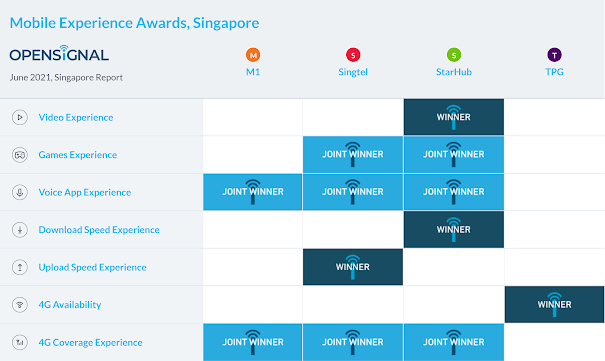
Independent network measurements show that the operators are not delivering identical experiences. In Opensignal's July 2026 Singapore Mobile Network Experience report, Singtel won the 5G Availability category with users connected to an active 5G signal for 79.9% of the time measured. StarHub recorded 70%, M1 67% and SIMBA 31.4%.

These figures are not measures of geographic coverage. Instead, they indicate how often Opensignal's users with suitable devices and subscriptions were actually connected to 5G. The distinction becomes increasingly important now that headline coverage is no longer enough to differentiate operators.

Private 5G and enterprise connectivity

Enterprise connectivity remains one of the most important potential growth areas for Singapore's operators. Government agencies, operators and technology companies have been testing and deploying private or dedicated 5G solutions in sectors including maritime operations, manufacturing, smart estates, transport and other connected infrastructure.

Potential applications include robotics, automated vehicles, industrial monitoring, remote operations, connected equipment, video analytics and real-time data processing.

M1's introduction of commercial RedCap services and Singtel's push towards commercially enforceable network slicing illustrate how the enterprise proposition is evolving from simply providing private coverage towards differentiated connectivity for particular applications.

However, the challenge remains commercial rather than purely technical. Many private 5G and edge-computing projects remain trials, targeted deployments or industry-specific implementations. Singapore's advanced infrastructure provides an excellent environment for such applications, but operators still need to demonstrate repeatable business cases and sustainable recurring revenues.

Fibre is moving towards 10 Gbps

The next phase is not limited to mobile networks. Singapore is also upgrading its Nationwide Broadband Network to support speeds of up to 10 Gbps. IMDA has committed up to S$100 million to the programme, and more than half a million households are expected to sign up for and benefit from higher speeds by 2028.

Commercial competition has already moved in this direction, with 10 Gbps residential broadband services and Wi-Fi 7 increasingly used in premium packages. SIMBA's entry into fixed broadband has also added another aggressive competitor to this part of the market.

As with 5G, the interesting question is not simply how much speed can be delivered, but which services will make practical use of the additional capacity.

Cybersecurity becomes a strategic telecom issue

Singapore's advanced digital infrastructure also makes the resilience and security of its telecommunications networks particularly important.

In February 2026, Singapore's Cyber Security Agency and IMDA disclosed details of Operation CYBER GUARDIAN, the country's largest coordinated cyber incident response operation to date. The authorities said that advanced persistent threat actor UNC3886 had conducted a deliberate campaign targeting all four major Singapore operators: Singtel, StarHub, M1 and SIMBA.

The operation involved more than 100 cyber defenders across government agencies and the operators and lasted for more than eleven months. UNC3886 obtained unauthorised access to parts of telecom networks and exfiltrated a small amount of primarily network-related technical data. However, the authorities said there was no evidence that sensitive or personal customer records had been accessed or exfiltrated, and no evidence that telecommunications services had been disrupted.

The incident is an important reminder that telecom competition increasingly includes resilience, cybersecurity and operational capability alongside speed, coverage and price.

Smart Nation, AI and the wider digital ecosystem

Singapore's Smart Nation strategy and highly coordinated digital infrastructure policies continue to provide favourable conditions for telecommunications innovation.

The country combines extensive fibre infrastructure, nationwide 5G, major data-centre and cloud operations, subsea cable connectivity, a sophisticated cybersecurity ecosystem and close collaboration between government, operators, technology companies and research institutions.

Operators are increasingly applying AI and machine learning to areas such as network optimisation, predictive maintenance, cybersecurity, fraud detection, customer service and capacity management. At the same time, cloud and edge partnerships allow them to combine connectivity with compute, storage, security and data services.

This changes the role of a telecom operator. The long-term opportunity is not simply to sell another mobile subscription, but to become part of the digital infrastructure used by enterprises to run applications, automate operations and manage data securely. Whether operators capture a meaningful share of that value remains an open question.

Market outlook

Singapore's telecom market is therefore entering a different stage of development.

The initial nationwide 5G rollout is largely complete. The three legacy 3G networks are gone. Standalone 5G is becoming the normal architecture rather than an additional feature. Fibre is moving towards 10 Gbps. The focus is shifting towards 5G-Advanced, network slicing, RedCap, enterprise connectivity, AI-enabled operations, cybersecurity and differentiated digital services. 

At the same time, competitive pressure remains intense. SIMBA continues to grow and compete aggressively on value. StarHub is building scale through its brands, wholesale relationships and MyRepublic. Singtel is using its network leadership to push towards more programmable and differentiated 5G services. Keppel is restructuring M1 while openly keeping future industry consolidation in view. 

The failed SIMBA-M1 transaction therefore may not have been the end of Singapore's consolidation story. It may simply have delayed it.

Singapore's compact geography, regulatory environment and highly developed digital infrastructure make it an unusually useful market in which to observe what happens after nationwide 5G coverage has been achieved.

The next competition will not be about which operator can claim to have 5G. It will be about who can make the most effective commercial use of it.

Related Posts: 

Thursday, 8 February 2024

6 Mobile Operators in the Global 100 Ranking of the World’s Most Sustainable Companies

The Global 100 is an annual assessment by Corporate Knights Inc. The 100 most responsible companies in the world were selected based on an assessment of 6,733 international listed companies against 25 metrics for environmental responsibility, social responsibility and good governance.

Their official press release says: 

Since 2005, the Global 100 has been one of the world’s most valued and transparent rules-based sustainability ratings that emphasizes the impact of a company’s core products and services. It is the best-performing global sustainability index (ticker: CKG100), with more than 10 years of history. All publicly traded companies with more than US$1 billion in revenue are assessed across 25 key performance indicators that cover resource management, employee management, financial management, sustainable revenue and sustainable investment, and supplier performance. Companies engaging in “red flag” activities such as blocking climate policy and contributing to deforestation are disqualified.

Telecom TV's morning headlines newsletter produced a nice summary reproduced below:

Seven telecom operators have ended up in the Global 100 ranking of the world’s most sustainable companies, compiled by Canadian sustainable economy magazine Corporate Knights. Bell Canada scored the highest among its telco peers, ranking 51st globally (down from 42nd in 2023). Next of the telecom providers is Finnish operator Elisa (59th), Singaporean telco Singtel (62nd), North American hybrid fibre coaxial cable operator Cogeco Communications (73rd), Brazilian telco Telefônica Brasil (75th), Singaporean operator StarHub (80th, down from 34th last year) and Canadian telco Telus (85th, down from position 37st last year). On the vendor side, Ericsson is recognised as one of the most sustainable companies worldwide, climbing from position 65 in 2023 to 15 this year. Cisco is also present, ranking 64th. Tech giant Apple has climbed a mere two spots to 71st place globally. Corporate Knights explained that the rankings included all public companies with more than US$1bn in revenue, with assessments made across 25 key indicators, including percentage of “sustainable revenue” and “sustainable investment” into green solutions, such as renewable energy and energy efficiency, taxes paid, carbon productivity, and racial and gender diversity.

It's great to see MNOs taking initiatives for a sustainable future.

Related Posts: 

Thursday, 10 March 2022

Singapore is a 5G leader in Southeast Asia


The Covid-19 pandemic had a significant impact on Singapore’s telecom sector in 2020, pushing down penetration rates and delaying several major infrastructure projects due to production and supply chain disruptions. The good news, at least, is that the overall effect on the sector has been relatively modest compared to other industries that effectively collapsed under the shutdown. Telecommunications remained an essential service during the period, with many people even needing to upgrade their services and plans to enable a shift to working and schooling from home. Singapore’s modern infrastructure and capacity weathered the storm well.

Most telecom operators suffered financially, with declines in revenue and profit as subscribers tightened their belts and reduced discretionary spending. The downturn was roughly in line with the retraction in the Singapore economy. All the major players continued to provide services, and to proceed with their investment programs, particularly in 5G networks (with a focus on standalone). The operators are voicing strong optimism for the coming months as travel restrictions are reduced and economic activity starts to bounce back. While forecasting should be viewed as a very risky activity in such uncertain times, there is a high degree of confidence across the industry that penetration rates in Singapore will quickly return to pre-Covid-19 levels.

Singapore continues to push ahead with its 5G rollout. 5G networks and services are expected to form the backbone of growth in the telco sector over the coming years as service providers seek new ways to engage customers in a market that is otherwise already saturated.

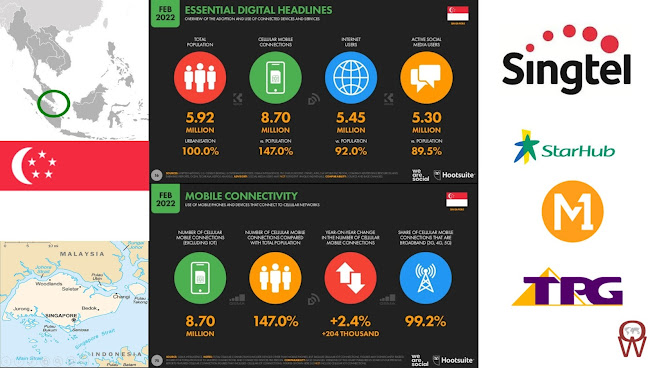
Singapore currently has 4 mobile operators, Singtel Mobile, StarHub, M1 and TPG Telecom (4G-only).

Singtel is the market leader, Starhub is in second position, M1 is in third and TPG is in fourth. Coverage and speed is excellent in the city on the three major networks. No 2G is available, 3G on 900 and 2100 MHz, and 4G/LTE has started on all three providers on 1800 MHz (band 3) and 2600 MHz (band 7). 900 MHz (band 8) and 2500 MHz (band 41) were later added, and from 2019 spectrum on 700 MHz (band 28) is added for 4G/LTE.

5G trials were started by Starhub in August 2020 on 2100 MHz (n1) and by Singtel in September 2020 on both 2100 MHz (n1) and 3500 MHz (n78), and quietly commenced commercial operations on the three major operators in early-2021 when 3500 MHz (n78) was also added for 5G for Starhub and M1, but is currently not open for prepaid.

The coverage and speeds in this city state are superb by all three providers. 4G/LTE covers all of the city outdoors and the MRT (= metro, subway). Note that for Singapore you'll need to bring a 3G/4G device as 2G is switched off. 2G/GSM networks of all three providers were shut down on April 1, 2017. There is no 2G coverage anymore. So bring a 3G or 4G/LTE capable device. The sale of 2G-only mobile devices has been banned from January 2017 or retailers could be given a penalty. 


Singtel Mobile by the Singtel Group is the biggest provider in town and has a market share of about 45%. The Singapore Telecommunications Ltd. is one of the largest mobile network operators in Southeast Asia. It has a coverage of 99% for 3G and 4G/LTE: Singtel 3G 4G. 4G/LTE is on 900, 1800 and 2600 MHz, bands 3, 7 and 8.

Singtel is ramping up its 5G standalone (SA) deployment in Singapore, by expanding the network and developing new 5G use cases in partnership with Ericsson. In a press release the Swedish vendor said it is powering Singtel’s 5G SA network with 5G radio access products and cloud-native dual-mode 5G Core network solutions. The pair hope to deliver high-quality connectivity for outdoor coverage in densely populated areas and help drive strong indoor-mall coverage across the city-state. Ericsson went on to say ‘the COVID-19 pandemic has fuelled the need for better connectivity indoors, due to the numerous travel and lock-down restrictions’. The deployment builds on a long-standing relationship between the two companies, including with Singtel’s initial wave of 5G rollouts.

In September 2021 Singtel confirmed that its 5G network now covers over two-thirds of Singapore, with new 5G sites added in densely populated areas like Choa Chu Kang, Punggol, Sembawang and Tampines. In addition, the mobile operator has expanded its 5G indoor coverage to more major shopping malls island-wide such as Funan, West Mall, Tampines Mall, Northpoint City and Waterway Point. In April 2021 Singtel revealed that as part of its 5G ‘push’, it had deployed hundreds of 5G SA sites across the city-state, in areas such as Orchard Road, the Central Business District, Harbourfront and Sentosa. With work ongoing to boost in-building coverage in Ngee Ann City and selected Singtel Shops across Singapore (having already begun the process at VivoCity), Singtel confirmed that in readiness for commercial launch, it had begun offering 5G SA compatible SIM cards. The cellco’s 5G SA sites run on 3.5GHz spectrum, enabling it to deliver ultra-fast speeds and swifter response times.

StarHub by local StarHub Ltd. is the 2nd provider in Singapore giving good speeds and coverage in 3G and 4G/LTE reaching a nationwide coverage. StarHub is the local partner of Vodafone and is the only provider to offer VoLTE (branded as HD Voice+) on prepaid. 4G/LTE is on 1800, 2100, 2500 and 2600 MHz, bands 1, 3, 7 and 41.  StarHub's 5G standalone network has also been very successful: 

 M1 (previously known as MobileOne) is the 3rd largest national provider in Singapore. Coverage on 3G and 4G is on par with the other two providers. 4G/LTE is on 1800 and 2600 MHz, bands 3 and 7.

 M1 launched its 5G Standalone network in July 2021 via what it terms ‘an exclusive market trial, allowing both its existing and new mobile customers to enjoy the enhanced benefits of the … technology’. In a press release the operator confirmed that customers can experience ‘true’ 5G by signing-up for a ‘5Go Plus Booster’ plan both online or in-store. As part of this, the carrier is running an exclusive launch promotion giving users ‘at least three months of free access to the True 5G experience, following which they can continue to enjoy the service at a discounted price starting at SGD5 per month, until the end of 2021’.

The operator’s new 5G SA network currently covers about 50% of the city-state including the Central Business District (CBD), Marina Bay Financial Centre, key town centres and high data usage areas such as Ang Mo Kio, Bishan, Chinatown, Clementi, Orchard Road, Pasir Ris, Paya Lebar, Sengkang, Tampines and Woodlands. Going forward, M1 plans to extend coverage to 75% of Singapore by the end of 2021 with full coverage completed by the end of 2022 – eclipsing the regulator’s requirements of 50% coverage by that date.

In 2016 the bidding auction for a 4th operator was started. The winner was named with TPG Telecom from Australia, founded by Malaysian billionaire David Teoh. It was allocated spectrum in the unusual 900 MHz and 2300 MHz bands (8 and 40) to provide only 4G/LTE services which started in 2020.

According to Mobile World Live TPG Telecom has two years to reach 50 per cent coverage with an SA 5G network and five years for nationwide. It holds spectrum in the 900MHz and 2.3GHz bands won as part of its market entry in 2016. It has also been provisionally awarded 2 (two) 5MHz paired lots of spectrum in the 2.1 GHz band for a price of S$31m. 

Related Posts:

Saturday, 9 May 2020

Singapore Launching Standalone 5G in January 2021

The Singapore regulator IMDA (Infocomm Media Development Authority) recently announced Singtel Mobile Singapore Pte Ltd (Singtel) and the Joint-Venture Consortium (JVCo) formed by StarHub Mobile Pte Ltd (StarHub) and M1 Limited (M1) as the winners of its 5G Call for Proposal (CFP).

Singtel and JVCo will be allocated 100MHz of 3.5GHz spectrum each to deploy nationwide 5G networks. Other mobile operators can access these network services through a wholesale arrangement. IMDA had earlier stated that each lot of spectrum will cost at least 55 million Singapore dollars (roughly US$ 40 million).

Additionally, IMDA will allocate 800MHz of mmWave spectrum each to SingTel, StarHub and M1 to deploy localised high-capacity 5G hotspots. With this, M1, StarHub, Singtel, TPG Telecom and mobile virtual network operators would be able to offer retail 5G services to end users. The frequency was not disclosed but over the last couple of years there have been trials taking place between 26 and 28 GHz.

The winners will roll out 5G Standalone (SA) networks from January 2021, keeping pace with first-mover cities in other countries. The winners will be required to provide coverage for at least half of Singapore by end-2022, scaling up to nationwide coverage by end 2025.

The winners will deploy SA networks that can deliver full-fledged 5G capabilities, such as network slicing, ultra-reliable and low latency communications, and massive machine type communications. The two nationwide 5G networks will also be supplemented by localised mmWave deployments that provide high capacity 5G hotspots. Businesses and consumers will benefit from faster network speeds among other exciting applications.

In their press release, M1 said:

M1 has been leading in Singapore’s enterprise segment to trial 5G use cases through a range of partnerships. A collaboration with PSA Corporation and IMDA demonstrated the potential use of 5G in a Smart Port for Automated Guided Vehicles (AGV) and remote control of container handling equipment to support maritime operations. M1 has also partnered with Keppel Offshore & Marine (Keppel O&M) to establish reliable ship-to-shore communication for autonomous vessels, and support mission-critical Internet-of-Things (IoT) maritime applications. Other collaborations include M1 partnering with Nanyang Technological University (NTU) to help develop the first 5G cellular vehicle-to-everything (C-V2X) communication, as well as with Singapore University of Technology and Design (SUTD) for remote operations of robots using 5G.

Leading up to the 5G network licence award, M1 has also been able to demonstrate 5G technological advancements in the consumer space. At this year’s Chingay Parade, M1 leveraged its 5G SA technology to livestream an aerial footage of the longest dragon dance, one of the key highlights of the parade through the lens of a camera drone. M1 also collaborated with Haidilao’s new flagship restaurant to turn it into a smart restaurant with enhanced customer experience.

The 5G network licence award cements M1’s strength in network development and deployment capabilities. M1 was also the first operator in Singapore to offer nationwide 4G service, ultra high-speed fixed broadband, fixed voice and other services on the Next Generation Nationwide Broadband Network (NGNBN).

In their press release StarHub said:

As a leading wireless service provider for Singaporean consumers, enterprises and government clients, StarHub will encourage many application developers and 3rd parties to leverage the new, low latency, more secure, faster transmission 5G technology and develop new applications and use cases. StarHub believes 5G will play a pivotal and transformative role in supporting the digital needs of the society, accelerating Singapore’s digital economy and delivery of many essential services as well as creating new job opportunities. 

With its existing wireless network capabilities and expertise, and as the fastest 4G network according to the most recent IMDA IMconnected Report, StarHub will complement its existing wireless capabilities with new 5G technology. StarHub’s 5G services will be deployed via standalone architecture using the 3.5GHz spectrum, as well as non-standalone architecture using the 800 MHz of mmWave spectrum. This dual approach will fast track the rollout of services, so that both retail and enterprise customers can experience the benefits and innovative applications that 5G can enable with its high-speed, low-latency and secure campus networking capabilities.

Today, StarHub is broadcasting ‘live’ 5G signals from its headquarters and it is also the first in Singapore to introduce 5G cellular-on-wheels vehicle to showcase the benefits of 5G island-wide. StarHub has been conducting trials and proof-of-concepts with its 5G ecosystem of technology, business, institutes of higher learning and public agency partners, to co-create innovative, highly relevant and sustainable 5G use cases across the six national strategic clusters.


Related Posts:

Sunday, 22 December 2019

Singapore: Surplus of MVNOs


Back in 2016, there were three major Singapore operators— Singtel, StarHub and M1. The cheapest SIM-only plan with 3GB of data cost $20 from Singtel, whilst users on M1’s network had to pay $125 for 13GB.


In 2016 the mobile virtual network operator (MVNO) Circles Life entered into the market. Since then, more MVNOs have flooded the scene. MVNOs do not own or operate any network infrastructure and have to lease it from Singtel, M1 or StarHub at a cost. For example MyRepublic and VivoBee use StarHub’s network, while Zero Mobile and Zero 1 are hosted on Singtel. Circles.Life, the first MVNO in Singapore, has a partnership with M1.

Fast forward to 2019, and prices have fallen. That same $20 will buy you 20GB of data on Singtel’s network, with similar deals available from the other operators. However, operating a wireless network hasn’t suddenly got cheaper; in fact, with the deployment of LTE-Advanced technology and new spectrum requiring more equipment and cell sites, capital expenditure has been up for Singtel and M1 since 2015.


This decreasing price pressure has been led by this emergence of mobile virtual network operators (MVNOs), which buy wholesale capacity from the network operators and resell the service to consumers. Through aggressive price points and novel rate plans, MVNOs have been able to target particular niches, and have carved out a small but significant market share – the biggest, Circles.Life, claims a three to five percent market share.
The 3 newest MNVOs that have joined the fray mid-2019 are: redONE, ViViFi and Grid Mobile.

Different MVNOs have different market strategies targeting various market segments, such as the lifestyles of various age groups. Circles.Life major selling point was that they offered off-contract data plans. They were more cost-effective than the three big telcos, and able to offer more competitively priced plans than them. Therefore they have become Singapore’s fastest growing MVNO, gaining market share at the MNOs expense and insisting they “gave power back to the consumers”.Circles.Life, MyRepublic and Zero Mobile all target data heavy users who prefer the contract-free route.

While redONE  for example gave more value to commuters travelling between Singapore and Malaysia because of the absence of Singapore and Malaysia roaming charges in the data bundles offered by them.

VivoBee, which has partnered StarHub, also offers low-cost plans with flexible overseas top-up schemes catered for the foreign workforce. Grid Mobile appeals to millennials with a points system that rewards consumers for loyalty and helps offset their spending.

So is this fierce competition a positive phenomenon? Many analysts seem to think so. For consumers, competition from MVNOs and new entrants should keep prices low, and Singapore’s networks are well-positioned for a rapid transition to 5G, which will enable even lower prices and larger data plans.

For operators, the short-term pain from MVNOs will help protect their long-term positions, and the experimentation with pricing schemes and data plan features can help hone a more sustainable business into the 5G era and beyond.

Related Posts:

Saturday, 27 October 2018

5G Development and Progress in Singapore

The Singapore regulator IMDA (Info-communications Media Development Authority) recently presented at ITU-APT 26-28 GHz India 5G spectrum Workshop. This blog contains a summary of the presentation by Mr. Henry Foo, Senior Assistant Director in Policy, Regulation & Competition Development Group, IMDA.

To encourage 5G testing and development in Singapore, IMDA has waived any fees associated with spectrum during the trials. It is also doing co-existence trials with other stakeholders and spectrum in the 3.5GHz and 28GHz bands.

Remember that as pointed out in the tweet above, there is a possibility of interference between 4G & 5G. Singapore already has 1800 MHz (1.8 GHz) in use for LTE so trials need to identify the interference between 1.8 & 3.5 GHz.
As with most other countries, its looking at 700 MHz for coverage layer, 3.5 GHz for capacity layer and 26, 28 & 38 GHz for high throughput layer.


The operators in Singapore (M1, Singtel, Starhub) have similar concerns to operators elsewhere. How do you recover the investments in LTE before investing further into 5G? What are the killer use cases for 5G that will be a source for additional new revenue?
5G small cells are foreseen to play a big role in the mmWave spectrum for providing high throughput in low-mobility scenarios. Fixed Wireless Access (FWA) is another technology being trialed. FWA is going to be an interesting use case because Fiber to the home and premises (FTTH/FTTP) is easily available there with speeds upto 10 Gbps.

Back in July, Singtel announced that it will launch by the fourth quarter of this year Singapore’s first 5G pilot network at one-north, the country’s science, business and IT hub along with Ericsson. The pilot network can deliver 5G coverage with enhanced Mobile Broadband (eMBB) speed and low latency communications.
"Singtel and Ericsson are planning drone and autonomous vehicle trials on their 5G pilot network later this year at one-north and other designated areas. Enterprises can use the network to develop new 5G use cases and tap the business potential of 5G." 

M1 is working with Huawei & Nokia for 5G. First announcement with Huawei
M1 Limited (M1) and Huawei today announced plans to jointly showcase innovative 5G use cases in Singapore, starting with the live demonstration of 360-view Virtual Reality (VR) content broadcast by end of June this year. The demonstration, using 5G equipment setup at M1’s MiWorld building in Jurong, is Singapore’s first end-to-end 5G live trial using Huawei’s 5G equipment operating at the 28GHz millimetre wave (mmWave) frequency band.

The next announcement with Nokia, a day later.
M1 Limited (M1) and Nokia today announced plans to conduct Nokia’s first 5G small cell trial in Southeast Asia. The two companies will also showcase demand-driven 5G use cases in selected vertical industries which require dedicated small cell capacity and very low latency IoT connectivity. 
Leveraging on M1’s engineering experience in deploying an extensive 4.5G Heterogeneous Network (HetNet) at traffic hotspots throughout Singapore, this 5G small cell trial marks another important milestone in M1 and Nokia’s joint efforts in staying at the forefront of the  latest technology developments. The findings from this live trial will provide valuable practical learnings for the commercial deployment of 5G small cells in a dense cell grid architecture and operating at very high 5G frequency bands.

Starhub upgraded their LTE network to Gigabit LTE (4.5G or LTE-A Pro) back in April. It has announced that it will be switching on limited 5G by the end of the year.
"StarHub and Nokia have signed a multi-year agreement under which Nokia will deploy network upgrades using its advanced radio access, small cells, virtualised core and IP routing technologies as well as its cloud orchestration and signalling, network management, security, IoT, self-organising network and session border controller software."
Other operators from Southeast Asia a keenly watching 5G developments in Singapore to decide their way forward.