Showing posts with label Technology SDN/NFV. Show all posts

Thursday, 8 June 2023

Low Cost Bit Factory as Foundation for Axiata's Telco to Techco Evolution

Last year, Thomas Hundt, chief strategy and technology officer at Axiata Group, outlined the company’s efforts to reduce operating costs, as it grapples with the challenge of managing rising capex at Huawei eMBB Forum in Bangkok. Axiata is one of the largest operator groups in Asia, with 163 million customers in 11 countries including Malaysia and Indonesia. MWL reported:

Hundt insisted operators can better handle the “capex tsunami” by collaborating and sharing infrastructure and offloading tower assets.

He highlighted Axiata’s aim to become a platform company which requires building new technical capabilities. “We are very much engaged in transforming our IT” to improve efficiency.

As data demand grows exponentially, ARPU has been relatively flat and even declining, with sub-$2 ARPU in some of its markets, he said.

The price of a 1GB of data has fallen significantly every year since 2020, but at the same time the yield is declining. “At the end of the day, the yield and the costs are not giving us a fantastic data margin, which we have to address through structural transformation.”

While Axiata has not launched commercial 5G services in markets in Asia, he said it is preparing for rollouts, adding in the next year it aims “to unlock the power of 5G”.

As you will notice from the image on the top, Axiata has set itself a target of driving the bit production cost down to 10 cents per Gigabyte. This will only be possible is they utilise the collective brain of all OpCo leaders coming together to make Group-wide decisions, OpCo resources taking on Group targets, and OpCo resources involved in end-to-end execution. 

The group is go through a number of activities to be able to achieve this very challenging target of USD 0.10/GB. These include:

  • Value-Based Planning
  • 3G Shutdown
  • Moving to Open RAN and Open Networks
  • Spectrum Optimization
  • Improving VoLTE Maturity
  • Transitioning to NFV/SDN/Distributed Network Architecture
  • Harmonization of procurement across the group
  • Squeeze hardware efficiency through software
  • Lean/Autonomous Operations
  • Network De-risking

You can watch the presentation embedded below:

Axiata is in process of evolving from a traditional CSP towards being both a platform play and a digital CSP (DSP).

Related Posts:

Wednesday, 22 February 2023

Energy and Carbon Footprint Reduction are a Priority for Orange

At Huawei's Mobile Broadband Forum (#HWMBBF) 2022 in October, Emmanuel Chautard, SVP of Operations & Networks Economics at Orange Group presented their vision on transitioning 'Towards a Green, Software-based Telco'.

During his talk he mentioned that to fight global warming, Orange has identified three areas of concern:

  1. The carbon footprint does not scale with traffic and there is no proportional relation between them
  2. A major element source of greenhouse emissions is the customer device which can have a big impact on carbon footprint reduction.
  3. Finally, ICT and softwarization can have a positive contribution to the overall carbon footprint impact for the society and for the other verticals and industries.

Devices, on the other hand has a huge impact on carbon footprint reduction. An article on the group page highlights that it takes around 70kg of raw material to make a 120g smartphone (500 times its weight!). Raw material has to take four turns around the world before the phone arrives in our hands.

In his talk Emmanuel highlighted that Orange is reviewing how devices are one of the largest sources of greenhouse gas emissions. To support this fact he shared French regulator statistics showing that more than 75% of the carbon emissions are associated with the devices whereas the share for Network traffic is reduced to 6% for overall network and data centers consume 16% of the overall energy. Hence according to them, one quick win would be to increase the lifetime of the customer devices and focus on recycling.

The final area that we are touching in this post is Orange's transition towards software-based Telco. 

This softwarization, as can be seen in the picture above, is based on four pillars. The first being disaggregation, which is the fact that Orange plans to no longer implement black boxes within their networks as they have traditionally done. The journey towards identifying the software layer, the OS, and the infrastructure layer has started with the introduction to virtualization and deploying several Network functions on the same Cloud infrastructure. 

In addition, the softwarization journey continues further with Automation, AI and Machine Learning in order to support both the life-cycle management and the in-life management of the network. Introduction of software with APIs that are exposed Network APIs is expected to enable the on-demand network connectivity that their customers have started expecting.

Emmanuel also talked about the 100% software-enabled experimental network in Lannion, in the Britany department of France, which was announced in a press release back in June 2021 by Mavenir. The press release had noted that "This first phase of a two-year project is a key pillar in Orange’s preparations to transition towards more efficient and agile cloud-native zero-touch Open RAN networks."

The talk of the video is embedded below:

Related Posts: 

Thursday, 16 December 2021

NTT Docomo is Open and Virtualized Networks Leader

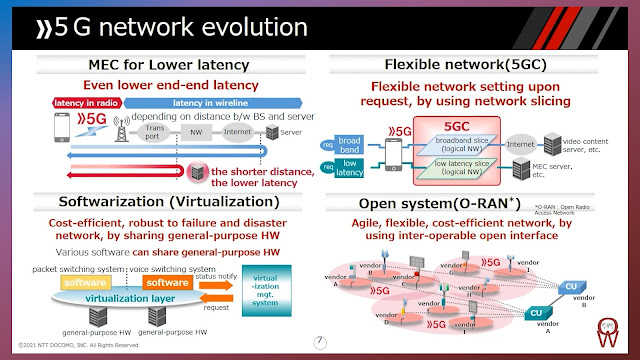
We have highlighted many firsts of Japanese operator NTT Docomo in many different posts in our blogs. For the regular readers of our blogs, it won't come as a surprise that NTT Docomo announced that they have already 10,000+ base stations based on O-RAN principles and the number is expected to exceed 20,000 by March 2022. 

In fact NTT Docomo is also trying to export their know-how, partners and ecosystem to other interested operators. To highlight how this would work, they had also published a 5G Open RAN Ecosystem (OREC) Whitepaper back in June as can be seen in the Tweet above. 

In not just the RAN virtualization where Docomo leads. Back in 2016, Docomo introduced world's first multi-vendor network virtualization technology to LTE packet service. By March, the core network virtualization adoption rate had increased to 56%. It is expected to reach the 100% target by the end of FY 2024.

At 5G Techritory conference, Takehiro Nakamura, SVP and GM of 6G-IOWN Promotion Department at NTT Docomo Inc., presented the 5G Status in Japan, most with regards to NTT Docomo. His talk contained some interesting nuggets and is embedded below, for as long as the talk is available online.

In addition, please check out all the posts below providing interesting insights from NTT Docomo.

Related Posts: